
The cryptocurrency market operates continuously, creating a unique challenge for human traders who need rest. Unlike traditional stock markets that close for the night and weekends, digital asset exchanges function twenty-four hours a day, every day of the year. This relentless schedule has driven the adoption of automated trading solutions designed to monitor price movements and execute strategies without human intervention.
Trading bots have evolved from niche tools for programmers into accessible platforms for everyday investors. These software programs interact directly with financial exchanges to analyze market data and place orders based on pre-defined criteria. By removing emotional decision-making and physical limitations, automation allows market participants to capitalize on opportunities that might arise at inconvenient times.
The shift toward automation represents a fundamental change in how individuals approach portfolio management. Rather than manually entering every transaction, traders now act as architects who design systems to do the work for them. This passive approach requires significant upfront effort to configure, but it offers the potential for consistent execution once active.
The Mechanics of Automated Trading
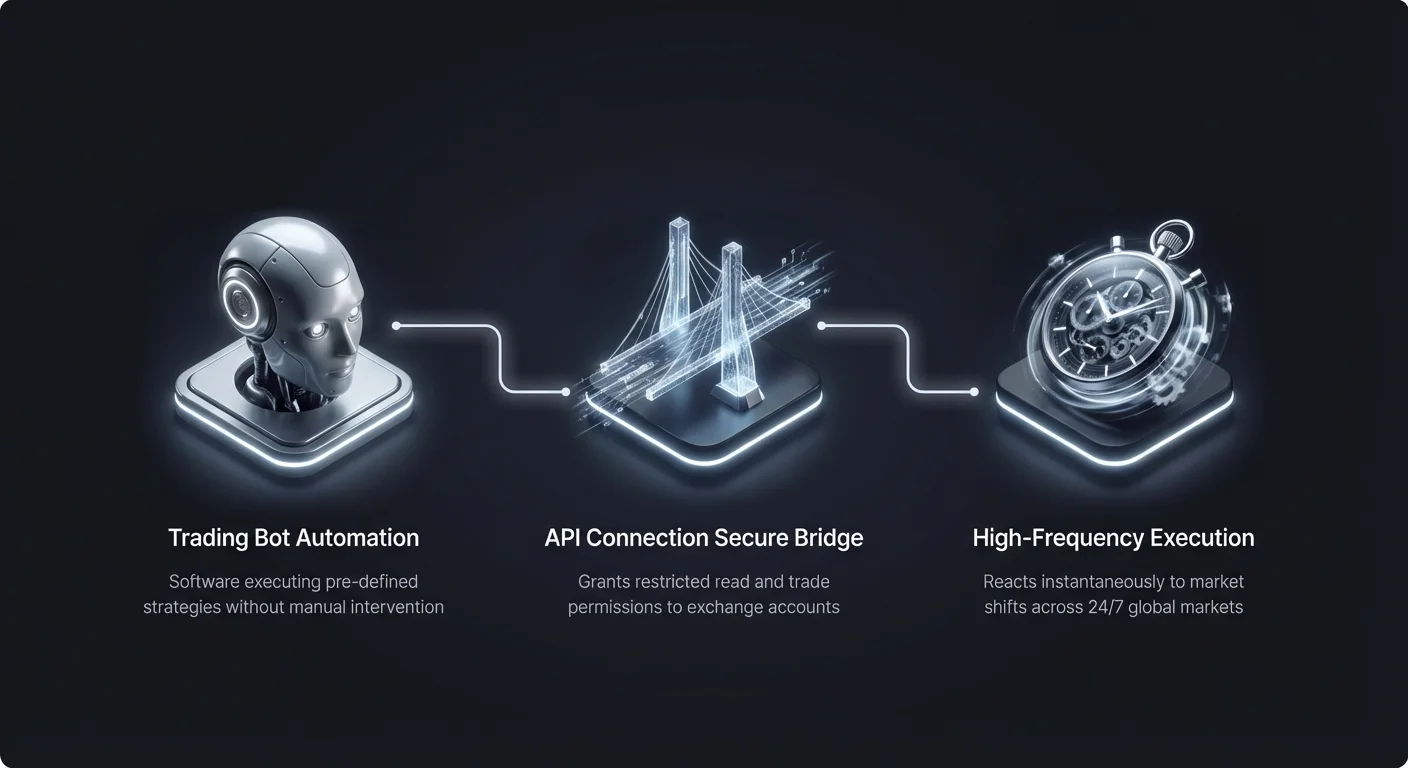
At the core of every trading bot is an interaction with an exchange through an Application Programming Interface (API). The API acts as a bridge, allowing the software to send instructions to the trading platform and receive real-time data in return. This connection enables the bot to view account balances, check current prices, and execute buy or sell orders instantaneously.
Setting up this connection typically involves generating API keys within the exchange account. These keys function like a specialized password that grants the bot specific permissions. Security best practices dictate that these permissions should be restricted to "read" and "trade" access only. Withdrawal permissions should almost never be granted to an automated tool, ensuring that funds cannot be removed from the account even if the software is compromised.
Once connected, the bot operates in a continuous loop. It queries the market for the latest price data, compares that data against the user's strategy parameters, and decides whether to take action. This cycle can happen effectively instantly, allowing bots to react to market shifts faster than any human could manually click a mouse.
High-Frequency and Low-Latency Advantages
Speed is a defining characteristic of automated trading systems. In a volatile market, the price of an asset can fluctuate by several percentage points in a matter of seconds. Human reaction times, combined with the time required to navigate an interface and confirm a trade, often result in missed opportunities or slippage.
Bots eliminate the physical interface from the equation. They communicate directly with the exchange's matching engine. This low-latency execution is particularly critical for strategies like scalping or arbitrage, where profit margins are thin and depend entirely on capturing a specific price point before it disappears.
Furthermore, automation allows for simultaneous monitoring of dozens or even hundreds of market pairs. A human trader can only watch a few charts effectively at one time. A well-configured bot can scan the entire market for specific patterns, ensuring that no opportunity meeting the strategy's criteria is overlooked due to a lack of attention.
Analyzing Grid Trading Strategies
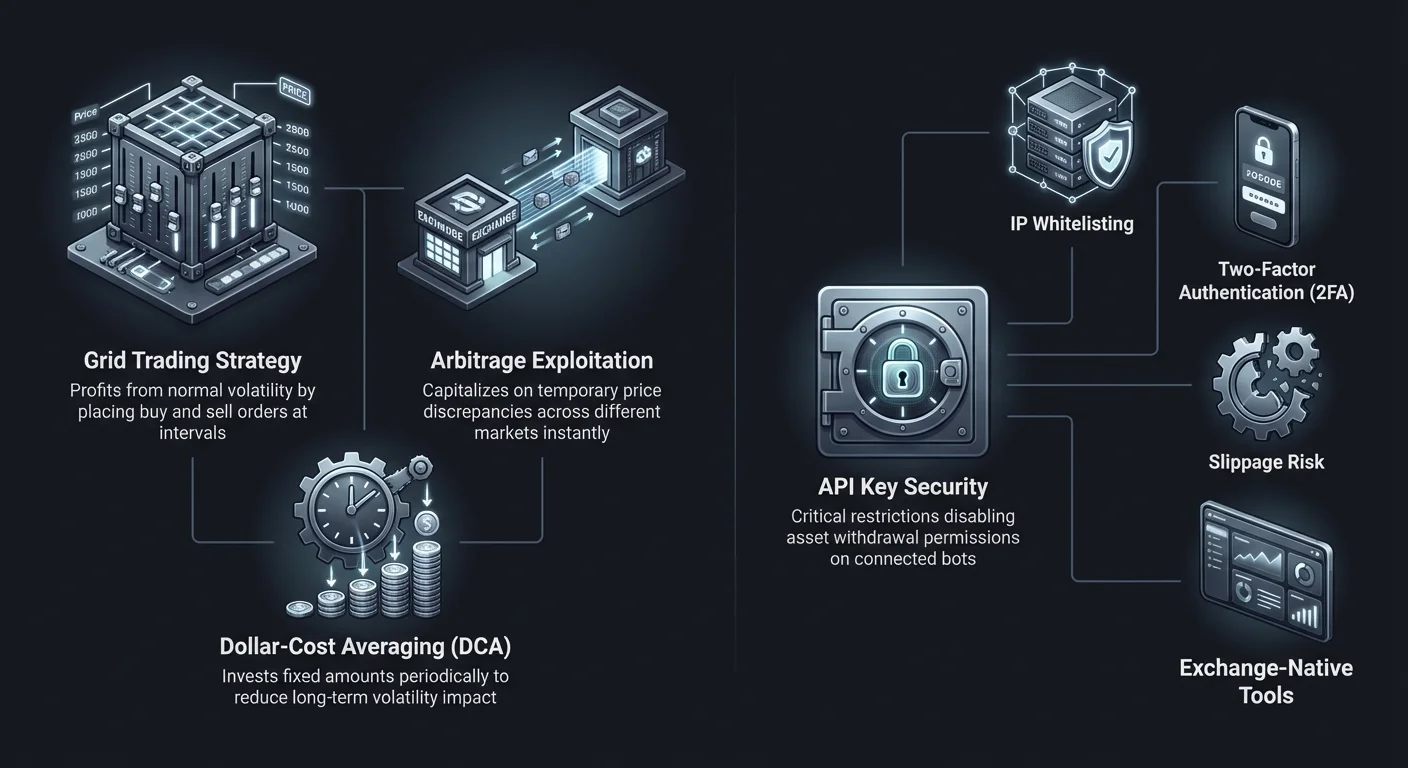
Grid trading stands out as one of the most popular strategies for automated crypto trading, particularly in markets that lack a clear directional trend. This strategy is designed to profit from normal volatility rather than predicting which way the price will go. It works by placing a series of buy and sell orders at predetermined intervals above and below the current price.
The result looks like a grid of orders overlaying the price chart. When the price drops to a certain level, the bot executes a buy order. If the price then rises to the next level up, the bot sells the asset, locking in the difference as profit. This process repeats continuously as the price bounces up and down within the defined range.
This approach transforms volatility from a source of anxiety into a source of profit. In a sideways market where the price oscillates between support and resistance levels without breaking out, a grid bot can generate frequent small gains. These gains accumulate over time, potentially outperforming a simple holding strategy during periods of stagnation.
Configuring Grid Parameters
Success in grid trading depends heavily on the configuration of the grid's parameters. The trader must define the upper and lower limits of the price range. If the price moves outside this range, the bot will typically stop trading or leave the user with an open position that may be at a loss. Selecting a range that is too narrow increases the risk of the price breaking out, while a range that is too wide may result in fewer executed trades.
The number of grid lines, or the density of the grid, determines the profit per trade. More grid lines mean smaller price gaps between orders. This results in more frequent trades with smaller individual profits. Conversely, fewer grid lines result in larger profits per trade but require larger price movements to trigger an execution.
Traders must also decide between arithmetic and geometric grids. Arithmetic grids maintain a constant price difference between levels, such as buying every $100 drop. Geometric grids maintain a constant percentage difference, such as buying every 1% drop. The choice depends on the asset's volatility characteristics and the trader's preference for profit compounding.
Risks Inherent to Grid Trading
While grid trading is powerful in ranging markets, it carries significant risks during strong trends. If the market crashes significantly below the lower limit of the grid, the bot will have purchased the asset all the way down, leaving the trader with a bag of depreciating coins. This is often referred to as "impermanent loss" in the context of automated market making, as the value of the holding is less than if the trader had simply held the quote currency.
Conversely, if the price skyrockets above the upper limit, the bot will have sold all its positions on the way up. While the trader realizes a profit in the quote currency, they miss out on the additional gains that would have come from simply holding the asset during the rally. This opportunity cost is the primary downside of using grid strategies during a bull run.
To mitigate these risks, advanced grid bots often include stop-loss features. A stop-loss triggers a complete sale of the position if the price drops below a critical safety level, preventing catastrophic losses during a market crash. Trailing features can also be used to move the grid range up or down as the market trends, allowing the bot to remain active dynamically.
Understanding Arbitrage Automation
Arbitrage exploits price discrepancies for the same asset across different markets. In the fragmented world of cryptocurrency, it is common for Bitcoin to trade at a slightly different price on one exchange compared to another. These differences arise due to variations in trading volume, liquidity, and regional demand.
An arbitrage bot constantly monitors prices across multiple exchanges. When it detects that an asset is cheaper on Exchange A and more expensive on Exchange B, it simultaneously buys the asset on A and sells it on B. The difference in price, minus trading and transfer fees, represents a risk-free profit.
This strategy relies entirely on speed. Price gaps usually exist for only a few seconds or milliseconds before other traders or bots close them. Therefore, manual execution of arbitrage is virtually impossible. Automated solutions are essential to identify and act on these discrepancies instantly.
Types of Arbitrage Strategies
Cross-exchange arbitrage is the most straightforward form. It requires the trader to hold funds on both exchanges involved. This eliminates the need to transfer funds between platforms during the trade, which would be too slow. The bot simply uses the available balance on each exchange to execute the opposing orders simultaneously, rebalancing the portfolio later.
Triangular arbitrage is another complex variation that occurs within a single exchange. This involves trading three different assets in a loop. For example, a trader might trade Bitcoin for Ethereum, then Ethereum for Litecoin, and finally Litecoin back to Bitcoin. If the exchange rates between these pairs are not perfectly aligned, the trader ends up with more Bitcoin than they started with.
Triangular arbitrage avoids the risks associated with transferring funds between exchanges or managing balances on multiple platforms. However, it requires highly sophisticated algorithms to calculate the cross-rates and execute the three-leg trade before the market corrects itself.
Challenges in Arbitrage Trading
While arbitrage sounds like a guaranteed money-maker, execution is fraught with challenges. Trading fees are the primary obstacle. Since arbitrage profits are often very small fractions of a percentage, high trading fees can easily wipe out the potential gain. Successful arbitrage often requires VIP status on exchanges to access lower fee tiers.
Slippage is another major risk. Slippage occurs when the executed price is worse than the expected price due to a lack of liquidity. If a bot attempts to buy a large amount of an asset to capitalize on a small price difference, it might push the price up, eroding the profit margin.
Network latency and exchange stability also play a role. During periods of high volatility, exchange APIs may become slow or unresponsive. If one leg of an arbitrage trade executes but the other fails due to lag, the trader is left with an unhedged position exposed to market risk.
Dollar-Cost Averaging (DCA) Bots
Dollar-Cost Averaging (DCA) is a long-term investment strategy designed to reduce the impact of volatility. Instead of trying to time the market by investing a lump sum at the "perfect" moment, a DCA strategy involves investing a fixed dollar amount at regular intervals, regardless of the asset's price.
Automated DCA bots remove the discipline required to maintain this strategy manually. A user can configure the bot to purchase $50 worth of Bitcoin every Monday at 9:00 AM. Over time, this results in buying more units when prices are low and fewer units when prices are high, potentially lowering the average cost per unit.
This strategy is particularly effective for investors who believe in the long-term value of an asset but want to avoid the stress of daily price watching. By automating the purchases, the investor eliminates the emotional hesitation that often occurs during market dips, which are ironically the best times to buy.
Advanced DCA Features
Modern DCA bots offer features that go beyond simple scheduled buying. Some bots include "Martingale" strategies, which increase the investment size significantly after a price drop to lower the average entry price more aggressively. This carries higher risk but can result in faster recovery when the price rebounds.
Take-profit conditions can also be integrated into DCA bots. The software can monitor the average buy price of the accumulated position and automatically sell a portion or all of the holdings once a specific profit percentage is reached. This creates a cycle of accumulation and realization without manual intervention.
Flexible intervals allow bots to adjust purchase timing based on market indicators. For instance, a bot might be programmed to execute a DCA buy order only when the Relative Strength Index (RSI) indicates the asset is oversold, rather than strictly on a time-based schedule. This combines the safety of DCA with the precision of technical analysis.
Copy Trading Platforms
Copy trading introduces a social element to automation. Instead of configuring a bot with specific parameters, a user connects their account to the portfolio of an experienced trader. Every trade made by the expert is automatically replicated in the user's account, scaled proportionally to their investment size.
This approach is ideal for beginners who lack the technical knowledge to configure grid or arbitrage bots. It allows them to leverage the expertise of seasoned market participants. Platforms typically display detailed performance metrics for each "master" trader, including historical return on investment, maximum drawdown, and win rate.
However, copy trading is not without risk. The past performance of a trader is never a guarantee of future results. A trader who had a lucky streak in a bull market might incur heavy losses when market conditions change. Users must carefully vet the traders they choose to copy, looking for consistent performance over long periods rather than short-term explosive gains.
Evaluation Metrics for Copy Trading
When selecting a trader to copy, the "Maximum Drawdown" metric is often more important than total profit. This figure represents the largest percentage loss the trader's portfolio has experienced from a peak to a trough. A low maximum drawdown indicates that the trader employs effective risk management strategies and protects capital during downturns.
The number of followers and the total assets under management (AUM) can also serve as indicators of trust. A trader with a large following and significant AUM is likely to be more cautious, as their decisions impact a large number of people. However, extremely large trade sizes can sometimes lead to slippage issues if the market liquidity is insufficient.
Diversification remains crucial in copy trading. Relying on a single master trader exposes the investor to the specific biases and errors of that individual. Spreading capital across multiple traders with different styles—such as one focused on Bitcoin, another on altcoins, and a third on low-risk stablecoin strategies—can create a more balanced automated portfolio.
Standalone Bot Platforms vs. Integrated Exchange Tools
Traders have two primary options when seeking automated solutions: standalone third-party software or built-in tools provided directly by cryptocurrency exchanges. Each approach has distinct advantages depending on the user's technical proficiency and trading goals.
Standalone platforms like 3Commas, CryptoHopper, and Quadency specialize in creating sophisticated interface layers that sit on top of multiple exchanges. These services connect via API to Binance, Coinbase, Kraken, and others, allowing users to manage strategies across different platforms from a single dashboard.
The primary benefit of standalone platforms is the depth of customization. They often offer advanced strategy designers, backtesting capabilities that simulate strategies against historical data, and marketplaces where users can buy signals or templates from other community members. They are powerful tools for traders who want to fine-tune every aspect of their automation.
Exchange-Native Automation
In contrast, many major exchanges now offer their own integrated trading bots. Platforms like Pionex, Bitget, and Binance provide grid trading and DCA tools directly within their trading interface. These built-in solutions are typically free to use, charging only standard trading fees, whereas standalone platforms often require a monthly subscription.
Integrated bots offer a seamless user experience. There is no need to manage API keys or worry about connection interruptions between a third-party server and the exchange. The liquidity is native, and the latency is often lower because the bot is running on the exchange's own infrastructure.
For beginners, exchange-native tools are often the best starting point. They provide a low-barrier entry into automation without the complexity of setting up external software. However, they may lack the advanced features and cross-exchange capabilities found in dedicated bot platforms, limiting the user to the specific assets and tools available on that single exchange.
Technical Analysis in Automation
Trend-following bots rely on technical indicators to make decisions. These bots are programmed to identify market momentum and execute trades that align with the prevailing trend. Common indicators used in these algorithms include Moving Averages (MA), the Relative Strength Index (RSI), and Moving Average Convergence Divergence (MACD).
A simple trend-following strategy might involve a "Golden Cross" setup. The bot is programmed to buy when a short-term moving average crosses above a long-term moving average, signaling upward momentum. Conversely, it sells when the short-term average crosses below, signaling a potential downturn.
RSI-based bots look for overbought or oversold conditions. If the RSI drops below 30, the asset is considered oversold, and the bot executes a buy order expecting a bounce. If the RSI rises above 70, the asset is overbought, and the bot sells. These strategies attempt to capture swings within a broader trend.
Backtesting and Optimization
Before deploying a technical analysis bot with real funds, backtesting is essential. Backtesting involves running the bot's algorithm against historical price data to see how it would have performed in the past. This process helps identify flaws in the strategy and allows the trader to optimize parameters for better performance.
However, traders must be wary of "overfitting." This occurs when a strategy is tuned so perfectly to past data that it becomes inflexible and fails to perform in live markets. A robust strategy should perform reasonably well across different time periods and market conditions, rather than generating perfect returns in only one specific historical window.
Paper trading is the next step after backtesting. Many bot platforms offer a "paper trading" or demo mode where the bot executes strategies using virtual funds in real-time market conditions. This allows the trader to verify that the bot behaves as expected and to gauge its performance without financial risk.
Key Platforms for Automated Trading
The landscape of automated trading includes a variety of platforms, each catering to different needs. 3Commas is widely recognized for its "Smart Trade" terminal and versatile bot options. It supports a vast array of exchanges and allows for complex multi-stage trade setups with trailing stop-losses and take-profit targets.
Pionex distinguishes itself by being an exchange with built-in trading bots as a core feature. It offers over a dozen free bots, including grid trading, DCA, and rebalancing bots. The integration eliminates the need for API management, making it a frictionless option for users who want to start automating immediately.
CryptoHopper operates as a cloud-based solution, meaning the bots run on their servers rather than the user's computer. This ensures 24/7 operation even if the user's device is turned off. It features a unique marketplace where users can download strategies and signals from professional analysts.
Specialized Bot Solutions
Bitsgap is another contender that focuses heavily on high-frequency grid trading. Its interface is designed to visualize grid performance and manage positions across multiple exchanges simultaneously. It also offers arbitrage features that scan for price differentials between connected platforms.
Quadency offers a streamlined experience with a library of pre-built strategies. It appeals to users who want professional-grade tools without a steep learning curve. Its "accumulate" bot is a sophisticated version of DCA that helps users build positions over time with minimal market impact.
For those interested in copy trading specifically, platforms like Bitget and eToro have built their reputation on social trading features. They provide leaderboards and detailed analytics to help users find the best traders to mirror. This social-first approach democratizes access to professional trading strategies.
Security Considerations for Bot Users
Entrusting funds to an automated system requires a rigorous approach to security. The most critical vulnerability lies in the management of API keys. If a hacker gains access to a user's API secret key, they can potentially execute trades that drain the account value, often by buying a low-liquidity coin that the hacker is selling at an inflated price on the other side.
To mitigate this, users should strictly limit API permissions. Withdrawal access should be disabled on all API keys used for trading bots. This ensures that even if the key is compromised, the attacker cannot transfer assets out of the exchange wallet. IP whitelisting is another vital feature; it restricts the API key to accept commands only from specific IP addresses associated with the bot platform.
Two-factor authentication (2FA) should be enabled on both the exchange account and the trading bot platform account. Using an authenticator app or a hardware key is significantly more secure than SMS-based 2FA, which is vulnerable to SIM-swapping attacks.
| Security Feature | Purpose | Recommendation |
|---|---|---|
| API Permissions | Limit bot access | Disable withdrawals, enable trade only |
| IP Whitelisting | Restrict access location | Link to bot platform's static IP |
| 2FA | Account login protection | Use Google Auth or YubiKey |
Monitoring and Maintenance
Passive trading does not mean "set it and forget it" forever. Market conditions change, and a bot configured for a bull market can quickly deplete funds in a bear market. Regular monitoring is required to ensure the strategy remains relevant to the current economic environment.
Users should check their bots daily to verify they are running correctly and to review recent trades. If a bot is consistently losing money due to a shift in market trend, it may need to be paused or reconfigured. Staying informed about major news events is also important, as sudden regulatory announcements or hacks can cause volatility that exceeds the parameters of standard algorithms.
Software updates and platform maintenance are also factors. Standalone bot platforms occasionally undergo maintenance or API updates. Users need to ensure their connections remain active and that their subscription plans are renewed to prevent service interruptions during critical market movements.
Choosing the Right Bot for Your Goals
The selection of a trading bot should align with the investor's financial goals and risk tolerance. For a conservative investor looking to accumulate Bitcoin over the next five years, a simple DCA bot on a major exchange like Coinbase or Binance is likely the best choice. It requires minimal setup and effectively averages entry costs.
For a trader with a higher risk tolerance looking to generate income from a sideways market, a grid trading bot on Pionex or Bitsgap offers the tools needed to capitalize on volatility. These users must be comfortable with the technical aspects of setting support and resistance levels.
Experienced traders who want to execute complex strategies across multiple exchanges will find the most value in platforms like 3Commas or Quadency. The ability to customize indicators, use trailing stops, and manage a diverse portfolio from one screen justifies the subscription costs associated with these premium services.
Cost-Benefit Analysis
Investors must also consider the cost of the bot relative to their portfolio size. Paying a $50 monthly subscription for a bot platform makes little sense if the total trading capital is only $500. The fees would eat up any potential profits. In such cases, free exchange-integrated tools are the superior option.
Conversely, for larger portfolios, the advanced features and potential for optimized returns offered by paid platforms can easily outweigh the subscription costs. Features like arbitrage scanning or concurrent bot limits become valuable multipliers for significant capital.
Ultimately, the best bot is one that the user understands. Using a complex algorithmic strategy without understanding how it functions is a recipe for disaster. New users should start with simple strategies, use small amounts of capital or paper trading, and scale up only as they gain confidence in the system's reliability.
Conclusion
The landscape of cryptocurrency trading has been permanently altered by the accessibility of automated tools. Trading bots offer a compelling solution to the challenges of a 24/7 market, providing speed, efficiency, and emotional detachment that human traders cannot match. From simple dollar-cost averaging to complex grid and arbitrage strategies, there is an automated solution for nearly every investment style.
However, automation is not a magic path to guaranteed wealth. It requires a solid understanding of market mechanics, careful strategy configuration, and ongoing risk management. The tools described, including standalone platforms and exchange-native features, are powerful instruments that magnify the intent of the user. Used wisely, they can smooth out volatility and systematically build value. Used recklessly, they can accelerate losses.
As the technology matures, we can expect even more sophisticated integration of artificial intelligence and machine learning in these platforms. For now, the key to success lies in choosing the right tool for the job, securing the connection, and maintaining a disciplined approach to monitoring and optimization.
Successful automation requires treating trading bots as employees that need clear instructions and supervision, not as magic wands that create money from nothing.