
Digital asset markets rely on infrastructure that facilitates the exchange of value between participants. At the heart of the most common trading platforms lies the Centralized Exchange, often abbreviated as CEX. These platforms function as intermediaries, much like traditional stock exchanges or banks, connecting buyers and sellers in a controlled environment. To navigate these marketplaces effectively, a trader must understand the underlying mechanics that drive price discovery and trade execution.
The primary engine powering a centralized exchange is the order book. This digital ledger records the interests of market participants in real-time, displaying the prices at which users are willing to buy or sell a specific asset. Unlike decentralized alternatives that might use automated market maker algorithms, a CEX relies on this list of orders to match demand with supply.
Understanding how these components interact provides the foundation for all trading strategies. Whether one intends to hold assets for the long term or engage in frequent day trading, the ability to read an order book and interpret trading pairs is essential. It reveals the sentiment of the market, the depth of available liquidity, and the potential costs associated with entering or exiting a position.
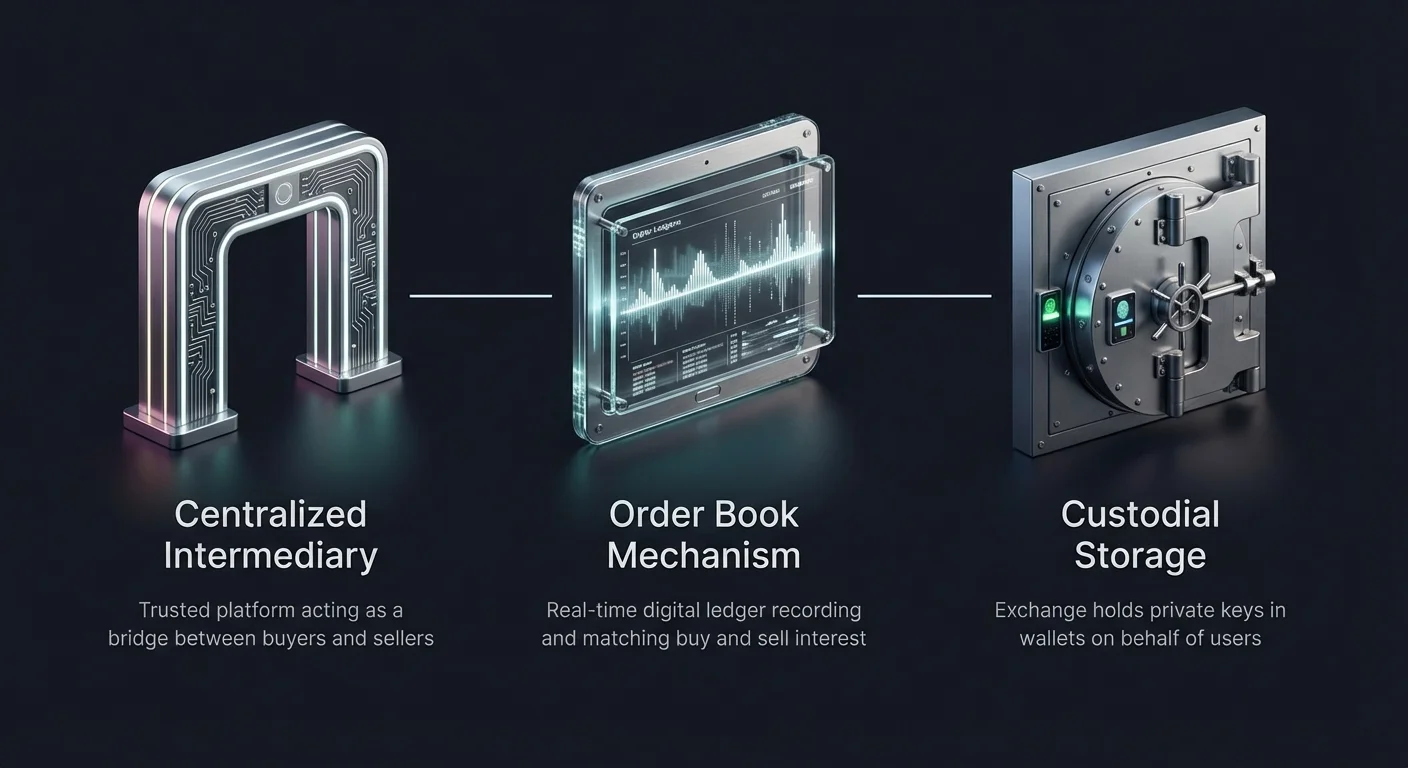
Vloga centraliziranega posrednika
Centralizirana menjalnica deluje kot zaupanja vreden tretji del med dvema trgovcema. Ko uporabnik ustvari račun, običajno nakaže sredstva v denarnico, ki jo nadzoruje menjalnica. Ta model je znan kot skrbniška storitev. Menjalnica hrani zasebne ključe za digitalna sredstva in tako dejansko deluje kot banka za kriptovalute. Ta centralizacija omogoča izjemno hitre hitrosti transakcij, saj se trgovanja izvajajo v notranji podatkovni bazi menjalnice in ne na blockchainu samem.
V tem sistemu je menjalnica odgovorna za varnost, ujemanje transakcij in posodobitve stanj. Ker se trgovanja dogajajo off-chain, uporabniki ne morajo čakati na potrditve blokov ali plačati omrežne gas provizije za vsako posamezno trgovanje. Namesto tega plačajo trgovalne provizije platformi za storitev ujemanja njihovih naročil. Ta učinkovitost naredi CEX-e primarni prehod za nove vlagatelje, ki vstopajo v kripto prostor.
Nasprotje tej udobnosti je zahteva po zaupanju v upravljalca. Uporabniki se zanašajo na varnostne ukrepe menjalnice za zaščito svojih sredstev pred krajo ali slabim upravljanjem. Poleg tega so te enote, ker so podjetja, podvržene predpisom v jurisdikcijah, kjer delujejo. To pogosto zahteva postopke preverjanja identitete, znane kot Poznaj svojo stranko (KYC), preden lahko uporabnik nakaže fiatno valuto ali dvigne znatne količine kripto.
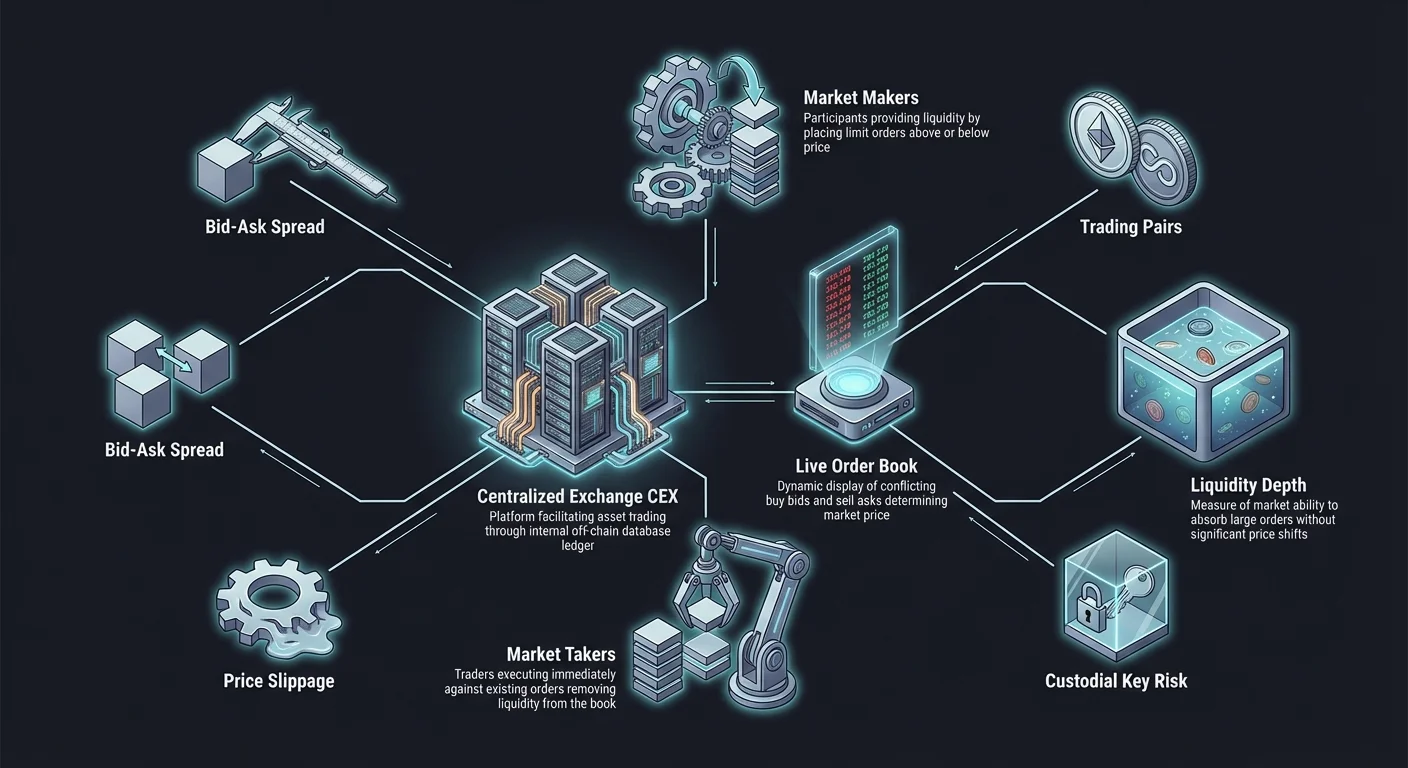
Razstavljanje knjige naročil
Knjiga naročil je dinamičen, v realnem času posodobljen seznam kupnih in prodajnih naročil za določeno sredstvo. Običajno je razdeljena na dva ločena dela. Zgornji del običajno prikazuje "zahteve" ali prodajna naročila, ki so pogosto označena z rdečo barvo. Ti predstavljajo cene, po katerih so trenutni imetniki pripravljeni prodati svoja sredstva. Cene v tem delu naraščajo, pri čemer je najnižja zahtevena cena najbližje sredini.
Spodnji del knjige naročil prikazuje "ponudbe" ali kupna naročila, običajno označena z zeleno barvo. Ti predstavljajo cene, po katerih so drugi uporabniki pripravljeni plačati za pridobitev sredstva. Te cene so urejene v padajočem vrstnem redu, pri čemer je najvišja ponudba na vrhu, najbližje sredini. Interakcija med tema dvema stranema določa trenutno tržno ceno sredstva.
Med najvišjo ponudbo in najnižjo zahtevo je vrzel, znana kot "spread". Ta spread predstavlja razliko v ceni med tem, kar kupec želi plačati, in tem, kar prodajalec želi prejeti. Na visoko likvidnih trgih z mnogimi udeleženci je ta spread običajno zelo majhen, včasih le del centa. Na trgih z manj udeleženci ali nižjo aktivnostjo pa je lahko spread pomemben, kar predstavlja višje stroške za izvedbo takojšnjega trgovanja.
Market Makers and Market Takers
The ecosystem of an order book is populated by two distinct types of participants: makers and takers. Understanding this distinction is vital because it often dictates the fees a trader will pay.
Market Makers
Makers are traders who populate the order book with limit orders. They place buy orders below the current price or sell orders above the current price. By doing so, they are "making" the market by providing liquidity. They are not looking for immediate execution but are willing to wait for the price to come to them. Because they add depth to the order book and make it easier for others to trade, exchanges often incentivize makers with lower trading fees or even rebates.
Market Takers
Takers are participants who agree to the current prices listed on the order book. They "take" the liquidity provided by the makers. If a trader wants to buy Bitcoin immediately, they will accept the lowest available selling price (the ask). This removes an order from the book. Because takers remove liquidity and require immediate service, they generally pay higher fees than makers.
| Role | Action | Liquidity Impact | Typical Fee Structure |
|---|---|---|---|
| Maker | Places Limit Order | Adds Liquidity | Lower Fees / Rebates |
| Taker | Places Market Order | Removes Liquidity | Higher Fees |
Vrste trgovalnih naročil
Za interakcijo s knjigo naročil trgovci uporabljajo specifične vrste naročil, ki se ujemajo z njihovo strategijo in nujnostjo. Dve najbolj temeljni vrsti sta tržna naročila in limitna naročila.
Tržna naročila
Tržno naročilo deluje kot ukaz za takojšnjo kupnjo ali prodajo sredstva po najboljši razpoložljivi trenutni ceni. Daje prednost hitrosti pred gotovostjo cene. Ko uporabnik odda tržni nakupni naročilo, ga motor za ujemanje takoj spari z najnižjim razpoložljivim prodajnim naročilom (ask) v knjigi. Če je nakupno naročilo veliko, lahko porabi prvo prodajno naročilo in se premakne na naslednje, dražje. To zagotavlja, da se trgovanje zgodi takoj, vendar je lahko končna povprečna plačana cena višja od zadnje trgovalne cene.
Limitna naročila
Limitno naročilo omogoča trgovcu, da nastavi specifično ceno, po kateri je pripravljen kupiti ali prodati. Za limitno nakupno naročilo trgovec navede najvišjo ceno, ki jo bo plačal. Za limitno prodajno naročilo navede najnižjo ceno, ki jo bo sprejel. Ta naročila se ne izvedejo takoj, razen če tržna cena ustreza določeni omejitvi. Namesto tega se postavijo v knjigo naročil, kar dodaja globini trga. Ta vrsta naročila zagotavlja ceno, vendar ne zagotavlja izvedbe. Če trg nikoli ne doseže omejitvene cene, se trgovanje ne bo nikoli zgodilo.
Understanding Trading Pairs
In the world of cryptocurrency exchanges, assets are never traded in isolation. They are always traded in pairs. A trading pair denotes which assets are being exchanged for one another. The structure is similar to foreign exchange markets. The first asset listed is the "base" currency, and the second is the "quote" currency.
For example, in the pair BTC/USDT, Bitcoin (BTC) is the base currency, and Tether (USDT) is the quote currency. The price displayed on the exchange represents how much of the quote currency is needed to purchase one unit of the base currency. If the price of BTC/USDT is 50,000, it means one Bitcoin costs 50,000 Tether.
Fiat and Stablecoin Pairs
The most common pairs involve a volatile cryptocurrency traded against a stable asset. This allows traders to easily track the fiat value of their holdings. Pairs like ETH/USD or BTC/USDT are highly liquid because they serve as the primary on-ramps and off-ramps for the market. Traders use these pairs to move in and out of volatile positions, effectively "cashing out" without leaving the crypto ecosystem.
Crypto-Cross Pairs
Exchanges also offer pairs that trade one volatile asset directly for another, such as ETH/BTC. In this example, Ethereum is priced in Bitcoin rather than dollars. These are known as cross pairs. Traders use these to speculate on the relative strength of one cryptocurrency against another. If a trader believes Ethereum will outperform Bitcoin, they would buy the ETH/BTC pair. This allows for portfolio adjustments without the need to convert back to fiat currency or stablecoins as an intermediate step.
The Concept of Liquidity
Liquidity is a measure of how easily an asset can be converted into another asset without affecting its price. In the context of an order book, liquidity refers to the volume of pending orders at various price levels. A "thick" or "deep" order book has a substantial amount of buy and sell orders close to the current market price.
Financial Liquidity
This aspect refers to the ease of entering or exiting a position with cash or cash equivalents. Major assets like Bitcoin and Ethereum generally have high financial liquidity on large centralized exchanges. This means a trader can sell a significant amount of Bitcoin and receive US Dollars (or stablecoins) almost instantly. Conversely, smaller, obscure tokens may lack this financial liquidity, making it difficult to sell large amounts without waiting days for buyers to appear.
Market Liquidity
Market liquidity specifically concerns the ability of the market to absorb large orders without significant price shifts. In a liquid market, a large buy order will not drive the price up significantly because there are enough sellers to satisfy the demand. In an illiquid market, a relatively small buy order might clear out all the sellers at the current price, forcing the buyer to pay much higher prices to fill the rest of their order. This phenomenon is known as price impact or slippage.
Slippage in vpliv na ceno
Slippage se zgodi, ko se trgovanje poravna po drugačni ceni, kot je bilo pričakovano. Čeprav je ta izraz pogosto povezan z decentraliziranimi menjalnicami, je enako relevanten v centraliziranih knjigah naročil. Ko trgovec postavi veliko tržno naročilo v paru z nizko likvidnostjo, deluje kot "kit" v majhnem ribniku.
Če je knjiga naročil tanka, kar pomeni, da je malo naročil na voljo po trenutni ceni, mora motor za ujemanje iti globlje v knjigo, da izpolni zahtevo. Za kupca to pomeni nakup najcenejših kovancev najprej, nato naslednjih najcenejših in tako naprej, dokler ni naročilo izpolnjeno. Povprečna plačana cena bo višja od začetne tržne cene, prikazane na zaslonu.
Trgovci morajo biti budni glede likvidnosti pri trgovanju parov z nižjimi trgovalnimi volumni. Čeprav prikazana cena morda izgleda privlačno, globina knjige naročil morda ne podpira velikega trgovanja po tej specifični ceni. Napredni trgovci analizirajo graf globine, vizualni prikaz knjige naročil, da oceni, koliko kapitala je potrebnega za premik cene za določen odstotek.
Reading Market Sentiment
The order book provides more than just a mechanism for trading; it acts as a window into market psychology. By observing the density of buy and sell orders, traders can infer support and resistance levels. A "buy wall" is a large concentration of buy orders at a specific price level. This suggests that many traders believe the asset is undervalued at that price and are poised to buy, potentially preventing the price from falling further.
Conversely, a "sell wall" is a massive accumulation of sell orders at a higher price level. This indicates that many holders intend to take profits at that point, creating a barrier that the price may struggle to break through. These walls can be organic, representing genuine market consensus, or artificial, placed by large entities to manipulate perception.
However, order books can be deceptive. Orders can be canceled at any moment before execution. A large buy wall might disappear seconds before the price reaches it, a practice sometimes called "spoofing." Therefore, while the order book offers valuable data, it represents intent rather than a guarantee. It shows what traders are saying they will do, which may differ from what they actually do when the market moves.
The Importance of Volume
Trading volume serves as a critical indicator of the validity of price action within an order book. Volume represents the total amount of an asset exchanged over a specific period, usually 24 hours. High volume indicates strong interest and participation. When prices rise on high volume, it suggests that the trend has conviction and is supported by many participants.
Low volume during a price move can indicate weakness. If the price of an asset spikes but very little trading actually occurred, it suggests that the move might be unsustainable or the result of a single large order in an illiquid market. Centralized exchanges display volume data prominently for every trading pair, helping users distinguish between active, healthy markets and dormant, risky ones.
Volume also relates directly to liquidity. Generally, higher volume pairs have tighter spreads and deeper order books. This correlation exists because active markets attract more market makers who can profit from the high turnover, even with small spreads. For beginners, sticking to high-volume pairs is a common strategy to ensure they can enter and exit positions efficiently without suffering from excessive slippage.
Tveganja skrbništva in varnost
Medtem ko centralizirane borze ponujajo prijazne uporabniške vmesnike in visoko likvidnost, uvajajo tveganje skrbništva. Ko se sredstva nakažejo na račun borze, uporabnik v bistvu prenese lastništvo teh sredstev na denarnico borze. Uporabnik ohrani zahtevo do sredstev, ki jo predstavlja stanje na njegovem zaslonu, vendar ne nadzoruje zasebnih ključev.
Ta struktura naredi centralizirane borze primarne tarče za hekerje. Če je varnost borze ogrožena, lahko ukradejo uporabnikova sredstva. Zgodovinsko gledano so bile primeri, ko so borze postale insolventne ali slabo upravljale uporabniške depozite. Ta realnost je v kriptovalutni skupnosti popularizirala frazo »not your keys, not your coins«.
Da bi omilili to tveganje, ugledne borze uporabljajo obsežne varnostne ukrepe. Ti vključujejo hladno shranjevanje, kjer je večina sredstev shranjena brez povezave na zračno ločenih napravah, ter dvofaktorsko avtentikacijo (2FA) za uporabniške račune. Uporabnikom priporočamo uporabo močnih, edinstvenih gesel in omogočanje 2FA za zaščito svojih posameznih računov. Poleg tega je najboljša praksa hraniti na borzi samo sredstva, ki se aktivno uporabljajo za trgovanje, dolgoročne naložbe pa prestaviti v samo-skrbniško denarnico.
Regulatory Compliance and Access
Centralized exchanges act as the primary bridge between the traditional financial world (fiat) and the crypto economy. Because they deal with national currencies and facilitate money transmission, they are subject to strict regulations. This is why most major CEXs require Identity Verification.
This process usually involves submitting government-issued identification, such as a passport or driver's license, and sometimes proof of address. This compliance is designed to prevent money laundering and illicit financing. While some privacy-focused users view this as a drawback, it provides a layer of legitimacy and legal recourse that does not exist in unregulated environments.
The regulatory status of an exchange also dictates who can use it. Some platforms are restricted in certain countries or states due to local laws. Traders must ensure they are using a platform that is legally authorized to operate in their jurisdiction to avoid the risk of having their accounts frozen or restricted.
Conclusion
Centralized exchanges remain the cornerstone of the cryptocurrency market, offering the liquidity and infrastructure necessary for efficient price discovery. Through the mechanism of the order book, these platforms organize the chaos of global demand and supply into an orderly stream of data. By understanding the interplay between bids, asks, makers, and takers, investors can navigate the market with greater confidence and precision.
The concept of trading pairs further organizes the digital asset landscape, allowing for seamless transitions between fiat currencies and cryptocurrencies, or between different digital assets directly. While the convenience and speed of CEXs are undeniable, they come with the responsibility of understanding custodial risks and the importance of security. Ultimately, the order book is a tool—a reflection of collective market sentiment—and mastering its interpretation is a fundamental skill for any participant in the digital economy.
Successful trading begins with understanding the mechanics of the marketplace before risking capital.