
When most people learn about cryptocurrencies like Bitcoin, their attention is immediately drawn to the miners—those high-powered, energy-consuming entities that compete to create new blocks and earn monetary rewards. Miners are often framed as the system's engine. However, the true guardians of the network, the decentralized auditors who ensure the engine never breaks the rules, are the full nodes.
Full nodes are simply computers running the core software, tirelessly validating every transaction and block, acting as the ultimate historical record and rule-enforcer. They are the backbone of the system's trustlessness. Yet, unlike miners, node operators receive no direct monetary payment for their service. This raises a crucial question: What is the economic rationale for running an entity that costs time, money, and resources but pays no salary?
The answer lies in a specialized area of economics called Cryptoeconomics, where the incentive is not immediate profit, but self-sovereignty. For the node operator, the return on investment (ROI) is absolute security, verifiable truth, and complete control over their financial destiny. This analysis delves into the economic commitment required to be a decentralized auditor and why the non-monetary return of sovereignty is the highest value asset in the digital age.
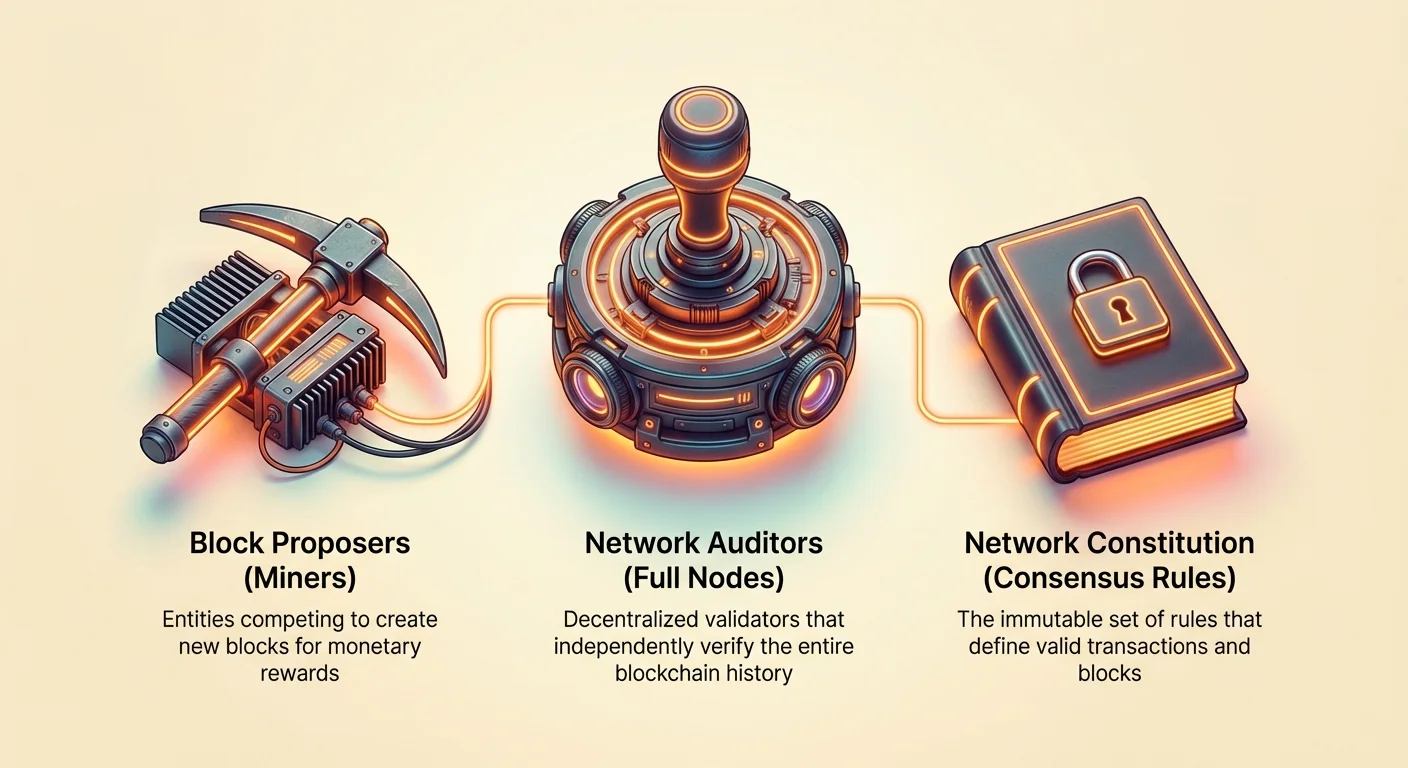
The Difference Between Nodes and Miners: Roles in the Network
To understand the economics of a full node, we must first clearly delineate its role from the miner. While both use the core blockchain software, their functions, incentives, and hardware requirements are vastly different.
The Miner's Job: Building the Block
Miners are the specialized workforce responsible for bundling pending transactions into a new block, solving a complex cryptographic puzzle (Proof-of-Work, or PoW), and proposing that block to the network. Their primary incentive is purely monetary: the block reward (newly minted crypto) and the transaction fees included in the block.
Miners are focused on maximizing profit. They decide which transactions to include based on the fees offered, prioritizing those that offer the highest economic yield. If a miner were to attempt cheating—for instance, including invalid transactions—they would waste expensive electricity and computing power only to have their block rejected by the rest of the network. This system is secured by immense computational cost and monetary reward.
The Full Node's Job: Auditing and Enforcing the Rules
Full nodes, by contrast, are the network's librarians and auditors. Every full node stores a complete copy of the blockchain history, verifying the entire sequence of events from the very first block.
When a miner proposes a new block, it is instantly checked by every full node. Nodes verify approximately 50 strict rules:
- Is the Proof-of-Work correct?
- Are the transactions validly signed?
- Is the total coin supply limit maintained?
- Has the sender truly owned the funds being spent (no double-spending)?
If a miner proposes a block that breaks even one rule, the full nodes immediately reject it and refuse to relay it to their peers. This means that while miners create the blocks, the full nodes enforce the rules, ensuring no entity, no matter how powerful, can violate the consensus agreement. They are the critical check on the miners' power.
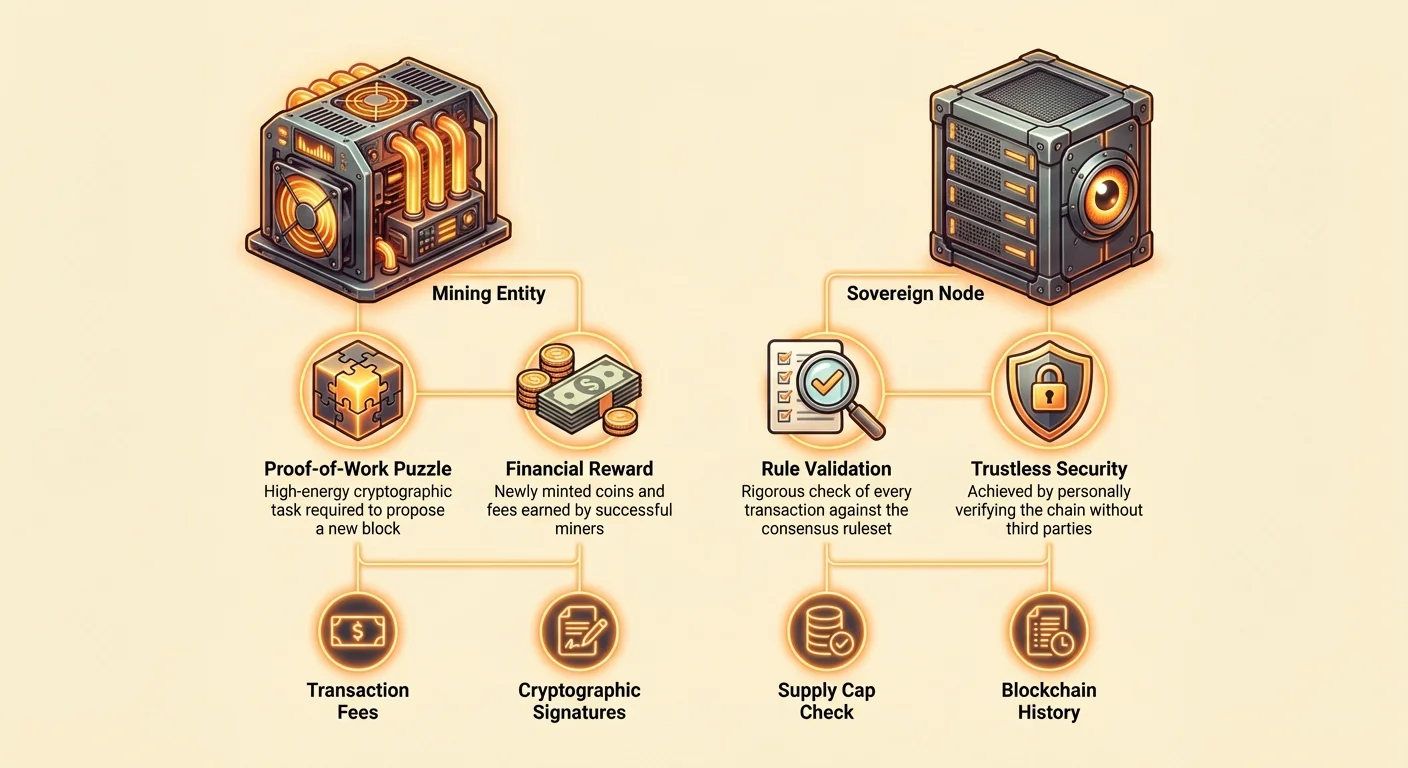
Full Nodes vs. Lightweight Nodes (SPV): Trust vs. Verification
Not all blockchain participants run a full copy of the blockchain. Most popular wallets use a shortcut to access and transact on the network. Understanding this distinction is key to grasping the value proposition of a full node.
SPV Nodes: Convenience Through Delegation
Most mobile and lightweight wallets operate using a technology called Simple Payment Verification (SPV) or similar methods. These nodes do not download the entire blockchain. Instead, they only download the header information of blocks and rely on connecting to a handful of trusted full nodes operated by third parties (like the wallet provider).
The convenience of an SPV node is its speed and minimal resource usage. The trade-off is trust. When an SPV node confirms a transaction, it is essentially saying, "I trust that the full node I connected to told me the truth, and that full node correctly validated the miners' work." The user is outsourcing the verification process. While SPV is highly reliable in a healthy, decentralized network, it forfeits the ultimate guarantee of trustlessness.
Full Nodes: The Foundation of Trustlessness
A full node eliminates the need for trust entirely. By storing and verifying the entire chain, the operator doesn't need to ask or trust any external entity—miner, developer, or corporation—to know the state of the system.
If a user receives a transaction confirmation via their own full node, they know with mathematical certainty that:
- The funds are truly available.
- The transaction complies with every rule established since the network's inception.
- The chain they are viewing is the longest and most valid chain.
Running a full node is the only way to interact with the network without trusting a third party. This non-delegated verification is the definition of true self-sovereignty within the decentralized financial system.
The Mechanics of Verification: How Full Nodes Enforce Consensus
A full node's primary utility is its strict adherence to consensus rules. This process isn't just about ensuring balances are correct; it’s about maintaining the entire cryptoeconomic structure of the chain.
Validating Every Rule: A Checkpoint System
When a full node receives a new block from a miner, it subjects the block to a rigorous verification process. This process ensures the integrity of the blockchain at multiple levels:
- Checking Proof-of-Work: The node first confirms that the computational difficulty target was met. This ensures the miner expended the required energy to build the block, making the chain expensive to rewrite (the core security guarantee of PoW).
- Verifying Transaction Validity: For every transaction within the block, the node checks that all cryptographic signatures are valid, that the inputs have not been previously spent (preventing double-spending), and that the total amount of inputs equals the total amount of outputs plus the transaction fee.
- Enforcing Supply Limits: Crucially, the node checks the block reward received by the miner. It ensures the reward adheres to the predetermined emission schedule (e.g., the halving schedule). If a miner attempted to grant themselves an extra coin, the node would detect the inflation and immediately reject the block, enforcing the scarcity rule.
Relay and Propagation: Securing the Network's View
Once a full node successfully validates a new block, it relays that block to all its connected peers. This propagation mechanism is how consensus is achieved globally.
If a malicious miner successfully proposed a block that broke the rules (say, by slightly inflating the supply), the honest full nodes would reject it. Because the honest nodes refuse to relay the invalid block, that block would not propagate across the wider network. The miner’s attempt to cheat would die instantly, and they would lose their expensive computational investment, illustrating the game theory at play: miners are economically incentivized to obey the rules enforced by the nodes.
Analyzing the Economic Commitment: The Cost of Sovereignty
Since full nodes do not earn fees or block rewards, the economic commitment required to operate one is a direct, recurring cost borne solely for the benefit of the operator's security and the network’s health.
Initial Investment: Hardware and Storage Requirements
Running a modern full node requires dedicated, consistent hardware. While the computing power needed is modest compared to a mining rig, the storage requirement is substantial and ever-increasing.
- Hardware: Typically, a low-power, single-board computer (like a Raspberry Pi) or a dedicated old desktop machine is sufficient. Initial hardware costs generally range from $150 to $500, depending on the quality and robustness desired.
- Storage: The most significant hardware commitment is the storage drive. A full copy of the blockchain requires hundreds of gigabytes, and this size grows over time as more transactions are recorded. To ensure fast synchronization and reliability, a high-quality Solid State Drive (SSD) is essential. This initial outlay is the primary barrier to entry for new node operators.
Operational Costs: Bandwidth, Energy, and Time
Beyond the hardware purchase, the node incurs operational costs that further define the economic commitment.
- Bandwidth: Full nodes constantly listen for new transactions and blocks, and they actively relay valid data to their peers. They also serve historical data requests. This activity consumes significant upload and download bandwidth, especially during the initial synchronization period. In regions with strict data caps or high bandwidth costs, this can be a noticeable expense.
- Energy: While low-power devices minimize electricity usage, a full node runs 24/7/365. This energy consumption, while minor compared to industrial mining, represents a zero-return expense paid purely for the operator's peace of mind.
- Time Investment: The operator must spend time setting up the node, monitoring its health, applying software updates, and troubleshooting connection issues. This opportunity cost (time spent on node maintenance rather than other income-generating activities) is often overlooked but is a real component of the overall economic commitment.
Calculating the Opportunity Cost
The economic commitment of running a full node is fundamentally the opportunity cost of diverting capital and time away from financially profitable activities and investing it instead in verification infrastructure.
The average person can easily outsource verification to a free, lightweight wallet. The choice to incur costs—hardware, bandwidth, and time—is a voluntary economic decision to reject convenience in favor of security. The opportunity cost is therefore the price of true self-sovereignty.
The Non-Monetary Incentives: Why People Run Nodes
If the economic incentive is negative (you pay to run it), why are there thousands of dedicated full nodes operating worldwide? The answer lies in the profound non-monetary returns that accrue to the operator.
Achieving Absolute Trustlessness (Verifying Transactions Without Trust)
The core incentive is the elimination of trust in third parties. For many adopters of decentralized systems, the primary goal is escaping the need to trust banks, governments, or centralized exchanges. A full node is the only tool that delivers on this promise.
When you transact using your own node, you don’t trust Coinbase, Binance, or even the Bitcoin Foundation. You are trusting cryptography and mathematics, enforced by your own machine. This personal, verifiable truth is the highest possible security standard and the primary return on investment.
Protecting Personal Privacy and Financial Freedom
Lightweight wallets typically connect to a few central servers or third-party full nodes. This means that the operators of those nodes can monitor your IP address, track which public keys belong to you, and see which specific transactions you are broadcasting. This surveillance represents a significant privacy leak.
When you run your own full node, all your wallet traffic is routed directly through your private node. You become your own connection point to the global network. This shields your activity from external observers, dramatically increasing your transactional privacy and ensuring no single entity can blacklist your transactions based on geographic location or personal identity.
Participation in Governance and Rule Enforcement
While miners dictate the short-term transactional flow, full node operators dictate the long-term rules of the network. This is the node's role in governance.
If developers propose a major change to the software (a change that alters the consensus rules, known as a hard fork), that change is only enacted if the majority of full nodes adopt the new ruleset. If miners attempt to impose a rule change that node operators disagree with, the nodes will simply reject the miners' blocks, effectively refusing to recognize the new chain.
This dynamic proved crucial during debates over block size (the SegWit scaling debate). Node operators held veto power over the changes, demonstrating that the network's constitution is enforced not by hash power (miners) but by the sheer collective will of the independent validators (nodes). Running a node is therefore a vote for the rules you wish to live under.
Decentralization Through Distribution: Why Node Count Matters
The network's security and resilience are directly proportional to the number of independent full nodes running globally. A decentralized network is one where failure or malicious control of any single component does not compromise the whole.
Resilience Against Censorship and Attacks
If all full nodes were located in a single jurisdiction, a powerful government could potentially seize the servers, forcing rule changes or censoring transactions. When nodes are distributed across thousands of independent operators in diverse legal and political systems, the network becomes functionally un-censorable.
Every new full node adds a layer of redundancy. If one node goes offline, the others maintain the integrity of the chain and continue to relay data. This geographic and jurisdictional distribution is the network’s protective shield against both technical failure and state-level attack.
Preventing Rule Changes (The User Activated Soft Fork Concept)
The power of the full node collective manifests most clearly during protocol changes. If a developer consensus or a miner majority tries to push through an unwanted rule change, it requires what is known as a "User Activated Soft Fork" (UASF).
In a UASF scenario, node operators signal their intent to switch to a new set of rules regardless of miner support. If enough economic activity (merchants, exchanges, and wallets) connects to and trusts these UASF-supporting nodes, the miners are compelled to follow, or else their blocks will be rejected by the economically relevant portion of the network.
This illustrates the ultimate check and balance: economic power (represented by the nodes used by people and businesses) triumphs over computational power (miners). By incurring the cost of running a full node, an individual contributes directly to the collective power necessary to resist protocol capture.
Zaključek
Ekonomija zagonu polnega vozlišča je obrnjena v primerjavi s tradicionalnimi poslovnimi modeli. Namesto iskanja pozitivnega finančnega donosa operater naredi potrebno ekonomsko zavezo – v strojni opremi, pasovni širini in času –, da doseže nemonetary donos, ki je v decentraliziranem sistemu veliko bolj dragocen: zaupanje brez zaupanja in samozasebnost.
Z zagonom decentraliziranega revizorja ne samo zavaruješ svojo denarnico; udeležuješ se upravljanja sistema, zavaruješ njegovo odpornost proti cenzuri in zagotavljaš, da se vzpostavljena pravila izvajajo proti vsem močnim entitetam, vključno z razvijalci in rudarji. Za tiste, ki so predani pravi finančni samohranitvi, je majhen strošek zagonu polnega vozlišča ni strošek – je neizogibna premija za absolutno digitalno avtonomijo.