
Entering the world of cryptocurrency trading involves more than just analyzing charts and selecting the right assets. A critical component of profitability often overlooked by beginners is the cost of doing business. Every interaction with the market carries a price tag, whether it is an explicit fee charged by a service provider or a hidden cost resulting from market inefficiencies.
When you buy or sell digital assets, you are effectively exchanging value. In the traditional financial world, intermediaries like banks and brokers facilitate these exchanges and charge for their services. The crypto market operates similarly in some respects but introduces unique cost structures depending on the type of platform used.
Understanding where your money goes during a transaction is the first step toward preserving your capital. Small percentages lost to fees, spreads, and price discrepancies can compound over time. This erosion of capital can turn a profitable strategy into a losing one if not managed correctly.
To navigate this landscape effectively, traders must dissect the various expenses associated with buying, selling, and transferring assets. These costs generally fall into two categories: fixed exchange fees and variable market costs. By mastering the mechanics behind these expenses, you can execute trades more efficiently and retain a larger portion of your gains.
The Anatomy of Exchange Fees
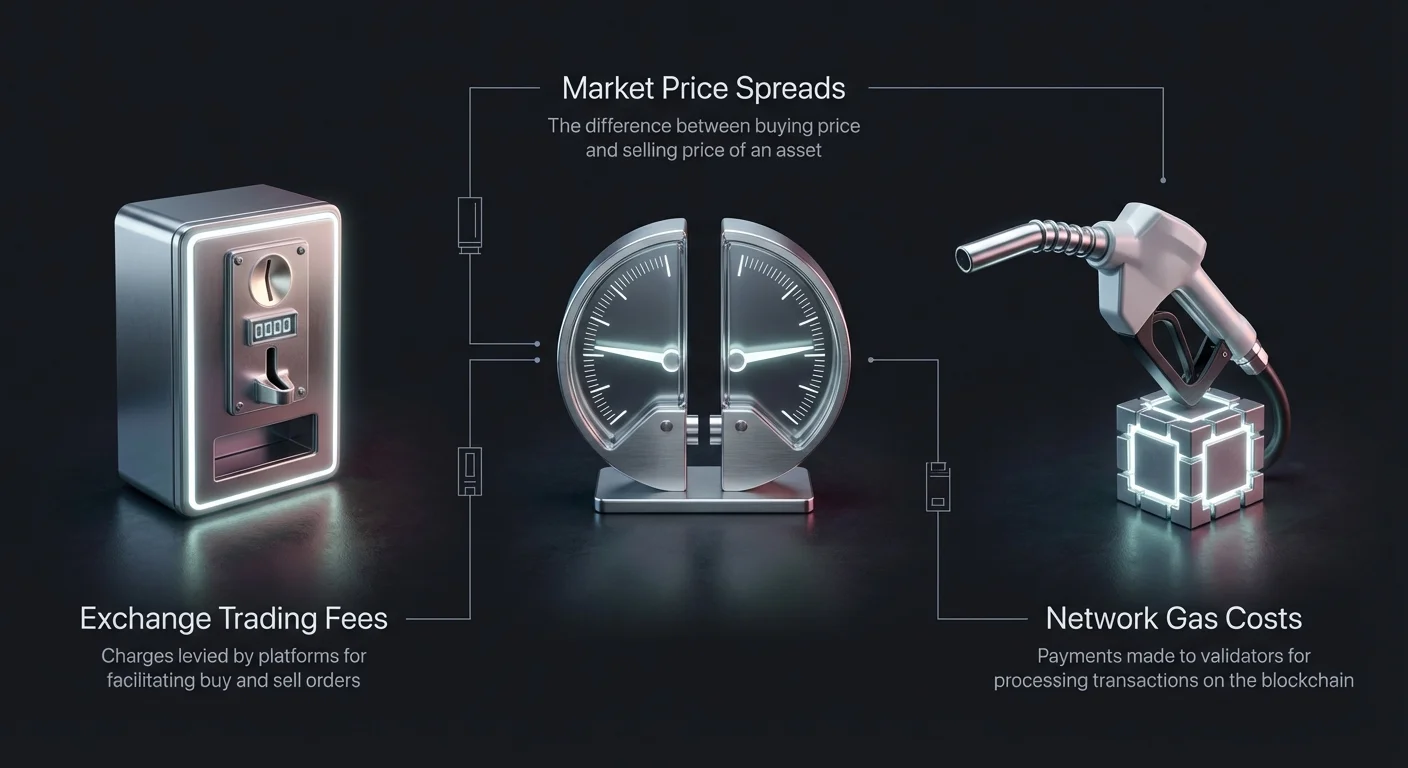
Crypto exchanges are businesses that facilitate the buying and selling of digital assets. Like any business, they require revenue to operate, maintain security, and provide customer support. The primary way they generate this revenue is through transaction fees. These are typically calculated as a percentage of the total trade value.
When you execute a trade, a small portion is deducted immediately. For example, if you purchase a specific amount of Bitcoin, you might receive slightly less than the calculated market amount because the exchange keeps a fraction as its service charge. These rates vary significantly between platforms.
It is essential to distinguish between the different types of platforms to understand their fee structures. Centralized exchanges (CEXs) act as custodial intermediaries. They match buyers and sellers using an internal order book. Their fees are often tiered, rewarding high-volume traders with lower costs.
In contrast, decentralized exchanges (DEXs) operate without a central authority. While they may not charge the same type of service fee as a CEX, they introduce other costs such as network gas fees. Understanding the base fee structure of your chosen platform is vital for accurate profit calculation.
Deposit and Withdrawal Costs
Beyond the cost of trading itself, moving money in and out of an exchange often incurs fees. Most platforms charge a fee to withdraw crypto assets to a personal wallet or another exchange. Unlike trading fees, which are usually percentages, withdrawal fees are often fixed amounts.
These fixed costs are determined by the network congestion of the specific cryptocurrency being withdrawn. For instance, withdrawing Bitcoin might cost a specific flat rate regardless of whether you are moving ten dollars or ten thousand dollars worth of the asset. This makes small withdrawals disproportionately expensive.
Some "banked" exchanges allow you to transfer local currency directly from a bank account. While deposits might sometimes be free to encourage funding, withdrawals of fiat currency back to a bank account often carry processing fees. These can be significant depending on the banking method used, such as wire transfers versus debit card transactions.
The Hidden Cost of Spreads
Another cost factor on many platforms is the spread. This is the difference between the buying price and the selling price of an asset. On some simplified trading interfaces, a platform might claim to offer "zero fee" trading. However, they often bake the cost into the price of the asset itself.
For example, the market price of an asset might be one value, but the price you are quoted to buy it is slightly higher. Conversely, the price you are offered to sell it is slightly lower. This gap is the spread, and it functions as a hidden fee that goes directly to the exchange or broker.
Traders should be wary of platforms that obscure their fee structures behind wide spreads. While the user interface may look simple and inviting, the actual cost of acquisition can be higher than on platforms with transparent, percentage-based fee schedules. Always compare the quoted price against the global market average to gauge the true cost.
Makers, Takers, and Market Depth
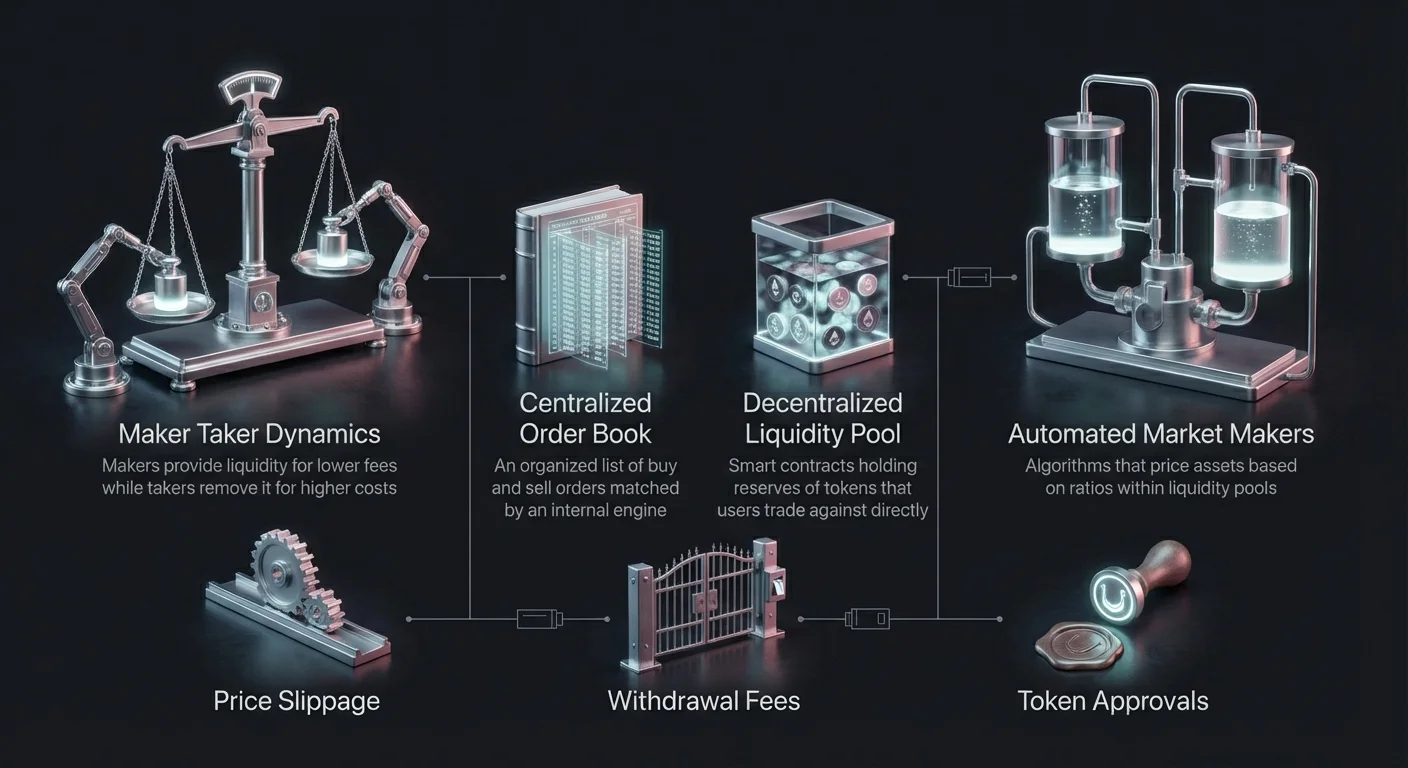
To optimize trading costs on centralized platforms, one must understand the concepts of "makers" and "takers." These terms refer to how a user interacts with the exchange's order book. The order book is a list of all buy and sell orders currently open for a specific trading pair.
Market depth refers to the size and volume of these orders. A deep market has a large volume of orders waiting to be executed, meaning large trades can happen without significantly shifting the price. The people who place these waiting orders are providing liquidity to the market.
Exchanges incentivize users to provide this liquidity by offering lower fees. When you place a "limit order"—an order to buy or sell at a specific price that is not yet available—you add to the order book. You are "making" the market. Because you are helping the exchange operate smoothly, you are often charged a reduced fee.
The Price of Convenience
On the other hand, users who want their trades executed immediately are known as "takers." When you place a "market order," you are accepting the current best available price. You are removing liquidity from the order book by matching with an existing order.
Because takers reduce the available liquidity, exchanges typically charge them higher fees. The convenience of instant execution comes at a premium. For day traders who execute many trades, the difference between maker and taker fees can amount to a significant sum over time.
Strategic traders often use limit orders not just to enter the market at a specific price point, but also to qualify for maker fees. By being patient and allowing the market to come to you, you essentially pay less for the privilege of trading.
Order Book Dynamics
The interplay between makers and takers dictates the health of an exchange. A robust order book with many makers ensures that takers can buy or sell large amounts of crypto at prices close to the global market rate. This efficiency attracts more traders, creating a positive cycle of liquidity.
However, if an exchange has few makers, the order book is thin. In this scenario, a taker might have to pay a higher price to fulfill a large order because there aren't enough sell orders at the best price. This leads to price slippage, a concept that is closely tied to liquidity and fees.
Understanding Liquidity
Liquidity is a fundamental concept that underpins the entire trading ecosystem. In the context of cryptocurrency, it generally refers to two related ideas: financial liquidity and market liquidity. Financial liquidity measures how easily an asset can be converted into cash. Cash is the ultimate liquid asset, while real estate is highly illiquid.
Market liquidity, which is more relevant to daily trading costs, refers to a market's ability to facilitate the exchange of assets without causing dramatic shifts in price. A liquid market is stable and resilient. It can absorb significant buying or selling pressure without the price collapsing or spiking erratically.
Bitcoin is widely considered the most liquid cryptocurrency because it has the highest number of participants and the greatest trading volume. However, even within the crypto space, liquidity varies drastically between different assets and different exchanges.
| Aspect | High Liquidity | Low Liquidity |
|---|---|---|
| Execution Speed | Instant | Delayed |
| Price Stability | High | Low |
| Slippage Risk | Minimal | Significant |
The Cost of Illiquidity
Trading in an illiquid market is expensive. When there are fewer buyers and sellers, the gap between the highest price a buyer is willing to pay and the lowest price a seller is willing to accept widens. This gap creates inefficiency.
If you try to sell a large amount of a low-cap altcoin on a small exchange, you may find there are not enough buyers at the current price. To complete your sale, you will have to accept progressively lower offers. This effectively reduces the total value you receive for your assets.
Illiquidity also poses a risk during market downturns. When prices fall, liquidity often dries up as buyers exit the market. This flight to safety can make it difficult to convert assets back into cash or stablecoins, potentially trapping traders in losing positions or forcing them to sell at a steep discount.
Measuring Liquidity
Traders can gauge the liquidity of a trading pair by looking at its 24-hour trading volume. Higher volume generally indicates better liquidity. However, volume alone does not tell the whole story. One must also consider the depth of the order book relative to the size of the trade they wish to execute.
If your intended trade size represents a large percentage of the daily volume or the available orders, you will likely face cost penalties. In such cases, it is often smarter to break a large trade into smaller chunks or to seek out an exchange with deeper liquidity for that specific asset.
The Mechanics of Slippage
Slippage is the difference between the expected price of a trade and the price at which the trade is actually executed. It occurs when there is insufficient liquidity to fill an entire order at the requested price. While often associated with decentralized exchanges, it happens on centralized platforms as well.
When a buyer places a large market order, they consume the cheapest sell orders first. Once those are gone, the system moves to the next available sell orders, which are priced higher. The average price paid for the total asset amount effectively "slips" upward.
Slippage is a direct cost to the trader. It means you get less crypto than you expected for your money, or you pay more cash than planned for your crypto. In highly volatile markets, slippage can occur even on small orders if prices change in the split second between submitting an order and its execution.
Slippage on Decentralized Exchanges
On decentralized exchanges (DEXs), slippage functions slightly differently due to the absence of a traditional order book. Most DEXs use Automated Market Makers (AMMs) to price assets. In this model, prices are determined algorithmically based on the ratio of assets in a liquidity pool.
When a trader swaps tokens in a pool, they alter the ratio of the assets. This change in ratio automatically adjusts the price for the next unit of the asset. For small trades relative to the pool size, the price impact is negligible.
However, for trades that are large compared to the pool's total value, the price impact can be severe. The algorithm progressively increases the price as the ratio becomes more unbalanced. This is a mathematical certainty in the AMM model, making slippage a predictable but unavoidable cost for large DEX trades.
Managing Slippage Tolerance
DEX interfaces typically allow users to set a "slippage tolerance." This is a percentage setting that dictates the maximum price movement you are willing to accept. If the price slips by more than your tolerance during the transaction, the trade will fail.
Setting a low tolerance protects you from bad prices but increases the risk of a failed transaction. If the market is moving fast, a strict tolerance might mean your trade never goes through. Conversely, setting a high tolerance ensures the trade executes but leaves you vulnerable to front-running bots.
Front-running occurs when bots detect your pending transaction and quickly buy the asset before you, forcing the price up. They then sell it to you at the inflated price, pocketing the difference. This is a common predatory practice in DeFi that directly exploits high slippage settings.
Automated Market Makers (AMMs)
To fully grasp costs in the decentralized finance (DeFi) sector, one must understand the engine powering it: the Automated Market Maker. Unlike traditional exchanges that match buy and sell orders, AMMs allow users to trade against a pool of tokens.
These liquidity pools are smart contracts that hold reserves of two or more tokens. The pricing mechanism is governed by a constant product formula, most commonly expressed as x * y = k. Here, x and y represent the quantities of the two tokens in the pool, and k is a fixed constant.
This formula ensures that the total liquidity in the pool remains constant relative to the price curve. When you buy token X from the pool, you add token Y. This increases the supply of Y and decreases the supply of X. According to the formula, the price of X must rise as it becomes scarcer in the pool.
Arbitrage and Pricing
AMMs rely on arbitrage traders to keep their prices in line with the broader market. If the price of Ethereum on a DEX is lower than on a centralized exchange, arbitrageurs will buy it on the DEX and sell it on the CEX.
This buying pressure on the DEX reduces the supply of Ethereum in the pool, driving the price back up until it matches the external market. While this system is efficient, it means that the "market price" on a DEX is constantly fluctuating based on internal supply ratios.
For the average trader, this highlights the importance of pool size. A pool with massive reserves (a high k value) is less sensitive to individual trades. The price moves less when someone buys or sells. Small pools, however, are highly volatile and expensive to trade in due to the dramatic price shifts caused by even moderate transactions.
Network Costs and Gas
In the realm of decentralized trading, fees extend beyond the exchange protocol itself. Every action taken on a blockchain—whether swapping tokens, depositing into a pool, or approving a contract—requires a network fee, commonly known as gas.
Gas fees are paid to the validators or miners who secure the network. These fees are not determined by the value of your trade but by the computational complexity of the transaction and the current demand for block space.
During periods of high network congestion, gas fees can skyrocket. It is possible for the cost of the transaction to exceed the value of the trade itself for small amounts. This makes timing a crucial factor in cost minimization. Trading during off-peak hours when the network is less busy can result in substantial savings.
Approval Transactions
A specific cost unique to DeFi is the token approval transaction. Before a smart contract can interact with the tokens in your wallet, you must grant it permission. This is a security feature, but it requires an on-chain transaction that costs gas.
This is a one-time fee per token per protocol, but it adds up. If you trade ten different tokens on a new DEX, you will have to pay ten separate gas fees just to approve the tokens for trading. This initial setup cost is often a surprise to beginners.
Furthermore, failed transactions also cost gas. If you set your slippage tolerance too low and the price moves beyond it, the smart contract will revert the trade to protect you. However, the work to attempt the trade was still done by the network, so you still pay the gas fee even though no trade occurred.
Strategies for Minimizing Costs
Reducing trading costs requires a proactive approach that combines platform selection, timing, and strategic execution. The first step is choosing the right venue. For high-frequency trading, centralized exchanges with tiered fee structures and high liquidity are generally superior. They avoid the variable gas costs of blockchains and offer tighter spreads.
For those who prefer self-custody and decentralized options, utilizing DEX aggregators is a powerful strategy. Aggregators scan multiple liquidity pools across different exchanges to find the best price for a trade. They can split a single order across several pools to minimize slippage and optimize the route.
Routes act like a GPS for your trade. Instead of swapping directly between two illiquid assets, an aggregator might route the trade through a highly liquid intermediary like USDC or ETH. This multi-hop approach often results in a better final exchange rate, even after accounting for the extra steps.
Utilizing Limit Orders
Whenever possible, use limit orders rather than market orders. By setting a specific price at which you are willing to buy or sell, you eliminate the risk of negative slippage. You ensure that you never pay more than you intended.
On centralized exchanges, limit orders also classify you as a "maker," qualifying you for lower trading fees. While this requires patience—as there is no guarantee the market will reach your price—the cost savings on fees and spreads are often worth the wait.
Some decentralized protocols have also begun implementing limit order functionality. This brings the benefits of price control to the DeFi space, allowing traders to avoid the predatory nature of AMM pricing for larger trades.
Analyzing Volume and Spreads
Before executing a trade, take a moment to analyze the volume of the trading pair. If the volume is low, check the order book or the liquidity pool size. If the spread is wide (a large gap between the buy and sell price), consider whether you really need to trade that specific asset right now.
Sometimes, simply waiting for liquidity to improve or moving funds to a larger exchange with more volume can save a significant percentage. Be aware of withdrawal fees when moving funds between exchanges, as these can negate the savings from better trading fees if the transaction amount is small.
Finally, consider the broader market trend. In times of extreme volatility, spreads widen and gas fees spike. Panic selling or "FOMO" buying during these windows is the most expensive way to trade. Staying calm and executing trades when the network is quieter ensures you keep more of your hard-earned capital.
Conclusion
Navigating the cryptocurrency market requires a keen awareness of the friction points where value can be lost. Trading costs are not merely a nuisance; they are a fundamental variable in the equation of profitability. From the explicit percentages charged by centralized exchanges to the dynamic gas fees and slippage inherent in decentralized protocols, every transaction carries a financial weight.
Success involves more than just picking winning assets; it requires the efficient execution of those decisions. By understanding the mechanics of makers and takers, the mathematics of liquidity pools, and the behavior of automated market makers, traders can anticipate costs before they occur. Utilizing tools like limit orders and aggregators, and timing trades to avoid congestion, allows participants to defend their margins against necessary but manageable expenses.
Ultimately, the most successful traders are those who treat fees and slippage as manageable risks rather than unavoidable penalties.