
Cryptocurrency wallets act as the foundational gateway to the digital asset ecosystem. They are not merely storage bins for digital coins but sophisticated tools that manage the cryptographic keys required to access and transact on the blockchain. Understanding how these tools function is the first step toward financial sovereignty in the digital age.
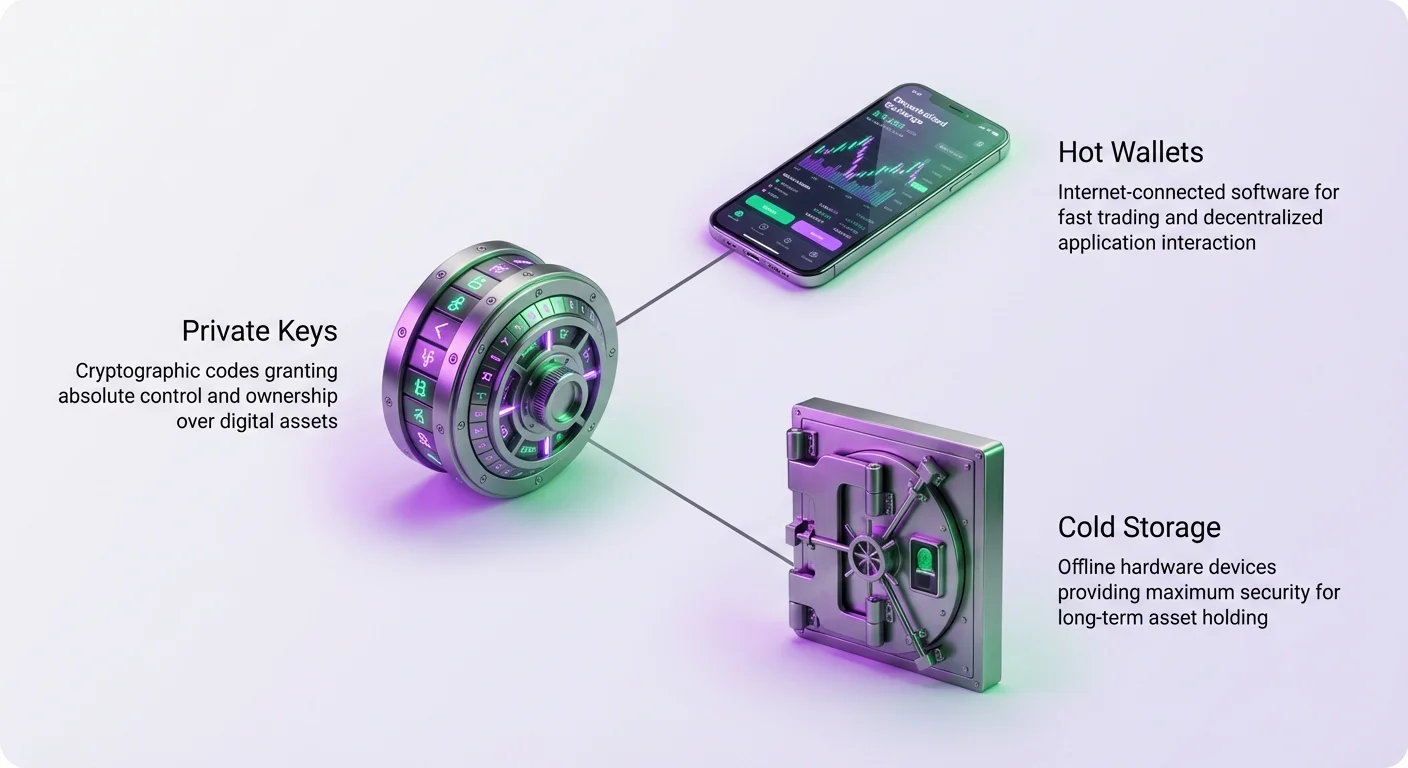
Unlike a physical wallet that holds cash or cards, a crypto wallet does not store the asset itself. The assets live on the blockchain network, updated by a distributed ledger. The wallet holds the private keys, which are essentially the passwords that prove ownership and authorize the movement of funds from one address to another. If you lose these keys, you lose the ability to claim the assets recorded on the ledger.
Choosing the right storage solution requires analyzing your specific needs, risk tolerance, and activity level. Traders who move funds daily have different requirements than long-term investors looking to secure wealth for a decade. The market offers a spectrum of options ranging from always-online software interfaces to completely offline hardware devices.
This guide explores the technical nuances between hot and cold storage strategies. It examines the mechanics of custody, the complexities of operating across multiple blockchains, and the security protocols necessary to protect digital wealth. By understanding the trade-offs between accessibility and security, users can construct a robust strategy for managing their portfolio.
The Mechanics of Digital Ownership
Public and Private Key Cryptography
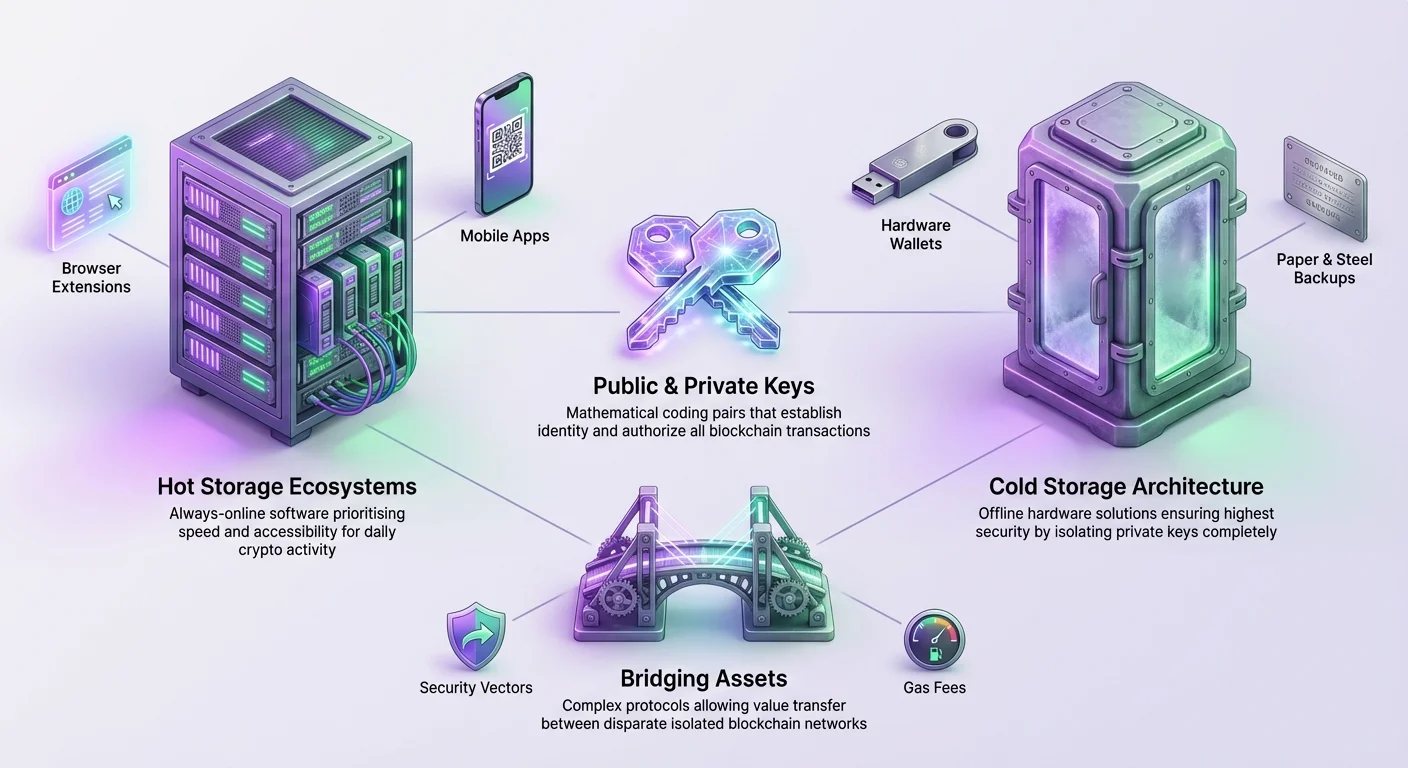
At the core of every cryptocurrency transaction lies a pair of cryptographic keys. The public key is derived from the private key and serves as the address others use to send funds to you. It is comparable to a bank account number or an email address. You can share this publicly without compromising the security of your funds.
The private key is the critical component that must remain secret. It functions as the digital signature verifying that you have the right to spend the funds associated with the public key. Anyone with access to a private key has absolute control over the assets. This mathematical relationship ensures that ownership is absolute and mathematically verifiable without a third-party intermediary.
The Role of Seed Phrases
Most modern wallets use a standard known as BIP-39 to generate a recovery phrase, often called a seed phrase. This is a human-readable representation of your private keys, usually consisting of 12 to 24 random words. This phrase acts as a master key for the wallet.
If a hardware device is damaged or a phone is lost, the seed phrase allows the user to regenerate the entire wallet and all associated private keys on a new device. This mechanism makes the physical device secondary to the information it holds. Protecting this sequence of words is the single most important task for any crypto user.
Hot Storage Ecosystems
Defining Online Connectivity
Hot storage refers to any cryptocurrency wallet that maintains a connection to the internet. These wallets are typically software applications running on mobile devices, desktop computers, or web browsers. The primary advantage of hot storage is accessibility. Users can initiate transactions instantly without needing to connect a physical device or bridge an air-gap.
This connectivity makes hot wallets the preferred choice for active trading and interacting with decentralized applications (dApps). When you need to swap tokens on a decentralized exchange or purchase an NFT, a hot wallet provides the necessary speed and integration. However, this constant connection creates a permanent attack vector for malicious actors.
Browser Extensions and Web Wallets
Browser-based wallets are among the most common forms of hot storage, particularly for the Ethereum and Solana ecosystems. These extensions inject code into websites, allowing users to connect their funds directly to Web3 platforms. They facilitate seamless interaction with smart contracts and DeFi protocols.
While convenient, browser extensions operate within a complex and often vulnerable environment. They are susceptible to phishing attacks where a malicious website mimics a legitimate dApp to trick the user into signing a transaction. Users must exercise extreme caution and verify every URL before connecting these types of wallets.
Mobile Wallet Applications
Mobile wallets offer a balance between the utility of hot storage and the security features of modern smartphones. Many mobile apps utilize the secure enclave chips found in phones to encrypt private keys locally. This adds a hardware-based layer of protection against software malware.
These applications often come with integrated features such as QR code scanning for quick payments and built-in browsers for dApps. They serve as excellent tools for carrying small amounts of cryptocurrency for daily use or payments, functioning similarly to a physical wallet with petty cash.
Cold Storage Architecture
Hardware Wallets explained
Cold storage represents the gold standard for asset security. The most popular form is the hardware wallet, a dedicated physical device designed solely to store private keys offline. These devices look like USB drives or small remotes and contain specialized secure element chips.
The critical distinction is that a hardware wallet never exposes the private keys to an internet-connected device. When a user initiates a transaction on a computer, the unsigned transaction data is sent to the hardware wallet. The user visually confirms the details on the device's screen and physically presses a button to sign it. Only the signed transaction is returned to the computer.
Paper and Steel Backups
For long-term storage that requires zero electronic maintenance, some users opt for paper wallets. This involves printing the public and private keys on a physical piece of paper, which is then stored in a secure location. While immune to digital hacking, paper wallets are vulnerable to physical degradation, fire, and water damage.
To mitigate physical risks, many investors etch their recovery phrases into stainless steel or titanium plates. These metal backups are fireproof and corrosion-resistant, ensuring the keys survive extreme conditions. This method is strictly for archival storage, as moving funds from a paper wallet usually requires sweeping the keys into a software wallet, momentarily exposing them.
Custodial Versus Non-Custodial Models
The concept of custody defines who actually possesses the private keys. In a non-custodial (or self-custodial) setup, the user holds the keys and bears full responsibility for the funds. If the user loses access, no customer support agent can recover the money. This model aligns with the core ethos of cryptocurrency, offering censorship resistance and absolute ownership.
Custodial wallets are hosted by third-party services, such as centralized exchanges. In this model, the service provider holds the private keys and promises to execute transactions on the user's behalf. This functions similarly to a traditional bank. While this offers convenience—such as easy password recovery and fraud protection—it introduces counterparty risk. If the exchange becomes insolvent or halts withdrawals, the user loses access to their assets.
Navigating Multi-Chain Environments
The Challenge of Fragmentation
The crypto ecosystem is not a single monolithic network but a collection of disparate blockchains. Ethereum, Solana, Bitcoin, and Avalanche all operate on different protocols with unique rules and architectures. A wallet address generated for one chain often cannot receive funds from another.
Modern wallets are increasingly becoming "multi-chain," allowing users to manage assets across various networks from a single interface. However, users must remain vigilant. Sending Bitcoin to an Ethereum address, or vice versa, can result in the permanent loss of funds. Users must always verify that the sending and receiving networks match before confirming a transaction.
Native Tokens and Gas Fees
Every blockchain requires a specific native asset to pay for transaction fees, known as "gas." For example, moving a token on the Ethereum network requires ETH to pay the miners. Doing the same on the Polygon network requires MATIC. Even if a user has thousands of dollars in stablecoins in their wallet, they cannot move them without a small amount of the native token to cover the fee.
When entering a new chain, the first step is always acquiring a sufficient amount of its native currency. Experienced users maintain a "dust" balance of native tokens in their wallets to ensure they never get stuck with illiquid assets that they cannot afford to move.
The Mechanics of Bridging Assets
How Bridges Operate
Blockchains act as isolated silos. To move an asset from one chain to another, users must utilize a protocol known as a bridge. Bridges work by locking assets on the source chain and minting an equivalent amount of "wrapped" tokens on the destination chain. This maintains the total supply while allowing value to travel across networks.
This process involves complex smart contracts and carries specific risks. If the smart contract holding the locked assets on the source chain is exploited, the wrapped tokens on the destination chain may become worthless. Users should only use highly reputable bridges with significant liquidity and audited codebases.
Time and Cost Considerations
Bridging is rarely instant. Depending on the network congestion and the security parameters of the bridge, transfers can take anywhere from a few minutes to several hours. Users moving large amounts should be prepared for these delays to avoid panic.
Furthermore, bridging typically incurs transaction fees on both the source and destination networks. Users need to calculate these costs beforehand. It is often more economical to bridge larger amounts less frequently than to execute multiple small transfers that eat away capital through redundant gas fees.
Security Vectors and Defense
Phishing and Social Engineering
The most common cause of fund loss is not sophisticated hacking but social engineering. Attackers create fake websites that look identical to legitimate wallet providers or dApps. When a user connects their wallet or enters their seed phrase, the attacker steals the information.
Users must strictly adhere to the rule of never typing their seed phrase into a browser window or pop-up. Legitimate support teams will never ask for this information. Verifying URLs and bookmarking trusted sites prevents landing on malicious imposters hosted on misspelt domains.
Malicious Smart Contract Approvals
When interacting with DeFi applications, users must grant permission for the application to spend their tokens. Malicious contracts can request unlimited spending limits. If a user signs this permission, the attacker can drain the wallet of that specific asset at any time in the future without further interaction.
To defend against this, users should regularly review and revoke token allowances for dApps they no longer use. Many wallets now offer features to simulate transactions before signing, showing exactly what assets will leave the wallet and what permissions are being granted.
Asset Segregation Strategies
Because no single storage method is perfect, the most effective strategy involves segregation. Users should view their holdings in tiers based on liquidity needs. High-value assets intended for long-term holding should reside in cold storage, completely isolated from smart contract risks and malware.
Active trading capital should be kept in a separate hot wallet. This limits the potential blast radius of a compromise. If a hot wallet interacting with a new dApp is drained, the majority of the user's wealth remains safe in cold storage. This approach mimics the "savings account" vs. "checking account" model of traditional finance.
Advanced Wallet Features
Staking and Yield Generation
Modern wallets have evolved beyond simple storage to become financial hubs. Many now support in-app staking, where users can lock up their Proof-of-Stake assets (like Solana or Cardano) to earn rewards directly from the wallet interface. This allows users to grow their holdings without relinquishing custody to a third party.
Advanced users can also participate in decentralized finance directly through their wallets. This includes lending assets for interest or providing liquidity to decentralized exchanges. While profitable, these activities introduce smart contract risk, reinforcing the need for asset segregation.
Privacy and Anonymity Tools
For users prioritizing privacy, certain wallets offer enhanced features like Tor routing and built-in VPNs. These tools mask the user's IP address, making it harder to link physical locations to on-chain activity. Some wallets also support the management of multiple sub-addresses.
Privacy-focused architectures are particularly relevant for public ledgers where transaction history is visible to everyone. By rotating addresses and using privacy-preserving network layers, users can maintain a degree of financial confidentiality similar to cash transactions.
| Feature Category | Hot Wallet Attributes | Cold Wallet Attributes |
|---|---|---|
| Connectivity | Constant internet access | Air-gapped / Offline |
| Transaction Speed | Instant signing | Requires physical confirmation |
| Best Use Case | Daily trading & dApps | Long-term holding |
Recovery and Inheritance Planning
Advanced Backup Solutions
Standard seed phrases are robust, but single points of failure exist. If a fire destroys the paper backup and the device fails, the funds are gone. Advanced hardware wallets now support Shamir's Secret Sharing. This cryptographic method splits the seed phrase into multiple unique parts (shares).
To recover the wallet, a user needs a specific subset of these shares (e.g., 3 out of 5). This allows users to distribute backups across different physical locations or trusted individuals. If one location is compromised or one share is lost, the wallet remains recoverable, yet no single share is enough to steal the funds.
Planning for the Unforeseen
Crypto assets do not automatically transfer to next of kin. Without the private keys, digital wealth effectively vanishes upon the owner's death. A comprehensive storage strategy must include inheritance planning. This involves creating a secure mechanism for beneficiaries to access the necessary keys or seed phrases.
This is a delicate balance between accessibility for heirs and security against thieves. Solutions range from safety deposit boxes containing partial seeds to "dead man's switch" software services. Regardless of the method, clear instructions on how to operate the hardware and software are as critical as the keys themselves.
Conclusion
The landscape of cryptocurrency storage is defined by the tension between convenience and security. Hot wallets offer the speed and connectivity required to engage with the vibrant world of DeFi, NFTs, and daily transactions. They serve as the checking accounts of the crypto world, necessary for activity but vulnerable to the hazards of the internet. Conversely, cold storage provides the digital vault needed to secure generational wealth, protecting assets from remote attacks through physical isolation.
A mature crypto strategy rarely relies on a single solution. Instead, it employs a tiered approach where the majority of assets remain offline in cold storage, while a smaller, calculated percentage is deployed in hot wallets for active use. By understanding the technical underpinnings of private keys, bridges, and custody models, users can navigate the risks of the blockchain ecosystem. The goal is not just to accumulate digital assets, but to retain absolute control over them through diligent management and robust security practices.
True ownership requires taking full responsibility for your private keys and segregating assets based on risk.