
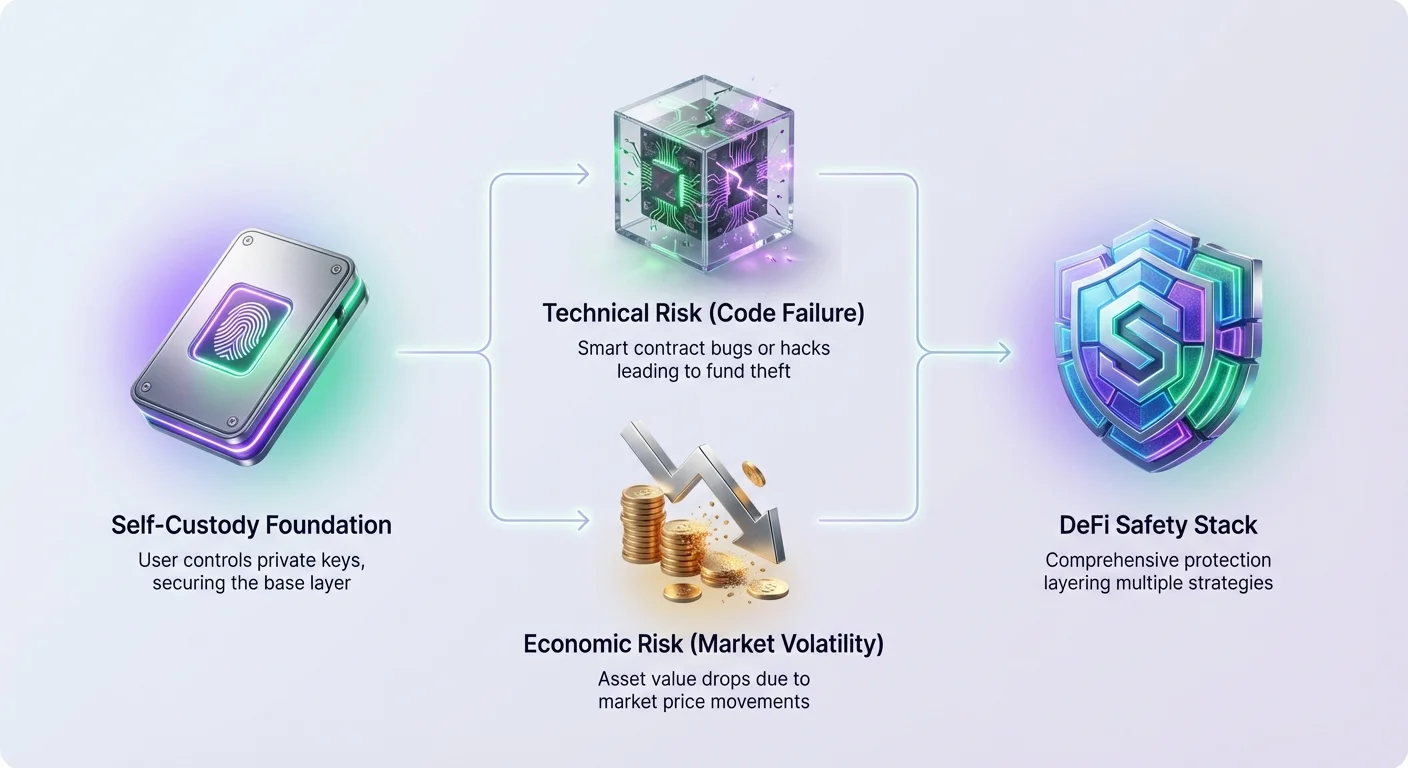
Decentralized Finance offers an open alternative to traditional banking, but it introduces a unique set of responsibilities for the user. Unlike centralized systems where a bank or exchange acts as a custodian, DeFi places the burden of security and risk management entirely on the individual. This shift grants total control over assets, but it also exposes capital to risks ranging from smart contract failures to market volatility. To navigate this environment safely, sophisticated participants build a "safety stack."
This stack is not a single product but a combination of strategies and protocols designed to mitigate specific dangers. It involves purchasing formal insurance coverage for code failures, utilizing financial derivatives to hedge against price drops, and establishing policies to protect against stablecoin instability. By layering these protections, users can participate in yield generation and lending markets with a security profile that rivals or exceeds traditional financial protections.
The foundation of this stack lies in understanding that risk in DeFi is bifurcated. There is technical risk, where the machinery of the protocol breaks, and there is economic risk, where the market moves against your position. A complete insurance strategy must address both. While technical risk is handled by insurance protocols that pool community funds, economic risk is often managed through the strategic use of perpetual futures and leverage.
The Foundation: Protocol and Smart Contract Cover
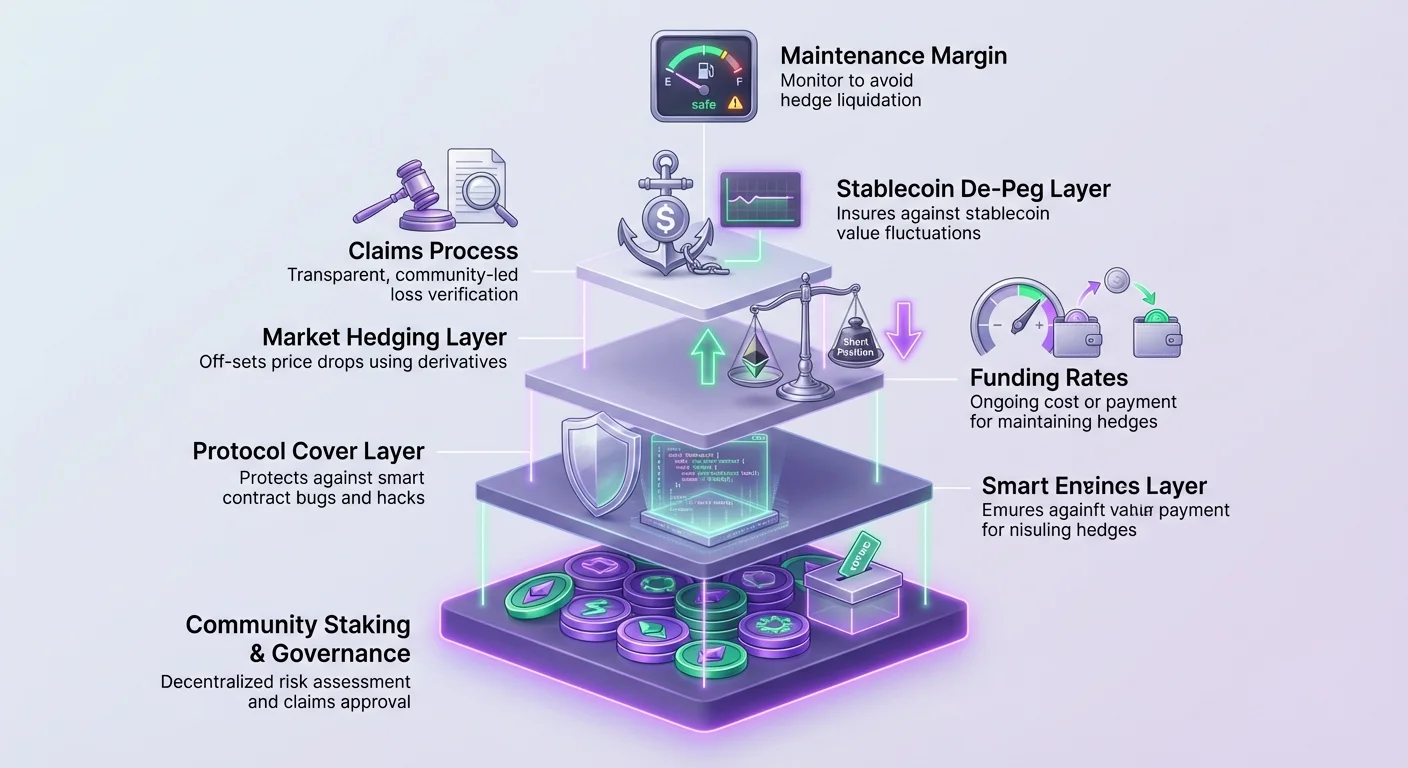
The base layer of any DeFi insurance stack addresses the most catastrophic risk: code failure. In the decentralized ecosystem, applications run on smart contracts. These are automated programs deployed on a blockchain like Ethereum. While they remove the need for human intermediaries, they can contain bugs or vulnerabilities. If a hacker exploits a smart contract, the funds held within it can be drained in seconds.
Traditional insurance cannot easily address this because there is no central entity to underwrite the policy. Decentralized insurance platforms fill this gap. These platforms operate as Decentralized Autonomous Organizations (DAOs). They are owned by their members rather than a corporation. Members pool their capital into a shared risk fund. This capital is then used to underwrite coverage for various DeFi protocols.
When you purchase protocol cover, you are essentially buying a promise from this DAO. If the specific protocol you are insuring suffers a hack or a smart contract failure that results in a loss of funds, the DAO pays out a claim. This mechanism relies on the collective assessment of risk by the community members who stake their capital against specific contracts they believe are secure.
The Mechanics of Decentralized Risk Assessment
In this system, risk is not assessed by an actuary in an office but by a decentralized network of participants. Members of the insurance protocol stake tokens, such as NXM, on protocols they deem safe. This staking process signals confidence in the security of a target application. The more stake a protocol receives, the more insurance capacity becomes available for other users to purchase.
This creates a market-driven pricing model for safety. Protocols that are viewed as risky by the community will have less staked capital, making insurance capacity scarcer or more expensive. Conversely, battle-tested protocols will attract more stake, lowering the cost of coverage for the end user. This transparency is a distinct advantage over opaque centralized insurance models.
The transparency extends to the funds themselves. In a traditional setup, the solvency of the insurer is often known only via quarterly audits. In DeFi, the risk sharing pool is on-chain. Anyone can verify exactly how much capital is available to pay claims at any given moment. This real-time proof of reserves is a critical component of trust in the decentralized insurance stack.
| Feature | Traditional Insurance | DeFi Protocol Cover |
|---|---|---|
| Governance | Corporate Board | Member DAO |
| Risk Assessment | Internal Actuaries | Community Staking |
| Transparency | Quarterly Reports | Real-Time On-Chain |
Hedging Market Risk with Derivatives
While protocol cover protects against theft and bugs, it does not protect against the asset losing value. This is where the second layer of the stack comes into play: financial derivatives. Derivatives are contracts that derive their value from an underlying asset, such as Bitcoin or Ethereum. In the context of insurance, they are used to construct a "hedge."
A hedge is a trade designed to offset losses in another position. For example, if a user holds Ethereum to earn yield in a lending protocol, they are exposed to the risk of the price of ETH dropping. To "insure" this price, the user can utilize perpetual futures on a decentralized exchange like dYdX.
The primary tool for this is the "short" position. Going short means selling a perpetual contract with the expectation that the price will fall. If the price of ETH drops, the short position gains value. Ideally, the profit from the short position matches the loss in the holding value of the ETH. This effectively locks in the dollar value of the portfolio, regardless of market movement.
Understanding Leverage in a Protection Context
Derivatives platforms offer leverage, which allows traders to control a large position with a smaller amount of collateral. While leverage is often used for speculation, in an insurance stack, it is a tool for capital efficiency. For instance, if a user wants to hedge 1 ETH worth of exposure, they do not necessarily need to deposit 1 ETH to open a short.
Using leverage, a user might deposit a fraction of the value to open a short position of equivalent size. However, using leverage introduces its own risks, primarily liquidation. Liquidation occurs when the market moves against the derivative position to a point where the collateral can no longer support the trade.
For insurance purposes, it is widely recommended to use very low leverage, such as 1x. This minimizes the risk of liquidation. If a user employs 1x leverage, the price of the asset would need to double before the short position is threatened with liquidation. This conservative approach ensures that the hedge remains intact during normal market volatility, functioning as a reliable insurance policy rather than a speculative gamble.
The Cost of Hedging: Funding Rates
Just as traditional insurance requires a monthly premium, maintaining a hedge in DeFi comes with a cost known as the "funding rate." Funding is a mechanism used by perpetual futures platforms to keep the price of the contract close to the spot price of the underlying asset. It involves payments exchanged between traders holding long positions and those holding short positions.
When the market sentiment is bullish, there are more longs than shorts. In this scenario, the price of the perpetual contract often trades slightly higher than the underlying asset. To correct this, the funding rate becomes positive, meaning long traders pay short traders. In this specific case, the person hedging (shorting) actually gets paid to maintain their insurance.
However, when the market is bearish and there are more shorts than longs, the funding rate can turn negative. In this situation, short traders must pay long traders. This payment acts effectively as the "premium" for the price insurance. Users constructing a stack must monitor funding rates to understand the ongoing cost of their protection strategy.
Yield Vault Protection Strategies
Yield farming involves depositing assets into a decentralized exchange or liquidity pool to earn rewards. This activity is popular but carries significant risk. Users face potential smart contract bugs in the farming protocol and "impermanent loss" from market movements. A comprehensive insurance stack addresses both of these simultaneously.
To protect the principal deposit, a user buys protocol cover specifically for the exchange where they are farming. Insurance platforms often list specific coverage options for popular Decentralized Exchanges (DEXs). This policy protects the user if the smart contract governing the liquidity pool is exploited.
Simultaneously, the user can mitigate market volatility by shorting the assets they have deposited. For example, if a user deposits ETH into a yield farm, they effectively own that ETH. If the market crashes, the yield earned might not cover the loss in principal value. By opening a corresponding short position on a derivatives platform, the user neutralizes the market exposure. The goal is to earn the farming yield while the short position and the held asset cancel out price fluctuations.
Stablecoin De-Peg Policies
A specific niche within the DeFi insurance stack is protection against stablecoin failure. Stablecoins are digital assets designed to maintain a value of exactly one US dollar. However, they can fluctuate or "de-peg" due to market pressures or flaws in their backing mechanism. A de-peg event can be devastating for users who keep their "safe" capital in these assets.
Insurance protocols offer specific policies for stablecoin de-pegs. These covers differ from standard smart contract protection. Instead of looking for a code bug, the policy is triggered by price data. If the stablecoin trades below a certain threshold (e.g., $0.90) for a sustained period, the cover allows the holder to claim the difference or receive a payout.
This type of protection is essential for users who hold large amounts of dry powder in stablecoins or who participate in liquidity pools that pair volatile assets with stablecoins. It ensures that the "stable" portion of the portfolio actually remains stable, regardless of the underlying issuer's solvency or market panic.
The Claims Assessment Process
When a loss occurs, the value of the insurance stack is tested through the claims process. In decentralized insurance, this process is governed by the community rather than a corporate claims department. The process begins when a cover holder connects their wallet to the platform and submits a claim.
The user must provide details of the incident and proof of loss. Once submitted, the claim is reviewed by claims assessors. These are typically other members of the mutual or token holders who vote on the validity of the claim. They review the evidence against the wording of the cover policy.
This voting mechanism is designed to be transparent. The votes and the rationale are often visible on-chain. While this introduces a human element, the economic incentives of the protocol generally align with paying out valid claims. If a protocol unfairly denies claims, trust evaporates, and the value of the platform's token likely collapses. Therefore, the community is incentivized to act fairly to maintain the protocol's reputation.
Purchasing Cover: The User Experience
The actual process of buying insurance in DeFi is streamlined compared to traditional methods. It starts with a self-custodial wallet, which serves as the user's identity and bank account. There is no need to speak to a broker or fill out paper forms. The user navigates to the insurance DApp and connects their wallet.
Once connected, the user selects the specific protocol or asset they wish to cover. They then designate the amount of coverage required (the payout limit) and the duration of the policy. The platform calculates a premium based on these inputs and the current risk assessment of the protocol.
The premium is paid in cryptocurrency, often in the platform's native token or a major asset like ETH or a stablecoin. Once the transaction is confirmed on the blockchain, the cover is active immediately. This efficiency allows users to spin up protection for specific high-risk trades or farming periods and let the cover expire when it is no longer needed.
Executing the Hedge: Order Types
When implementing the derivatives layer of the stack, execution method matters. There are two primary ways to open the short position that acts as a hedge: market orders and limit orders. A market order executes immediately at the current best available price. This is useful when protection is needed instantly, perhaps during a period of high volatility.
A limit order, however, allows the user to specify the exact price at which they are willing to open the short. This is often preferred for setting up a hedge strategically. For instance, a user might set a limit order to open a short if Bitcoin reaches a certain resistance level. This ensures that the insurance layer kicks in exactly when the user feels the market is becoming overextended.
Using limit orders also avoids "slippage," which is the difference between the expected price of a trade and the price at which it actually executes. In fast-moving markets, slippage on market orders can be significant, increasing the cost of entering the hedge. Limit orders guarantee the entry price, making the cost of the safety stack more predictable.
The Role of Self-Custody
The underlying prerequisite for the entire DeFi insurance stack is self-custody. Both the insurance protocols and the derivatives platforms operate on the assumption that the user controls their own private keys. Accessing these services requires a Web3 wallet.
Self-custody eliminates the counterparty risk of an exchange going bankrupt, but it places the responsibility of key management on the user. If a user loses access to their wallet, or if their private key is stolen, neither protocol cover nor hedging can retrieve the funds. The insurance covers external hacks of protocols, not personal security failures.
Therefore, the safety stack must be built on a secure foundation. This involves using hardware wallets for significant sums and employing best practices for digital hygiene. The combination of secure key management, protocol insurance, and market hedging creates a robust defense system that addresses the multifaceted risks of decentralized finance.
| Stack Layer | Primary Risk | Mitigation Tool |
|---|---|---|
| Base Layer | Code/Contract Failure | Nexus Mutual Protocol Cover |
| Market Layer | Price Depreciation | dYdX Perpetual Short |
| Stable Layer | Asset De-Peg | Stablecoin Peg Cover |
Maintenance and Adjustments
A DeFi insurance stack is not a "set it and forget it" system. It requires active maintenance. Insurance policies expire and must be renewed. If a user increases their position in a yield farm, they must purchase additional cover to match the new value exposed to risk.
Similarly, the hedging layer requires monitoring. If the value of the underlying asset rises significantly, the short position will lose value. While this loss is offset by the gain in the held asset, the short position itself consumes margin. If the margin falls below the maintenance requirement, the hedge could be liquidated.
Users must monitor their "Maintenance Margin" to prevent this. This may involve adding more collateral to the derivatives account as the market rises. This active management ensures that the hedge remains effective and that the user does not get forced out of their protection position at an inopportune moment.
Conclusion
The DeFi insurance stack represents a mature approach to navigating the decentralized economy. It moves beyond simple speculation and acknowledges the complex reality of on-chain risks. By combining protocol cover to handle technical failures with derivatives to manage economic exposure, users can create a comprehensive safety net.
This approach requires a shift in mindset. It demands that users view costs like insurance premiums and funding rates not as lost profits, but as necessary operating expenses for capital preservation. As the ecosystem evolves, these tools will likely become more integrated, but for now, the responsibility lies with the user to assemble them effectively.
True security in DeFi comes from layering different types of protection to ensure that neither a line of bad code nor a red candle on a chart can wipe out your portfolio.