
When newcomers first encounter Bitcoin, they usually focus on its price or its use as digital money. But beneath the surface of the asset lies a profound and complex history rooted in a fundamental architectural debate: how should Bitcoin scale to handle global demand?
The period roughly spanning 2015 to 2017 is often referred to as the "Scaling Wars." This was not a purely technical argument; it was an ideological battle over Bitcoin’s identity. Should Bitcoin evolve into a high-throughput, low-fee digital payment rail, prioritizing speed? Or should it remain an extremely secure, heavily decentralized store of value (digital gold), prioritizing immutability and relying on secondary layers for speed?
The outcome of this intense debate—which saw developers, miners, businesses, and users violently disagree, ultimately resulting in multiple network splits known as "forks"—permanently shaped the direction of the entire crypto ecosystem. Understanding the scaling wars is crucial, as it explains why Bitcoin has embraced Layer-2 solutions over simply increasing the size of its base ledger.
The Genesis of the Scaling Problem (The 1MB Constraint)
To understand the conflict, we must first look at how Bitcoin’s transaction capacity was initially limited.
When Satoshi Nakamoto released Bitcoin in 2009, they placed an arbitrary limit of 1 megabyte (1MB) on the size of each block added to the blockchain. A block is essentially a bundle of validated transactions. Since a new block is generated approximately every ten minutes, the 1MB limit meant that the network could handle a very small number of transactions per second—far fewer than global payment networks like Visa.
The 1MB Limit: Intentional Friction
The 1MB block size limit was not meant to be permanent. It was originally implemented to mitigate potential denial-of-service (DDoS) attacks and prevent the blockchain from growing uncontrollably in the early days, when the network was small and fragile.
However, as Bitcoin's popularity exploded around 2015, two critical consequences of the fixed block size became apparent:
- Congestion and Delay: When demand for transactions exceeded the space available in the 1MB blocks, transactions had to wait in a queue (the "mempool").
- Rising Fees: Users had to offer higher transaction fees to incentivize miners to pick their transaction for inclusion in the next block. This turned Bitcoin transactions from cheap (pennies) to potentially expensive (dollars or even tens of dollars during peak periods).
The 1MB limit transformed from a security measure into an active constraint on growth, forcing the community to decide whether to change the foundational rules of the system.
The Trade-Off Triangle: Decentralization, Security, and Speed
The core challenge in scaling any blockchain network is balancing the "Blockchain Trilemma" or, in Bitcoin’s case, the three core trade-offs:
- Security: How resistant is the network to attack? (Bitcoin achieves this via Proof-of-Work mining and a massive number of participants.)
- Decentralization: How many independent nodes verify the chain? (If nodes require expensive hardware or massive storage, fewer people can run them, leading to centralization.)
- Speed/Throughput: How quickly and cheaply can transactions be processed?
The central tenet of the "Scaling Wars" was that increasing the block size on the foundational layer (Layer 1, or L1) compromised decentralization. If blocks were 8MB or 32MB, the hardware requirements for running a full validating node—the backbone of the network—would increase drastically. This would filter out smaller, hobbyist nodes, potentially concentrating validation power in the hands of large corporations, thus sacrificing decentralization for speed.
The Ideological Divide: Big Blocks vs. Small Blocks
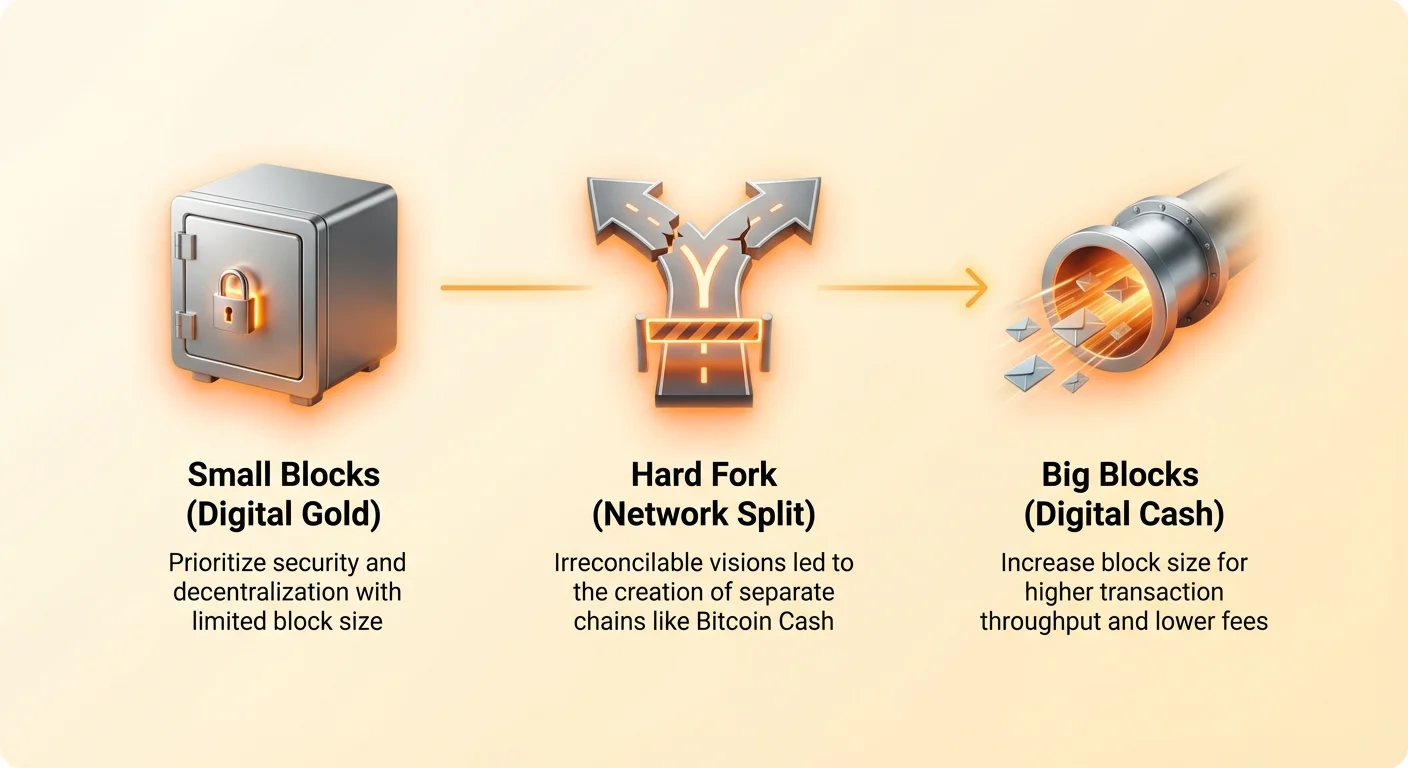
The scaling debate fractured the community into two distinct ideological camps, each with a different vision for Bitcoin's future role in the world.
The "Big Blockers" (The High-Throughput Vision)
This faction, often represented by large miners, some businesses, and proponents of Bitcoin as a fast, everyday digital payment system (peer-to-peer electronic cash), argued that the 1MB limit was an emergency measure that had long outlived its utility.
- The Goal: Increase the block size (e.g., to 2MB, 8MB, or dynamically adjustable sizes) to accommodate more users and lower transaction fees.
- The Rationale: Bitcoin must be affordable and fast to compete with traditional payment systems and achieve mass adoption. If transaction fees become too high, only high-value transfers will be economical, excluding billions of people.
- Key Proponents: Early developers like Gavin Andresen, businesses dependent on fast transactions, and eventually, the creators of Bitcoin Cash.
The "Small Blockers" (The Digital Gold Vision)
This faction, which included most of the core developers and the majority of the current community, argued vehemently against increasing the block size limit on L1.
- The Goal: Maintain the 1MB limit (or slightly increase its effective size via clever restructuring) to ensure that running a full node remains cheap and accessible worldwide.
- The Rationale: Bitcoin’s unique value lies in its high security and unparalleled decentralization. If these features are sacrificed for speed, Bitcoin becomes just another centralized payment network, losing its purpose. Scaling should be moved to separate, off-chain (Layer 2) networks.
- Key Proponents: Blockstream developers (including those who developed the Lightning Network), and the current Bitcoin Core development team.
The Small Blockers viewed Bitcoin as a secure "settlement layer"—the foundation upon which other, faster payment rails could be built. They believed high transaction fees were not a failure, but a necessary signal that demand was high, pushing users toward Layer 2 solutions.
The Technical Solution: Segregated Witness (SegWit)
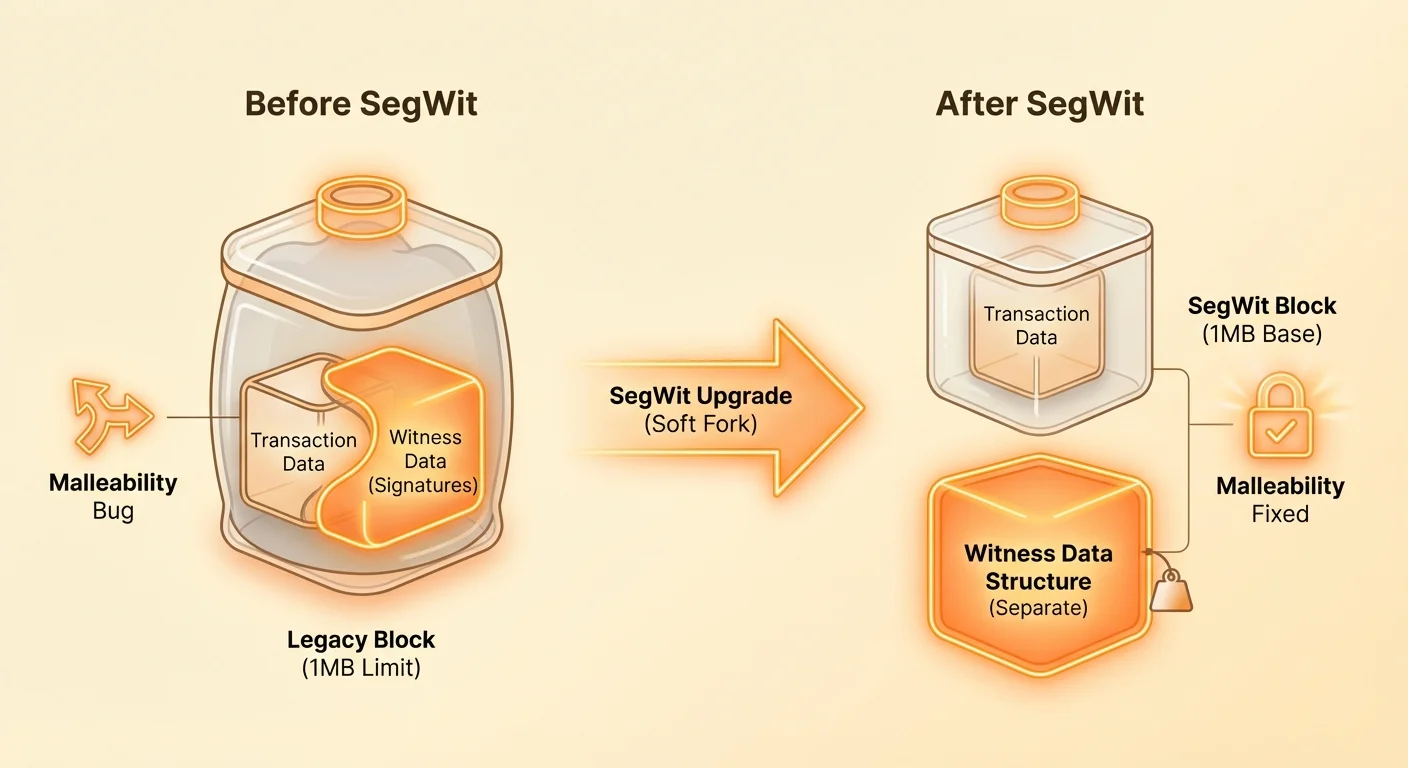
While the ideological debate raged over increasing the fixed block size, a brilliant and less-contentious technical solution called Segregated Witness, or "SegWit," was developed. SegWit provided a way to increase capacity without fundamentally altering the 1MB block limit and, critically, it was implemented as a soft fork.
Fixing Malleability: A Necessary Precursor
Before SegWit, Bitcoin transactions suffered from a critical vulnerability known as transaction malleability.
In simple terms, transaction malleability meant that a third party could slightly modify the transaction ID (TxID) of a transaction before it was confirmed into a block, without changing the underlying transaction details (who paid whom and how much).
This small technical flaw was a massive headache for developers attempting to build secondary layers (like the Lightning Network), because these off-chain protocols require absolute certainty that a transaction’s ID will not change while it is pending confirmation. SegWit was initially developed primarily to eliminate malleability, thereby unlocking the potential for advanced Layer 2 solutions.
How SegWit Increases Effective Block Size (The Weight Unit Model)
SegWit’s core mechanism involved changing the way data is counted within a block. It achieved scaling by segregating (separating) the witness data (digital signatures required to authorize a transaction) from the transaction data (the actual movement of funds).
- Witness Data: The digital signature data is the largest part of any Bitcoin transaction.
- Separation: SegWit moved this witness data to a separate, auxiliary structure at the end of the block.
Crucially, instead of using the simple 1MB size limit, SegWit introduced a new metric called Block Weight, where different types of data are weighted differently:
- Legacy transaction data counts as 4 units per byte.
- Witness data (the signatures) counts as only 1 unit per byte.
By counting the space-intensive signature data four times cheaper than the core data, SegWit effectively allowed more transactions to fit into a block while keeping the base block size technically within the 1MB limit (or, more precisely, setting the maximum Block Weight at 4 million units, allowing the total effective block size to reach up to nearly 4MB, depending on the transaction type).
This solution satisfied the Small Blockers because it avoided a massive, immediate jump in block size that would threaten decentralization, yet still provided a significant capacity increase (typically about 70-80% more transactions).
The Soft Fork Strategy
SegWit was deployed via a soft fork. This meant it was backward-compatible. Older nodes that did not upgrade could still see SegWit transactions as valid (though they couldn't validate the witness data properly), ensuring the network remained unified.
The adoption of SegWit was slow and politically fraught. Its implementation was delayed by mining pools and business interests that favored a massive L1 block increase. However, after months of intense pressure and community organizing, SegWit was eventually locked in and activated in August 2017, setting the stage for the next phase of Bitcoin development and solidifying the 'small-block' ideology.
The Escalation: Hard Forks and Network Splits
The failure to achieve consensus on block size—specifically the refusal of the Bitcoin Core developers to endorse a massive L1 increase—led the Big Block faction to abandon the main chain and create their own, resulting in major hard forks.
Hard Forks vs. Soft Forks Explained
To understand the splits, we must distinguish between the two types of network upgrades:
| Feature | Soft Fork | Hard Fork |
|---|---|---|
| Backward Compatibility | Yes (Older nodes still see new blocks as valid). | No (Older nodes see new blocks as invalid). |
| Rule Change | Tightens rules (e.g., SegWit added a new rule about how data is structured). | Loosens or drastically changes rules (e.g., changing the 1MB limit to 8MB). |
| Consensus Required | High consensus among miners/nodes is needed, but 100% adoption is not mandatory for network continuity. | All participants must upgrade, or the chain splits permanently. |
| Outcome | Unified network. | Potential creation of two separate, competing cryptocurrencies. |
The Big Block proponents realized that their plan (significantly increasing the block size limit) required a hard fork. Since they couldn't persuade the majority of the core developers and the user base, they chose to initiate a split.
Bitcoin Cash (BCH): The Fork of Ideology
On August 1, 2017, Bitcoin Cash (BCH) officially split from the main Bitcoin chain.
Bitcoin Cash was the most significant outcome of the Scaling Wars and represented the culmination of the Big Block ideology.
- Key Change: Immediately increased the block size limit from 1MB to 8MB (later increased further to 32MB).
- The Vision: BCH sought to fulfill the original mandate of Bitcoin as a fast, cheap, peer-to-peer electronic cash system. Its proponents explicitly rejected the idea that Bitcoin should be a slow settlement layer, arguing that the L1 must handle massive transaction volumes.
- Implementation: Every holder of Bitcoin (BTC) at the time of the split automatically received an equal amount of the new Bitcoin Cash (BCH), as the chains shared a history up until the fork block.
The BCH fork settled the ideological debate with finality. While BCH offered cheap transactions, it failed to attract the developer ecosystem and network effect of the original Bitcoin. It demonstrated that the market prioritized the security and decentralization afforded by the Small Block approach, even at the cost of L1 throughput.
Bitcoin SV (BSV): The Extreme Block Size Gambit
The ideological fracturing didn't stop with Bitcoin Cash. In 2018, BCH itself split into two camps: Bitcoin ABC (which maintained the BCH name) and Bitcoin SV (Satoshi's Vision).
- Key Change: Bitcoin SV proposed massive, nearly unlimited block sizes, pushing limits into the gigabyte range, arguing that this was necessary to allow Bitcoin to handle global commerce scale.
- The Trade-Off: This extreme block size approach drastically increases the barrier to entry for running a full node, essentially centralizing the validation process into the hands of a few large, professional mining operations.
The repeated forks highlighted the fundamental danger of pursuing scaling purely through Layer 1 throughput increases: the risk of destroying the decentralized nature that makes Bitcoin valuable in the first place.
The Triumph of Layer-2 Architecture
The ultimate resolution of the Scaling Wars was not a technical consensus but an architectural shift: the realization that Bitcoin’s base layer must remain small, secure, and decentralized, while scaling must happen elsewhere.
The adoption of SegWit (a soft fork) and the subsequent failure of the hard-forked coins (BCH, BSV) to challenge Bitcoin (BTC) established a clear development philosophy: Bitcoin is the secure settlement layer; Layer 2 is the scaling layer.
Why Layer-2 Preserves Decentralization
Layer 2 solutions, such as the Lightning Network, allow millions of transactions to occur off-chain without needing to be recorded on the main Bitcoin ledger immediately.
This architecture solves the Trilemma by separating concerns:
- Layer 1 (The Blockchain): Handles security, final settlement, and decentralization (the most critical and unchanging functions). Because the blocks remain small, anyone can run a full node cheaply.
- Layer 2 (Off-Chain Networks): Handles speed and low costs (the flexible functions). These networks use specialized protocols to manage high throughput, leveraging the security of the underlying L1.
If Bitcoin had chosen the Big Block approach, the chain data would have grown so quickly that within a few years, only massive data centers could afford to run validating nodes. This would have led to censorship risks and reduced censorship resistance—the exact opposite of Bitcoin’s original purpose.
By embracing Layer 2, the Bitcoin community affirmed that self-sovereignty and censorship resistance are non-negotiable foundations, even if it means sacrificing native L1 transaction speed.
Enabling Advanced Development
The successful deployment of SegWit laid the groundwork for further innovation that would redefine Bitcoin's capability beyond simple transfers.
- Lightning Network: By fixing transaction malleability, SegWit allowed the Lightning Network—a network of two-way payment channels—to safely develop. Lightning allows users to open a channel by locking funds on L1, conduct thousands of instant, nearly free transactions off-chain, and then settle the final balance back onto L1 when the channel closes.
- Smart Contracts on Bitcoin: Historically, Bitcoin was viewed as having limited smart contract capability compared to platforms like Ethereum (Source 1). However, the architectural improvements paved the way for more complex scripting. SegWit, and later Taproot (a subsequent upgrade that improved privacy and efficiency), significantly reduced the costs and complexity of advanced transactions. This development environment allows for innovation, including protocols that enable tokenization, advanced financial instruments, and, increasingly, smart contract functionality (Source 2), all while benefiting from Bitcoin’s robust security model.
The Scaling Wars provided the crucial historical filter that forced Bitcoin to prioritize architecture over raw throughput, ultimately leading to a more secure and resilient system defined by layered scaling (Source 3).
Conclusion: The Long-Term Impact of the Scaling Wars
The Bitcoin Scaling Wars of 2015-2017 were perhaps the most significant existential challenge the network has ever faced. It was a stressful, contentious, and often chaotic period that tested the fundamental consensus mechanism of decentralized governance.
The eventual outcome—the adoption of SegWit and the rejection of massive L1 block increases—was a foundational victory for the principles of decentralization and security. By choosing to keep the base layer minimal, the Bitcoin community ensured that the network would remain accessible to anyone with basic hardware and internet access, safeguarding its resistance to control and censorship.
This historical moment defined Bitcoin's identity as a robust, slow, and expensive settlement network—the digital bedrock—upon which a diverse and rapid financial ecosystem (Layer 2) could safely be built. Understanding this conflict is essential for any crypto newcomer, as it provides the critical context for why the Bitcoin development roadmap focuses heavily on secondary layers and architectural optimization rather than simply copying the scaling methods of faster altcoins. The trade-offs made during the Scaling Wars solidified Bitcoin’s status as digital gold, prepared to scale not by growing its block, but by building smart, secure layers above it.