
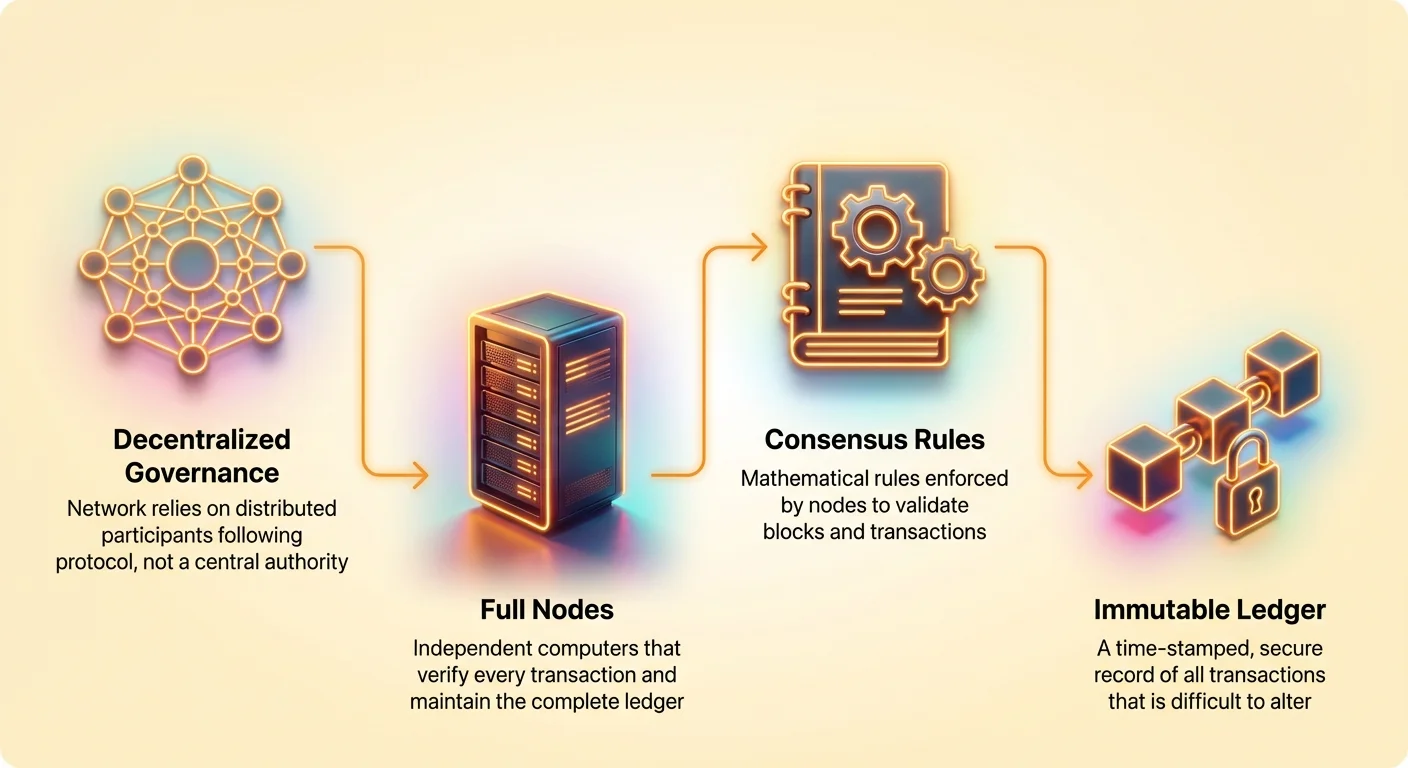
In the traditional financial world, banks and central authorities enforce the rules of money. They determine who has funds, who can transact, and the total supply of currency in circulation. In a decentralized network like Bitcoin, there is no central office or CEO to make these decisions or enforce regulations. Instead, the network relies on a distributed system of participants who voluntarily follow a specific protocol. This system allows strangers to transact globally without requiring trust in one another or a third party.
The governance of this system is maintained through a mechanism known as node enforcement. Thousands of independent computers, scattered across the globe, run software that verifies every action on the network. These computers, or nodes, act as the referees of the system. They independently check that the rules of the protocol are being followed. If any participant attempts to cheat or break the rules, the nodes simply reject their actions.
This structure creates a robust environment where the rules are enforced by code and consensus rather than human discretion. The integrity of the ledger is preserved not by authority, but by the collective verification of every participant. Understanding how these nodes operate and enforce rules is essential to grasping the true value of decentralized digital assets. It explains how a digital currency can remain secure and scarce without a central issuer.
The Foundation of Network Governance
At the heart of decentralized protocol enforcement lies the node. A node is simply a computer that runs the software required to connect to the network. These devices download the history of transactions and participate in the constant relay of information. While miners are often credited with securing the network through energy expenditure, nodes are the entities that actually define the network. They decide which blocks of transactions are valid and which are not.
The Role of Full Nodes
Full nodes are the backbone of the network's security model. These nodes download and maintain a complete copy of the blockchain, which is the public ledger of all transactions that have ever occurred. By possessing the entire history, a full node can independently verify the authenticity of every coin and transaction back to its origin. This independence is what gives the network its censorship-resistant properties.
A full node does not rely on external sources to know the state of the network. It validates every rule of the protocol for itself. When a new block of transactions is proposed, the full node checks it against the consensus rules. If the block contains invalid transactions or violates protocol parameters, the node rejects it. This happens automatically, ensuring that no invalid data propagates through the honest part of the network.
Variances in Node Types
Not all network participants run full nodes. Some users prioritize convenience or have limited hardware resources, leading them to use lightweight clients. These are often called Simplified Payment Verification (SPV) clients. While useful for quick transactions on mobile devices, they do not offer the same level of sovereignty as a full node. They rely on full nodes to provide them with correct information.
| Node Type | Storage Needs | Verification Level | Security Model |
|---|---|---|---|
| Full Node | High | Complete validation | Trustless |
| Pruned Node | Medium | Complete validation | Trustless |
| Light Node | Low | Partial validation | Trusted |
Pruned nodes offer a middle ground. They function exactly like full nodes in terms of validation but discard older data to save disk space. They still verify every transaction from the beginning but only keep the recent history and the current set of unspent coins on hand. This allows users to participate in governance without needing massive storage capacity.
Mechanics of Transaction Verification
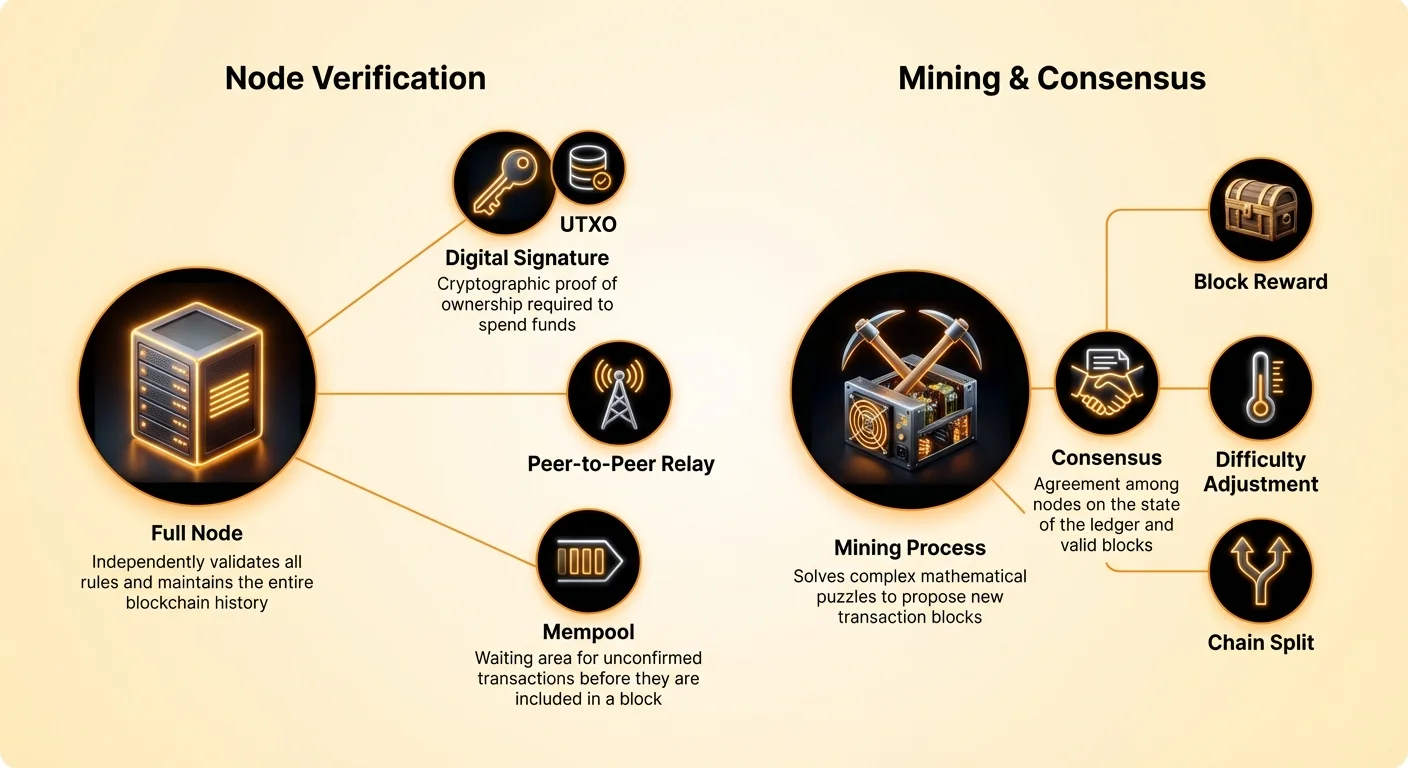
Before a transaction can even be considered for a block, it must pass a series of rigorous checks by the nodes. When a user broadcasts a payment, it is sent to a few connecting nodes. These nodes immediately analyze the transaction to ensure it adheres to the protocol's scripting language and rules. If the transaction is valid, they pass it to their peers. If it is invalid, they drop it, effectively stopping it in its tracks.
Digital Signatures and Ownership
The primary rule nodes enforce is ownership. To send funds, a user must provide a digital signature generated by their private key. This signature proves they have the authority to move the coins associated with a specific public address. Nodes use the corresponding public key to mathematically verify this signature. If the signature does not match or is malformed, the transaction is deemed invalid.
This cryptographic verification ensures that funds cannot be stolen or moved without the owner's permission. The process is entirely mathematical and requires no human intervention. Nodes also check that the inputs being spent actually exist and have not been spent before. This prevents the "double-spend" problem, where a user might try to send the same digital coin to two different people simultaneously.
Script Execution and Constraints
Bitcoin uses a specific scripting language to define how coins can be spent. This language is stack-based and intentionally limited in scope to prevent infinite loops and security vulnerabilities. When a transaction is validated, the network executes a script that combines the sender's unlocking data with the recipient's locking requirements.
For a transaction to be valid, the script execution must result in a "true" value. Nodes run this script for every input in a transaction. This mechanism allows for complex spending conditions, such as multi-signature requirements where multiple people must sign to move funds. It also enables time-locks, where funds can only be spent after a certain block height. By enforcing these script rules, nodes ensure that the specific conditions set by the sender are strictly honored.
The Mining Process and Block Proposal
While nodes validate transactions, miners are responsible for ordering them. Miners collect valid transactions from the network and group them into a candidate block. Their role is to solve a difficult mathematical puzzle known as Proof of Work. This process requires significant computational energy and serves as a barrier to entry for those wishing to modify the ledger.
Proof of Work as a Security Filter
Proof of Work acts as a costly signal that protects the network from spam and rewriting history. Miners compete to find a specific number, called a nonce, which produces a hash below a certain target when combined with the block data. This is a probabilistic process that functions like a lottery. The more computing power a miner employs, the higher their chance of finding a solution.
However, finding the solution is only the first step. Once a miner finds a valid nonce, they broadcast the new block to the network. The nodes then receive this block and perform their own validation. They check that the Proof of Work is correct and that the miner actually expended the required energy. Crucially, they also re-verify every transaction within that block.
The Difficulty Adjustment Mechanism
To maintain a consistent flow of new blocks, the protocol includes a difficulty adjustment mechanism. The network targets an average block time of ten minutes. If more miners join and total computing power increases, blocks might be found too quickly. In response, the protocol automatically increases the difficulty of the puzzle.
Conversely, if miners leave and power drops, the puzzle becomes easier. This adjustment happens every 2,016 blocks, or roughly every two weeks. Nodes enforce this rule strictly. If a miner proposes a block with a difficulty target that does not match the current network requirement, nodes will reject it as invalid. This self-regulating thermostat ensures the system remains stable regardless of external factors.
Rejecting Invalid Blocks and Consensus
The relationship between miners and nodes is a system of checks and balances. Miners produce blocks, but they do not control the rules. If a miner creates a block that violates a protocol rule, such as awarding themselves too many new coins or including a double-spent transaction, the nodes will simply ignore it. The miner will have wasted electricity and resources for no reward.
The Power of Rejection
This rejection mechanism is the ultimate enforcement tool of the network. It means that even if a coalition of miners possessing a vast majority of the computing power decided to change the rules (for example, to increase the supply cap), the economic majority of nodes would not accept their new chain. The miners would effectively be mining a different currency that the rest of the network does not recognize.
This dynamic forces miners to remain honest. They are economically incentivized to follow the rules that the nodes accept. If they deviate, they lose revenue. Therefore, the governance of the protocol is not dictated by those with the most power, but by the consensus of the participants who validate the ledger.
Resolving Chain Splits
Occasionally, two miners may find a valid block at nearly the same time. This creates a temporary split in the blockchain, as different nodes may receive different versions of the "latest" block. To resolve this, the network follows the "longest chain" rule, or more accurately, the chain with the most accumulated Proof of Work.
Nodes will temporarily keep both versions but will eventually switch to the chain that extends first. Once a new block is added to one of the competing chains, it becomes longer and is accepted as the truth. The other block becomes an "orphan block" and is discarded. This consensus mechanism allows thousands of independent nodes to converge on a single history without communicating directly or voting.
The Mempool and Transaction Propagation
Before transactions are mined into a block, they reside in a waiting area known as the mempool. Every node maintains its own mempool, which is essentially a collection of unconfirmed transactions that the node has validated but not yet seen in a block. This dynamic queue is where the fee market develops and where the immediate state of network demand is visible.
Managing Network Congestion
The mempool is not a single, centralized database. It is a decentralized collection of data held locally by each node. When the network is busy, the mempool fills up with pending transactions. Because block space is limited to a specific size (measured in bytes), only a finite number of transactions can be confirmed every ten minutes. This scarcity creates competition among users to have their transactions included in the next block.
Miners naturally prioritize transactions that pay higher fees to maximize their revenue. This creates a fee market where users effectively bid for block space. Nodes facilitate this by relaying transactions across the network. However, nodes also have limits. If a mempool becomes too large, nodes may start rejecting low-fee transactions to prevent their memory from being overwhelmed.
Fee Estimation and prioritization
Users and wallet software use the state of the mempool to estimate appropriate fees. By looking at the queue of unconfirmed transactions, a wallet can calculate the fee required to be included in the next block, or the next few blocks. This estimation is crucial for user experience.
| Network State | Mempool Size | Fee Strategy | Confirmation Time |
|---|---|---|---|
| Low Traffic | Small | Low Fee | Fast |
| Normal Traffic | Medium | Standard Fee | Moderate |
| High Congestion | Large | High Fee | Variable |
If a user sets a fee too low during congestion, their transaction may remain in the mempool for hours or days. Eventually, if it is never picked up by a miner, it will be dropped from the mempools of nodes and returned to the sender's wallet. This mechanism ensures that the network can handle varying loads without crashing, prioritizing high-value or urgent transfers when necessary.
Economic Incentives and Supply Control
The governance of the network is deeply tied to its economic model. The protocol has a hard-coded limit on the total supply of currency, set at 21 million coins. This scarcity is one of the fundamental rules that nodes enforce. The issuance of new coins occurs only through the block reward given to miners, and this reward is programmed to decrease over time.
The Halving Mechanism
Every 210,000 blocks, or roughly every four years, the block reward is cut in half. This event, known as the halving, reduces the inflation rate and ensures the supply follows a predictable deflationary schedule. Nodes enforce this strictly. If a miner attempts to claim a reward that is even one satoshi higher than the current allowed amount, the block is invalid.
This supply schedule mimics the extraction of precious metals like gold. Initially, gold is easy to find, but over time it becomes harder and more resource-intensive to extract. By enforcing this mathematical scarcity, the network participants uphold the asset's value proposition as a store of wealth that cannot be debased by arbitrary inflation.
Miner Profitability and Security
The economic incentives also secure the network. Miners invest heavily in hardware and electricity to participate. This investment acts as collateral. If they play by the rules, they are rewarded with valuable currency. If they attack the network, they risk destroying the value of the currency they earn, essentially undermining their own business.
Furthermore, as the block reward decreases, transaction fees become a larger portion of the miner's revenue. This transition ensures that miners remain motivated to secure the network even after the last coin is minted around the year 2140. The system transitions from being subsidized by inflation to being sustained by direct commerce and utility.
Preventing Double Spending
One of the most critical problems any digital cash system must solve is the double-spend problem. In a digital environment, data can essentially be copied and pasted perfectly. Without a central authority, preventing a user from spending the same digital token twice is a significant challenge. The combination of the blockchain ledger and Proof of Work provides the solution.
The Immutable Ledger
The blockchain serves as a time-stamped historical record. Once a transaction is included in a block, it is buried under layers of Proof of Work. To reverse a transaction and double-spend those funds, an attacker would have to redo the work for that block and every subsequent block. This effectively means they would need more computing power than the rest of the network combined.
Nodes play a vital role here by maintaining the integrity of this ledger. When a new transaction arrives, a node checks its internal database of Unspent Transaction Outputs (UTXOs). If the inputs referenced in the transaction have already been spent in a previous block, the node rejects the new transaction immediately. This check prevents conflicting transactions from even reaching the miners in many cases.
Confirmations and Finality
Security in this system is often measured in confirmations. A transaction has zero confirmations when it is in the mempool. Once included in a block, it has one confirmation. As each new block is added to the chain, the number of confirmations increases.
With each additional confirmation, the cost of reversing the transaction grows exponentially. For high-value transfers, recipients typically wait for multiple confirmations (often six) before considering the payment final. This practice leverages the immense difficulty of rewriting the blockchain history, providing a level of settlement assurance that increases with the passage of time.
Decentralization and Sovereignty
The true strength of the network lies in its decentralization. The more independent nodes there are validating the chain, the harder it is for any entity to capture or censor the network. If only a few large institutions ran nodes, they could collude to blacklist certain addresses or change protocol rules. A diverse, globally distributed network of nodes makes this coordination impossible.
The Importance of Self-Custody
Running a node is the ultimate expression of financial self-sovereignty. When users rely on third-party services or centralized exchanges to interact with the network, they are trusting those entities to relay the truth. They are essentially reverting to the traditional banking model. By running their own node, a user verifies their own transactions and balances without trusting anyone.
This "don't trust, verify" ethos is central to the culture of the protocol. It empowers individuals to be their own bank. It ensures that the rules they signed up for are the rules that are being enforced. No government or corporation can force a node operator to update their software to a version they do not agree with.
Resistance to Censorship
Because transactions are broadcast peer-to-peer, there is no central server to shut down. If one node blocks a transaction, the user simply connects to different peers. The data propagates through the network like water finding a crack. As long as there are honest miners and nodes willing to process transactions, payments cannot be stopped.
This resilience allows the network to function in hostile environments. It provides a neutral financial rail that is open to anyone with an internet connection. The decentralized architecture ensures that access is permissionless, meaning no ID or approval is required to create a wallet, run a node, or participate in the economy.
Scripting and Future Innovations
While the base layer is designed for stability and security, the scripting language allows for significant innovation. The protocol is evolving to support more complex applications while maintaining the rigidity of its core rules. Upgrades are implemented cautiously, often through soft forks that are backward compatible, ensuring that older nodes do not get kicked off the network.
Layer 2 and Scalability
To handle more transactions without bloating the blockchain, the network utilizes Layer 2 solutions like the Lightning Network. These protocols allow users to open payment channels between each other. These channels are anchored to the main blockchain using multi-signature scripts enforced by nodes.
Transactions within these channels can occur instantly and with negligible fees. They do not need to be broadcast to the entire network, offering privacy and speed. Only the final settlement is recorded on the main chain. This layered approach scales the network's capacity while preserving the decentralization of the base layer.
Programmable Money
The scripting capabilities also enable features like Ordinals, which allow data to be inscribed directly onto individual satoshis. This creates unique digital assets that are secured by the same Proof of Work as the currency itself. While controversial to some, these innovations demonstrate the flexibility of the protocol.
Smart contracts on the network are becoming more sophisticated. They enable trustless swaps, automated escrow services, and complex financial instruments. All of these are enforced by the same node network that secures simple payments. As technology advances, the utility of the network expands, but the foundational role of the node as the enforcer of rules remains constant.
Conclusion
The governance of a decentralized network is a complex symphony of mathematics, economics, and game theory. It replaces the need for human trust with cryptographic verification. Nodes act as the vigilant guardians of this system, independently validating every piece of data to ensure the integrity of the ledger. They work in concert with miners, who provide the security of energy expenditure, to create a system that is resistant to tampering and censorship.
This architecture ensures that the rules of the protocol—such as the fixed supply and the prohibition of double spending—are upheld without compromise. It creates a financial system where power is distributed among the edges rather than concentrated at the center. Whether through running a full node or simply holding keys, every participant contributes to the resilience of this ecosystem.
True financial freedom is built on verification, not trust.