
Bitcoin was born from the desire for peer-to-peer electronic cash, a system focused on the secure, transparent, and immutable transfer of value. For over a decade, the primary function of the Bitcoin blockchain—the foundational Layer 1—was almost exclusively financial: recording who owned what.
However, the introduction of the Ordinals protocol in early 2023 marked a profound shift. Ordinals, and the associated data structures called Inscriptions, fundamentally repurposed Bitcoin’s block space. They allowed arbitrary data, such as images, text, and even complex programs, to be permanently etched onto the world’s most secure ledger. This functionality instantly transformed Bitcoin from a simple monetary network into a platform capable of supporting digital artifacts similar to NFTs (Non-Fungible Tokens).
This technical innovation immediately launched a massive, ongoing debate centered on economics and philosophy. While Ordinals brought unprecedented interest and development to the ecosystem, they also created intense competition for the Bitcoin network’s most valuable resource: block space. This competition has driven transaction fees to record highs, impacting average users and forcing a critical reassessment of Bitcoin's destiny—is it purely a scarcity asset and settlement layer, or is it an evolving platform for general decentralized applications? This article moves beyond the technical 'what' of Ordinals to analyze the economic and structural 'how' they have changed the very dynamics of the Bitcoin network.
Decoding the Technical Mechanism of Inscriptions
To understand the economic contention Ordinals created, we must first understand the technical avenues used to introduce arbitrary data into the Bitcoin blockchain. This process leverages recent protocol upgrades, particularly SegWit and Taproot, which slightly expanded the network’s capacity for non-monetary information.
The Role of Satoshis and Ordinal Theory
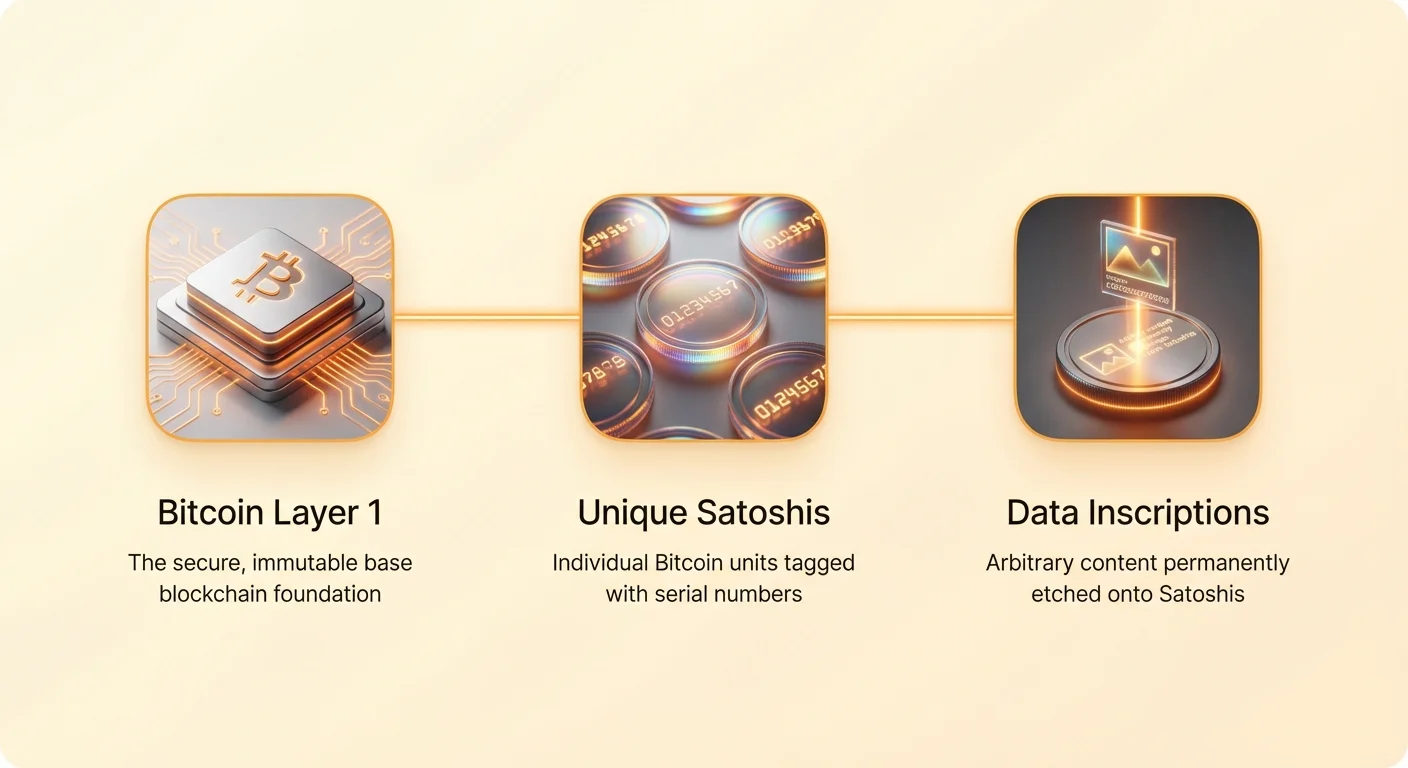
At the heart of the Ordinals protocol is a simple but revolutionary idea known as Ordinal Theory. A Bitcoin, which is the base unit of value, is divisible into 100 million smaller units called Satoshis (Sats). Ordinal Theory is merely a proposed numbering scheme: it assigns a unique serial number to every single Satoshi, starting from the very first one ever mined.
This serial numbering system changes the perception of Satoshis from being completely interchangeable (fungible) to being unique entities (non-fungible).
- Fungible: One dollar bill is functionally identical to any other dollar bill.
- Non-Fungible (Unique): A specific Satoshi is now traceable and uniquely identified by its creation order.
While the Ordinal Theory provides the method for tracking unique Satoshis, Inscriptions are the actual digital content (the image, text, or code) permanently attached to that specific, numbered Satoshi.
Leveraging Witness Data and the Taproot Upgrade
The ability to write large amounts of data onto the blockchain became possible due to two key upgrades: Segregated Witness (SegWit, 2017) and Taproot (2021).
SegWit and Witness Data
Before SegWit, every part of a Bitcoin transaction counted equally toward the strict 1MB block size limit. SegWit changed how transaction data is weighted, separating the data needed to verify a transaction (the witness data, which includes digital signatures) from the core transaction details.
Crucially, witness data is given a lower weight in calculating the effective block size limit (around 4MB). This meant developers could include more witness data without violating the traditional 1MB rule, making transactions cheaper and increasing overall transaction efficiency. Inscriptions utilize this cheaper, expanded "witness data" area to store their content.
The Enabling Power of Taproot
The Taproot upgrade, implemented in 2021, was intended primarily to improve Advanced Privacy and efficiency for complex transactions. However, it inadvertently provided the perfect technical loophole for Inscriptions.
Taproot simplified the way complex scripts (rules governing spending) appear on the blockchain. Because Taproot transactions can carry a significant amount of "script data," developers realized they could hide large amounts of arbitrary information (the inscription) within this data field. Essentially, the protocol treats the inscription data as part of the transaction’s execution requirements, even though it’s being used to store a picture or text.
In summary: Ordinals are the unique ID tags for Satoshis; Inscriptions are the data payload attached to those tags; and SegWit/Taproot provided the technical space (witness data) to store that payload cheaply and permanently on the Layer 1 chain.

The Economics of Scarcity: How Ordinals Drive Fee Contention
Bitcoin’s defining architectural limitation is its scarcity of space. Every block, which occurs roughly every 10 minutes, has a maximum practical capacity. Since demand for block space often exceeds supply, Bitcoin operates a competitive fee market. Ordinals activity, by consuming large chunks of this fixed resource, fundamentally alters this market dynamic.
Block Space: The Most Valuable Real Estate
Imagine a Bitcoin block as a limited cargo container that arrives every ten minutes. In a standard scenario, everyone puts their financial transactions (small packages) into the container, paying a shipping fee (transaction fee) based on how quickly they need their package delivered.
Before Ordinals, the main competition for this space was between standard financial transactions. With Ordinals, however, massive, high-data-volume inscriptions (like digital artworks or large text files) are now competing for the same space.
When an inscription is mined, it may take up the equivalent space of hundreds of simple financial transactions. Because the Ordinal creator is often willing to pay a premium to ensure their unique digital artifact is permanently etched into the most secure chain, they bid up the transaction fees significantly.
The Direct Impact on Average User Fees
The most noticeable economic effect of Ordinals is the dramatic rise in average transaction fees.
When demand for block space surges due to a rush of inscriptions (e.g., during the minting of a popular BRC-20 token standard), the queue of unconfirmed transactions (the mempool) swells. To get their transaction confirmed in the next block, users must outbid the ongoing inscription activity.
For a user sending a simple transaction (e.g., $50 worth of Bitcoin), the resulting high fee (sometimes $10, $20, or even $50) can make the transaction economically unviable. This creates a functional block space pricing crisis, especially for users in developing economies where low-cost P2P cash transfers are essential.
| Economic Scenario | Pre-Ordinals/Low Congestion | Post-Ordinals/High Congestion |
|---|---|---|
| Block Space Usage | Primarily financial transfers | Financial transfers + Large data payloads |
| Mempool Size | Small, transactions clear quickly | Large, backlog of transactions forms |
| Typical Fee | 1-5 sats/vbyte (Very low) | 50-300+ sats/vbyte (High, volatile) |
| Impact on Users | Accessible P2P cash for all | Prices out low-value transactions |
The Critical Role of Miner Revenue and Security
While high fees inconvenience standard users, they are a massive economic boon for Bitcoin miners. This is the positive counter-argument in the economic debate.
Bitcoin’s security model relies on miners expending computational power to secure the network. Miners are compensated in two ways:
- The Block Subsidy: Newly minted Bitcoin (which halves every four years).
- Transaction Fees: The sum of all fees from transactions included in the block.
As the block subsidy inevitably decreases over time, the long-term security of the Bitcoin network must increasingly rely on transaction fees. Ordinals provide a powerful, organic source of demand that drives fee volume.
When inscription demand is high, fees can temporarily eclipse the block subsidy, providing miners with huge profitability. This injection of revenue directly incentivizes more mining power, which increases the network’s hash rate and, consequently, its security against attacks.
The Economic Trade-off: Ordinals activity essentially transfers wealth from the Bitcoin network’s users (via higher fees) to its security providers (miners), fulfilling a crucial, long-term necessity for Bitcoin's economic stability post-halving, albeit at the cost of short-term usability for basic payments.
The Great Block Space Contention: Philosophical and Architectural Debate
The Ordinals phenomenon didn't just cause a technical surge; it ignited a philosophical conflict within the Bitcoin community that rivals the earlier "block size wars." The core of the debate is: What is the primary purpose of Bitcoin’s Layer 1 (the main blockchain)?
The Utility Argument: Bitcoin as a Data Layer
Proponents of Ordinals view the protocol as a vital expansion of Bitcoin's utility. They argue that the ability to store immutable data is inherently valuable and that this new use case strengthens the network overall.
- Innovation and Development: Ordinals attract new developers, capital, and cultural attention to the Bitcoin ecosystem, which historically lagged behind Ethereum and other chains in terms of programmability and decentralized applications (dApps).
- Market Efficiency: If people are willing to pay high fees to store data on the blockchain, then that usage is economically rational. Preventing this usage, proponents argue, is market manipulation and stunts Bitcoin's organic growth. The fee market should dictate the highest and best use of the scarce block space.
- Security Funding: As discussed, Ordinals provide necessary, robust, and unpredictable revenue streams that ensure the mining security model remains economically viable for decades to come, independent of the shrinking block subsidy. They see the occasional spike in high fees as a necessary "tax" on high-value activity that benefits the entire network.
The Block Spam Argument: Bitcoin as Pure P2P Cash
Critics of Inscriptions view the activity as "bloat," "spam," or a misuse of sacred space. They adhere strictly to the vision of Bitcoin as a simple, efficient, and cheap peer-to-peer electronic cash system.
- Erosion of Cash Use Case: High fees undermine Bitcoin’s role as a usable currency, making micro-payments and small transfers impractical. This disproportionately affects users who rely on Bitcoin for remittance or basic daily transactions where fiat alternatives are unavailable.
- Centralization Risk: When blocks are filled with large, opaque data inscriptions, running a full node—which is crucial for verifying the entire transaction history—becomes more resource-intensive due to increased storage and bandwidth requirements. Critics fear this high cost could lead to fewer individuals running nodes, thus increasing network centralization.
- Philosophical Purity: Some maximalists argue that the Layer 1 chain should be reserved exclusively for verifiable monetary transactions and settlement, not for arbitrary cultural artifacts like JPEGs, which they claim should reside on Layer 2 solutions or external storage layers.
Addressing Fungibility: The Taint of Uniqueness
A subtle but important philosophical challenge Ordinals raise relates to fungibility. Historically, all Satoshis were treated equally. Ordinals, by attaching unique IDs and permanent data to specific Satoshis, introduce a form of non-fungibility.
This raises concerns about "taint." If a specific Satoshi was used in an illicit transaction years ago, and is now identified as a "rare Satoshi" with a high market value because of its Ordinal number, its unique history might become economically relevant. This complicates the standard assumption that any Bitcoin can be exchanged for any other Bitcoin without affecting its value—a key property of sound money.
The Interplay with Scaling Solutions (Layer 2)
The Ordinals surge dramatically highlighted the necessity and economic viability of Layer 2 (L2) solutions, which are protocols built on top of the Bitcoin main chain (Layer 1) to handle high volume, low-value transactions cheaply and quickly.
Layer 1 vs. Layer 2: Redefining Roles
The contention over block space is forcing a clearer architectural separation between Bitcoin’s layers:
Layer 1 (The Main Chain)
The Layer 1 chain is defined by its immutable security and decentralization. The high cost imposed by Ordinals means L1 is increasingly viewed not as a daily payment network, but as a settlement layer—the ultra-secure foundation where high-value, highly critical transactions (like multi-million dollar institutional transfers or the opening/closing of L2 channels) are finalized. The presence of Ordinals reinforces L1 as a premium, high-cost commodity.
Layer 2 (e.g., Lightning Network)
Layer 2 solutions like the Lightning Network were designed to offer instantaneous, near-free transactions by moving activity off-chain. Ordinals activity, by pricing small users out of Layer 1, actually strengthens the economic case for adopting Lightning.
When L1 fees are negligible, users might tolerate slow confirmation times for convenience. When fees are $20, moving assets onto Lightning becomes a mandatory, cost-saving step for anyone intending to use Bitcoin for daily commerce. Thus, Ordinals inadvertently accelerate the adoption and necessity of the scaling infrastructure designed to solve the very congestion they create.
Ordinals as L1 Demand Drivers
Some developers argue that Ordinals should be seen as net positive drivers for scaling, rather than just causes of congestion.
- Incentivizing L2 Development: The economic pressure created by Ordinals pushes development teams and wallet providers to prioritize L2 integration, moving the ecosystem towards a multi-layered structure faster.
- Layer 1 Security Dependence: Ordinals, by definition, require the immutability of Layer 1. Unlike traditional NFTs, which often store the actual artwork data on external servers (like IPFS) and only store a link on the blockchain, Bitcoin Inscriptions store the entire artifact directly on L1. This reliance on the main chain confirms the high value placed on the security and censorship resistance of the L1 itself.
The Rise of BRC-20 and Fungible Tokens on Bitcoin
The Ordinals protocol didn't stop at digital art. Developers quickly leveraged the inscription mechanism to create the BRC-20 token standard.
BRC-20 tokens are fungible tokens (like Ethereum's ERC-20 tokens, which underpin most DeFi and utility tokens) that exist entirely through Ordinal Inscriptions. They work by using specific text inscriptions (JSON code) that dictate the function of "deploy," "mint," or "transfer" for a specific token ticker.
The introduction of BRC-20 tokens exponentially increased block space contention:
- Initial Minting Spikes: The deployment and initial minting of new BRC-20 tokens require thousands of individual inscriptions to be processed, leading to massive, sudden spikes in fee contention.
- Decentralized Trading: Every subsequent transfer of a BRC-20 token also requires a new inscription transaction on Layer 1. This activity solidifies Bitcoin’s Layer 1 not just as a store of value, but as a host for highly active, data-intensive decentralized token exchanges.
The economic reality is that this activity is likely permanent. As long as market participants value the immutability and security of conducting token transfers and digital art storage directly on Bitcoin’s Layer 1, they will be willing to outbid financial transactions for the scarce block space.
Actionable Insights and Future Implications
For newcomers navigating the world of Bitcoin, understanding the Ordinals phenomenon is crucial, as it dictates how you interact with the network, particularly concerning cost and speed.
Practical Tips for Interacting with the Bitcoin Network
- Prioritize Layer 2 for Payments: For daily use, coffee purchases, or moving smaller amounts of Bitcoin quickly and cheaply, always use the Lightning Network. Use Layer 1 only for final settlement, large storage transfers, or high-value activities.
- Monitor the Mempool: If you must use Layer 1, check the current mempool congestion (the queue of unconfirmed transactions). If the mempool is crowded due to high Ordinals activity, either wait for the congestion to clear (which can take hours or days) or be prepared to pay a significantly higher fee.
- Understand Fee Estimation: Use reliable wallet software that provides dynamic fee estimation. This helps you calculate the lowest fee required to ensure confirmation within a reasonable timeframe (e.g., 6 blocks). Never use a flat, low fee when congestion is high, or your transaction may be stuck indefinitely.
- Embrace Batching: When sending multiple transactions, check if your wallet supports transaction batching. This practice combines several outputs into a single transaction input, saving on overall transaction size and therefore fees—a critical strategy during periods of high contention.
The Future of Transaction Filtering
The community debate over "block spam" has led to discussions about how future network participants might categorize or filter block space usage.
Currently, Bitcoin is permissionless and politically neutral; all valid transactions that pay the required fee are treated equally by miners. Some critics have proposed technical mechanisms, like specialized fee markets or filtering options, to give priority to financial transactions over arbitrary data.
However, implementing such filtering mechanisms is fraught with difficulty because:
- Technical Ambiguity: Due to the complexity of Taproot transactions, it is almost impossible for a miner to definitively tell the difference between a high-value smart contract execution and a simple image inscription without interpreting the underlying script, which violates the principle of transaction neutrality.
- Censorship Risk: If nodes or miners begin implementing subjective filters, it introduces a dangerous precedent of censorship, where one type of use case is prioritized over another, potentially undermining Bitcoin’s core value of permissionless inclusion.
The prevailing view is that the market will solve this—Ordinals are an economic reality that must be managed through better scaling solutions (L2s) and efficient fee management, rather than through controversial protocol changes aimed at filtering specific transaction types.
Conclusion: Bitcoin’s Evolution to a Multi-Use Platform
The advent of Ordinals and Inscriptions represents a major inflection point in Bitcoin’s history, solidifying its evolution beyond a simple peer-to-peer cash system. This movement has transformed the scarcity of block space from a technical bottleneck into a highly competitive economic asset.
The central takeaway is that Ordinals are not merely a new type of digital collectible; they are a permanent source of demand for Layer 1 security. By driving up fees, they secure the long-term economic viability of the network by funding miners, even as the block subsidy diminishes.
The resulting block space contention forces a clear division of labor: Bitcoin’s Layer 1 is cementing its role as the ultra-secure settlement layer for high-value transactions and immutable data storage, while daily commerce and low-value transfers are increasingly relegated to high-speed, low-cost Layer 2 solutions like the Lightning Network.
Navigating the future of Bitcoin means embracing this multi-layered architecture, understanding that the core blockchain is now a premium commodity, and adapting user behavior to utilize the right layer for the right purpose. Ordinals have proven that the market is willing to pay high prices for the unique immutability Bitcoin offers, ensuring its role remains central to the decentralized digital economy, even if its daily accessibility comes at a higher cost.