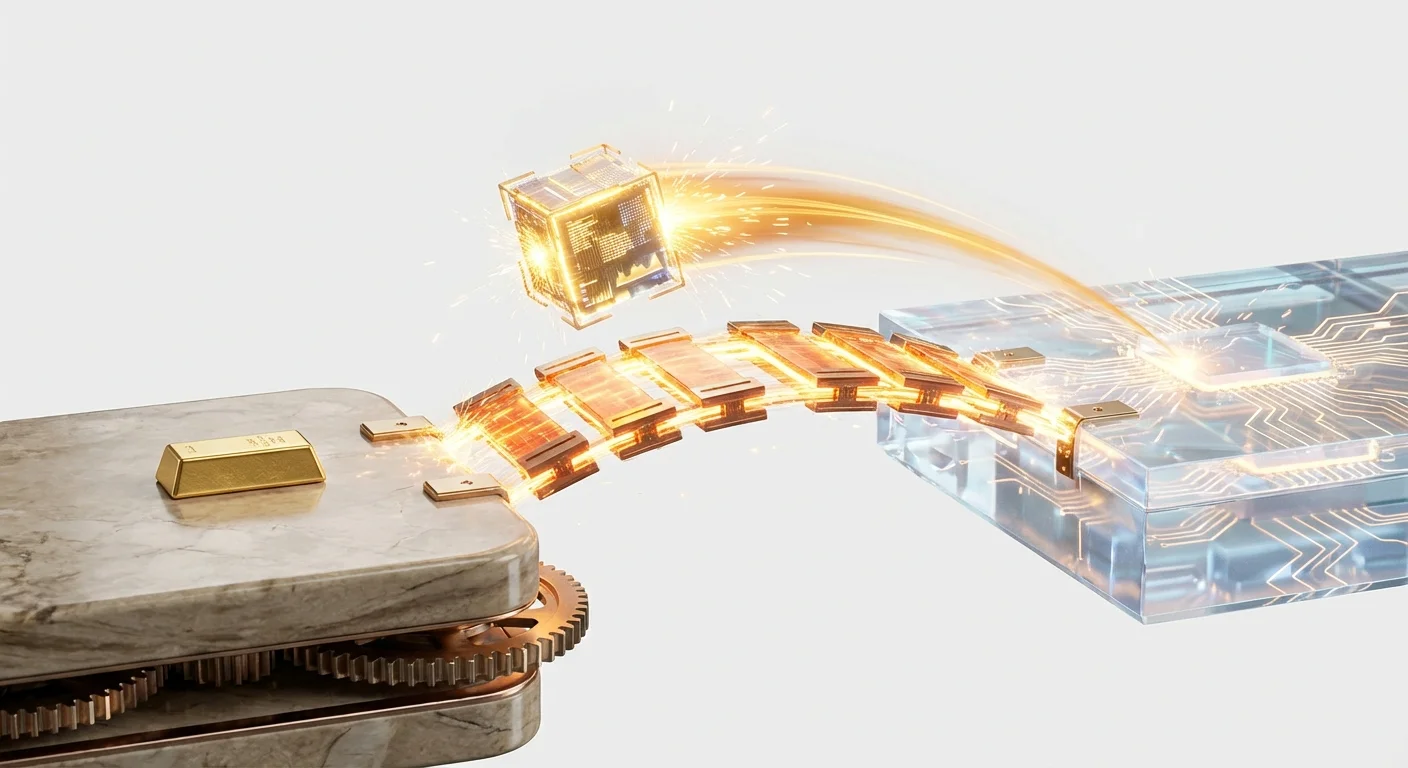
The rise of Web3 and the concept of the Metaverse are fundamentally changing how we view digital interaction. We are shifting away from centralized online platforms where property rights are dictated by a single company, toward decentralized, persistent digital worlds where users have genuine ownership and influence.
However, building these decentralized environments is far more complex than simply linking together a few servers. To sustain a Metaverse—or any successful digital community that involves transactions, investment, and long-term participation—you must design a functioning, resilient economy. This involves establishing rules for ownership, defining monetary policy, controlling inflation, and creating mechanisms for adaptation and change.
This guide explores the essential components and deliberate design decisions required to build a stable, asset-driven virtual economy. We move past abstract definitions to analyze the engineering trade-offs required to transition a digital space from a simple platform into a self-governing, valuable digital nation.
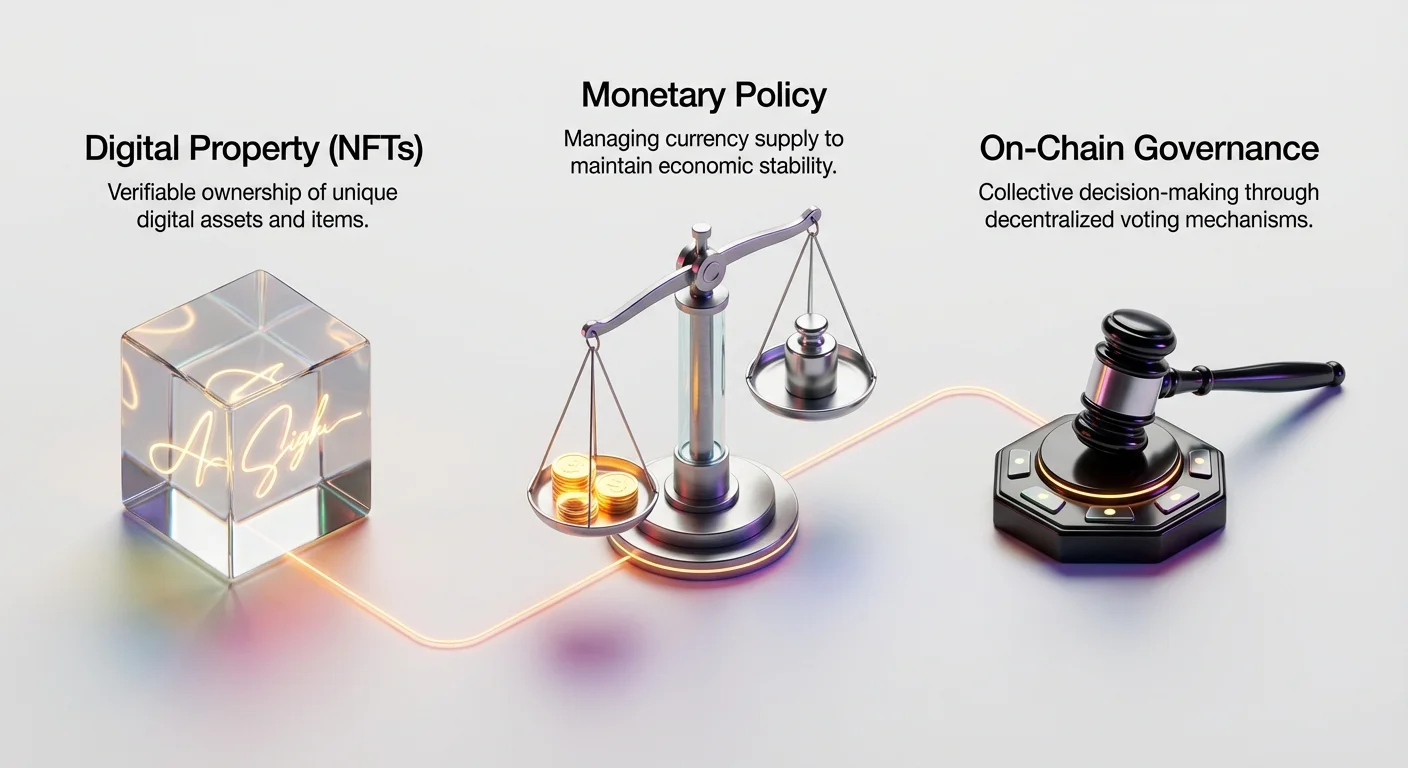
The Foundation of Digital Property: Non-Fungible Tokens (NFTs)
In any viable economy, participants must be able to define, transfer, and trust the ownership of assets. In the traditional internet (Web2), ownership of a digital item—like a skin in a game or a virtual plot of land—is merely an entry in a company’s database. If the company shuts down, the asset disappears.
Non-Fungible Tokens (NFTs) fundamentally solve this problem by providing on-chain, verifiable property rights. They are the digital deeds and titles of the Web3 world, giving rise to persistent virtual economies.
Fungible vs. Non-Fungible: Establishing Scarcity
The core economic distinction is between fungible and non-fungible assets:
- Fungible Assets: These are mutually interchangeable. A $1 bill is fungible with any other standard $1 bill. Similarly, most cryptocurrencies like Bitcoin (BTC) or Ether (ETH) are fungible. If you loan someone 1 ETH, you expect 1 ETH back, but not the exact same physical unit you handed over. Fungible assets typically act as currency or commodities.
- Non-Fungible Assets (NFTs): These are unique and cannot be swapped one-to-one for an identical item. A specific piece of digital art, a unique character avatar, or a virtual land parcel are non-fungible. The non-fungibility is what establishes verifiable digital scarcity, crucial for assigning lasting value and enabling economic trade.
Defining Ownership Standards (ERC-721 and ERC-1155)
NFTs are defined by smart contract standards, which dictate how they behave, how they are stored, and how they interact with decentralized applications (DApps). These standards are the foundation of on-chain property rights:
- ERC-721 (The Unique Asset): This is the initial and most famous standard, used for assets where every single item is distinct. If a virtual world issues 10,000 unique avatars, each avatar will be a distinct ERC-721 token. This is ideal for land ownership, one-of-a-kind art, or unique items of legendary status.
- ERC-1155 (The Multi-Token Standard): ERC-1155 is a newer standard that allows a single smart contract to manage both fungible and non-fungible assets simultaneously. Economically, this is far more efficient for complex virtual worlds. For instance, a game could use ERC-1155 to track 10,000 unique sword NFTs (non-fungible) alongside millions of gold coins (fungible) and 500,000 units of "iron ore" (semi-fungible commodity) all within the same contract. This flexibility is vital for designing internal supply chains and commodities markets.
The Secondary Market Effect: Liquidity and Value
One of the most powerful economic consequences of using NFTs is the activation of the secondary market. In Web2, if you spent $100 on a special sword in a game, that value was locked within the platform. If you quit the game, the value disappeared.
With NFTs, the assets reside on the blockchain, independent of the original game developer. This means:
- Liquidity: Assets can be traded on open, permissionless NFT marketplaces (like OpenSea or Magic Eden). This ease of trade ensures that assets maintain a degree of liquidity, providing a potential exit route for investors and players.
- Interoperability (Potential): While difficult to achieve completely, the standardized nature of NFTs theoretically allows assets to be used across different virtual environments. For example, the same avatar NFT might be displayed in a social Metaverse space, used as a profile picture on Twitter, and appear as a character in a specific game—deepening its utility and intrinsic value.
Monetary Policy in Virtual Worlds
Every persistent economy, whether national or digital, requires careful management of its currency supply to maintain stability. For virtual worlds, this means moving beyond simple reward mechanics and adopting sophisticated monetary policy to prevent hyperinflation and ensure long-term value for participants.
Designing Dual-Token Systems (Utility vs. Governance)
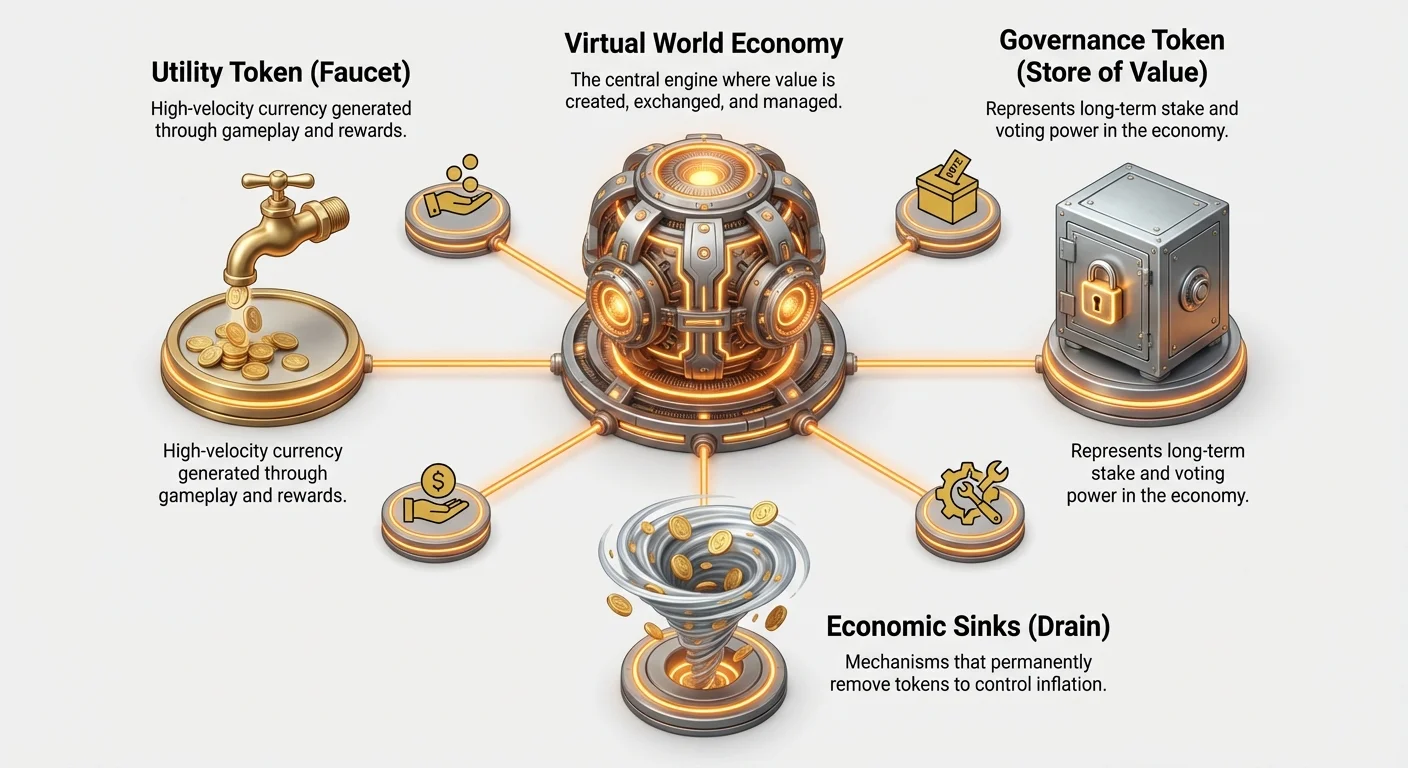
Many successful virtual economies employ a dual-token structure, separating the currency used for daily transactions from the token used for investment and governance. This economic architecture is used to balance stability and incentives:
- Utility Token (The Currency): This token is often inflationary, generated through gameplay, rewards, or staking. Its primary purpose is to facilitate transactions within the environment—buying resources, paying fees, or rewarding labor. Because it is designed for spending and circulation, its value is often more volatile, mirroring the daily economic output of the virtual world.
- Example: An "in-game Gold" token earned by completing quests.
- Governance Token (The Investment): This token is usually deflationary or capped in supply. It represents a share in the project’s future success and grants the holder voting rights in the economy’s governance structure (DAO). Since holders are incentivized to hold rather than spend, this token acts as the primary store of value and the long-term investment vehicle for the virtual economy.
- Example: A "Virtual World Stock" token that allows voting on fee structures.
By separating these roles, designers can manage the inflation of the utility token (which is necessary to keep players active) without immediately destroying the value of the long-term governance token (which attracts capital investment).
Controlling Inflation and Value Decay (The Gold Sink Problem)
Inflation occurs when the rate at which currency is generated (faucets) significantly outpaces the rate at which currency is removed from circulation (sinks). If not managed, high inflation renders the in-game currency worthless, driving away new players and collapsing the economy.
Economic designers must implement strategic sinks—mechanisms that permanently remove tokens from the circulating supply.
| Mechanism | Description | Economic Purpose |
|---|---|---|
| Upgrade Costs | Requiring tokens to permanently upgrade an NFT (burning the tokens in the process). | Drives demand for the token and rewards long-term engagement. |
| Transaction Taxes | A small percentage of all marketplace sales are automatically burned or sent to a governance treasury. | Controls high-velocity transactions and dampens speculative trading. |
| Destruction Mechanics | Items or resources degrade over time and must be repaired using the utility token. | Ensures continuous demand and prevents over-saturation of basic items. |
| Staking/Lockups | Requiring tokens to be locked up for a period to access certain benefits (e.g., higher yields or priority access). | Removes tokens from immediate circulation, reducing market supply. |
Effective virtual economy design is a continuous effort to tune the balance between faucets (rewards) and sinks (costs).
Managing Supply Shock and Velocity
Another challenge in virtual economics is managing velocity—how quickly tokens change hands. If tokens move too quickly (high velocity), it often indicates speculative behavior rather than genuine utility. Conversely, if tokens move too slowly, it indicates a stagnant economy.
Designers utilize vesting schedules and multi-stage rewards (e.g., earning a low-level token that must be combined with a rare NFT to mint a valuable asset) to manage this flow. Furthermore, early investors often receive tokens that are slowly released over months or years (vesting), preventing a sudden "supply shock" that would immediately depress the price and stability of the nascent economy.
Connecting Worlds: Real-World Assets (RWAs) and Oracles
To maximize their economic potential, virtual worlds cannot remain completely isolated. The most ambitious Web3 visions involve integrating the virtual economy with the value and stability of the physical world. This is primarily achieved through the tokenization of Real-World Assets (RWAs) and the use of decentralized data bridges called Oracles.
Tokenizing Tangible and Intangible Assets
Tokenizing an RWA means creating a verifiable NFT or specialized token on the blockchain that legally represents ownership of a corresponding asset in the physical world.
- Tangible RWAs: Examples include fractionalized ownership of real estate, art collections, or physical commodities like gold. A user in a Metaverse might own a token representing 1% of a commercial building in Manhattan, allowing them to participate in the real-world rent earnings, which are then distributed on-chain.
- Intangible RWAs: Examples include copyrights, intellectual property rights, or income streams (like future royalties from a music track).
Integrating RWAs provides critical benefits to the virtual economy: it introduces external collateral, adds stability through proven real-world value, and creates novel investment opportunities that bridge the two financial systems.
Blockchain Oracles: Bridging On-Chain and Off-Chain Data
For a smart contract in a virtual world to execute based on real-world events, it needs a trusted source of external data. This is the role of the Blockchain Oracle.
Blockchains are deterministic systems—they only know what happens within their own network. They cannot, by themselves, check the current price of gold, verify election results, or confirm that a real-world payment was made. The Oracle acts as a secure, decentralized middleware:
- Data Collection: Oracles collect and verify information from off-chain sources (e.g., financial data feeds, sensors, weather APIs).
- Data Transmission: They transmit this validated data onto the blockchain in a format the smart contract can read.
- Triggering Events: This data then triggers the smart contract execution.
Example Use Case: A decentralized insurance contract in the Metaverse requires $1,000 to be paid out if the price of a specific RWA (like tokenized copper) falls below a certain threshold. The Oracle constantly feeds the current copper price into the smart contract. When the price dips, the contract automatically executes the payout, without relying on any single centralized party to trigger the event.
Without Oracles, the scope of virtual economies would be severely limited, unable to leverage the complex, external data required for robust financial products like derivatives, lending protocols, or RWA management.
Legal and Regulatory Challenges for RWAs
While the technology for tokenizing RWAs is mature, the design of virtual economies must account for the ongoing legal friction. An NFT representing a piece of real estate only has value if that token is legally recognized as proof of ownership in the jurisdiction where the physical property resides.
Designers must partner with legal entities to ensure their RWA tokens are compliant with securities laws and property transfer regulations. Failure to do so exposes the entire virtual economy to severe counterparty risk—the risk that the real-world issuer fails to honor the digital asset.
On-Chain Governance: Directing Economic Evolution
A key difference between a traditional, centralized game economy and a Web3 virtual economy is the capacity for the community to direct its own future. Economies are living systems that require constant adaptation—changing tax rates, adjusting resource scarcity, and implementing new features. In Web3, this is managed through On-Chain Governance, primarily facilitated by Decentralized Autonomous Organizations (DAOs).
DAOs as Economic Central Banks
The DAO is the organizational structure used to make collective decisions in a decentralized manner. In the context of a virtual economy, the DAO functions much like a central bank and a legislative body combined:
- Policy Setting: DAO members vote on critical economic parameters, such as the inflation rate of the utility token, the fees charged on the marketplace, the distribution of treasury funds, or whether to introduce a new resource sink (tax).
- Protocol Upgrades: The DAO votes on technical updates and protocol changes, ensuring that the infrastructure evolves based on community consensus, not unilateral developer mandate.
This governance layer is essential for preventing the economic collapse seen in many Web2 games where developers, chasing short-term profit, made unbalanced changes that alienated the player base.
The Voting Power of Economic Stake
In most Web3 governance models, voting power is proportional to the number of governance tokens a participant holds (often referred to as “one token, one vote”). This intentionally links economic stake to political power.
Those who have invested the most capital and hold the greatest long-term interest in the virtual economy are given the loudest voice in its future direction.
While efficient, this system presents inherent design trade-offs:
- Risk of Centralization: If a small number of "whales" (large token holders) control the majority of votes, the economy risks being governed by an oligarchy, potentially making decisions that benefit large holders over the average user.
- Mitigation Strategies: Designers implement strategies to mitigate this, such as using delegation (allowing smaller holders to lend their votes to trusted representatives) or quadratic voting (where holding more tokens grants diminishing returns on voting power, encouraging broader participation).
A healthy virtual economy requires governance mechanisms that are both efficient for passing necessary economic reforms and decentralized enough to reflect the needs of the diverse participant base.
Treasury Management and Long-Term Sustainability
Another core function of the DAO is managing the Treasury. The Treasury accumulates revenue generated by the virtual economy—such as transaction fees, NFT sale royalties, and platform taxes.
This fund serves as the economic reserve, vital for long-term sustainability. The DAO must vote on how to deploy this capital:
- Development Funding: Paying developers and auditors for essential maintenance and future upgrades.
- Marketing and Growth: Allocating funds for attracting new users and expanding the economy's reach.
- Economic Stabilization: Using reserve funds to perform open market operations (e.g., buying back tokens to reduce supply during a market downturn) to stabilize the currency.
The transparency of an on-chain treasury, where every transaction is auditable, fosters unprecedented trust, contrasting sharply with traditional corporate finance where game revenue is opaque.
Conclusion
Designing a persistent, decentralized virtual economy requires moving beyond coding and engaging directly with economic theory, game theory, and governance models. NFTs provide the crucial foundation of verifiable digital property, while sophisticated monetary policy—often involving dual-token systems and careful inflation sinks—ensures the long-term stability of the currency. Finally, the inclusion of Oracles and decentralized governance structures (DAOs) allows these economies to integrate with the real world and adapt democratically over time.
The economic plumbing of Web3 is still in its early stages. Successful virtual economies will be those that prioritize transparency, stability, and the establishment of robust, equitable governance mechanisms capable of weathering economic shocks and driving innovation for years to come.