
The Bitcoin Halving is perhaps the single most critical, deterministic economic event in the world of cryptocurrency. Unlike traditional financial markets where central banks debate and adjust interest rates based on current economic conditions, Bitcoin's monetary policy is immutable, transparent, and coded into its very foundation.
To understand Bitcoin as an investment asset—a store of value, a medium of exchange, or a hedge against inflation—one must first master the mechanics and macro-economic consequences of the Halving cycle. This event is not merely a technical adjustment; it is the programmed supply shock that drives the asset’s long-term scarcity and dictates the cyclical nature of its price action.
This analysis moves beyond the basic definition of the Halving. We will adopt the perspective of a financial analyst, examining the structural impact of cutting the new supply of Bitcoin in half every four years. We will analyze the resulting squeeze on miner profitability, the crucial role of the "cost of production" as a potential price floor, and how these forces combine to create the most profound economic pattern in the digital asset landscape.
The Foundation of Digital Scarcity: Understanding the Halving Mechanism
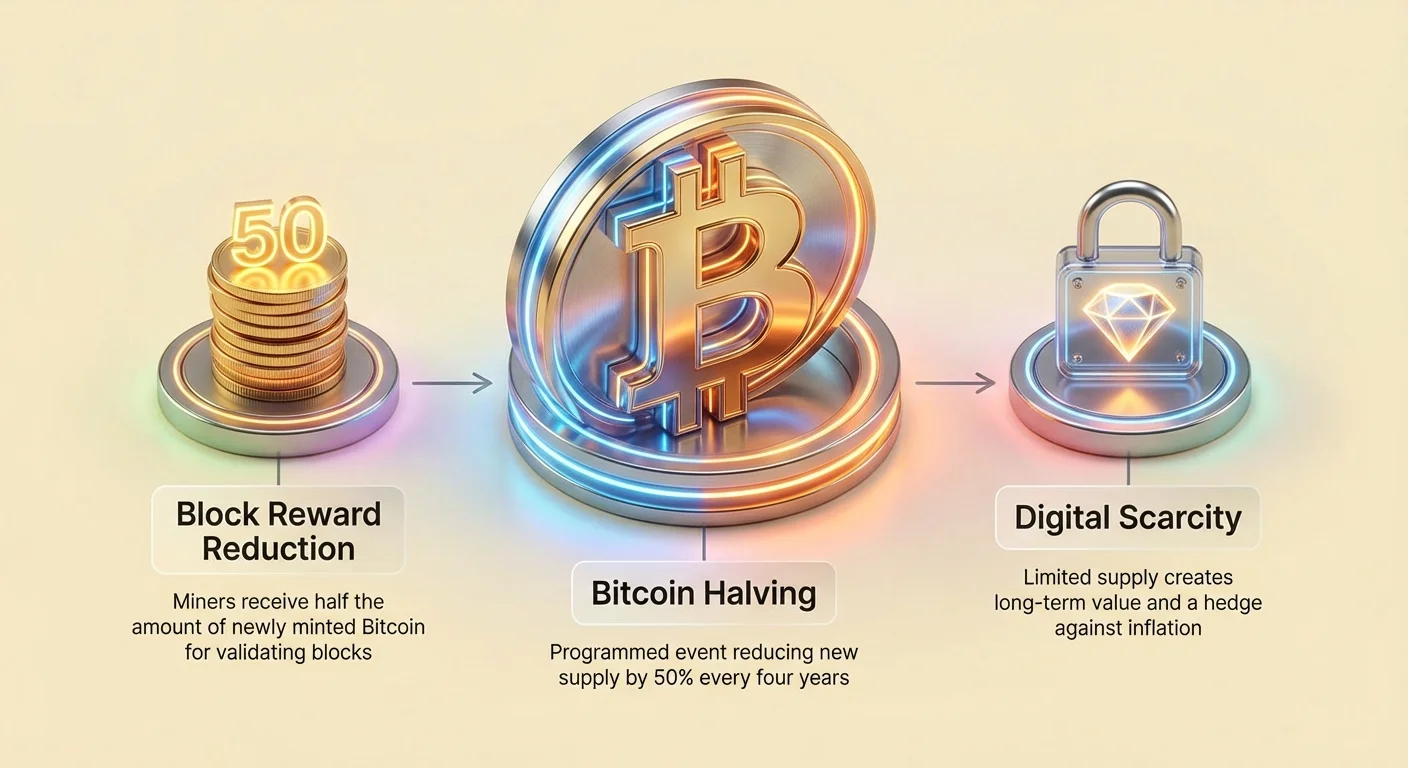
Before dissecting the economic models, we must establish the core mechanics of the Bitcoin network. The Halving is the specific enforcement mechanism for Bitcoin’s hard cap of 21 million coins.
What is the Block Reward?
Bitcoin is created through a process known as mining, where specialized computers (miners) solve complex mathematical problems to validate batches of transactions, known as blocks. When a miner successfully adds a new block to the blockchain, they receive two things: the transaction fees paid by the users included in that block, and a "block reward," which is newly minted Bitcoin.
The block reward is the primary source of new supply entering the market. Historically, this reward started at 50 BTC per block in 2009.
The Programmed Reduction Schedule
The Halving is the pre-programmed event where the block reward is automatically cut in half. This occurs approximately every four years, or specifically, after every 210,000 blocks have been mined.
| Halving Year | Initial Block Reward (BTC) | Post-Halving Block Reward (BTC) | Supply Reduction |
|---|---|---|---|
| 2009 (Genesis) | 50 | N/A | N/A |
| 2012 (First Halving) | 50 | 25 | 50% |
| 2016 (Second Halving) | 25 | 12.5 | 50% |
| 2020 (Third Halving) | 12.5 | 6.25 | 50% |
| Upcoming (Fourth Halving) | 6.25 | 3.125 | 50% |
This structured reduction guarantees that the inflation rate of Bitcoin drops consistently and predictably, completely independent of human intervention, political pressure, or market price. This predictable decrease in new supply is the central tenet of Bitcoin's monetary policy, contrasting sharply with the discretionary policies governing fiat currencies.
The Inelasticity of Bitcoin Supply
In economics, a supply shock occurs when there is an unexpected change in the supply of a commodity. However, the Bitcoin Halving is a programmed supply shock. The key economic consequence is the profound inelasticity of supply.
In a typical market, if demand spikes, producers can ramp up production to meet that demand, dampening the price rise. In the Bitcoin network, regardless of whether the price is 10,000$ or100,000$, the network produces the same number of new coins per day (roughly 144 blocks * the current block reward).
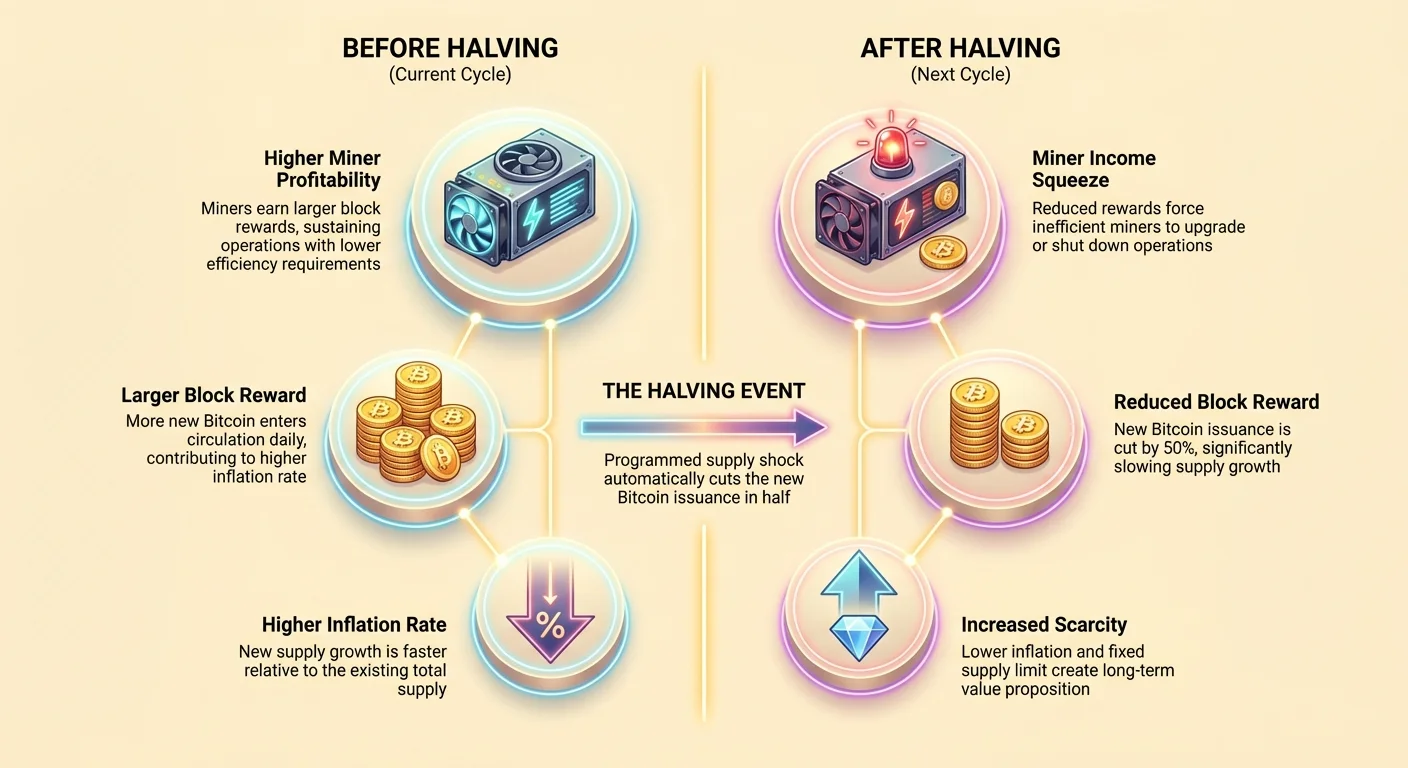
Once the Halving occurs, the daily supply entering the market is cut in half permanently. If demand remains constant, or if demand rises (as it often does due to increased awareness and institutional adoption), the price must adjust upward significantly to absorb the structural imbalance created by the supply reduction.
The Critical Impact on Miner Profitability
The most immediate and profound economic effect of the Halving is felt by the Bitcoin mining industry. Miners are the producers of the commodity, and their business operations are suddenly faced with a 50% drop in revenue from the block reward component.
Analyzing the Miner Business Model
Bitcoin mining is a highly capital-intensive business, characterized by significant fixed and variable costs:
- Fixed Costs (CapEx): Investments in specialized hardware (ASICs) and infrastructure (warehouses, cooling systems).
- Variable Costs (OpEx): Primarily electricity, cooling, maintenance, and labor. Electricity typically constitutes the largest variable cost.
For a miner, profitability is determined by the equation: (BTC Price * Block Reward) - Operating Costs. When the block reward is cut in half, the miner needs the price of Bitcoin to double just to maintain the same gross revenue stream.
The Post-Halving Hash Rate Adjustment and Capitulation
When the Halving hits, miners with the highest operating costs (often those paying higher electricity rates or using older, less efficient hardware) become instantly unprofitable. This triggers a period known as miner capitulation or the hash rate adjustment phase.
- Shutdown: Unprofitable miners are forced to temporarily or permanently shut down their machines.
- Hash Rate Drop: The total computational power dedicated to securing the network (the hash rate) falls.
- Difficulty Adjustment: The Bitcoin protocol automatically adjusts the difficulty of mining every 2,016 blocks (approximately two weeks). As the hash rate falls, the difficulty decreases, making it easier for the remaining, more efficient miners to find blocks.
This adjustment period is crucial. It purges the network of inefficient participants, often leading to a temporary slowdown in the market immediately after the Halving. However, it ultimately ensures that the only miners left are those operating at maximum efficiency and the lowest cost, strengthening the network’s long-term security.
Shifting Revenue Streams: Fees vs. Subsidy
Historically, the bulk of miner revenue came from the block reward (the subsidy). As the subsidy continually halves, transaction fees become an increasingly important component of the miner’s income.
This shift has a fascinating economic implication: it incentivizes miners to advocate for higher network usage and supports development that facilitates more transactions, thereby helping Bitcoin transition from relying on the fixed block reward subsidy to relying purely on transaction utility for its security funding.
Historical Precedent Analysis: Patterns of the Halving Cycle
While the famous investment disclaimer notes that past performance is not indicative of future results, the historical analysis of the three previous Halvings provides indispensable data points on how the market reacts to this cyclical supply shock.
2012: The First Halving (50 BTC to 25 BTC)
The first Halving occurred in November 2012. At the time, Bitcoin was still a niche asset, trading around 12$.</p> <ul> <li><strong>Pre-Halving:</strong> There was minor anticipation, but the overall market size was small.</li> <li><strong>Post-Halving Reaction:</strong> The price remained relatively stable for several months. However, the structural supply pressure soon began to manifest.</li> <li><strong>Cycle Outcome:</strong> Within one year of the Halving, the price exploded, rising from the12$ range to a peak near 1,150$ by late 2013, demonstrating a massive lag effect between the supply shock and the ultimate price discovery.</li> </ul> <h3>2016: The Second Halving (25 BTC to 12.5 BTC)</h3> <p>The second Halving took place in July 2016. The market was larger, and there was significantly more speculative interest. Bitcoin was trading around650$ leading up to the event.
- Pre-Halving: Price saw a moderate run-up driven by early speculation, but then experienced a brief pullback, showcasing a classic "buy the rumor, sell the news" dynamic immediately preceding the event.
- Post-Halving Reaction: Similar to 2012, the market experienced a lengthy period of consolidation and lower volatility, lasting approximately six months. Miner adjustments were also observed during this time.
- Cycle Outcome: The major bull run began in late 2016/early 2017, culminating in the historic peak near 20,000$ in December 2017. The 2017 run confirmed the Halving's role as the primary long-term catalyst.</li> </ul> <h3>2020: The Third Halving (12.5 BTC to 6.25 BTC)</h3> <p>The third Halving occurred in May 2020, amidst unprecedented global economic uncertainty and institutional discovery of Bitcoin as a macro-asset. Bitcoin was trading in the8,000$ to 9,000$ range.</p> <ul> <li><strong>Pre-Halving:</strong> The market experienced the "Black Thursday" crash in March 2020 due to global panic (unrelated to the Halving itself), which temporarily obscured the typical pre-halving accumulation. However, price recovered swiftly before the event.</li> <li><strong>Post-Halving Reaction:</strong> The accumulation and consolidation period was relatively short compared to previous cycles, perhaps aided by massive global liquidity injections by central banks.</li> <li><strong>Cycle Outcome:</strong> The Halving acted as a structural catalyst for the 2020-2021 bull run, driven heavily by corporate treasury adoption (MicroStrategy, Tesla) and the introduction of new institutional products. Bitcoin peaked near69,000$ in late 2021.
Short-Term Price Dynamics vs. Long-Term Market Structure
A common mistake made by new investors is expecting immediate, explosive price action on the day of the Halving. Economic reality, however, dictates a more patient analysis, differentiating between immediate sentiment and long-term structural changes.
The Immediate "Sell the News" Effect
In the short term (days to weeks immediately following the Halving), the price is often stagnant or even slightly bearish. This can be attributed to several factors:
- Speculative Fatigue: Traders who bought purely on the "Halving narrative" often liquidate their positions immediately after the event, realizing that the short-term catalyst has passed.
- Miner Dumping: Unprofitable miners, needing liquidity to cover immediate costs or facing the necessity of winding down operations, may sell their coin reserves, adding slight downward pressure on supply.
- The Discounting Principle: In efficient markets, large, well-known events like the Halving should theoretically be "priced in" already. While the full supply shock cannot be perfectly priced in, short-term excitement is often mitigated by those who anticipated the event.
The Lag Effect: Structural Supply Imbalance
The true economic impact of the Halving is realized in the medium- to long-term (6 to 18 months post-event). This is the key difference between a technical event and its economic consequences.
If the Halving cuts daily new supply from 900 BTC to 450 BTC, the market does not immediately feel the absence of 450 BTC. It takes months for major buyers—institutional funds, corporate treasuries, and large retail pools—to realize that their continuous demand is now competing for a much smaller daily pool of newly issued coins.
Over a six-month period, the total reduction in new supply can equal tens of thousands of Bitcoin. This structural imbalance, where consistent demand meets structurally tightening supply, is the engine that drives the subsequent parabolic price discovery phase.
Advanced Valuation Frameworks: The Cost of Production Model
For sophisticated investors, the Halving introduces a powerful analytical framework: the Cost of Production Model. This model suggests that the fundamental price floor of Bitcoin is determined by the marginal cost required for the most efficient miners to continue operating profitably.
Defining the Intrinsic Floor
The cost of production is fundamentally influenced by the block reward, as this determines the gross revenue per block.
Before the Halving, if the cost to mine 1 BTC was, for example, 30,000$, miners were comfortable operating above that price. Once the block reward halves, the cost required to generate the same revenue roughly doubles (assuming electricity rates and difficulty remain constant in the short term). If the price remains at30,000$, a miner who was just barely profitable before is now operating at a loss.
In the long run, the price of Bitcoin must rise above the new marginal cost of production. Why?
- Supply Control: If the price dips below the cost of production for a prolonged period, miners shut down. This reduces selling pressure (less new supply enters the market) and also reduces the hash rate.
- Self-Correction: As the hash rate falls, mining difficulty drops, lowering the cost of production for the remaining efficient miners. However, if the price remains depressed, this loop continues until virtually all new supply ceases.
- Mandatory Price Discovery: Since institutional and sustained retail demand remains constant, the market is forced to bid the price up until mining becomes profitable again, ensuring the network remains secured and supply issuance continues.
The Halving dramatically elevates the minimum price required to sustain the operational security of the network, effectively setting a new, higher economic floor for the asset.
Stock-to-Flow Modeling (S2F)
The supply shock economics of the Halving are the basis for the famous Stock-to-Flow (S2F) model, popularized by the analyst known as "PlanB."
S2F measures scarcity by dividing the total existing supply (Stock) by the annual production (Flow).
When the Halving occurs, the Flow is instantly cut in half, thus doubling the Stock-to-Flow ratio. Assets with high S2F ratios (like gold) are considered extremely scarce and valuable stores of wealth. Because Bitcoin’s S2F ratio fundamentally shifts up every four years, the model suggests a direct, predictable, exponential relationship between scarcity and valuation. While the S2F model has been subject to debate regarding its predictive accuracy, its economic logic perfectly captures the structural scarcity created by the Halving.
Strategic Implications for Investors and Analysts
Understanding the Halving cycle is essential for building a coherent, long-term investment thesis for Bitcoin. It transforms investment strategy from short-term speculation into disciplined, cyclical participation.
Interpreting the Halving as a Market Signal
Investors should view the Halving not as a guaranteed short-term pump, but as the inevitable starting gun for the next multi-year bull cycle.
Actionable Tip: Historically, the most opportune time to accumulate Bitcoin has been in the year leading up to the Halving, during the bear market consolidation phase, or in the 6-12 months immediately following the event, before the structural shortage fully registers in the price. Using a Dollar-Cost Averaging (DCA) strategy throughout the consolidation and lag phase capitalizes on this predictable pattern.
The Role of Institutionalization
In previous cycles, Bitcoin was largely driven by retail traders. Today, institutional actors (ETFs, corporate treasuries, sovereign wealth funds) play a dominant role. This changes the dynamics in several ways:
- Accelerated Price Discovery: Institutional investment often involves massive capital inflows, capable of absorbing the newly reduced supply much faster than retail markets could previously.
- Consistent Demand: Institutional products (like spot ETFs) require continuous, mandated daily purchases of physical Bitcoin to back their shares. Post-Halving, this fixed institutional demand competes for half the new supply, intensifying the scarcity effect.
- Lower Volatility in Later Stages: As professional asset managers enter the market, increased liquidity and arbitrage activity may slightly dampen the extreme volatility seen in earlier cycles, leading to more sustainable, yet still substantial, upward trends.
Analyzing Supply Elasticity
For the advanced analyst, the Halving forces a reassessment of supply elasticity.
- Before the Halving: Supply elasticity is low but not zero (miners can slightly increase production efficiency or sell reserves).
- After the Halving: Effective supply elasticity becomes even lower. The market's ability to respond to rising demand with increased production is crippled. This is the core reason why even modest increases in institutional demand can lead to outsized price movements in the post-Halving period.
The supply is not just fixed; it is structurally contracting relative to the existing stock, making Bitcoin the scarcest liquid asset in the digital world.
Conclusion: The Halving as Bitcoin's Core Economic Engine
The Bitcoin Halving is more than just a date on the calendar; it is the fundamental economic engine that dictates the structure, volatility, and scarcity of the asset. By analyzing the Halving through the lens of supply shock economics, we understand that its influence is not based on speculative hype, but on mathematical certainty.
The cycle consistently involves three phases: pre-halving accumulation, a short-term post-halving adjustment (miner capitulation and price lag), and the inevitable, long-term parabolic price discovery driven by the structural shortage of new supply.
For the investor, recognizing the Halving's impact on miner profitability, the elevation of the cost of production floor, and the dramatic tightening of supply elasticity provides the necessary framework to navigate Bitcoin's market cycles successfully. The Halving confirms Bitcoin's thesis as a technologically enforced, digitally scarce store of value, designed to reduce inflation and drive self-sovereignty in the new digital economy.