
Securing digital wealth involves far more than simply remembering a password. As the cryptocurrency ecosystem expands beyond Bitcoin to include diverse altcoins like Solana, Ethereum, BNB, and XRP, the attack surface for investors grows exponentially. Each blockchain network introduces unique protocols, transaction standards, and potential vulnerabilities that demand a tailored security approach. Moving assets off centralized exchanges is the first step toward true ownership, but it also shifts the entire burden of security onto the individual.
The concept of "hardening" refers to the process of reducing system vulnerabilities by eliminating potential security risks. In the context of crypto assets, this means layering defense mechanisms to protect private keys from both digital theft and physical loss. While convenience often drives users toward mobile apps and browser extensions, the highest tiers of security require a disciplined approach to cold storage and seed phrase management.
For investors managing a portfolio of altcoins, understanding the specific requirements of each chain is vital. An Ethereum address functions differently than an XRP ledger account, and the speed of Solana transactions leaves little room for error. This guide explores advanced strategies for securing these assets, ensuring that self-custody results in financial sovereignty rather than catastrophic loss.
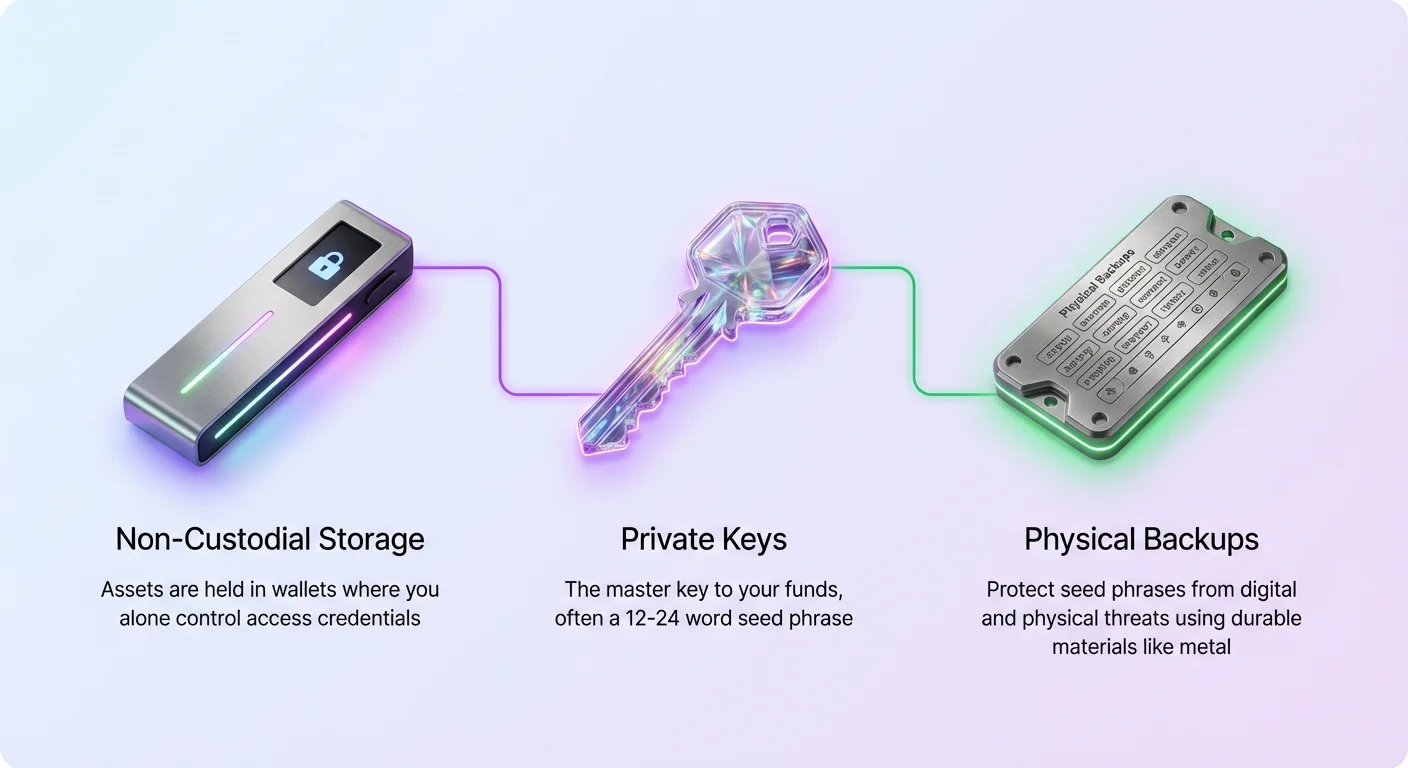
The Foundation of Non-Custodial Security
True security begins with understanding the distinction between custodial and non-custodial storage, mapping the crypto custody spectrum. When assets remain on an exchange, the user holds an IOU rather than the actual cryptocurrency. The exchange manages the private keys, which means the user is susceptible to platform hacks, insolvency, or regulatory freezes. Hardening your portfolio requires moving funds to non-custodial wallets where you alone control the access credentials.
Mastering Private Keys and Seed Phrases
The core of any non-custodial wallet is the private key, often represented as a 12 or 24-word seed phrase. This sequence of words is not merely a password reset tool; it is the literal master key to your funds. If a wallet application is deleted or a device is destroyed, the seed phrase is the only mechanism to restore access to the blockchain addresses.
Anyone who discovers this phrase gains immediate, irrevocable access to the associated assets. Therefore, hardening this aspect of security involves strict isolation. This phrase should never touch a digital environment. Typing it into a computer, taking a screenshot, or saving it in a cloud document exposes it to malware and clipboard hackers.
The Role of Specialized Wallet Interfaces
Different blockchains require specific interface standards to interact with decentralized applications (dApps). For instance, the Ethereum ecosystem relies heavily on EVM-compatible wallets like MetaMask, which manage ERC-20 tokens and NFTs. Conversely, the Solana network utilizes SPL tokens and requires specialized interfaces such as Phantom or Solflare.
Using the correct interface is crucial for security. Attempting to force incompatible tokens into the wrong wallet structure can result in loss of funds or technically complex recovery scenarios. A hardened security strategy involves verifying that your chosen wallet officially supports the specific network standards of your assets, such as BEP-20 for Binance Smart Chain or the specific destination tags required by the XRP Ledger.
Cold Storage vs. Hot Wallets
The most significant decision in asset hardening is choosing between hot wallets and cold storage. Hot wallets are connected to the internet, making them convenient for daily transactions and DeFi interaction but vulnerable to online threats. Cold storage involves keeping private keys on devices that never touch the internet, effectively air-gapping the assets from remote attackers.
| Feature | Hot Wallet (Software) | Cold Storage (Hardware) |
|---|---|---|
| Connectivity | Always online | Offline / Air-gapped |
| Security Risk | High (Malware/Phishing) | Low (Physical theft only) |
| Best Use Case | Daily trading & DeFi | Long-term holding |
Hardware wallets like Trezor or Ledger provide the gold standard for cold storage. These devices generate and store private keys within a secure element chip. When a user initiates a transaction, the unsigned data is sent to the device, signed internally, and only the signed authorization is returned to the computer. The private key itself never leaves the hardware environment, rendering key-logging malware ineffective.
For substantial altcoin holdings, relying solely on a browser extension or mobile app is insufficient. These "hot" environments are susceptible to sophisticated phishing attacks and browser vulnerabilities. Hardening your setup requires migrating the bulk of your portfolio to cold storage, using hot wallets only as a temporary bridge for active transaction needs.
Securing Specific Altcoin Ecosystems
Each major altcoin presents unique characteristics that influence how it should be secured. A one-size-fits-all approach often overlooks critical nuances, such as reserve requirements or memo fields, which can lead to user error or fund loss.
Hardening Solana and SPL Token Storage
Solana is renowned for its high speed and low transaction costs, but this efficiency requires vigilance. Wallets like Phantom and Solflare are designed to handle the high throughput of the network, allowing for seamless swapping and staking. However, the speed of execution means mistakes happen instantly.
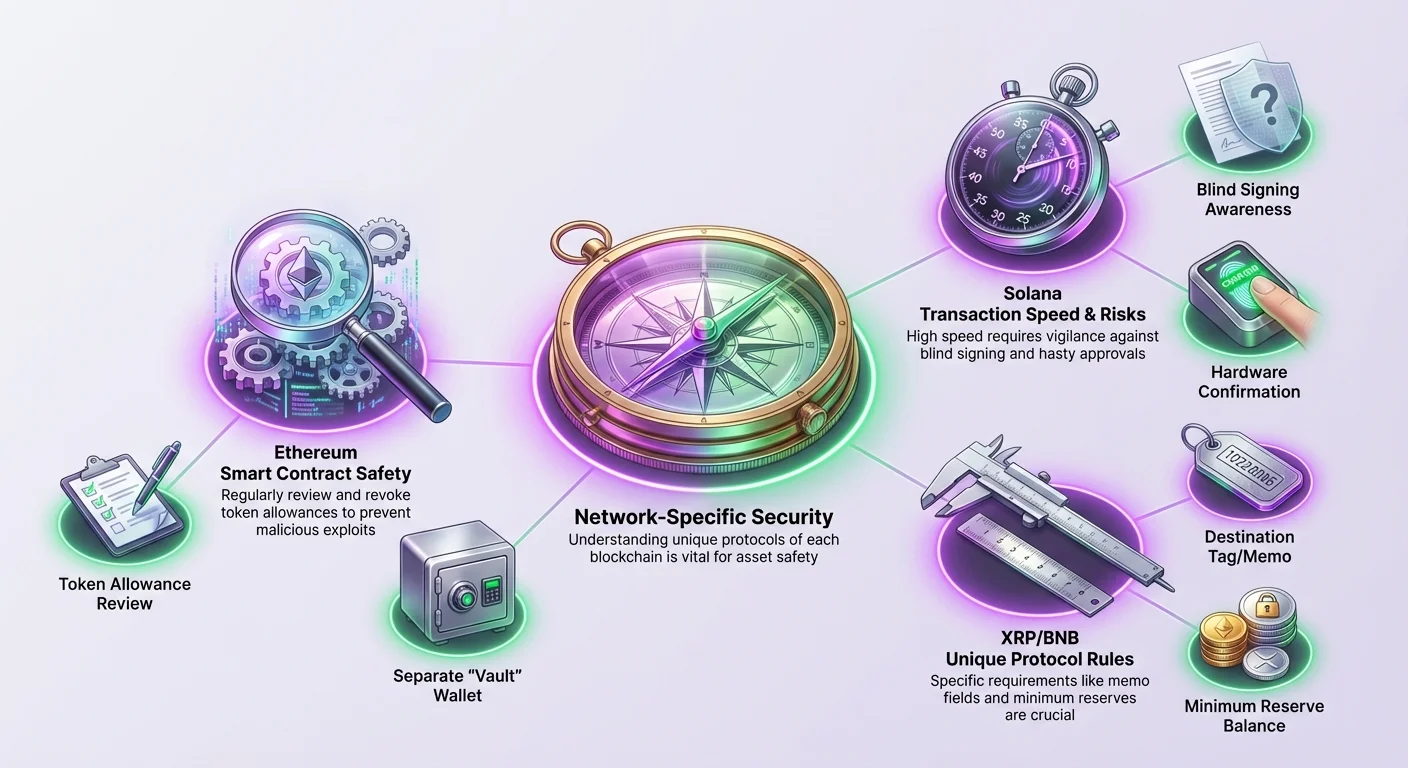
When securing Solana, users must pay close attention to the blind signing of transactions. Many malicious dApps attempt to trick users into approving permissions that allow the attacker to drain the wallet. Hardening a Solana setup involves using a hardware wallet connected to the Phantom interface. This requires physical confirmation on the device for every transaction, adding a crucial "human in the loop" check against hasty approvals. Additionally, because Solana uses a different account model for tokens (SPL), ensuring your wallet recognizes and properly displays these distinct assets is essential for accurate portfolio tracking.
Managing Ethereum and EVM Chains
The Ethereum ecosystem is the hub of Decentralized Finance (DeFi), making it a prime target for attackers. Wallets like MetaMask facilitate connections to Ethereum, Binance Smart Chain (BSC), and Polygon. The risk here often lies in infinite approval allowances. When interacting with a smart contract, users typically grant permission for the contract to spend their tokens.
If a contract is malicious or exploited later, the attacker can drain the approved tokens without further user action. To harden Ethereum security, users should regularly review and revoke token allowances using trusted audit tools. Furthermore, separating assets is a key strategy. Users should maintain a "vault" address in cold storage that never interacts with smart contracts, and a separate "burner" wallet with limited funds for daily DeFi activities.
Unique Protocols: XRP and BNB
Ripple (XRP) and Binance Coin (BNB) introduce specific transaction requirements that differ from the standard address models of Bitcoin or Ethereum. For XRP, the network requires a minimum reserve balance (typically 10 XRP) to activate a new wallet address. This prevents ledger spam but means a small portion of funds is essentially locked.
More critically, XRP and centralized BNB transactions often require a "Destination Tag" or "Memo" when sending funds to an exchange. This numeric code identifies the specific user within the exchange's pooled wallet. Omitting this tag is a common cause of fund loss. Hardening your process for these assets involves double-checking memo fields and sending small test transactions before moving large amounts. For BNB, users must also distinguish between the older Beacon Chain and the EVM-compatible Binance Smart Chain, as sending tokens to the wrong network type can complicate recovery.
The Physical Layer of Protection
Digital security measures are rendered useless if the physical backup of the seed phrase is compromised. "Offline backup" does not simply mean writing the phrase on a sticky note stuck to a monitor. It requires protection against environmental damage, theft, and degradation over time.
Paper wallets are the entry-level form of physical backup, but paper is fragile. It is susceptible to water damage, fire, and fading ink. For a hardened setup, investors often turn to metal backup solutions. These involve stamping or engraving the seed phrase onto steel or titanium plates. These materials can withstand extreme temperatures and physical impact, ensuring the recovery phrase survives house fires or floods.
Redundancy is also a critical component. A single physical backup creates a single point of failure. Advanced security strategies involve creating multiple copies of the seed phrase and storing them in geographically separate, secure locations. This mitigates the risk of a local disaster destroying the only means of recovering the portfolio. However, this increases the risk of theft, so each location must be strictly secured.
Mitigating Social Engineering and Phishing
The most sophisticated firewall cannot protect against a user voluntarily handing over their credentials. Phishing remains the primary vector for crypto theft. For a deeper look at common attack vectors, read our guide on mitigating SIM swaps and phishing. Attackers create exact replicas of wallet websites or support pages to trick users into entering their seed phrases.
Identifying Malicious Vectors
Official wallet providers, whether for Solana, Ethereum, or hardware devices, will never ask for a seed phrase for "verification" or "unlocking" purposes. Any website, email, or support agent requesting these 12-24 words is an attacker. Hardening your behavior involves bookmarking official URLs and never clicking on sponsored search results, which are often bought by scammers to impersonate legitimate services.
Browser extension wallets are particularly vulnerable to permissions exploits. A compromised browser extension can monitor activity or inject malicious code into legitimate webpages. To counter this, dedicated crypto operations should ideally occur on a clean browser instance or a dedicated machine used solely for financial transactions, separating it from general web browsing and email.
The Importance of Two-Factor Authentication
While non-custodial wallets rely on keys, many users still utilize centralized platforms for on-ramping (buying) or off-ramping (selling). For these accounts, robust Two-Factor Authentication (2FA) is non-negotiable. SMS-based 2FA is weak due to the prevalence of SIM-swapping attacks, where hackers hijack a phone number to intercept codes.
A hardened security posture utilizes app-based authenticators (like Google Authenticator) or hardware security keys (like YubiKey). These methods require physical possession of the authentication device, making remote account takeovers significantly more difficult. This layer of security protects the gateways where fiat currency interacts with the crypto ecosystem.
Conclusion
Securing a diverse altcoin portfolio requires a shift in mindset from convenience to vigilance. The decentralized nature of networks like Solana, Ethereum, and the XRP Ledger empowers users with absolute control, but that control comes with the responsibility of total defense. By combining the isolation of hardware wallets with rigorous seed phrase management, investors can build a fortress around their digital wealth.
Understanding the specific nuances of each blockchain is equally important. Whether it is the destination tags of XRP, the token approvals of Ethereum, or the blind signing risks on Solana, knowledge of the underlying mechanics is a defense mechanism in itself. Hardening is not a one-time task but an ongoing process of education, audit, and physical security maintenance.
True security is achieved when the cost of attacking your system exceeds the value of the assets it protects.