
Bitcoin’s ascent to significant valuation levels has created a psychological barrier for many potential investors. When the price of a single whole unit reaches tens of thousands of dollars, it can feel unattainable for the average individual. This perception often leads newcomers to believe they have missed the boat or that the asset is exclusively for the wealthy. However, this view stems from a fundamental misunderstanding of how the digital currency works.
Unlike physical assets or even traditional stocks which often trade in whole units, digital currencies are highly divisible. The system was designed from the inception to handle micro-transactions and fractional ownership. You do not need to purchase a whole unit to participate in the network. In fact, the vast majority of network participants own fractions of a coin rather than whole ones.
This divisibility allows for specific investment strategies that focus on gradual accumulation rather than large, lump-sum purchases. By understanding the denomination of the currency and the mechanics of accumulation, investors can build significant positions over time. This approach shifts the focus from the intimidating price of a whole coin to the accessible goal of accumulating smaller subunits.
The Mechanics of Divisibility
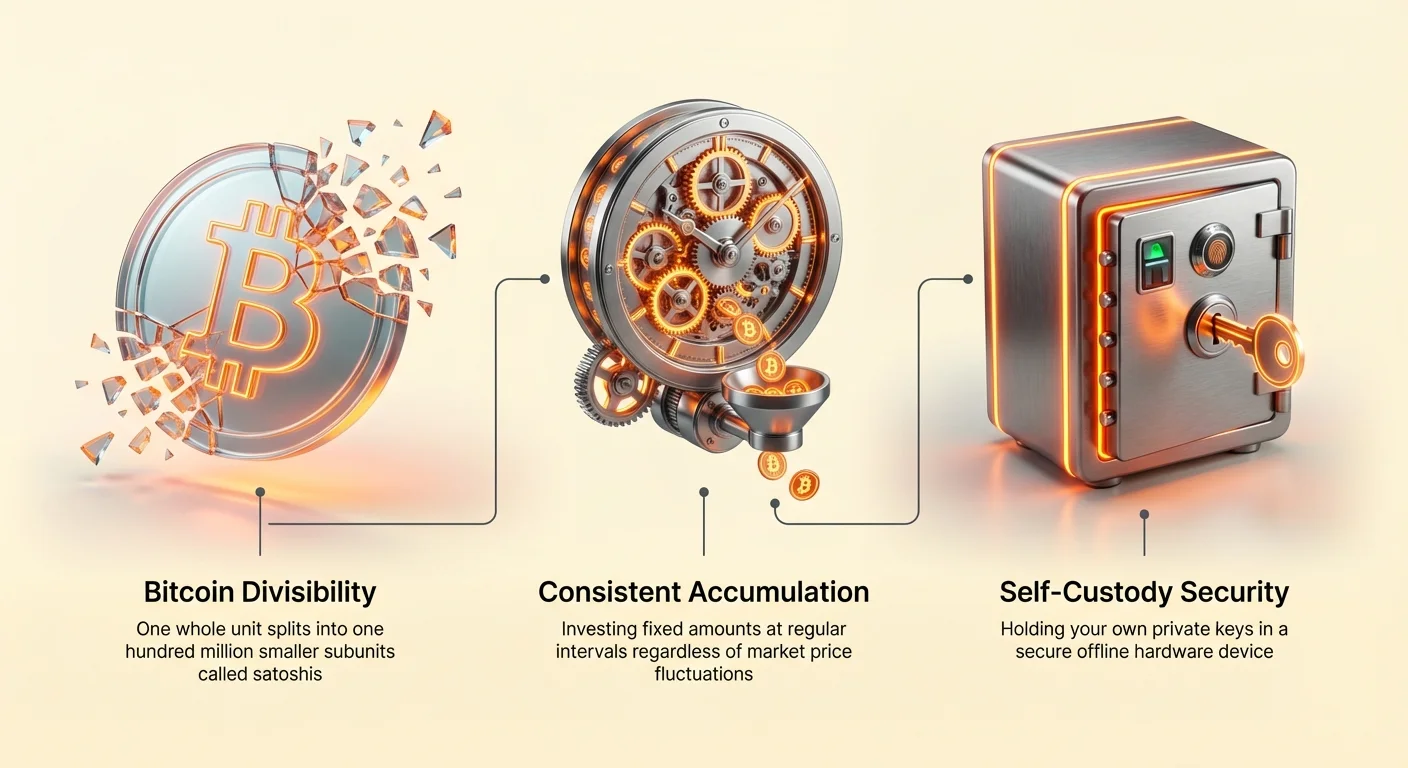
The architecture of Bitcoin allows for extreme precision in value transfer. A single bitcoin is not the base unit of the system; rather, it is a convention used for display. The protocol itself operates on a much smaller unit known as a "satoshi," named after the pseudonymous creator of the network. There are 100 million satoshis in a single bitcoin.
This relationship is similar to dollars and cents, but with much greater granularity. While a dollar is divisible into 100 cents, a bitcoin is divisible into 100,000,000 units. This means that even if the price of a whole bitcoin were to reach one million dollars, a single satoshi would still be worth a mere penny.
| Unit Name | Value in BTC | Value in Satoshis |
|---|---|---|
| Bitcoin | 1.00000000 | 100,000,000 |
| Bit (µBTC) | 0.00000100 | 100 |
| Satoshi | 0.00000001 | 1 |
Understanding this denomination is crucial for adopting the right mental model for accumulation. When you purchase $50 worth of the asset, you are not buying a "fragment" in a derogatory sense; you are purchasing potentially hundreds of thousands of satoshis. This shift in perspective is often referred to as "stacking sats."
Overcoming Psychological Unit Bias
Human psychology plays a significant role in financial decision-making. One specific cognitive quirk relevant to crypto markets is "unit bias." This is the predisposition to prefer whole units over fractional ones. People naturally derive more satisfaction from owning 1,000 units of an asset priced at $1 than owning 0.05 units of an asset priced at $20,000, even if the total value is identical.
This bias often leads inexperienced investors toward high-risk assets solely because they have a low price per coin. They might believe that a coin costing $0.01 has a better chance of doubling than a coin costing $50,000. This is a fallacy. The market capitalization and liquidity of the asset are far more important metrics than the unit price.
By denominating holdings in satoshis rather than whole bitcoins, investors can bypass this psychological hurdle. Instead of seeing a balance of 0.005 BTC, which feels small, an investor can view it as 500,000 satoshis. This framing aligns with the human desire for whole numbers and large quantities, making the accumulation process more satisfying and sustainable.
Implementing Dollar-Cost Averaging
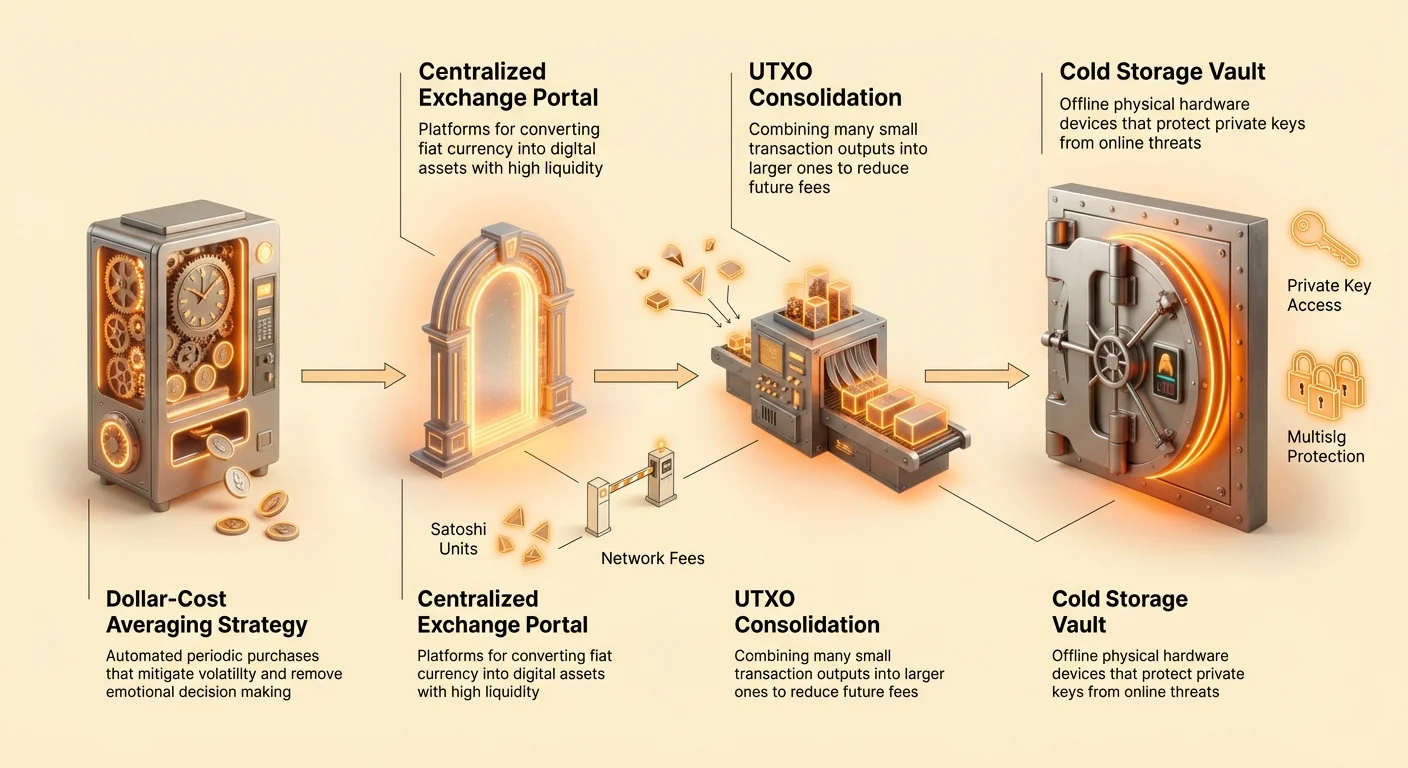
Dollar-Cost Averaging (DCA) is an investment strategy where an individual divides the total amount to be invested across periodic purchases. This is particularly effective for acquiring satoshis. instead of trying to time the market or waiting to save a large lump sum, an investor commits to buying a fixed dollar amount at regular intervals—weekly, bi-weekly, or monthly.
This strategy serves two primary purposes. First, it mitigates the impact of volatility. By buying regularly regardless of price, investors purchase more units when prices are low and fewer units when prices are high. Over time, this averages out the cost basis of the investment.
Second, it instills discipline. The emotional stress of watching price charts is removed. The goal becomes accumulation of units (sats) rather than monitoring the daily fiat value of the portfolio. Whether the market is up or down, the accumulator continues to increase their stack of satoshis. This consistent buying pressure, when adopted by many, creates a robust base of long-term holders.
Strategies for Buying and Accumulation
The pathway to acquiring digital assets has evolved significantly, offering multiple venues for accumulation. Choosing the right platform depends on a balance between convenience, privacy, fees, and control. For those engaging in DCA, minimizing friction and fees is paramount to long-term success.
Centralized Exchanges and Brokerages
Centralized exchanges (CEXs) act as intermediaries, similar to traditional stock brokerages. Users create accounts, verify their identity through Know Your Customer (KYC) regulations, and link banking methods. These platforms generally offer high liquidity, meaning it is easy to buy or sell large amounts without affecting the price.
For a beginner, exchanges offer the most familiar user experience. They typically provide custodial wallets, meaning the exchange holds the keys to the funds on behalf of the user. While convenient for buying, keeping funds on an exchange long-term introduces counterparty risk. If the exchange fails or is hacked, user funds can be lost.
When using an exchange for DCA, it is critical to look at withdrawal fees. Some exchanges charge high flat fees to move funds off the platform. If you are buying small amounts frequently, these withdrawal fees can eat into your accumulated stack. A common strategy is to buy on the exchange regularly but only withdraw to a private wallet once the balance reaches a certain threshold.
Peer-to-Peer and Decentralized Options
Peer-to-Peer (P2P) platforms connect buyers directly with sellers. These marketplaces can offer greater privacy and a wider variety of payment methods, including cash in person or bank transfers. Because trades occur directly between individuals, P2P options can sometimes bypass the strict identity verification requirements of centralized exchanges.
However, P2P trading often comes with a premium over the market price and requires vigilance against scams. Reputation systems are essential in these environments; buyers should look for sellers with a strong history of completed trades and positive feedback.
For accumulators who value privacy, buying via P2P reduces the data trail associated with their holdings. This method is often slower and less convenient than clicking a "buy" button on an app, but it adheres closer to the decentralized ethos of the network. It requires the user to be more hands-on with the security of their transaction.
Fees and Cost Considerations
Every purchase method incurs costs that must be factored into an accumulation strategy. These costs generally fall into three categories: exchange fees, network fees, and spread. Exchange fees are charged by the service provider for facilitating the trade. Spread is the difference between the buying and selling price; some "fee-free" services hide their costs here.
Network fees are paid to miners to process transactions on the blockchain. When you buy on a centralized exchange, the transaction usually happens off-chain within the exchange's internal ledger, avoiding network fees at the moment of purchase. However, when you eventually withdraw your satoshis to your own wallet, a network fee will be incurred.
Smart accumulation involves optimizing these costs. For example, making daily purchases might be inefficient if the platform charges a fixed fee per transaction. Adjusting the frequency to weekly or monthly can reduce the percentage of capital lost to fees. Similarly, monitoring network congestion can help in timing withdrawals to minimize mining fees.
The Technical Side of Accumulation: UTXOs
Understanding the underlying structure of transactions is vital for anyone accumulating bitcoin over a long period. The network uses a model known as Unspent Transaction Output (UTXO). This concept is distinct from the account-based models used by traditional banks.
How UTXOs Function
When you receive a transaction, you are not just increasing a number in a database. You are receiving a discrete "chunk" of digital currency, similar to receiving a physical cash bill. If you buy 0.01 BTC ten times, your wallet does not just hold 0.1 BTC; it holds ten separate "bills" or UTXOs, each worth 0.01 BTC.
When you later decide to spend or move your 0.1 BTC, your wallet must gather these ten separate inputs to construct the transaction. In the digital ledger, the size of a transaction is measured in data (bytes), not in dollar value. A transaction that combines ten inputs takes up significantly more data space than a transaction that uses a single input.
The Cost of Dust
For DCA investors, the UTXO model presents a specific challenge. Frequent small withdrawals from an exchange to a private wallet create a large number of small UTXOs. This is often referred to as "dust" if the amounts are very small.
When network fees are high, the cost to spend these small UTXOs can become prohibitive. For instance, if you have a UTXO worth $10 but the network fee to include that input in a transaction is $5, you effectively lose 50% of your value just trying to move it. In extreme congestion, the fee could exceed the value of the UTXO, rendering it unspendable.
Consolidation Strategies
To mitigate UTXO bloat, accumulators should manage their withdrawals carefully. Instead of withdrawing every single purchase immediately, investors can let funds accumulate on the exchange until they reach a larger amount, perhaps 0.01 BTC or more, before withdrawing. This creates one larger UTXO in the private wallet rather than many tiny ones.
Alternatively, users can perform "consolidation" transactions during periods of low network activity. This involves sending your entire balance to yourself at a new address within your own wallet. This action takes all the small inputs and combines them into one new, large output. By doing this when fees are low, you prepare your stack for future spending without worrying about high data costs later.
Storage: The Foundation of Ownership
The mantra "not your keys, not your coins" is central to the philosophy of cryptocurrency. Accumulating satoshis is only half the battle; securing them is the other. A wallet is not a storage device for coins but a key manager. It stores the private keys that allow you to authorize transactions on the blockchain.
Software Wallets (Hot Wallets)
Software wallets are applications that run on mobile devices or desktop computers. They are often referred to as "hot wallets" because they are connected to the internet. These are convenient for smaller amounts and daily spending. They make sending and receiving quick and easy, often utilizing QR codes for address sharing.
However, because they exist on general-purpose computing devices, they are vulnerable to malware and online attacks. For an accumulation strategy, a software wallet is an excellent starting point or a temporary staging area. It allows for easy monitoring of the balance and quick verification of received funds.
When choosing a software wallet, self-custody is non-negotiable. A self-custodial wallet ensures that the user alone possesses the private keys or recovery phrase. If the wallet provider were to disappear, the user could simply restore their funds using the recovery phrase on different software.
Hardware Wallets (Cold Storage)
For long-term accumulation, hardware wallets are the gold standard. These are physical devices, often resembling USB drives, that store private keys offline. They are never directly connected to the internet, even when plugged into a computer. When a transaction is needed, the unsigned transaction is sent to the device, signed internally by the private key, and then the signed transaction is returned to the computer to be broadcast.
This isolation protects the keys from hackers, keyloggers, and screen capture malware. For someone stacking satoshis for years, the investment in a hardware wallet is a small insurance premium for the safety of their wealth. It acts as a personal vault that is immune to digital theft vectors that plague internet-connected devices.
Shared and Multisig Wallets
As an accumulated stack grows significant, single-signature wallets may present a single point of failure. If the private key is lost or stolen, the funds are gone. Multisignature (multisig) wallets address this by requiring multiple keys to authorize a transaction.
A common configuration is a "2-of-3" setup. Three keys are generated; one might be held on a hardware wallet, one on a phone, and one in a secure physical location or with a trusted family member. To move funds, two of the three keys must sign the transaction. This structure provides redundancy. If one key is lost, the funds can still be recovered with the remaining two. If one key is stolen, the thief cannot steal the funds without a second key.
| Feature | Single Sig Wallet | Multisig Wallet |
|---|---|---|
| Setup | Simple | Advanced |
| Security | Moderate | High |
| Recovery | Risk of key loss | Redundant keys |
Security Best Practices
The responsibility of being your own bank requires strict adherence to security protocols. The most critical element is the backup of the private key, usually represented as a 12 to 24-word recovery phrase. This phrase must be written down on physical media, such as paper or metal, and stored securely.
Never store this recovery phrase digitally. Do not take a photo of it, do not save it in a cloud note, and do not email it to yourself. Digital copies are susceptible to hacking. If an attacker gains access to your cloud storage or email, they can drain your wallet instantly.
Beware of phishing attempts. Scammers often create fake websites or send emails posing as wallet support teams. They will ask for your recovery phrase to "verify" or "unlock" your account. Legitimate wallet providers will never ask for your recovery phrase. It is the master key to your funds, and revealing it grants total control to whoever possesses it.
Conclusion
The strategy of accumulating satoshis through Dollar-Cost Averaging is a powerful method for building wealth in the digital asset space. It bypasses the need for perfect market timing and leverages the extreme divisibility of the currency to make investment accessible to everyone. By focusing on "stacking sats" rather than buying whole coins, investors can overcome psychological barriers and maintain steady progress regardless of market price action.
However, accumulation is only effective when paired with robust security practices. Understanding the technical nuances of transaction outputs and fees ensures that the accumulated wealth remains spendable and efficient. Moving funds to self-custody wallets, particularly hardware devices or multisig setups, secures the investment against systemic risks and theft. The journey of accumulation is one of discipline, education, and personal responsibility.
Consistent accumulation of small amounts, combined with secure self-custody, builds long-term financial sovereignty and protects against market volatility.