
The cryptocurrency landscape is vast, ranging from foundational infrastructure like Bitcoin and Ethereum to complex decentralized finance (DeFi) protocols. Among the most volatile and often misunderstood segments are meme coins and community tokens. These assets, unlike traditional cryptocurrencies or equity shares, rarely derive their value from underlying technology, revenue, or established utility at inception. Instead, they are fueled primarily by social energy, collective attention, and network effects.
For sophisticated investors, treating these assets as pure speculation misses a vital opportunity for risk analysis. This guide offers an objective, advanced framework for managing high-risk capital in the community token space. We move beyond simply asking, "Is this coin going up?" to analyzing the specific market mechanisms—liquidity, distribution, and social momentum—that dictate their rapid rise and fall.
By applying rigorous analysis, including tracking social sentiment and monitoring on-chain activity, investors can develop a structure for understanding these unique assets. This framework transforms participation from blind gambling into calculated risk management within a highly dynamic, community-driven digital economy.

The Unique Economics of Community Tokens
In traditional finance, valuation involves discounting future cash flows, assessing tangible assets, or analyzing product utility. When we look at community tokens, these metrics are largely irrelevant. Their core value proposition is attention, shared belief, and the strength of the community narrative.
Attention as Asset Value (The Network Effect)
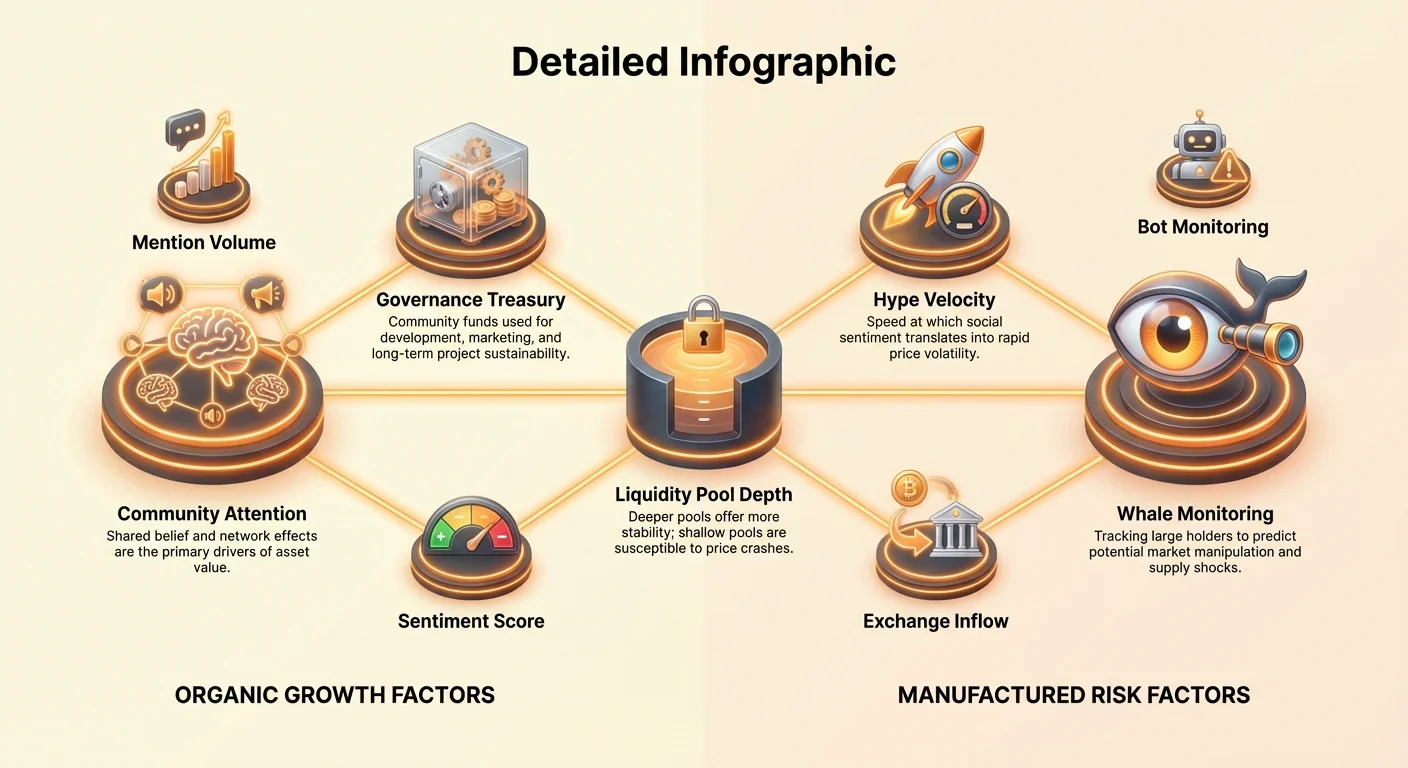
The primary driver of a community token’s price is the strength of its network effect—specifically, how many people are aware of it, discussing it, and motivated to participate. In this environment, engagement is the commodity.
If a token successfully captures the collective imagination, the increasing scarcity driven by buying volume against fixed supply creates the price movement. This creates a self-fulfilling loop: the rising price generates more attention, which draws in more buyers, further boosting the price. Analyzing a meme coin means analyzing the durability and breadth of its social network, rather than its code base.
The Velocity of Hype (Social Media Dynamics)
Hype is the speed at which attention translates into action. A slow, steady community build often results in a more stable token price, whereas rapid, viral deployment leads to extreme volatility. These rapid hype cycles are inherently unstable because the value is based on future promises and instant gratification rather than sustained utility.
The valuation peaks often occur not when the community is largest, but when the perceived velocity of growth is highest, leading to an expectation that tomorrow's buyer will pay significantly more than today's. When the velocity slows, the valuation collapses quickly, as the incentive structure that relies on continuous new capital injection breaks down.
Analyzing Social Sentiment and Hype Cycles
Since community token valuation is rooted in social perception, the ability to measure and interpret social sentiment is a non-negotiable skill for advanced analysis.
Key Social Sentiment Indicators
Social sentiment analysis involves tracking the volume and quality of discussion surrounding a specific asset across various digital platforms.
- Mention Volume: The raw number of times a token or its ticker is mentioned over a specific period (e.g., hourly or daily). A sudden spike in volume, particularly when correlated with a price increase, indicates the beginning of a hype cycle.
- Sentiment Score (Positive/Negative Ratio): Specialized tools use natural language processing (NLP) to classify mentions as positive, negative, or neutral. A rapidly improving sentiment score signals growing confidence, while a persistent negative score, even amidst volume spikes, can indicate coordinated fear, uncertainty, and doubt (FUD) or growing skepticism.
- Engagement Velocity: This measures how quickly discussion spreads (retweets, shares, comments). High velocity suggests a narrative is "going viral" and has escaped the core community into the broader retail market. This is often the signal that the token is transitioning from a niche play to mainstream speculation.
Actionable Tip: Look for congruence. Price movement without correlating volume or velocity suggests manipulation by large actors (whales) rather than genuine retail interest.
Detecting Organic vs. Synthesized Hype
A critical element of due diligence is discerning authentic community enthusiasm from manufactured excitement designed to attract exit liquidity.
- Bot Monitoring: Analyze the nature of accounts driving the volume. Are the posts generic, repetitive, or coming from brand new accounts with few followers? Automated trading and social media bots are commonly used to create the illusion of widespread interest.
- Influencer Quality Check: Identify which key opinion leaders (KOLs) are promoting the asset. Are they established figures with a history of transparent projects, or are they new accounts paid for promotional services (often called "shilling")? Projects heavily reliant on a small number of paid promoters carry significantly higher risk.
- Discord/Telegram Activity: Examine core community channels. Is the discussion substantive (focused on utility, governance, or roadmap) or primarily focused on price targets and calls for others to buy? Genuine community tokens focus on building; speculative tokens focus on pumping.
The Role of Influencers and Content Creators
Influencers are central to the meme coin ecosystem. Their endorsement provides the critical mass necessary for rapid adoption. However, this poses an inherent conflict of interest.
Many influencers acquire tokens early and use their platform to drive interest, creating ideal conditions for them to sell their position at a profit (a practice known as "pump and dump"). Analyzing the timing of influencer promotions relative to major price peaks is essential. Investors should use influencer promotion as a signal to heighten scrutiny, not as a reason to buy immediately.
Liquidity Provision Mechanics and Market Stability
Meme coins are predominantly traded on decentralized exchanges (DEXs) using Automated Market Makers (AMMs) and Liquidity Pools (LPs). Understanding how these pools are bootstrapped is key to assessing safety and potential volatility.
Bootstrapping Liquidity Pools (LP Tokens and Risks)
A liquidity pool requires two assets—typically the new community token and a major base currency like Ethereum (ETH), Solana (SOL), or a stablecoin like USDC. Liquidity providers (LPs) deposit both assets, receiving LP tokens in return.
The depth of the liquidity pool is directly correlated with the stability of the token. A shallow pool means that even a relatively small buy or sell order can dramatically impact the price (high slippage).
- Low Liquidity Risk: In a new meme coin, if the LP is small, a large buyer can swiftly push the price up (good for the initial holder), but a large seller (whale) can drain the pool instantly, causing a devastating price collapse.
- Identifying Red Flags: Projects where the founding team provides the vast majority of the initial liquidity, and then retains the LP tokens, present a high risk for a "rug pull."
Impermanent Loss and Rug Pull Prevention
A rug pull occurs when the project creators drain the liquidity pool, stealing the paired asset (e.g., ETH or USDC) and leaving holders with worthless tokens that cannot be traded.
To mitigate this risk, sophisticated investors look for specific security features:
- LP Token Locking/Burning: The single most crucial safety mechanism is the locking or burning of the initial LP tokens.
- Locking: The tokens are locked in a time-locked smart contract (like those offered by third-party services) for months or years, preventing the founders from withdrawing liquidity.
- Burning: The LP tokens are permanently sent to an unrecoverable "burner" address, ensuring that liquidity can never be removed by the creators.
- Token Contract Audits: While not foolproof, an independent smart contract audit can verify that the contract code does not contain hidden functions allowing developers to mint infinite tokens or blacklist users.
Centralized vs. Decentralized Exchange Listing Effects
The migration of a community token from its native DEX environment (e.g., Uniswap) to a major Centralized Exchange (CEX, e.g., Coinbase or Binance) marks a significant step in the hype cycle.
- DEX Phase (Initial Volatility): Trading is permissionless but high-risk. Liquidity can be unstable, and slippage is common. This is typically where early adopters and high-risk speculators operate.
- CEX Listing (Momentum and Legitimacy): A CEX listing provides institutional-grade liquidity, massive exposure to new retail buyers, and a perception of legitimacy. This is often the peak opportunity for early holders to distribute their tokens widely, frequently coinciding with the peak price of the hype cycle.
Advanced Strategy: Analyzing CEX listing announcements is critical. Often, "smart money" accumulates the token in the days before the listing announcement and sells into the subsequent retail buying frenzy after the listing goes live.
Advanced Analysis: Whale Monitoring and Distribution
In assets driven purely by speculation, transparency regarding who holds the supply is paramount. "Whales" (large holders) have disproportionate power to influence the market, making their activity a key indicator for potential manipulation and future supply shocks.
Identifying Key Holder Concentration
Analyzing the token distribution requires using blockchain explorers to view the top wallet addresses holding the asset. This is often the quickest way to gauge risk.
The 1% Rule: If the top 10 or 100 non-exchange wallets control an excessive percentage of the circulating supply (e.g., more than 50% held by 1% of the addresses), the asset is dangerously centralized. This creates an enormous systemic risk because any coordinated sell-off by a few individuals will crash the price immediately.
Key Monitoring Metrics:
- Wallet Age: How long have the top whales held their tokens? Older, inactive wallets suggest diamond-handed (committed) community members, while wallets that acquired tokens immediately before the launch and remain active indicate potential manipulation risk.
- Exchange Deposit Velocity: Track the inflow of the token from major whale wallets into centralized exchanges. Moving tokens to an exchange often precedes a large sell-off because exchanges provide the necessary deep order books to offload volume without crashing the price on a DEX.
Tracking Inflow/Outflow to Exchanges (Potential Dumping)
The single most valuable signal for predicting price volatility is the movement of tokens onto centralized exchanges.
When whales move millions of dollars worth of a token from their private, self-custody wallets onto a CEX, they are likely preparing to sell. This inflow adds immediate sell pressure to the exchange's order books. Conversely, if whales are accumulating tokens off the exchanges and into private wallets, it suggests they intend to hold or use the tokens in DeFi protocols, indicating long-term confidence.
Addressing the ‘Fair Launch’ Myth
Many community tokens claim a "fair launch," meaning no tokens were reserved for founders or venture capital firms prior to public trading. While this is an attractive narrative, genuine fairness is rare.
In many cases, the developers or early insiders still manage to accumulate massive amounts of the token at negligible cost through sophisticated methods:
- Hidden Presales: Selling tokens cheaply to a small circle of friends/insiders before the public announcement.
- Front-Running: Using sophisticated bots to buy vast quantities milliseconds before the public liquidity pool is announced.
The outcome is the same as a traditional pre-mine: the supply is concentrated among a few early holders, who then control the subsequent market dynamic. Investors should assume that high concentration exists and manage risk accordingly, rather than trusting the narrative of a truly "fair" distribution.
Governance and Longevity: The Community Treasury
For a meme coin to transition from a temporary speculative asset to a long-term community token, it must establish genuine utility and decentralized governance, typically managed through a community treasury.
Treasury Funding and Allocation
A community treasury is a pool of funds (often tokens, ETH, or stablecoins) collected from transaction fees, initial reserve allocations, or donations. This treasury is intended to fund the future development and marketing of the project.
Analysis focuses on:
- Transparency: Are the treasury holdings and allocations publicly auditable on the blockchain?
- Use Cases: Is the treasury being used for substantive activities (e.g., funding new product development, hiring full-time staff, forming partnerships) or merely used for unsustainable token buybacks or personal gain?
A transparent, well-managed treasury is a sign that the token aims for longevity beyond the initial hype cycle.
Governance Voting (The Weight of the Whale)
When a token incorporates governance (allowing holders to vote on proposals), the distribution of tokens becomes critically important.
In highly concentrated community tokens, a few whales often hold enough tokens to unilaterally decide all governance proposals. This centralization of voting power undermines the concept of decentralization. For long-term stability, investors should seek tokens where the voting power is widely distributed, ensuring that no single entity or small cohort can hijack the project’s future direction.
Conclusion
Community tokens and meme coins represent a high-risk, high-reward segment of the digital economy where market forces are dictated by human psychology, attention economics, and social velocity. For the advanced crypto participant, analyzing these assets requires shifting the focus from traditional financial metrics to on-chain social engineering.
By systematically monitoring social sentiment velocity, confirming liquidity safety (LP locking), and diligently tracking whale movements and supply concentration, investors can replace emotional buying with a structural framework for managing risk. While no amount of analysis can eliminate the inherent volatility of these assets, understanding their mechanics is crucial for building self-sovereignty and making informed decisions within the decentralized, community-driven space.