
For the seasoned investor or the diligent newcomer, understanding risk is the cornerstone of any successful investment thesis. While the typical financial market carries risks associated with interest rates, credit default, and macroeconomic shocks, decentralized assets like Bitcoin face a unique constellation of threats—systemic risks that could challenge the entire network's long-term viability and value proposition.
Systemic risk, in this context, refers to a vulnerability capable of causing a cascading failure across the entire Bitcoin ecosystem, fundamentally undermining its core properties of security, decentralization, or censorship resistance. Moving beyond day-to-day volatility, we must critically assess three major categories of existential threats: sudden regulatory shifts (Black Swans), technological breakthroughs (Quantum Computing), and internal structural vulnerabilities (the 51% attack). A comprehensive analysis of these dangers is not a bearish exercise; rather, it is crucial due diligence required to build a self-sovereign position in the new digital economy.
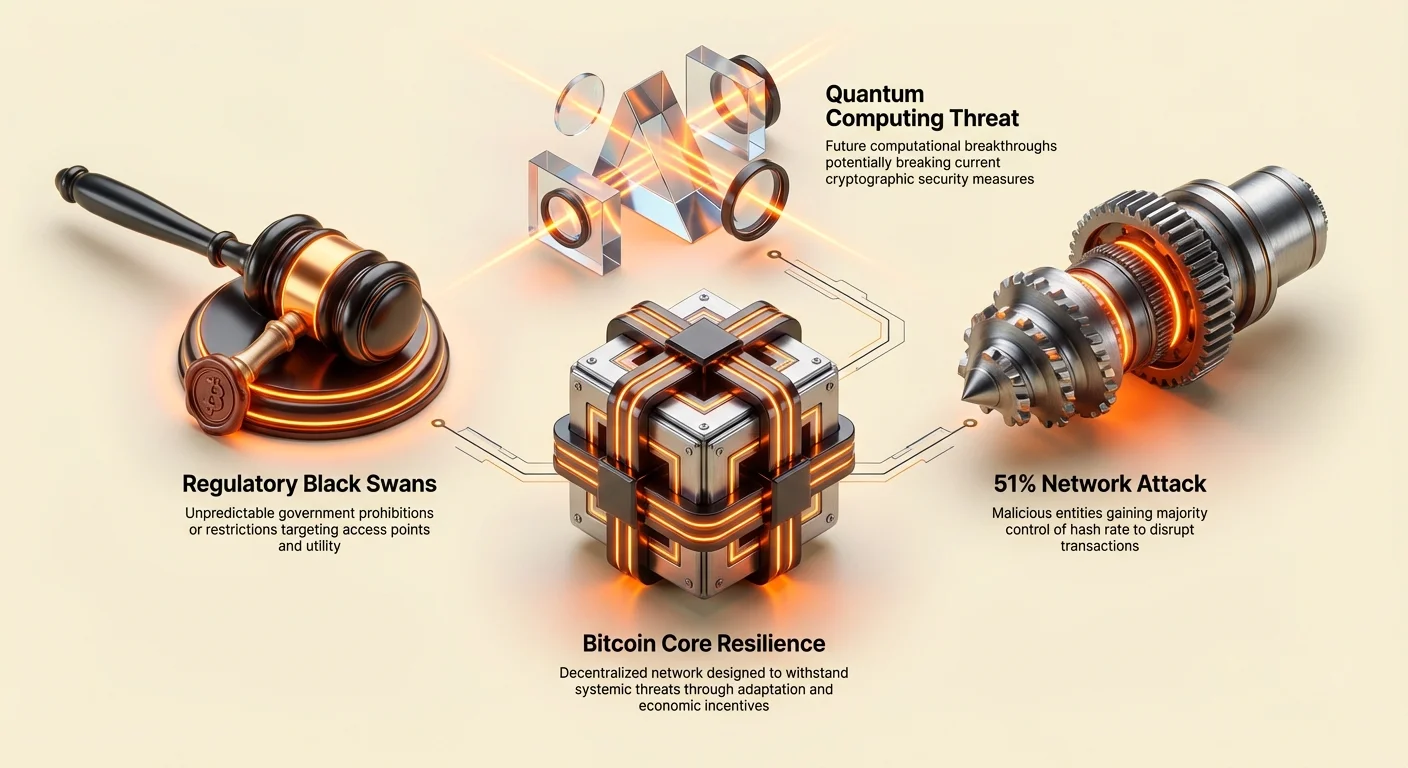
The Regulatory Landscape: Analyzing Black Swan Events
Regulation poses the most immediate and complex systemic risk to Bitcoin, primarily because it is governed by unpredictable political cycles and the competing interests of global sovereign nations. A regulatory "Black Swan" event is an unforeseen, high-impact policy decision—such as a sudden, coordinated global prohibition—that fundamentally restricts the utility or exchangeability of cryptocurrencies.
Global Fragmentation and Policy Inconsistency
Currently, the regulatory environment is fragmented. Different major jurisdictions treat Bitcoin in vastly different ways, creating both opportunities and friction points. This inconsistency is a systemic risk in itself because it prevents Bitcoin from achieving seamless global integration.
In regions like the European Union, comprehensive frameworks like the Markets in Crypto Assets Regulation (MiCA) aim to provide clarity, consumer protection, and operational certainty for crypto firms. This institutional adoption, while positive for market maturation, creates centralized chokepoints—the exchanges and custodians that serve as the main on- and off-ramps between fiat currency and Bitcoin.
Conversely, the United States has operated under a patchwork system of enforcement actions and conflicting definitions from multiple agencies (SEC, CFTC, IRS). This uncertainty creates policy risk, driving development and capital overseas and introducing the possibility of severe, market-crushing rulings.
Analyst Focus: The Chokepoint Strategy Governments rarely attempt to ban the holding of Bitcoin, which is technically difficult to enforce due to self-custody. Instead, the greatest regulatory systemic risk lies in the regulation of access points. If major countries impose restrictions on banks interfacing with crypto exchanges, or enforce strict KYC/AML requirements that compromise privacy, the fungibility and utility of Bitcoin as a permissionless monetary network could be severely curtailed.
The Institutionalization Paradox: Mitigation vs. Exposure
The massive influx of institutional capital, particularly through mechanisms like Bitcoin Spot Exchange Traded Funds (ETFs), presents a paradox.
On one hand, institutional adoption acts as a political firewall. As pension funds, corporations, and major Wall Street players gain exposure to Bitcoin, they acquire a powerful lobbying voice. This increased political capital helps mitigate the risk of outright prohibition in democratic nations, as a ban would negatively impact a significant portion of the financial establishment and their clientele.
On the other hand, institutionalization introduces new centralized points of failure. When billions of dollars of BTC are held by a handful of regulated custodians (required for ETF operations), these holdings become targets for:
- Regulatory Seizure: A court order or emergency mandate could force these custodians to freeze or transfer assets, effectively centralizing control over a large portion of the circulating supply.
- Compliance Burden: The rules imposed on institutional custodians (e.g., specific rules on the source of funds) could indirectly blacklist certain "tainted" coins, potentially hurting Bitcoin's fungibility.
The long-term resilience of Bitcoin depends on its ability to serve users outside these regulated channels, maintaining its permissionless nature even if institutional pathways become heavily restricted.
The Coordinated Global Ban Scenario
While highly improbable due to conflicting national interests, the theoretical systemic risk of a coordinated global ban requires assessment. For such a "Black Swan" to occur, the world’s major economies (US, EU, China, India) would need to simultaneously declare Bitcoin illegal and successfully enforce that ban.
Why it’s Difficult to Execute:
- Political Consensus: Achieving this level of global political alignment on any issue, let alone a complex technological one, is historically difficult. Nations view crypto as a strategic tool—either for financial innovation (EU/UK) or capital control circumvention (smaller economies).
- Technical Resistance: Banning the underlying protocol is impossible. The network would continue to operate as long as nodes and miners exist anywhere in the world, shifting to jurisdictions that remain permissive.
- Economic Cost: Banning a multi-trillion-dollar asset would lead to massive economic disruption, potential capital flight to less restrictive jurisdictions, and the rise of robust peer-to-peer dark markets, undermining the ban's effectiveness.
Actionable Tip for Due Diligence: Focus on where you hold your keys. The regulatory risk is drastically reduced if you utilize robust self-custody (hardware wallets) rather than relying on regulated, centralized exchanges (where assets are held in the name of the exchange and subject to their jurisdiction).
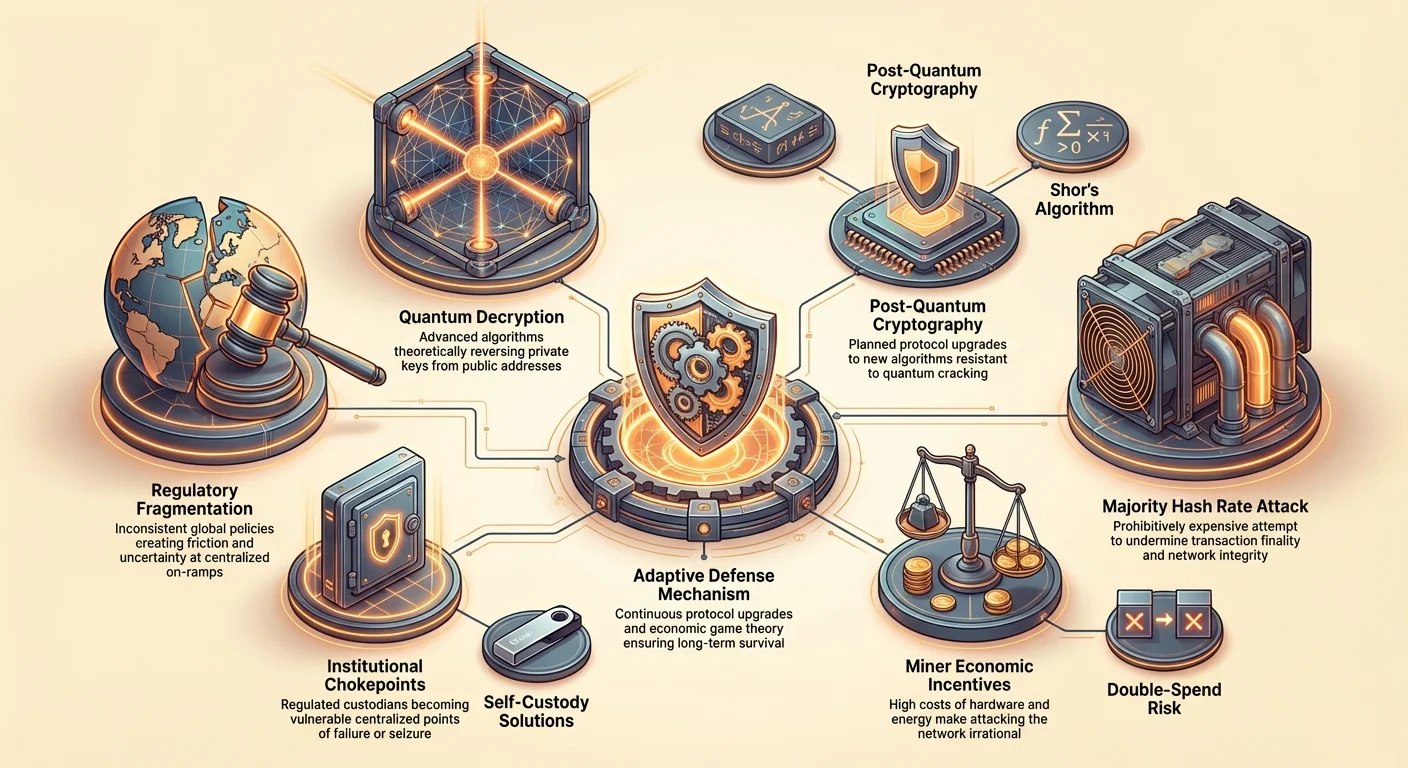
Technological Obsolescence: The Quantum Threat and Beyond
All modern digital security relies on cryptography. Bitcoin, like the global banking system and internet security, uses cryptographic algorithms to secure transactions and verify ownership. The most cited technological systemic risk is the emergence of sufficiently powerful quantum computers capable of breaking current encryption standards.
Understanding the Quantum Computing Threat
Bitcoin primarily uses two types of cryptographic functions:
- Hashing (SHA-256): Used for mining (Proof-of-Work) and linking blocks. Quantum computers accelerate certain types of search algorithms (Grover's algorithm), but the threat to SHA-256 is manageable and requires only a doubling of the hash output (e.g., moving to SHA-512) to restore security. This is generally not considered an existential threat.
- Digital Signatures (Elliptic Curve Digital Signature Algorithm, ECDSA): This is the crucial vulnerability. ECDSA secures your private key. When you send Bitcoin, you use your private key to generate a unique mathematical signature proving ownership.
The critical threat comes from Shor’s algorithm. A quantum computer running Shor's algorithm could efficiently reverse-engineer a private key from its corresponding public key.
The Attack Vector: In current Bitcoin practices, your public key (the address where coins are sent) is exposed only when you spend the coins. Once the public key is exposed on the blockchain, a sufficiently powerful quantum computer could, in theory, deduce the private key almost instantly, allowing the attacker to steal all funds associated with that address.
Vulnerabilities and Mitigation Strategies
While the quantum threat is existential, it is not an immediate one. Experts generally estimate that "cryptographically relevant" quantum computers—machines powerful enough to run Shor’s algorithm efficiently—are likely a decade or more away. This gives the Bitcoin developer community a crucial window of opportunity for mitigation.
The Mitigation Plan: Post-Quantum Cryptography (PQC)
The primary systemic defense against the quantum threat is a protocol upgrade to PQC algorithms. PQC refers to new cryptographic methods that are designed to be secure against both classical and quantum computers.
Implementing PQC in Bitcoin would involve a soft fork (a backward-compatible network upgrade) or a hard fork (a mandatory upgrade). This migration would replace ECDSA with a quantum-resistant signature scheme (e.g., schemes developed under the NIST standardization process).
Current Vulnerabilities:
- Legacy Addresses: Bitcoin spent using older protocols that immediately expose the public key are more vulnerable. Funds held in these addresses might need to be proactively moved to PQC-compliant addresses before the "quantum reckoning" arrives.
- In-Transit Transactions: A transaction broadcast to the network exposes the public key before it is confirmed in a block. A quantum attacker could theoretically steal the funds mid-transaction before the legitimate owner’s transaction is confirmed.
Analyst Focus: The Soft Fork Feasibility The critical question is whether the developer community can achieve consensus to implement such a massive change. While the necessity of the quantum upgrade would be universally accepted, the challenge lies in coordinating millions of users, nodes, and miners to adopt the new standard without creating a chain split, which would itself be a systemic crisis. Given Bitcoin's history of managing contentious upgrades (like SegWit), the capability exists, but the risk of failure to coordinate remains a systemic vulnerability.
Beyond Quantum: Obsolescence of Utility
Another, less publicized technological risk is the obsolescence of Bitcoin’s core utility—its settlement layer—due to superior alternatives.
If a new distributed ledger technology emerged that offered the same level of security and decentralization as Bitcoin, but with drastically faster finality, zero fees, and energy efficiency orders of magnitude better, the market might gradually transition away from Bitcoin.
However, Bitcoin's greatest defense against this risk is its Lindy Effect (the longer something exists, the longer it is likely to continue to exist) and its network effect. It possesses the highest hash rate and the largest established financial infrastructure. New technologies have a high barrier to entry because they must achieve the same scale of trust and security that Bitcoin has built over fifteen years of continuous operation. Obsolescence would require a fundamental, rather than marginal, technological leap.
Internal Network Risks: Resilience Against the 51% Attack
While external forces like regulation and quantum physics pose threats, Bitcoin must also secure itself internally. The most critical internal systemic risk is the 51% attack, where an attacker gains control over the majority of the network's hash rate (the collective computational power used by miners).
Defining and Executing the 51% Attack
In a Proof-of-Work system, miners validate transactions and secure the network. Controlling 51% of the hash rate allows the attacker to:
- Double-Spend: The attacker can confirm a transaction (say, sending Bitcoin to an exchange), receive goods or services in exchange for that BTC, and then use their majority hash power to secretly build a longer, competing version of the blockchain without that transaction. Once the attacker’s secret chain is revealed and validated, the original transaction is erased, and the attacker retains both the BTC and the goods—a successful double-spend.
- Censor Transactions: The attacker can prevent specific transactions (or all transactions from specific users) from being confirmed into blocks.
Crucially, a 51% attack cannot create new Bitcoin, steal funds from wallets they don't control, or change the underlying protocol rules (like the 21 million supply limit). The danger lies solely in undermining transaction finality and network integrity.
The Economics of Defense: The Cost of Acquisition
For smaller, lesser-known cryptocurrencies (altcoins) with low hash rates, 51% attacks are unfortunately common because the necessary hash power can be rented cheaply. Bitcoin, however, is secured by an unprecedented amount of dedicated computational power, making the attack economically infeasible.
The economic security of Bitcoin relies on the sheer, staggering cost of acquiring and maintaining 51% of the global hash rate:
- Hardware Cost: The initial investment required to purchase the necessary specialized mining hardware (ASICs) would run into the tens or hundreds of billions of dollars. This equipment is supply-constrained, meaning a single entity could not acquire it without raising massive alarm bells.
- Energy Cost: The attacker would need continuous, industrial-scale energy consumption—enough to power small countries—with daily operating costs in the tens of millions of dollars.
- Opportunity Cost: The attacker, having invested this capital, is forfeiting the legitimate revenue they would earn by simply mining honestly.
Game Theory and Rationality: For a 51% attack on Bitcoin to succeed, the attacker must spend astronomical sums only to commit a temporary double-spend and, in the process, permanently destroy the value of the asset they just invested billions into securing. If the value of Bitcoin crashes to zero because of a successful attack, the attacker's investment in hardware and energy becomes worthless. Bitcoin's security is thus ensured by rational, self-interested economic actors.
The Death Spiral Theory and Miner Incentive
A more subtle internal risk relates to the long-term incentive structure of the network. Bitcoin's security is funded by two sources: the block reward (newly minted BTC) and transaction fees. The block reward halves approximately every four years (the Halving), reducing the incentive for miners to secure the network.
The "Death Spiral" Hypothesis: The theory suggests that as block rewards diminish towards zero, transaction fees might not be sufficient to compensate miners, leading many to shut down. If the total hash rate drops precipitously, the cost to mount a 51% attack would fall to an affordable level, leading to a breakdown in security, and further price erosion—a downward spiral.
Counter-Arguments and Systemic Resilience:
- Fee Market Dynamics: As the network matures and transaction volumes increase (especially through scaling layers like the Lightning Network), fees should naturally rise to compensate miners. The security cost is priced into the utility of the network.
- Price Resilience: Historically, every Halving has been followed by a significant rise in the price of BTC. A higher BTC price makes even a smaller block reward highly lucrative in dollar terms, sustaining the hash rate.
- Security Adjustment: Bitcoin's difficulty adjustment mechanism ensures that mining remains profitable (or at least competitive) regardless of how many miners are active. If many miners leave, the difficulty of finding a block automatically decreases, making it easier and cheaper for the remaining miners to earn the block reward, thus stabilizing the network.
The system is designed to be dynamically self-correcting. The cost of a 51% attack remains proportional to the value of the network—if the value is high, the cost of attack is prohibitively high, reinforcing security.
Actionable Tip for Investment Analysis: When assessing systemic risks, distinguish between Bitcoin (the heavily secured, market-leader protocol) and other cryptocurrencies. For smaller chains, the 51% attack is a current and practical threat; for Bitcoin, it remains primarily a theoretical one minimized by robust economic reality.
Conclusion: Due Diligence and the Adaptive Defense
The systemic risks facing Bitcoin—regulatory unpredictability, the quantum threat, and internal incentive conflicts—are real and require continuous monitoring. However, a critical assessment reveals that Bitcoin possesses powerful innate defense mechanisms against each:
- Against Regulatory Black Swans: Decentralization and self-custody provide technical resilience against centralized enforcement. Institutionalization, while introducing new chokepoints, also creates political counter-leverage.
- Against Technological Obsolescence: The risk is visible and gives the developer community sufficient time to implement adaptive upgrades (PQC), leveraging the network’s robust consensus mechanism.
- Against Internal Attacks: The immense economic cost and game-theoretic disincentives embedded in the Proof-of-Work system make catastrophic failure highly improbable.
For the serious investor, recognizing these systemic risks is not a reason to retreat, but a vital step in understanding the true, long-term value proposition of the asset. Bitcoin’s endurance relies not on remaining static, but on its capacity to adapt and overcome these existential threats through technological upgrades, community consensus, and unbreakable economic principles. Due diligence demands a focus on this adaptive resilience.