
The evolution of money is entering its most disruptive phase yet. For decades, the global financial system operated under a clear hierarchy: physical cash and commercial bank deposits, all managed by sovereign central banks. The invention of Bitcoin shattered this paradigm by introducing decentralized, permissionless digital scarcity.
Today, the competitive landscape is complex, pitting three distinct forms of digital currency against each other: highly volatile, decentralized assets like Bitcoin (BTC); pegged, regulated assets like Stablecoins; and the impending entry of state-backed Central Bank Digital Currencies (CBDCs).
This comparison moves beyond simple technological differences. It is an analytical framework for understanding the future of monetary control, liquidity, and systemic risk. For investors and financial institutions, understanding the fundamental differences in monetary policy, regulatory framework, and political design among these three contenders is essential to crafting a resilient investment thesis and identifying the true digital reserve assets of the future.
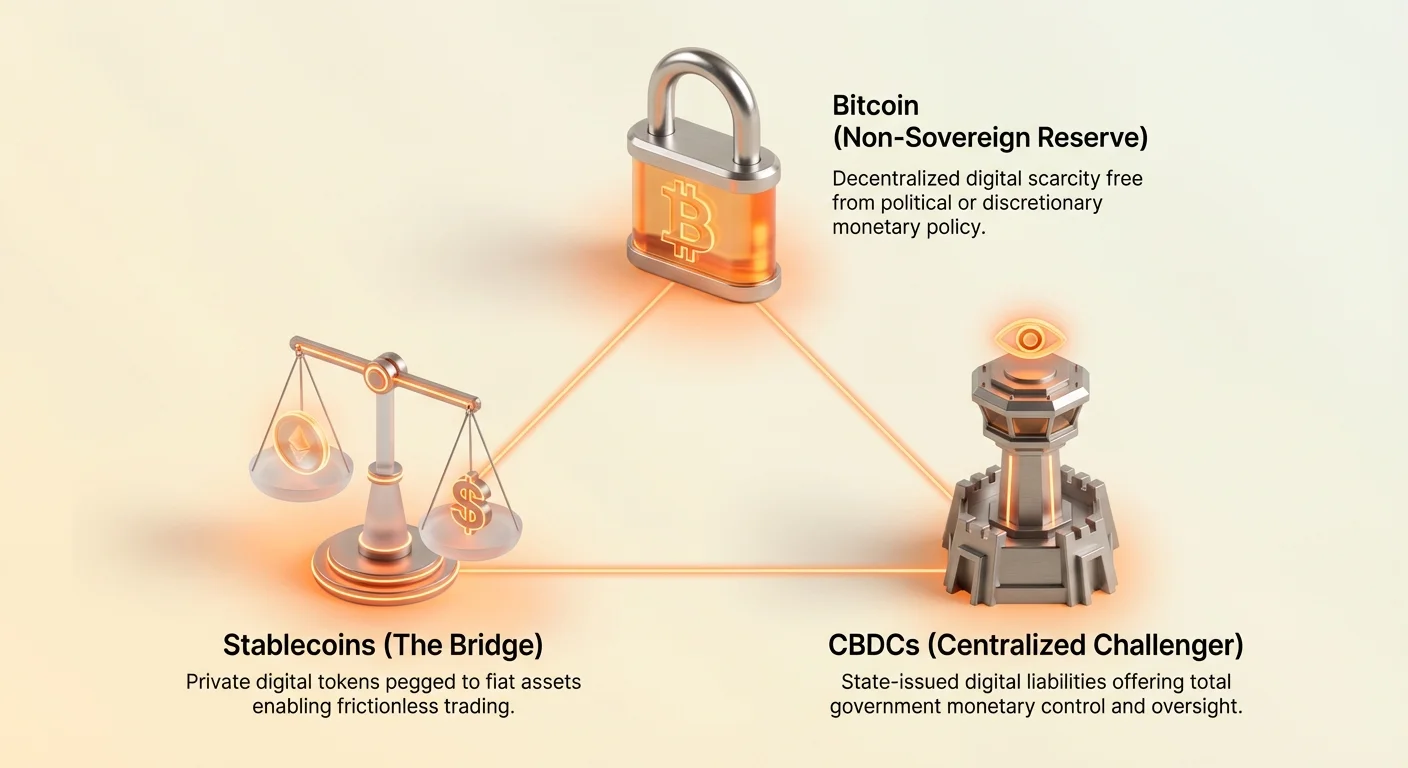
Bitcoin: The Non-Sovereign Digital Reserve Benchmark
To analyze the competitive field, we must first establish a benchmark. Bitcoin acts as the initial and defining template for decentralized digital money. Its design principles—scarcity, immutability, and decentralization—stand in stark contrast to the characteristics of both stablecoins and CBDCs.
The Hard Cap Thesis and Monetary Policy
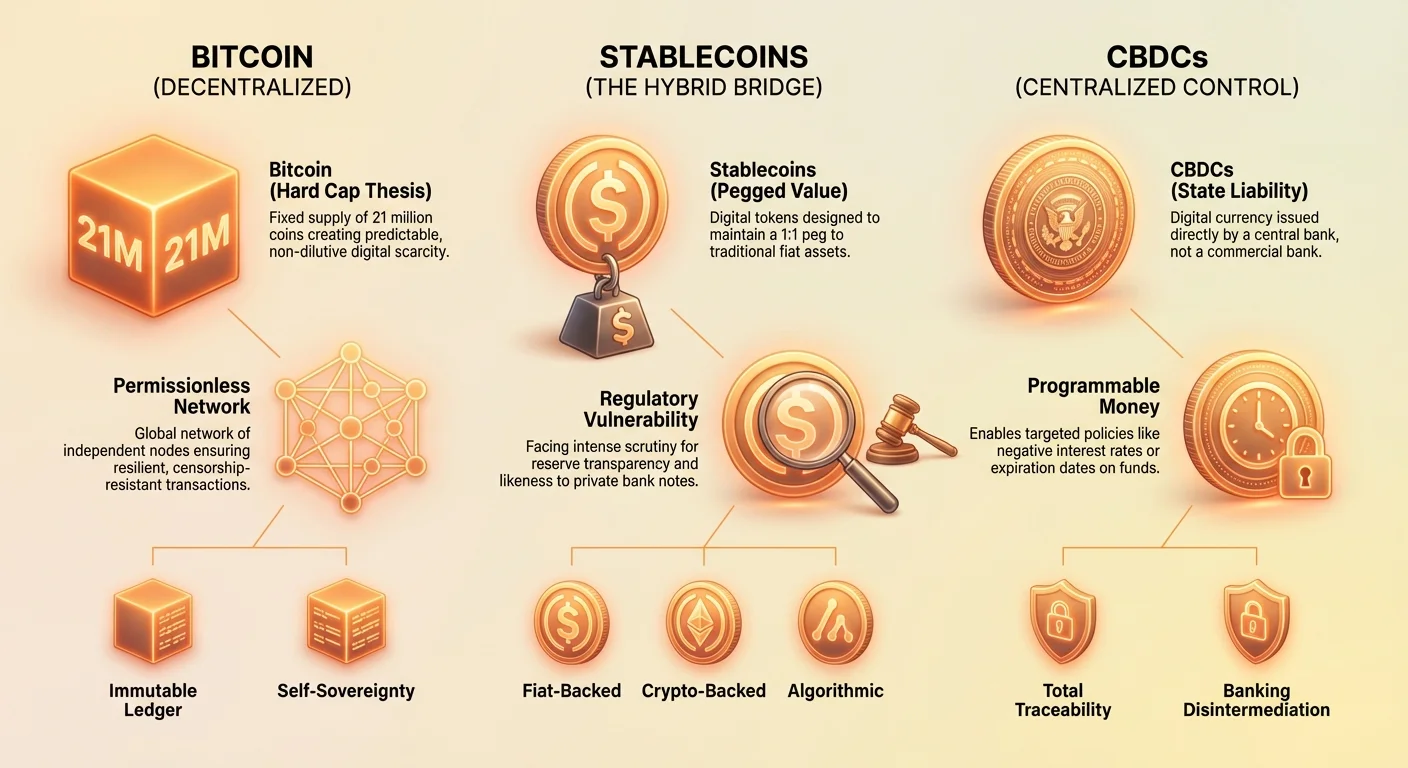
Unlike fiat currencies, which can be printed indefinitely by a central authority, Bitcoin adheres to a fixed supply limit of 21 million coins. This digital scarcity is not a technological constraint; it is the fundamental monetary policy.
This hard cap is the primary driver behind the argument that Bitcoin functions as a store of value. As inflationary pressure erodes the purchasing power of fiat currencies—a monetary system defined by expansion—Bitcoin offers a predictable, deflationary, and non-dilutive asset. From an investment analyst perspective, Bitcoin’s value proposition is derived from its lack of political or discretionary monetary policy. It is a non-sovereign hedge against the debasement of centralized currencies.
Decentralization and Self-Sovereignty
Bitcoin is often described as permissionless, meaning no third party or government can prevent you from holding, sending, or receiving BTC. Transactions are verified by a global network of independent nodes and miners, making the ledger highly resilient and censorship-resistant.
This decentralization is a key differentiator from any state-backed currency. When assessing potential digital reserve assets, institutional investors must weigh accessibility and systemic risk. An asset controlled by a single government (like a CBDC) carries geopolitical risk and regulatory risk; Bitcoin, precisely because it is governed by a consensus of code, mitigates both.
Bitcoin vs. Fiat: Why Store of Value Matters
The source articles emphasize Bitcoin’s role as a store of value. Historically, gold served this purpose because it was physically scarce and difficult to confiscate. Bitcoin attempts to replicate these properties in the digital realm.
| Feature | Fiat Currencies | Bitcoin (BTC) |
|---|---|---|
| Issuance | Unlimited, controlled by Central Bank | Fixed limit (21 million) |
| Policy | Discretionary, subject to political needs | Fixed algorithm (halvings) |
| Auditability | Difficult to audit reserves, opaque | Fully transparent public ledger |
| Censorship | Highly susceptible to seizure or freezing | Censorship-resistant |
Stablecoins: The Bridge and the Regulatory Hot Seat
Stablecoins occupy the middle ground between the radical decentralization of Bitcoin and the established authority of fiat money. They are digital tokens designed to maintain a stable value, typically pegged 1:1 to a traditional asset like the US Dollar (USD).
Stablecoins have proven essential in the crypto economy, serving three primary functions: facilitating frictionless trading, providing a safe haven during market volatility without converting back to traditional banking rails, and acting as a bridge asset for DeFi (Decentralized Finance).
Varieties of Stablecoin Design
The term "stablecoin" covers several distinct monetary structures, each carrying different levels of risk and requiring unique regulatory oversight:
- Fiat-Backed (Centralized): These are the most common type (e.g., USDT, USDC). They claim to hold reserves—cash, treasury bills, or commercial paper—equal to the amount of tokens issued. Their stability relies entirely on the issuer’s custody and regular auditing of those underlying reserves.
- Crypto-Backed (Decentralized): These stablecoins (e.g., DAI) maintain their peg through overcollateralization with volatile cryptocurrencies (like Ethereum). If the value of the collateral drops, the system automatically liquidates assets to maintain the peg. They remove the central issuer risk but introduce liquidation risk and smart contract risk.
- Algorithmic: These tokens attempt to maintain stability using smart contract logic and a fluctuating secondary token (seigniorage) rather than collateral. Historically, these models have proven highly fragile and prone to catastrophic failure when stressed, as they rely on continuous market demand and perfect arbitrage efficiency.
Stablecoins’ Role and Regulatory Vulnerability
Stablecoins currently dominate the trading pairs and liquidity pools across the crypto ecosystem. However, their use is drawing intense regulatory scrutiny precisely because they resemble private digital bank notes.
The key challenge for stablecoins is proving they are truly stable. Regulators worldwide are demanding stricter reserve requirements, faster redemption processes, and comprehensive audits. For investors, the difference between a high-quality, regulated stablecoin (like one fully backed by T-Bills and subject to US regulatory oversight) and an opaque, unregulated competitor determines the systemic risk you are importing into your portfolio.
From the perspective of central banks, robust stablecoins are seen as competition. If a private stablecoin becomes widely adopted as the currency of choice, it threatens the central bank's control over domestic monetary policy. This regulatory vulnerability is a primary motivation behind the push for CBDCs.
CBDCs: The Centralized Digital Challenger
Central Bank Digital Currencies (CBDCs) are a fundamentally new type of money issued and backed directly by a nation’s central bank. Unlike the digital money we use today (which is liability of commercial banks), a CBDC would be a direct liability of the state, just like physical cash.
The rise of Bitcoin and the proliferation of private stablecoins have forced central banks to accelerate their plans for issuing sovereign digital currency. CBDCs are not cryptocurrencies; they are centralized digital liabilities managed by a government entity.
Motivations for CBDC Development
Central banks around the world cite several reasons for exploring CBDCs, which shape their design and potential impact on financial markets:
- Monetary Sovereignty: Countering the influence of private digital currencies (like stablecoins or even foreign CBDCs) by ensuring that the national currency remains the primary medium of exchange.
- Payment Efficiency: Providing a real-time settlement system that lowers transaction costs and speeds up cross-border payments, potentially bypassing the current slow and expensive correspondent banking network.
- Financial Inclusion: Offering secure digital accounts to citizens currently excluded from the traditional banking system.
- Policy Tool Enhancement: CBDCs open the door to unprecedented monetary policy tools, such as the ability to implement negative interest rates directly on consumer holdings or issue targeted, time-limited stimulus checks (programmable money).
Design Implications: Retail vs. Wholesale Models
CBDCs are being studied primarily under two models, each carrying different implications for the user and the existing financial architecture:
- Wholesale CBDC: This model is restricted to use between central banks and commercial banks, aiming to improve the efficiency of large-value interbank settlements. This model has less direct impact on consumers but significantly affects market infrastructure.
- Retail CBDC: This model is designed for everyday use by the public (replacing or supplementing physical cash). This is the model that generates the most debate regarding privacy, monetary control, and disintermediation.
A retail CBDC could be designed as a direct liability model (where the central bank holds all user accounts) or an intermediated model (where commercial banks manage the accounts, but the liability still rests with the central bank). The choice of model determines the level of banking sector disintermediation and the ease with which the state can monitor transactions.
Comparative Analysis: Monetary Control and Digital Sovereignty
The core competitive tension between Bitcoin, Stablecoins, and CBDCs revolves around who controls the money supply, who verifies the transactions, and who has the ultimate authority over the user’s assets.
Monetary Control vs. Discretion
This is the most critical difference from an economic perspective.
- Bitcoin (BTC): Control is fixed and decentralized. Monetary policy is enforced by code (predictable inflation schedule, hard cap). It is the ideal asset for individuals and institutions seeking to opt out of discretionary monetary control.
- Stablecoins (e.g., USDC): Control is quasi-centralized. The issuer controls the issuance and management of reserves, but the central bank of the issuing fiat currency (e.g., the Federal Reserve for USD-pegged coins) controls the underlying asset backing.
- CBDCs: Control is absolute and centralized. The central bank retains full discretionary control over issuance, interest rates, and potentially the programmability of the currency. A CBDC is essentially an extension of existing fiat policy into a highly traceable digital form.
Privacy, Traceability, and Censorship
The level of user privacy inherent in the digital currency dictates its utility in a world concerned with digital sovereignty.
| Feature | Bitcoin (BTC) | Stablecoins (USDC/USDT) | CBDCs (Retail Model) |
|---|---|---|---|
| Pseudonymity/KYC | Pseudonymous (transactions linked to wallets) | Generally requires KYC/AML by issuer/exchange | Mandatory, full identity verification and traceability |
| Transaction Visibility | Public ledger, globally visible | Public ledger, linked to centralized KYC data | Private centralized ledger, visible only to Central Bank |
| Censorship Potential | Minimal (requires network attack) | Moderate (issuer can freeze wallets) | High (government can freeze, block, or expire funds) |
While Bitcoin transactions are visible on the public ledger, the identity of the transactor is generally not known (pseudonymity). Stablecoins often operate on public blockchains but are linked to centralized entities that must adhere to Know Your Customer (KYC) and Anti-Money Laundering (AML) laws, meaning identities are known and wallets can be frozen upon legal request.
CBDCs, by design, could offer the state complete oversight of all economic activity. This total traceability is seen by proponents as a tool for crime prevention and tax compliance, but by critics as a mechanism for financial surveillance and total state control.
The Threat of Banking Disintermediation
A fully implemented retail CBDC presents a major structural risk to the commercial banking sector.
Currently, commercial banks hold customer deposits, which they use to fund lending (fractional reserve banking). If consumers move large amounts of funds out of bank deposits and into risk-free CBDC accounts (direct central bank liabilities), commercial banks lose their funding source. This could destabilize the entire banking system, requiring central banks to change how lending is managed, or impose limits on how much CBDC an individual can hold (a tiered system) to protect commercial banks.
For investors, this structural uncertainty introduces new systemic risk into the financial sector that must be monitored as CBDC trials roll out.
Strategic Implications and Investment Thesis
The rise of these competing digital monetary forms fundamentally reshapes how we define "reserve asset" and hedge risk.
The Digital Reserve Asset Thesis: BTC vs. CBDCs
For institutions seeking a non-sovereign hedge, the emergence of CBDCs paradoxically strengthens the investment thesis for Bitcoin.
If the world moves toward highly controlled, programmable digital state money, the demand for truly scarce, non-programmable, and politically neutral assets will likely increase dramatically. Bitcoin is unique in this regard. Its value derives not from government backing, but from the decentralized consensus that prevents government interference.
Actionable Insight: As countries trial CBDCs, investors should monitor the public policy discussion around privacy and programmability. The more restrictive the CBDC design, the greater the incentive for individuals and institutions to seek protection in permissionless assets like Bitcoin.
Stablecoins’ Future Under CBDC Pressure
Stablecoins are facing a squeeze from two directions: regulatory demands (requiring them to operate more like regulated banks) and government competition (CBDCs).
In the short term, high-quality, regulated stablecoins will continue to serve as the critical on-ramp for crypto trading, liquidity provision, and cross-border settlement due to their speed and efficiency. However, central banks view them as an existential threat to monetary authority. It is highly probable that future regulation will seek to severely limit or eliminate competition from private stablecoins, classifying them as unauthorized issuance of currency.
Capital Flows and Market Dynamics
The competition between these assets is essential for understanding capital flows.
Stablecoin supply growth often correlates with overall market confidence, indicating fresh capital entering the crypto space or risk-off positioning within the crypto ecosystem. Conversely, the introduction of widely used CBDCs could potentially act as a short-term drain on capital if it creates an attractive, risk-free alternative to commercial bank deposits, though the effects on the BTC market (a store of value) may be minimal compared to riskier altcoins.
The Analyst View: Stablecoins are a high-utility bridge asset vulnerable to policy risk. CBDCs are a highly efficient monetary tool optimized for control. Bitcoin is the non-sovereign reserve asset optimized for scarcity and censorship resistance. Each asset serves a fundamentally different purpose in the digital economy.
Conclusion: Navigating the New Monetary Architecture
The convergence of Bitcoin, Stablecoins, and CBDCs is not merely a technological race; it is a fundamental debate over the structure of global finance. Will the future be defined by open, permissionless systems (Bitcoin) or tightly controlled, identity-verified networks (CBDCs)?
Bitcoin established the possibility of decentralized digital scarcity, creating the benchmark for a digital reserve asset free from political influence. Stablecoins serve the crucial temporary role of providing liquidity and bridging the gap between volatile crypto assets and fiat stability.
Meanwhile, CBDCs represent the institutional response—a move by central authorities to modernize payment systems while retaining full control over monetary policy.
For those navigating the crypto roadmap, the key is recognizing that these three assets do not compete on an equal footing. They compete on ideology: decentralization vs. centralization. Understanding this core conflict and the unique monetary policies baked into each asset is paramount to building an informed investment thesis for the digital economy.