
The evolution of the cryptocurrency market has moved well beyond simple buy-and-hold strategies. In the early days of digital assets, investors primarily relied on directional bets, hoping that the price of an asset like Bitcoin or Ethereum would rise over time. As the market has matured, so too have the financial instruments available to traders and investors. Derivatives have emerged as a cornerstone of modern crypto portfolio construction.
These complex financial tools allow market participants to manage risk, hedge against downturns, and utilize capital more efficiently. Rather than simply owning an asset and waiting for appreciation, traders can now access sophisticated instruments that derive their value from underlying cryptocurrencies. This shift opens the door to strategies that can profit in both bull and bear markets.
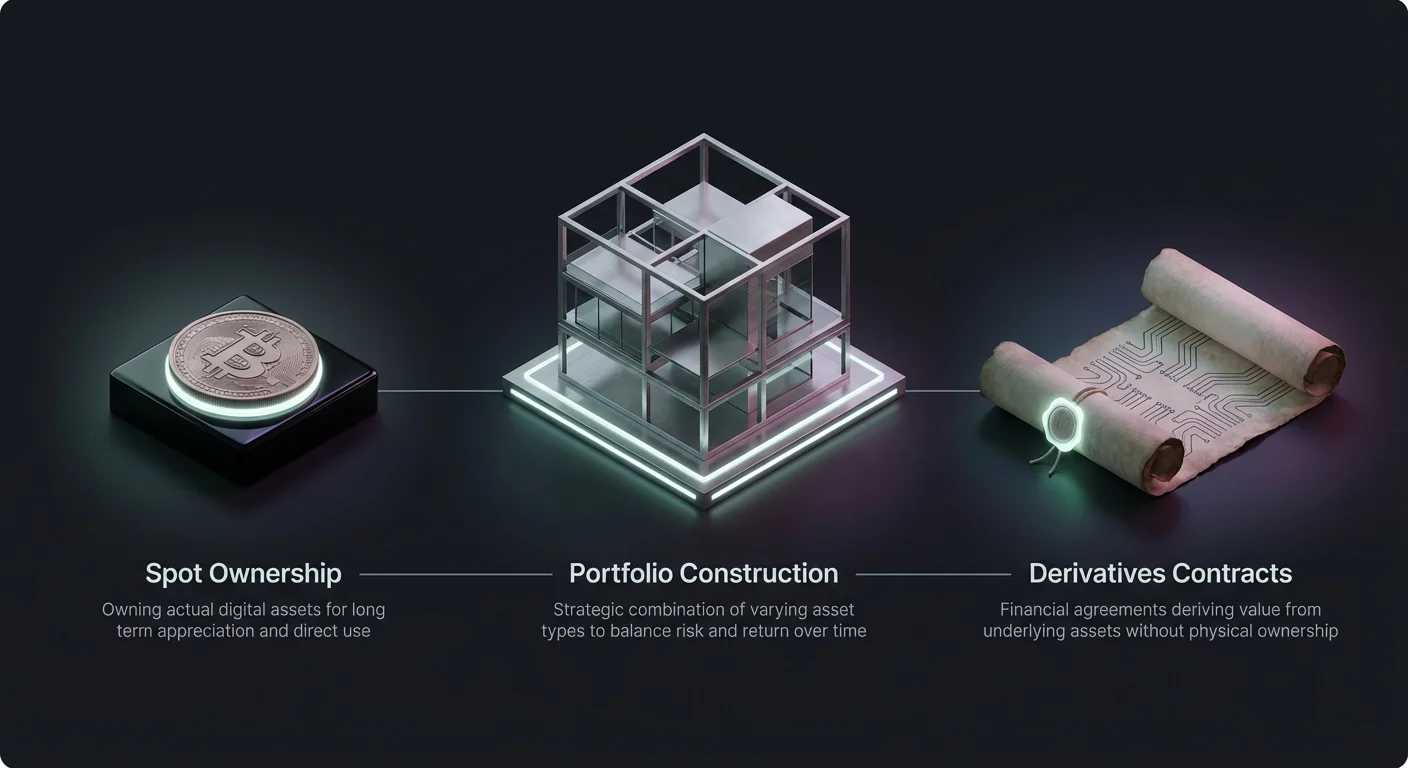
Understanding derivatives requires a move away from the mindset of simple asset ownership. When trading spot, you own the actual coin. In derivative markets, you are entering into a contract based on the value of that coin. This distinction is crucial for portfolio managers looking to optimize their holdings without necessarily increasing their exposure to the underlying volatility of the spot market.
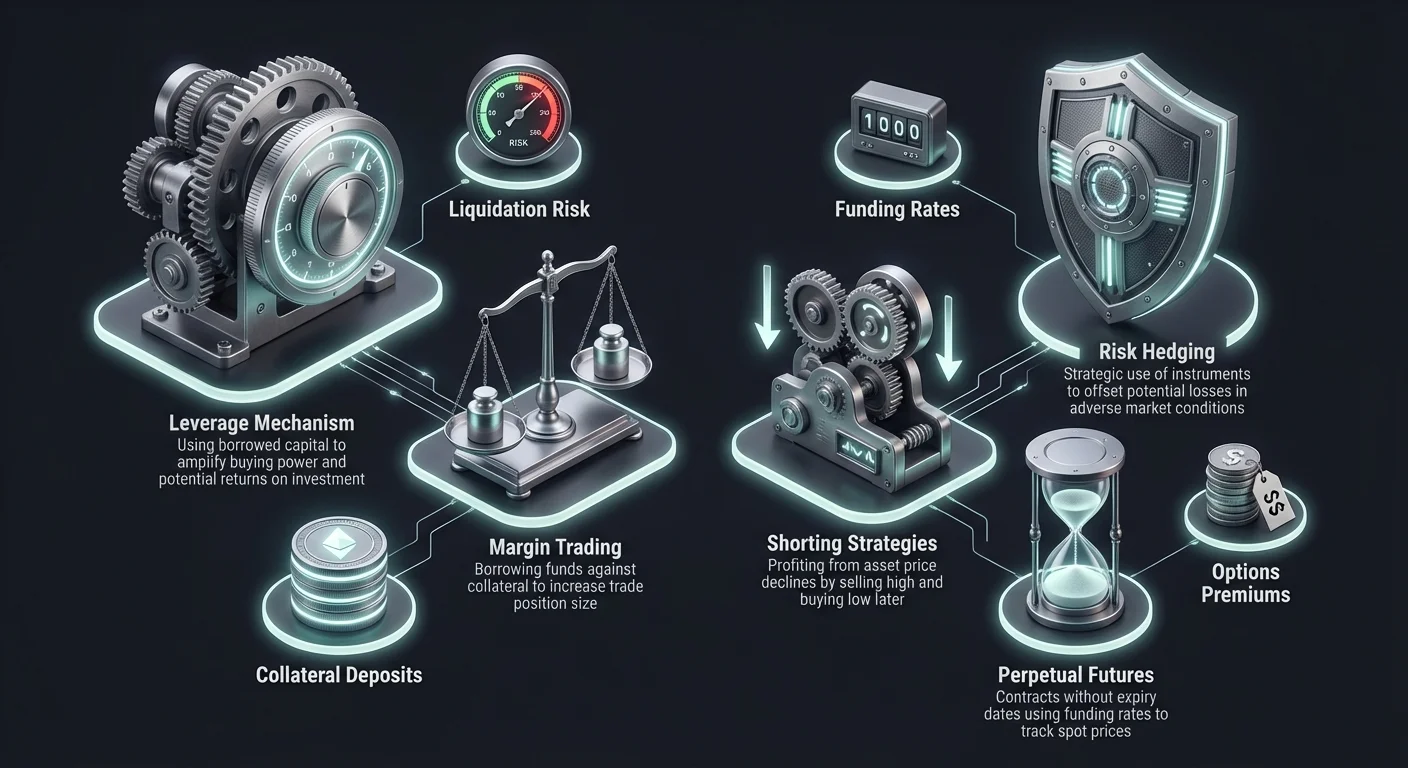
The integration of derivatives into a portfolio introduces concepts such as leverage, shorting, and hedging. These are not merely tools for speculation but are essential mechanisms for stabilizing returns and managing exposure. By mastering these instruments, investors can construct portfolios that are resilient to the notorious volatility of the crypto ecosystem.
The Fundamental Concept of Derivatives
At its core, a crypto derivative is a financial contract between two or more parties. The value of this contract is not intrinsic but is instead determined by the performance of an underlying digital asset. Common examples include contracts based on the price of Bitcoin, Ethereum, or other major altcoins. These instruments track the price movements of the asset, allowing traders to gain exposure without taking physical custody of the coin.
The primary utility of a derivative lies in its flexibility. In a traditional spot purchase, the investor profits only if the asset's price increases. With derivatives, the contract terms can allow for profitability in various market conditions. This includes scenarios where prices remain flat or even decline.
The relationship between the derivative and the underlying asset is maintained through various mechanisms depending on the specific instrument. For standard futures, this is determined by the expiry date and settlement price. For other types, such as perpetual contracts, complex funding rate mechanisms keep the contract price aligned with the spot market price.
Distinction From Spot Trading
Spot trading involves the immediate exchange of assets. When you buy Bitcoin on the spot market, you pay the full price upfront and receive the Bitcoin in your wallet. You are the owner, and you can transfer it, hold it, or use it for payments. The transaction is settled "on the spot."
Derivatives trading functions differently. You are not buying the asset itself but rather a contract that represents the asset's value. This often means you do not need to put up the full value of the trade upfront. Instead, you provide collateral, known as margin, to open a position that may be significantly larger than your initial capital.
This difference in settlement and ownership changes the risk profile entirely. In spot trading, you can never lose more than your investment, and you can hold the asset indefinitely regardless of price drops. In derivatives trading, the use of leverage and margin means that positions can be liquidated if the market moves against you, potentially resulting in a total loss of collateral.
The Role of Market Maturity
The rise of derivatives signals a maturing financial ecosystem. In traditional finance, the derivatives market is vastly larger than the spot market for assets like stocks or commodities. This is because institutional investors require tools to hedge their positions and manage risk. The crypto market is following a similar trajectory.
As infrastructure improves, liquidity in derivative markets has deepened. This allows for larger trade sizes and tighter spreads, making these tools accessible not just to institutions but also to sophisticated retail traders. The availability of these instruments on both centralized and decentralized platforms has democratized access to advanced financial strategies.
Analyzing Futures Contracts
Futures contracts are among the most established forms of derivatives in the cryptocurrency space. A futures contract is a legal agreement to buy or sell a particular cryptocurrency at a predetermined price at a specified time in the future. These contracts are standardized, meaning they have set expiration dates and contract sizes.
In a traditional futures contract, the buyer assumes the obligation to purchase the asset when the contract expires, while the seller assumes the obligation to sell it. This structure allows miners and large holders to lock in prices for their future production or holdings, effectively hedging against the risk of price drops.
For the portfolio constructor, futures provide a way to speculate on future price movements without holding the asset today. If a trader believes Bitcoin will be higher in three months, they can buy a futures contract with an expiry date three months out. The price of this contract will reflect market sentiment regarding the future value of Bitcoin.
Mechanics of Expiration
The defining feature of a standard futures contract is the expiry date. On this date, the contract must be settled. Settlement can occur in two ways: physical delivery or cash settlement. In physical delivery, the actual cryptocurrency is transferred from the seller to the buyer. In cash settlement, the difference between the contract price and the spot price is paid out in cash or stablecoins.
Because futures contracts have a fixed end date, their price does not always perfectly match the current spot price of the asset. This discrepancy is known as the basis. In a bullish market, futures often trade at a premium to the spot price, a condition known as contango. Conversely, in a bearish market, they may trade at a discount, known as backwardation.
Traders must be aware of these pricing dynamics. As the contract approaches expiration, the futures price and the spot price will converge. This convergence is a critical factor for anyone holding a position close to the expiry date, as it can impact the final profitability of the trade.
Perpetual Futures Innovation
While traditional futures are useful, the cryptocurrency market popularized a unique variant known as the perpetual future, or "perp." As the name implies, these contracts do not have an expiration date. A trader can hold a perpetual position for as long as they desire, provided they maintain sufficient margin to avoid liquidation.
Perpetual futures are the most common type of derivative in the crypto market. They offer the flexibility of a spot position—indefinite holding periods—combined with the leverage and shorting capabilities of a futures contract. This hybrid nature makes them highly attractive for active trading strategies.
Since there is no expiry date to force the price of the contract to match the spot price, perpetuals use a mechanism called the funding rate. This is a periodic payment exchanged between long and short traders. If the contract price is higher than the spot price, longs pay shorts. If it is lower, shorts pay longs. This economic incentive ensures the perp price closely tracks the underlying asset.
Comparing Traditional and Perpetual Futures
| Feature | Traditional Futures | Perpetual Futures |
|---|---|---|
| Expiry Date | Fixed date (e.g., monthly, quarterly) | No expiry date |
| Price Mechanism | Converges at settlement | Tethered by funding rates |
| Holding Period | Limited to contract duration | Indefinite (with margin) |
The choice between standard and perpetual futures depends on the trader's objective. Standard futures are often preferred for hedging over a specific timeframe without the variable cost of funding rates. Perpetual futures are preferred for day trading and continuous exposure where rolling over contracts would be cumbersome.
Options Trading Strategies
Options contracts introduce a layer of strategic depth beyond what futures offer. Unlike futures, which obligate the parties to transact, an option gives the buyer the right, but not the obligation, to buy or sell the asset at a specific price by a certain date. This distinction is vital for risk management.
There are two primary types of options: calls and puts. A call option gives the holder the right to buy the underlying asset. This is typically used when a trader expects prices to rise. A put option gives the holder the right to sell the underlying asset, which is useful when expecting prices to fall or when hedging existing holdings.
The seller of the option, often called the writer, assumes the obligation to fulfill the contract if the buyer chooses to exercise their right. In exchange for taking on this obligation, the seller receives a fee known as the premium. This premium is the price the buyer pays for the flexibility the option provides.
Hedging With Puts
One of the most powerful uses of options in portfolio construction is hedging. If an investor holds a substantial amount of Bitcoin and is concerned about a short-term price drop, they can purchase put options. If the market price falls, the value of the put option increases, offsetting the losses in the spot portfolio.
This strategy acts similarly to an insurance policy. The investor pays a premium for the put option. If the market remains stable or rises, the option expires worthless, and the investor loses only the premium. However, if the market crashes, the put option provides a financial cushion that protects the portfolio's overall value.
American vs. European Options
In the crypto derivatives market, options are generally classified as either American or European style. This classification dictates when the option can be exercised. An American option can be exercised by the holder at any point up until the expiration date. This offers maximum flexibility, allowing the trader to capture profits immediately if market conditions are favorable.
European options, in contrast, can only be exercised on the specific date of expiration. While this reduces flexibility, European options often come with lower premiums. Understanding the difference is critical when selecting a platform, as different exchanges may specialize in one style over the other.
The liquidity of options markets is also a consideration. While growing, crypto options markets may not be as liquid as futures markets. This can result in wider spreads between the bid and ask prices, which impacts the cost of entering and exiting positions.
The Mechanics of Margin Trading
Margin trading is distinct from derivatives but shares the concept of leverage. In margin trading, an investor borrows funds from a broker or an exchange to purchase a larger amount of the underlying asset. Unlike futures, where the trader holds a contract, margin trading involves the actual spot asset.
The borrowed funds allow the trader to amplify their buying power. For example, with 10x margin, a trader with $1,000 can open a position worth $10,000. The $9,000 difference is borrowed from the platform or other lenders on the platform.
This increased purchasing power magnifies both potential profits and potential losses. If the asset price rises, the gains are calculated on the full $10,000 position. However, if the price falls, the losses are also calculated on the total value, which can quickly deplete the trader's initial $1,000 equity.
Collateral and Interest
To access margin, a trader must provide collateral. This acts as a security deposit for the borrowed funds. The platform holds this collateral to ensure that the loan can be repaid even if the trade goes poorly. The amount of collateral required depends on the leverage ratio and the platform's risk policies.
Borrowing funds on margin incurs interest costs. These interest rates can vary based on market demand for the asset. In a bull market, where many traders want to borrow stablecoins to buy crypto, interest rates can rise significantly. These costs must be factored into the profitability of any margin trade, especially for positions held over longer periods.
Long vs. Short Margin Positions
Margin trading supports both long and short strategies. A long margin position involves borrowing cash (or stablecoins) to buy more cryptocurrency. The goal is to sell the asset later at a higher price, repay the loan and interest, and keep the remaining profit.
A short margin position works in reverse. The trader borrows the cryptocurrency itself and sells it immediately on the spot market. The objective is to buy the asset back later at a lower price to return to the lender. The difference between the selling price and the repurchase price constitutes the profit.
Capital Efficiency and Leverage
Leverage is the double-edged sword of crypto portfolio construction. It refers to the ability to control a large position with a relatively small amount of capital. Across futures, options, and margin trading, leverage is the common thread that allows for enhanced capital efficiency.
For a portfolio manager, leverage means that exposure to an asset can be maintained without tying up 100% of the capital required to own it. If a trader wants $50,000 worth of exposure to Bitcoin, they might only need to deposit $5,000 as collateral using 10x leverage. This frees up the remaining $45,000 for other investments or strategies.
However, this efficiency comes with heightened risk. The volatility of cryptocurrency markets is already significant; applying leverage multiplies this volatility. A 5% move in the underlying asset price becomes a 50% move in equity when using 10x leverage.
The Risk of Liquidation
The most severe risk associated with leverage is liquidation. Liquidation occurs when the value of the trader's position moves against them to the point where the remaining collateral is no longer sufficient to cover the potential losses and the borrowed funds.
When this threshold is reached, the exchange automatically closes the position to protect the lender's capital. The trader loses their initial margin. To prevent this, traders must monitor their maintenance margin requirements closely. Adding more collateral to a position can lower the liquidation price, but it also commits more capital to a losing trade.
Effective risk management strategies often involve using lower leverage ratios. While platforms may offer 100x leverage, this leaves almost no room for error. Experienced traders typically use much lower leverage to balance efficiency with safety, ensuring they can withstand normal market fluctuations without being liquidated.
Isolated vs. Cross Margin
Trading platforms generally offer two modes for managing margin: isolated and cross margin. In isolated margin, the trader allocates a specific amount of funds to a single position. If that position is liquidated, only the allocated funds are lost. The rest of the portfolio remains unaffected.
Cross margin, on the other hand, utilizes the entire available balance in the account as collateral for all open positions. This helps prevent liquidation for a single losing trade if other positions are profitable or if there is excess cash in the account. However, it also puts the entire account balance at risk. If the market moves violently across multiple assets, the entire account could be drained.
The Mechanics of Shorting
Shorting is a strategy that allows traders to profit from the decline in an asset's price. It is the exact opposite of the traditional "buy low, sell high" mentality. In a short trade, the sequence is "sell high, buy low." This capability is essential for a balanced portfolio, as it provides opportunities to generate returns even during bear markets or corrections.
To execute a short, a trader effectively sells an asset they do not currently hold. In derivatives markets like futures, this is a straightforward contract agreement to sell at a current price. In spot margin markets, it involves borrowing the asset to sell it.
Shorting is inherently riskier than going long. When buying an asset, the maximum loss is limited to the investment amount (if the price goes to zero). However, because an asset's price can theoretically rise infinitely, the potential loss on a short position is uncapped.
Bear Market Strategies
During a bear market, asset prices generally trend downward. A portfolio composed entirely of long spot positions will suffer significant drawdowns. By incorporating short positions, a trader can offset these losses.
For example, a trader might hold a core position in Ethereum for the long term. If the market enters a bearish phase, they can open a short position in Ethereum futures. Gains from the short futures position can balance out the paper losses of the spot holding. This allows the investor to maintain their long-term stack without suffering the full impact of the price drop.
Psychological and Technical Challenges
Shorting requires a different mindset and technical approach. Markets tend to fall faster than they rise, a phenomenon often described as "taking the stairs up and the elevator down." This speed requires quick decision-making and strict adherence to stop-loss orders.
Furthermore, short squeezes can occur. This happens when a heavily shorted asset rises in price, forcing short sellers to buy back the asset to cover their positions. This buying pressure drives the price up further, triggering more liquidations and buy-backs in a cascading effect. Short squeezes can result in rapid, massive losses for those betting on a decline.
Contract Trading and CFDs
Contract trading often encompasses instruments like Contracts for Difference (CFDs). These are financial derivatives that allow traders to speculate on price movements without owning the underlying asset. Similar to futures, CFDs are agreements to exchange the difference in the value of an asset between the time the contract opens and closes.
CFDs are popular because they simplify the trading process. There is no need to manage digital wallets or worry about the security of private keys. The trade is purely a financial agreement with the platform. This accessibility makes them a common entry point for traders transitioning from traditional finance to crypto.
However, CFDs usually do not offer the ability to transfer the asset off the platform. The trader is purely exposed to the price action. This limits the utility for those who might want to use the cryptocurrency for payments or decentralized finance (DeFi) applications eventually.
Binary Options
Binary options represent a simplified, albeit high-risk, form of derivative trading. In a binary option trade, the outcome is a simple "yes or no" proposition. Will the price of Bitcoin be above $50,000 at 12:00 PM? If the trader predicts correctly, they receive a fixed payout. If they are wrong, they lose their entire investment.
The appeal of binary options lies in their simplicity and defined risk. The trader knows exactly how much they stand to win or lose before placing the trade. However, the "all-or-nothing" nature of these instruments makes them more akin to gambling for many participants. They lack the nuance of futures or options, where positions can be managed, adjusted, or partially closed.
Infrastructure: CEX vs. DEX
The choice of where to trade derivatives is as important as the instrument itself. The market is divided between Centralized Exchanges (CEXs) and Decentralized Exchanges (DEXs).
Centralized exchanges act as intermediaries. They hold user funds, provide the order book, and match trades. They typically offer high liquidity, fast execution speeds, and a wide range of order types. However, they represent a single point of failure and require users to trust the platform with their assets.
Decentralized exchanges operate via smart contracts on a blockchain. Users retain control of their private keys and trade directly from their wallets. As DeFi matures, DEXs are increasingly offering sophisticated derivatives like perpetuals and options. While they offer better privacy and self-custody, they may suffer from lower liquidity and slower execution speeds compared to their centralized counterparts.
Security Considerations
Security is paramount when trading derivatives. Centralized platforms should offer robust measures like two-factor authentication (2FA), cold storage for the majority of assets, and proof of reserves. The history of the exchange regarding hacks and regulatory compliance is a critical factor.
For DEX users, security risks involve smart contract vulnerabilities. If the code governing the derivative platform has a bug, funds can be lost. Users must rely on audits and the open-source nature of the code to verify security. Regardless of the platform type, using hardware wallets and strong security practices is essential for protecting capital.
Protokoli upravljanja tveganj
Gradnja portfelja z derivati zahteva stroge protokole upravljanja tveganj. Povečana volatilnost, ki jo uvaja vzvok, pomeni, da lahko majhne napake postanejo drage. Uspešni trgovci uporabljajo različne orodja za zaščito svojega kapitala.
Stop-loss naročila so neizogibna za večino strategij derivatov. Stop-loss samodejno zapre pozicijo, ko cena doseže določeno raven, kar omeji potencialno izgubo. Trailing stop-i se lahko uporabijo za zaklepanje dobičkov, ko se cena premika v ugodno smer.
Velikost pozicije je še en ključni element. Trgovci ne smejo tvegati znatnega odstotka svojega portfelja na eno vzvodno trgovanje. Z ohranjanjem majhnih velikosti pozicij glede na celotno stanje računa lahko trgovci prenesejo serijo izgub brez propada.
Razumevanje tveganj likvidnosti
Tveganje likvidnosti se nanaša na sposobnost vstopa ali izstopa iz pozicije brez znatnega vpliva na ceno. Na visoko likvidnih trgih, kot so Bitcoin perpetuali, to redko predstavlja problem za maloprodajne trgovce. Vendar za derivate altcoinov ali opcije z nizkim trgovalnim volumnom je lahko likvidnost redka.
Nizka likvidnost vodi do slippage-a, kjer je cena izvedbe slabša od pričakovane. V ekstremnih pogojih trga lahko pomanjkanje likvidnosti prepreči trgovcu zapiranje izgubljene pozicije, kar vodi do večjih kot pričakovanih izgub. Trgovci bi morali vedno oceniti volumen in globino knjige naročil specifične pogodbe derivatov pred vstopom v trgovanje.
Conclusion
The integration of derivatives into a cryptocurrency portfolio marks a transition from passive participation to active management. These financial instruments—ranging from futures and options to margin trading and perps—offer mechanisms to decouple portfolio performance from simple market direction. They provide the tools necessary to hedge against downside risk, improve capital efficiency through leverage, and capture value during market declines.
However, the power of these tools is matched by their complexity and risk. Leverage can amplify losses just as quickly as it magnifies gains, and the nuances of funding rates, expiration dates, and liquidation thresholds require constant vigilance. Success in this arena demands a deep understanding of market mechanics and a disciplined approach to risk management.
By thoughtfully combining spot holdings with derivative strategies, investors can construct robust portfolios capable of navigating the inherent volatility of the digital asset space. Whether through hedging with options or managing exposure with futures, the effective use of derivatives is a defining characteristic of the sophisticated modern crypto trader.
Derivatives are powerful tools for hedging and efficiency, but require strict risk management to prevent amplified losses.