
Trgovanje z vzvodom uvaja visoko tveganje dinamiko na trg kriptovalut. Ponuja privlačnost povečanih dobičkov, ki trgovcem omogoča nadzor velikih pozicij z relativno majhnimi zneski kapitala. Vendar ta finančna moč prinaša pomembno past. Mehanizem, ki ojača dobičke, prav tako ojača izgube.
Ko se trg premakne proti vzvodni poziciji, postane tveganje likvidacije realnost. Likvidacija je prisilno zaprtje pozicije trgovca s strani borze. To se zgodi, ko lastna sredstva računa trgovca padejo pod zahtevano raven za podporo odprti trgovini. Gre za zaščitni ukrep, ki ga platforma izvede, da zagotovi, da izgubna trgovina ne povzroči dolga, ki ga trgovec ne more poravnati.
Razumevanje mehanizmov likvidacije je bistveno za vsakogar, ki se ukvarja s trgovanjem derivatov. Ni samo stvar slabše sreče ali nihanja trga. Vključuje natančne matematične pragove, specifične zahteve po marži in različne politike platform. Trgovci, ki ne razumejo teh konceptov, pogosto izgubijo celoten kapital.
Ta vodnik raziskuje tehnične komponente likvidacije. Pregledali bomo, kako delujejo pozivi na maržo, ključno razliko med začetno in vzdrževalno maržo ter strategije za izogibanje uničenju računa. Z obvladovanjem teh konceptov lahko udeleženci trga plavajo skozi nihanja digitalnih sredstev z večjo varnostjo in zaupanjem.
Osnove trgovanja na maržo
Koncept kupne moči
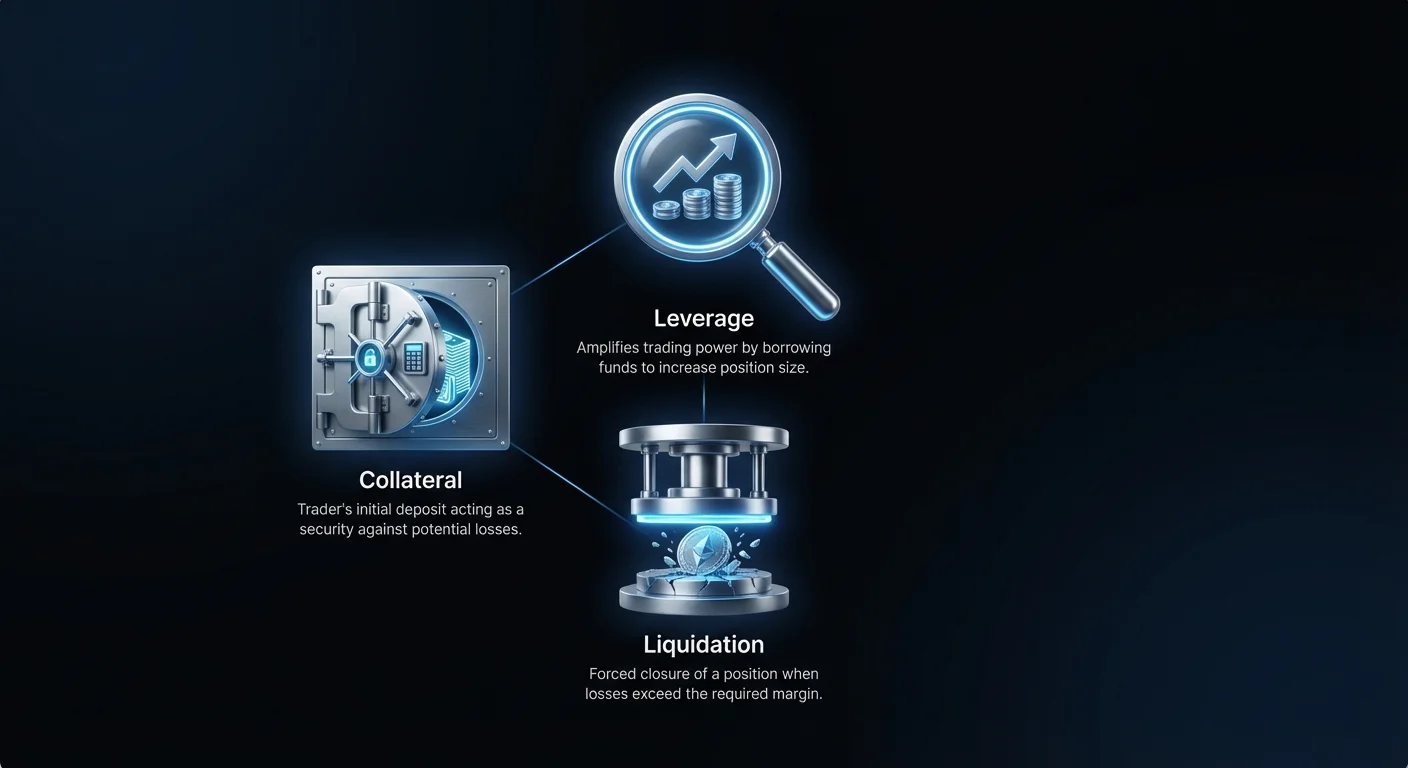
Trgovanje na maržo fundamentalno spremeni razmerje med kapitalom in izpostavljenostjo. V standardni spot transakciji, če imate $1,000, lahko kupite Bitcoin v vrednosti $1,000. Trgovanje na maržo vam omogoča, da si sposodite sredstva za povečanje te kupne moči. Ta sposojeni kapital ustvarja vzvod.
Če platforma ponuja 10x vzvod, lahko isti $1,000 nadzoruje pozicijo v vrednosti $10,000. $1,000, ki jih zagotovite, deluje kot kolateral. Ta kolateral je vaša "koža v igri." služi kot varščina za kritje morebitnih izgub.
Borza posodi preostalih $9,000 za dokončanje trgovanja. Čeprav ta ureditev omogoča znaten potencial dobička, če se cena premakne ugodno, ustvarja scenarij, kjer je trgovec odgovoren za celotno vrednost pozicije. Če vrednost pozicije pade, se izgube odštejejo izključno iz kolaterala trgovca, ne iz sposojenih sredstev.
Zahteve po začetni marži
Za odprtje vzvodne pozicije mora trgovec depozirati določen znesek sredstev. To je znano kot začetna marža. Je vstopnica v trgovanje. Zahtevani znesek je odvisen od izbranega razmerja vzvoda. Višji vzvod zahteva manj začetnega kapitala v razmerju z velikostjo pozicije, vendar poveča tveganje.
Na primer, uporaba 100x vzvoda lahko zahteva le 1 % celotne vrednosti pozicije kot začetno maržo. Uporaba 2x vzvoda bi zahtevala 50 %. Čeprav visok vzvod zmanjša potrebni začetni kapital, ustvari veliko ožje okno za gibanje cene, preden izgube pojedo kolateral.
Začetna marža je zaklenjena s strani borze za trajanje trgovanja. Ne jo je mogoče dvigniti ali uporabiti za druge trgovine, razen če je pozicija zaprta ali vzvod zmanjšan. Razumevanje te zahteve je prvi korak pri izračunu tveganja.
Vloga kolaterala
Kolateral v kripto trgovanju na maržo lahko prevzema različne oblike. Na mnogih platformah trgovci uporabljajo stabilne kovance, kot sta USDT ali USDC, kot kolateral. To zagotavlja stabilno osnovno vrednost za izračune. Vendar nekatere borze dovoljujejo uporabo nestabilnih sredstev, kot sta Bitcoin ali Ethereum, kot kolateral.
Uporaba nestabilnega sredstva kot kolaterala uvaja dodatno plast kompleksnosti. Če cena kolateralnega sredstva pade, medtem ko je odprta pozicija tudi v izgubi, trgovec doživi dvojni udarec. Vrednost varščine se zmanjša hkrati, ko se trgovina premakne v rdeče.
Ta scenarij pospeši pot proti likvidaciji. Zato je upravljanje vrste uporabljenega kolaterala enako pomembno kot upravljanje same trgovine. Trgovci morajo biti seznanjeni, kako se ocenjuje njihov kolateral in kakšne "odbitke" ali popuste borze morda uporabljajo za nestabilna sredstva.
Maintenance Margin and the Liquidation Price
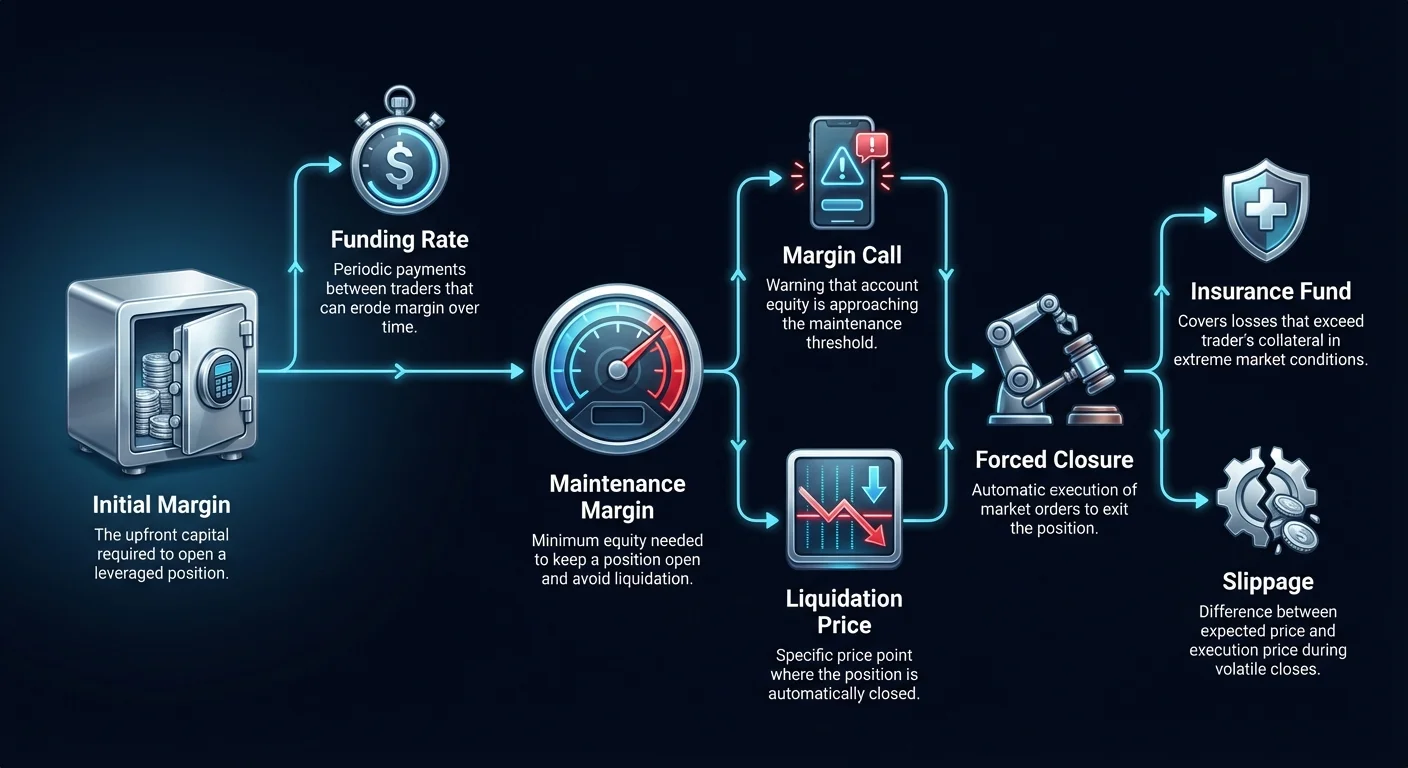
Maintenance margin is the absolute minimum amount of equity a trader must hold in their account to keep a position open. It is always lower than the initial margin. Think of the initial margin as the amount needed to open the door, and the maintenance margin as the amount needed to stay in the room.
As market prices fluctuate, the unrealized profit or loss of a position changes the trader's account equity. If a trade goes poorly, the equity begins to erode. The exchange watches this equity level closely.
If the equity drops to the level of the maintenance margin, the danger zone is reached. The exchange will not allow the equity to fall to zero or into negative territory. Before that happens, the liquidation protocols are triggered.
The liquidation price is the specific price point at which the account equity hits the maintenance margin threshold. This price is calculated the moment a trade is opened. It serves as a constant line in the sand.
If the market price touches this liquidation price, the platform's engine automatically takes over. It creates market orders to close the position immediately. This is done to preserve whatever capital remains to pay back the borrowed funds.
The gap between the entry price and the liquidation price depends entirely on leverage. Lower leverage results in a wide gap, allowing the asset to fluctuate significantly without triggering a blowout. Higher leverage results in a razor-thin gap.
Anatomy of a Margin Call
The Warning System
In traditional finance, a margin call was a literal phone call from a broker. The broker would demand that the client deposit more cash immediately to cover losses. If the client failed to do so, the broker would sell the assets.
In the fast-paced world of cryptocurrency, the "call" is often digital and automated. It typically arrives as an email or a notification from the trading app. It warns the trader that their margin balance is approaching the maintenance threshold.
However, due to the extreme volatility of crypto markets, prices can crash through the margin call level and hit the liquidation price in seconds. Sometimes, there is no time for the trader to react to the warning.
Adding Margin vs. Closing Positions
When a trader receives a margin call or sees their risk level rising, they have two primary options. The first is to add more collateral to the account. By depositing more funds, the trader increases their account equity. This effectively lowers the leverage ratio and pushes the liquidation price further away.
The second option is to close the position, or at least a portion of it. By realizing the loss and reducing the position size, the trader reduces the total borrowed amount. This can stabilize the account and prevent a total loss of funds.
Deciding between these options requires a cool head. Adding margin to a losing trade is often called "throwing good money after bad." It can lead to even larger losses if the market continues to move unfavorably.
Forced Liquidation Mechanics
If the trader does not act, or if the market moves too quickly, forced liquidation occurs. The exchange's matching engine places an immediate order to close the position. This is usually a market order, which accepts the best available price at that moment.
During a liquidation, the trader loses their initial margin. In many cases, they also lose any remaining maintenance margin to cover fees. Liquidation is not free. Exchanges often charge substantial liquidation fees to penalize the risky behavior and cover the administrative cost of the forced trade.
These fees are deducted from whatever capital is left. This explains why a liquidated account often ends up with a zero balance, or mere pennies, even if the market price bounces back moments later.
Types of Margin: Cross vs. Isolated
Risk management in derivatives trading heavily relies on the margin mode selected. Most exchanges offer two distinct modes: Cross Margin and Isolated Margin. Understanding the difference is vital for protecting one's total portfolio.
| Feature | Cross Margin | Isolated Margin |
|---|---|---|
| Scope | Uses entire account balance | Restricted to specific amount |
| Risk | Total wallet liquidation | Limited to assigned capital |
| Flexibility | Shared across positions | Separate for each trade |
Cross Margin Dynamics
Cross margin shares the entire balance of a trading account across all open positions. The available balance acts as a combined pool of collateral. If one position is in profit while another is in loss, the profit can help support the losing trade.
This mode is useful for hedging and for traders who want to avoid micro-managing the margin of every single active trade. It effectively lowers the risk of liquidation for individual positions because the collateral pool is larger.
However, the systemic risk is higher. If a single position goes catastrophically wrong and drains the shared pool, it can liquidate the entire account. Every other position, even those that were profitable, may be closed to cover the loss of the rogue trade.
Isolated Margin Security
Isolated margin compartmentalizes risk. In this mode, the trader allocates a specific amount of collateral to a single position. For example, a trader might put $100 into a Bitcoin long position.
If the price drops and the position is liquidated, the trader loses only that specific $100. The rest of the funds in their wallet remain untouched. The "fire" is contained within that one trade and cannot spread to the rest of the portfolio.
This mode allows for precise risk control. A trader can take a high-leverage gamble with a small amount of money without endangering their main capital. It is generally recommended for beginners and for speculative trades.
Choosing the Right Mode
The choice between cross and isolated margin depends on the strategy. Professional traders managing complex portfolios often use cross margin to balance exposure. They rely on strict stop-loss orders to prevent account-wide disasters.
Traders focusing on individual setups or volatile altcoins often prefer isolated margin. It provides peace of mind. They know exactly how much they stand to lose before the trade even begins.
Switching between modes is usually possible only when there are no open positions. Traders must decide their approach before entering the market. Mixing strategies without understanding the margin settings is a common cause of unexpected liquidations.
Perpetual Futures and Funding Rates
The Perpetual Contract Mechanism
Perpetual futures, or "perps," are the most popular derivative instrument in crypto. Unlike traditional futures, they have no expiry date. Traders can hold a position for as long as they can maintain the margin requirements.
Because there is no settlement date, the price of the perpetual contract must be anchored to the spot price of the underlying asset. Without a mechanism to tether them, the contract price could drift significantly away from the real market value.
The mechanism used to keep prices aligned is the Funding Rate. This is a periodic payment exchanged between buyers (longs) and sellers (shorts). It directly impacts a trader's margin balance and liquidation risk.
Funding Rates and Margin Erosion
Funding rates are typically calculated every eight hours. If the market is bullish and more people are going long, the funding rate is positive. This means traders with long positions must pay a fee to traders with short positions.
Conversely, if the market is bearish, the funding rate becomes negative. Short sellers pay the long traders. These payments are deducted automatically from the trader's margin balance.
If a trader holds a large position with high leverage, the funding fees can be substantial. Over time, these fees can eat away at the collateral. Even if the asset price stays flat, a trader paying funding fees could eventually see their margin drop below the maintenance level, triggering a liquidation.
Strategic Implications
Traders must monitor the funding rate before entering a long-term leverage position. In times of extreme euphoria, annualized funding rates can reach triple digits. Holding a position in such an environment is expensive.
Some traders use this to their advantage through arbitrage. They might open a position specifically to collect funding fees. However, for the directional trader, funding is a cost of doing business that must be factored into the liquidation calculation.
Ignoring funding rates is a common mistake. A position that is slightly profitable on the chart might actually be losing money once fees are subtracted. This "invisible" loss brings the liquidation price closer with every funding interval.
Kratka prodaja in neomejeno tveganje
Kratka prodaja vključuje sposodbo sredstva za njegovo prodajo z namenom, da ga kasneje odkupite po nižji ceni. Je način za dobiček iz padcev trga. Vendar mehanizmi likvidacije za kratke pozicije nosijo edinstven profil nevarnosti.
Ko kupite sredstvo (greste long), je najslabši scenarij, da cena pade na ničlo. Vaša izguba je omejena na vašo začetno naložbo. Ne morete izgubiti več, kot ste vložili (ob predpostavki brez dolga iz vzvoda).
Ko kratko prodajate sredstvo, teoretično ni meje, kako visoko lahko cena naraste. Kriptovaluta se lahko poveča za 100 %, 1.000 % ali celo 10.000 %. Ker mora kratki prodajalec odkupiti sredstvo za zaprtje pozicije, naraščajoča cena ustvarja naraščajoči dolg.
Da prepreči, da bi trgovec dolgovala več, kot ima, borze strogo uveljavljajo likvidacijo na kratkih pozicijah. Če cena naraste do točke, kjer kolateral komaj krije stroške odkupa, sistem likvidira trgovanje.
To pogosto vodi do "short squeezea". Ko se kratke pozicije likvidirajo, borza samodejno kupi sredstvo za zaprtje trgovanj. Ta nakupni pritisk še dodatno potisne ceno navzgor, kar sproži več likvidacij, ki povzročijo več nakupov.
Ta kaskadni učinek lahko povzroči hitre, vertikalne skoke cen. Kratki prodajalci lahko izginjajo v trenutkih. Upravljanje tveganj pri kratki prodaji zahteva izjemno disciplino pri postavljanju stop-lossov, da se izognete ujemanju v squeeze.
Pogosti vzroki za uničenje računa
Pretiran vzvod
Najpogostejši vzrok likvidacije je pohlep. Uporaba maksimalnega vzvoda (kot 50x ali 100x) pusti skoraj nič prostora za napake. 1 % premik cene proti 100x poziciji rezultira v 100 % izgubi marže.
V nestabilnih kripto trgih se lahko 1 % nihanje zgodi v sekundah. Visok vzvod majhni tržne šum pretvori v krizo plačilne sposobnosti. Trgovci pogosto precenjujejo svojo sposobnost napovedovanja kratkoročnega gibanja cen.
Prezrtje nihljivosti
Različne kriptovalute imajo različne profile nihljivosti. Bitcoin se morda premakne za 3 % v dnevu, manjši altcoin pa za 20 %. Uporaba iste strategije vzvoda na različnih sredstvih je recept za katastrofo.
Razmerje vzvoda, ki je varno za Bitcoin, je lahko samomorilsko za meme kovanca. Trgovci pogosto ne prilagodijo velikosti pozicije glede na specifično nihljivost sredstva, ki ga trgujejo.
Izpadi borze in slippage
Tehnična odpoved je dejavnik tveganja v kripto trgovanju. Med obdobji ekstremne tržne aktivnosti se lahko borze preobremeni. Uporabniki se lahko znajdejo, da ne morejo prijaviti ali oddati naročil.
Če trgovec ne more dostopati do platforme za dodajanje marže ali ročno zaprtje pozicije, je prepuščen milosti motorja likvidacije. Do takrat, ko se sistem vrne na splet, je pozicija morda že izgubljena.
Poleg tega, med padcem, lahko likvidnost presahne. To povzroči slippage. Motor likvidacije morda ne bo mogel prodati pozicije po sprožilni ceni. Morda bo moral prodati po veliko slabši ceni, kar izčrpa še več kapitala, kot je pričakovano.
Risk Management Strategies
The Hard Stop-Loss
The single most effective tool against liquidation is the stop-loss order. This is an instruction to close the position at a specific price before the liquidation point is reached.
A hard stop-loss ensures that a trader accepts a small, manageable loss rather than a total wipeout. It removes emotion from the decision. Professional traders always define their exit point before they enter the trade.
Position Sizing
Proper position sizing ensures that no single trade can destroy the account. A common rule of thumb is to risk only 1% to 2% of the total account capital on any single trade.
Even if a trader uses high leverage, they can manage risk by reducing the amount of capital assigned to that trade. It is better to have a small position with high leverage than a large position that puts the entire portfolio at risk.
De-leveraging
Traders should consider de-leveraging during volatile periods. Reducing the leverage ratio increases the buffer between the entry price and the liquidation price. This allows the trade to "breathe" and withstand normal market fluctuations without triggering a forced closure.
If a trade moves into profit, some traders choose to take partial profits. This locks in gains and reduces the overall exposure. It is a defensive strategy that prioritizes capital preservation over maximum potential yield.
Vloga zavarovalnih skladov
Ko pride do likvidacije, mora borza zagotoviti, da zmagovalna stran trgovanja dobi plačilo. V ekstremni nihljivosti se lahko pozicija likvidira po ceni slabši od cene bankrota. To pomeni, da kolateral trgovca ni dovolj za kritje izgube.
Da prepreči, da bi ta "izguba kontrakta" vplivala na druge uporabnike, borze vzdržujejo zavarovalne sklade. Ko je trgovec likvidiran, je pogosto zaprt po ceni rahlo boljši od bankrota. Razlika med vrednostjo likvidacije in vrednostjo bankrota se naloži v zavarovalni sklad.
Nasprotno, če se pozicija zapre z izgubo, ki presega kolateral, zavarovalni sklad pokrije primanjkljaj. Ta sistem ščiti integriteto borze. Zagotavlja, da lahko dobičkonosni trgovci vedno dvignejo svoje zaslužke, tudi če poraženci propadejo.
Vendar to tudi pomeni, da so provizije za likvidacijo pogosto agresivne, da zavarovalni sklad ostane solventen. Trgovci bi morali zavarovalni sklad videti kot varnostno mrežo za sistem, ne zase.
Regulatorni vidiki in omejitve vzvoda
Pokrajina trgovanja z vzvodom je močno vplivana z regulacijo. V mnogih jurisdikcijah so oblasti naložile stroge omejitve zneska vzvoda, ki ga lahko borze ponudijo maloprodajnim klientom.
Na primer, nekatere regije omejujejo kripto vzvod na 2x ali 5x za neprofesionalne trgovce. Te regulacije so namenjene zaščiti potrošnikov pred hitrimi izgubami, povezanimi z likvidacijo z visokim vzvodom.
Borze, ki delujejo v teh regijah, morajo spoštovati ta pravila. To pogosto vodi do razdeljenega trga, kjer offshore ali decentralizirane platforme ponujajo visok vzvod, regulirane domače entitete pa bolj konservativne produkte.
Trgovci bi morali biti seznanjeni s pravnim okoljem, v katerem delujejo. Uporaba nereguliranih platform za dostop do visokega vzvoda poveča tveganje protistranke. Če platforma propade ali sporazumi trgovanje, ima uporabnik malo pravnih možnosti.
Psychological Aspects of Liquidation
The Trauma of Loss
Being liquidated is a psychological blow. It validates that the trader was wrong, and it removes their ability to fight back in that specific trade. The immediate reaction is often anger or denial.
This emotional state is dangerous. It creates an urge to earn the money back quickly. This leads to "revenge trading," where the trader opens new, riskier positions immediately after a loss.
Revenge trading almost invariably leads to further liquidations. The trader abandons their strategy and acts on impulse. Recognizing this emotional trigger is crucial for long-term survival.
Discipline and Acceptance
Successful traders accept liquidation as a possibility but structure their trades to make it a rarity. They view losses as the cost of doing business. When a stop-loss is hit, they analyze what went wrong rather than trying to force the market to pay them back.
Discipline involves sticking to the plan even when emotions run high. It means refusing to move a stop-loss further away in the hope that the price will turn. It means accepting a small loss today to preserve capital for tomorrow.
Zaključek
Likvidacija je končni izvajalec v svetu trgovanja z vzvodom. Je mehanizem, ki ohranja solventnost sistema z odstranjevanjem udeležencev, ki ne morejo več podpirati svojih pozicij. Čeprav služi potrebni funkciji za borzo, predstavlja katastrofalno napako za posameznega trgovca. Razumevanje medigibanja med začetno maržo, vzdrževalno maržo in nihanjem cen je edini način za omilitev tega tveganja.
Pot do trajnostnega trgovanja je v spoštovanju vzvoda. Trgovci, ki maržo obravnavajo kot orodje za učinkovitost namesto loterijske vozovnice, preživijo dlje. Z uporabo izolirane marže, postavljanjem strogih stop-lossov in razumevanjem implikacij stopenj financiranja lahko udeleženci trga dostopajo do koristi derivatov brez padca v žrtev uničenja. Trg bo vedno nestabilen, vendar mora biti izpostavljenost trgovca temu nihanju vedno izračunana izbira.
Vzvot je orodje, ki ga je treba obravnavati z natančnostjo; brez strogega upravljanja tveganj bo trg neizogibno prevzel vaš kapital.