Decentralized finance represents a fundamental shift in how financial products are accessed and executed. At the heart of this movement lies the ability to lend and borrow assets without the need for a traditional bank or credit institution. This system relies entirely on software rather than human intermediaries to manage transactions, assess creditworthiness, and enforce repayment. By utilizing blockchain technology, these protocols allow users to interact directly with code.
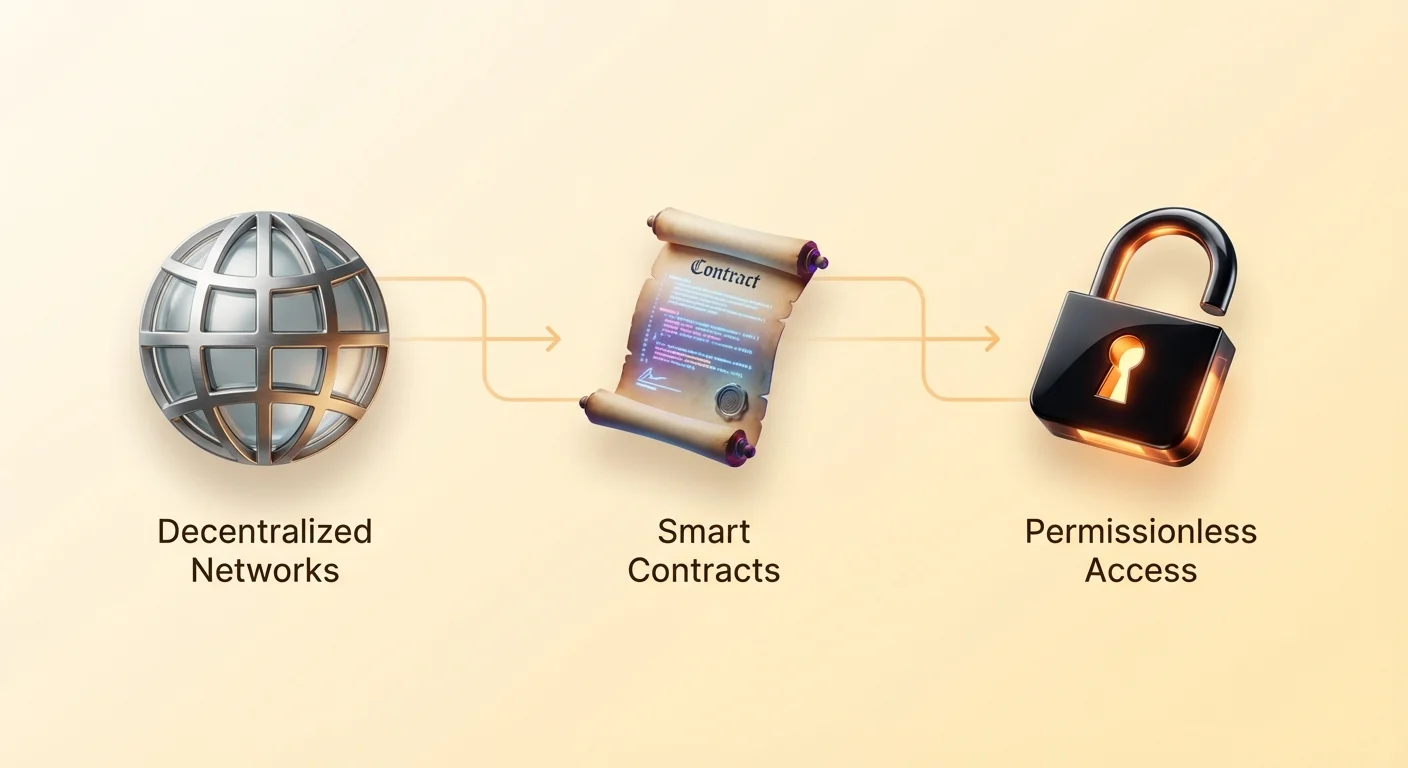
The concept is built upon decentralized networks like Ethereum, which serve as a global infrastructure for these financial applications. Users can deposit their cryptocurrency assets into a protocol to earn a yield, which is generated by the interest paid by borrowers. Conversely, users can borrow assets by providing collateral. This creates a permissionless environment where anyone with an internet connection and a digital wallet can participate in global money markets.
While the terminology often mirrors traditional finance, the mechanics are vastly different. There are no credit scores, no identity checks, and no bank managers. Instead, the safety and stability of the system are maintained through mathematics, game theory, and rigorous code execution. Understanding how these mechanisms function is essential for grasping the potential and the perils of this new financial landscape.
The Role of Smart Contracts in Lending
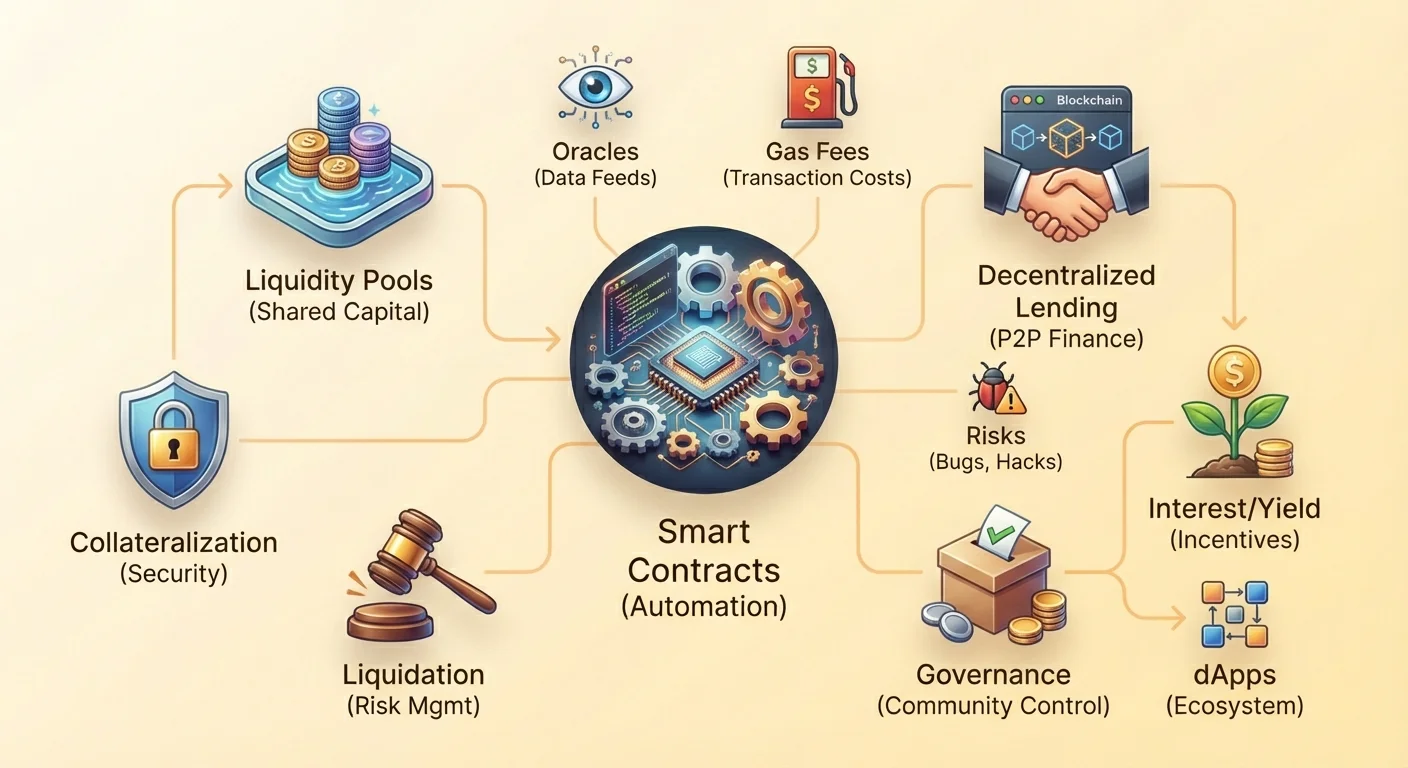
The engine driving decentralized lending is the smart contract. A smart contract is a computer program that runs on a decentralized network. It is stored on a blockchain and executes automatically when specific conditions are met. In the context of lending, these contracts replace the loan officer and the legal department. They define the terms of the loan, the interest rates, and the repayment schedules.
Because these networks are "trustless," participants do not need to know or trust one another. They only need to trust the code. When a lender deposits funds, the smart contract records their contribution and issues a claim on those funds plus interest. When a borrower takes a loan, the smart contract locks their collateral and releases the borrowed funds. This automation ensures that the terms of the agreement are enforced strictly and impartially.
This deterministic nature is a key feature. A smart contract follows "if this, then that" logic. If a borrower repays the loan, the contract releases their collateral. If they fail to maintain the required collateral value, the contract initiates liquidation. This eliminates the ambiguity and human error often found in traditional agreements. However, it also means there is no room for negotiation if market conditions turn against a borrower.
Collateralization Mechanisms
In traditional finance, unsecured lending is common. Banks rely on credit scores, income history, and legal recourse to ensure repayment. In a decentralized, anonymous system, these tools are unavailable. To solve this, decentralized protocols rely heavily on collateralization. This ensures that the lender's capital is protected regardless of the borrower's identity or location.
Most decentralized lending platforms require over-collateralization. This means the value of the assets deposited as collateral must exceed the value of the loan. For example, a protocol might require a collateralization ratio of 2:1. To borrow $500 worth of a stablecoin, a user might need to deposit $1,000 worth of Ethereum. This excess buffer protects the protocol against price volatility in the underlying assets.
If the value of the collateral drops significantly, the protocol needs a mechanism to recover the debt. The smart contract constantly monitors the market value of the collateral. This monitoring is often facilitated by "oracles," which are data feeds that bring off-chain price information onto the blockchain. If the collateral value falls below a specific threshold, the safety of the loan is threatened.
Liquidation and System Solvency
Liquidation is the primary defense mechanism for lending protocols. It ensures that the system remains solvent and that lenders can withdraw their funds. When a borrower's collateral value drops below the required ratio, the smart contract flags the loan for liquidation. This process is automatic and merciless.
During liquidation, the smart contract allows third-party actors, often called liquidators, to purchase the borrower's collateral at a discount. The proceeds from this sale are used to repay the outstanding debt. The borrower effectively loses their collateral but their debt is cancelled. This prevents "bad debt" from accumulating in the system.
Consider the example of an Ethereum-backed loan. If the price of ETH crashes relative to the US Dollar, the value of the collateral held in the smart contract decreases. If the borrower does not add more ETH or repay part of the loan to restore the safe ratio, the contract triggers a sale. The protocol prioritizes the safety of the liquidity pool over the position of the individual borrower.
The Structure of Liquidity Pools
Traditional lending is often peer-to-peer in a direct sense: one person lends to another specific person. Decentralized finance typically utilizes a pooled approach. Lenders deposit their assets into a massive aggregate fund known as a liquidity pool. This pool is managed by a smart contract.
When a user wants to borrow, they do not negotiate with a specific lender. Instead, they borrow directly from the pool. This model ensures that there is usually immediate liquidity available for borrowers, provided the pool is sufficiently funded. For lenders, this means their capital starts earning interest immediately upon deposit, rather than waiting to be matched with a counterparty.
Incentivizing these pools is critical. To attract capital, protocols offer yield. This yield comes from the interest paid by borrowers. In many cases, the protocol also distributes its own native tokens to participants as an additional reward. This is often referred to as "liquidity mining." By distributing ownership tokens, protocols attempt to crowd-source liquidity and align the interests of the users with the success of the platform.
The table below outlines the core differences between how liquidity and access are handled in traditional versus decentralized systems.
| Feature | Traditional Finance | Decentralized Finance |
|---|---|---|
| Access | Permissioned (KYC required) | Permissionless (Wallet only) |
| Custody | Bank holds assets | User/Smart Contract holds assets |
| Settlement | Days to clear | Minutes/Seconds (Block time) |
Analyzing Risks in Decentralized Protocols
While the mechanisms of decentralized lending offer efficiency and transparency, they introduce unique risks. These risks differ significantly from those found in the traditional banking sector. In the traditional world, risks are often related to human error, fraud, or credit defaults. In DeFi, risks are primarily technological and structural.
The reliance on software means that the system is only as strong as its code. Smart contracts are open source, which allows anyone to audit them for security. However, this also means that hackers can study the code to find vulnerabilities. A single bug in the logic of a lending contract can lead to the loss of all funds held in the pool.
Smart Contract Vulnerabilities
Smart contracts are immutable once deployed on many networks. If a developer makes a mistake, it cannot be easily fixed without deploying a new contract or utilizing complex upgrade mechanisms. This rigidity is a double-edged sword. It prevents tampering, but it also solidifies errors.
Hackers actively hunt for loopholes. A common exploit involves manipulating the logic of how the contract handles internal accounting. If an attacker can trick the contract into thinking they have deposited more collateral than they actually have, they can drain the lending pool. These attacks can happen in seconds and are often irreversible.
Even contracts that have been audited by security firms are not immune. Audits reduce the probability of bugs but do not eliminate them. The complexity of interacting smart contracts—where one dApp relies on another—creates a large attack surface. This "composability" or "money lego" aspect of DeFi allows for innovation but amplifies systemic risk.
The Risk of Malicious Design
Not all risks are accidental. The permissionless nature of decentralized networks means that anyone can create and deploy a lending protocol. There is no regulatory body to vet the intentions of the developers. This freedom allows for the creation of malicious dApps designed to steal user funds.
A "rug pull" is a prevalent form of fraud in this space. In this scenario, the developers of a project encourage users to deposit funds by promising high yields. Once a significant amount of capital has been pooled, the developers use "backdoor" functions in the code to withdraw the assets for themselves. They then abandon the project, leaving users with worthless tokens or empty pools.
Users must rely on their own due diligence. Unlike a bank, where government insurance might protect deposits, DeFi deposits are generally uninsured. If a user connects their wallet to a malicious smart contract, they granting that contract permission to move their funds. If the contract is designed to steal, the funds will be lost permanently.
Phishing and Front-End Attacks
The risk does not always lie in the smart contract itself. The user interface, or the website used to interact with the blockchain, can also be a vector for attack. Users typically access decentralized protocols through a web browser. Attackers often create fake versions of popular lending platforms to trick users.
These phishing sites look identical to the legitimate applications. However, when a user connects their wallet, the site directs them to interact with a malicious contract instead of the real one. The URL might differ by a single character, making the deception difficult to spot.
To mitigate this, users must verify the authenticity of the dApps they use. Bookmarking official sites and double-checking URLs are standard safety practices. Because the blockchain is immutable, transactions sent to a phishing address cannot be reversed. The responsibility for security falls entirely on the individual user.
Operational Challenges and User Experience
Beyond security risks, decentralized lending faces operational hurdles. The technology is still in a nascent stage compared to the centuries-old banking system. These challenges impact the speed, cost, and usability of lending platforms.
Decentralized networks function as shared computers. Every transaction must be verified by multiple nodes in the network. This process, while secure, is slower than a centralized database. During periods of high demand, the network can become congested. This leads to slower transaction times, which can be critical when trying to manage a loan position during market volatility.
Transaction Costs and Network Fees
Every interaction with a smart contract requires a fee. This fee, often called "gas," is paid to the network validators. The more complex the transaction, the higher the fee. Lending and borrowing involve complex computations, making them more expensive than simple transfers.
When the network is busy, gas fees can spike dramatically. This can price out smaller users. If the cost to deposit or withdraw funds exceeds the potential interest earned, the protocol becomes unusable for everyone except wealthy participants. This creates a barrier to entry that contradicts the inclusive ethos of decentralized finance.
Furthermore, these costs are unpredictable. A user might take out a loan when fees are low, only to find that fees have skyrocketed when they need to repay or adjust their collateral. This operational friction adds a layer of financial risk that does not exist in traditional banking, where transaction fees are generally fixed and predictable.
Regulatory Uncertainty
Decentralized applications operate in a legal gray area. Governments and regulatory bodies are still determining how to classify and police these protocols. The lack of a central entity makes enforcement difficult. A lending protocol is essentially code running on thousands of computers globally; there is often no company headquarters to raid or CEO to arrest.
However, regulation is likely to increase. Authorities are looking at ways to apply anti-money laundering (AML) and know-your-customer (KYC) laws to the interface level. This could fundamentally change how users access these platforms. If strict regulations are enforced, the permissionless nature of DeFi could be compromised.
The tension between censorship resistance and regulatory compliance is a defining characteristic of the current landscape. While proponents argue that code is free speech, regulators argue that financial services must be controlled to prevent illicit activity. Users navigating this space must be aware that the rules of the game could change rapidly.
The Ecosystem of Decentralized Applications
Lending protocols do not exist in isolation. They are part of a broader ecosystem of Decentralized Applications (dApps). A dApp combines a smart contract backend with a user interface frontend. This structure allows for a seamless experience that mimics traditional web applications while maintaining decentralized logic.
The backend logic is transparent. Anyone can inspect the code on the blockchain to verify how the application works. This transparency is a significant advantage over centralized applications, where the internal logic is hidden on private servers. In a centralized app, a user must trust the company's claims about how they handle data and funds. In a dApp, the user can verify it.
Interconnectivity and Composability
One of the most powerful features of this ecosystem is interoperability. Because most dApps live on shared public networks like Ethereum, they can interact with one another. A token representing a deposit in a lending protocol can be used as collateral in a separate trading protocol.
This interconnectedness allows for complex financial strategies. Developers can build new applications on top of existing ones, using them as building blocks. This is often referred to as "money legos." For instance, a developer could build an automated service that moves a user's funds between different lending protocols to chase the highest yield.
However, this dependency also compounds risk. If a foundational protocol fails, every application built on top of it is at risk. The failure of a major lending platform could trigger a domino effect across the entire DeFi ecosystem. This systemic risk is a critical consideration for anyone allocating significant capital to these markets.
Governance and Community Control
Many decentralized protocols are governed by their communities. This is often achieved through the issuance of governance tokens. Holders of these tokens can vote on proposals to change the parameters of the protocol. This might include adjusting interest rate models, adding new collateral types, or changing fee structures.
This democratic approach stands in stark contrast to the boardroom decisions of traditional finance. It gives users a voice in the direction of the platform. However, it also introduces political dynamics. Large token holders, or "whales," can sometimes dominate votes, potentially skewing the protocol in their favor.
Airdrops are frequently used to distribute these governance tokens. By sending free tokens to early users, a project can instantly decentralize its ownership. This not only rewards early adopters but also ensures that a wide base of users has a stake in the protocol's future. This alignment of incentives is a key driver of growth in the decentralized economy.
Conclusion
Decentralized lending and borrowing represent a radical experiment in financial engineering. By replacing intermediaries with smart contracts, these protocols offer a glimpse into a future where finance is more accessible, transparent, and efficient. The ability to earn yield or access liquidity without asking for permission is a powerful tool for financial inclusion.
However, the removal of intermediaries also removes safety nets. The responsibility for security, due diligence, and risk management shifts entirely to the user. The landscape is fraught with technical pitfalls, from code bugs to malicious actors. The immutable nature of the blockchain means that mistakes are often irreversible.
As the technology matures, it is likely that we will see improvements in security, user experience, and scalability. Innovations in code auditing, insurance protocols, and Layer 2 scaling solutions are already addressing many of the current limitations. While the risks are significant, the continued growth of decentralized lending suggests that for many, the utility of permissionless finance outweighs the dangers.
In DeFi, code is law, meaning you have total control but also bear total responsibility for your assets.