
Decentralized finance has fundamentally altered how individuals interact with their digital assets. In the past, holding cryptocurrency was largely a passive activity where investors waited for price appreciation. Today, protocols allow users to put those assets to work through sophisticated lending and borrowing markets. These platforms operate without intermediaries, utilizing smart contracts to automate transactions and secure funds.
Borrowing against crypto assets is no longer just about obtaining emergency cash. It has evolved into a strategic tool for traders and long-term holders alike. By leveraging holdings, investors can amplify their market exposure or access liquidity without triggering taxable events. This capability transforms a static portfolio into a dynamic financial engine.
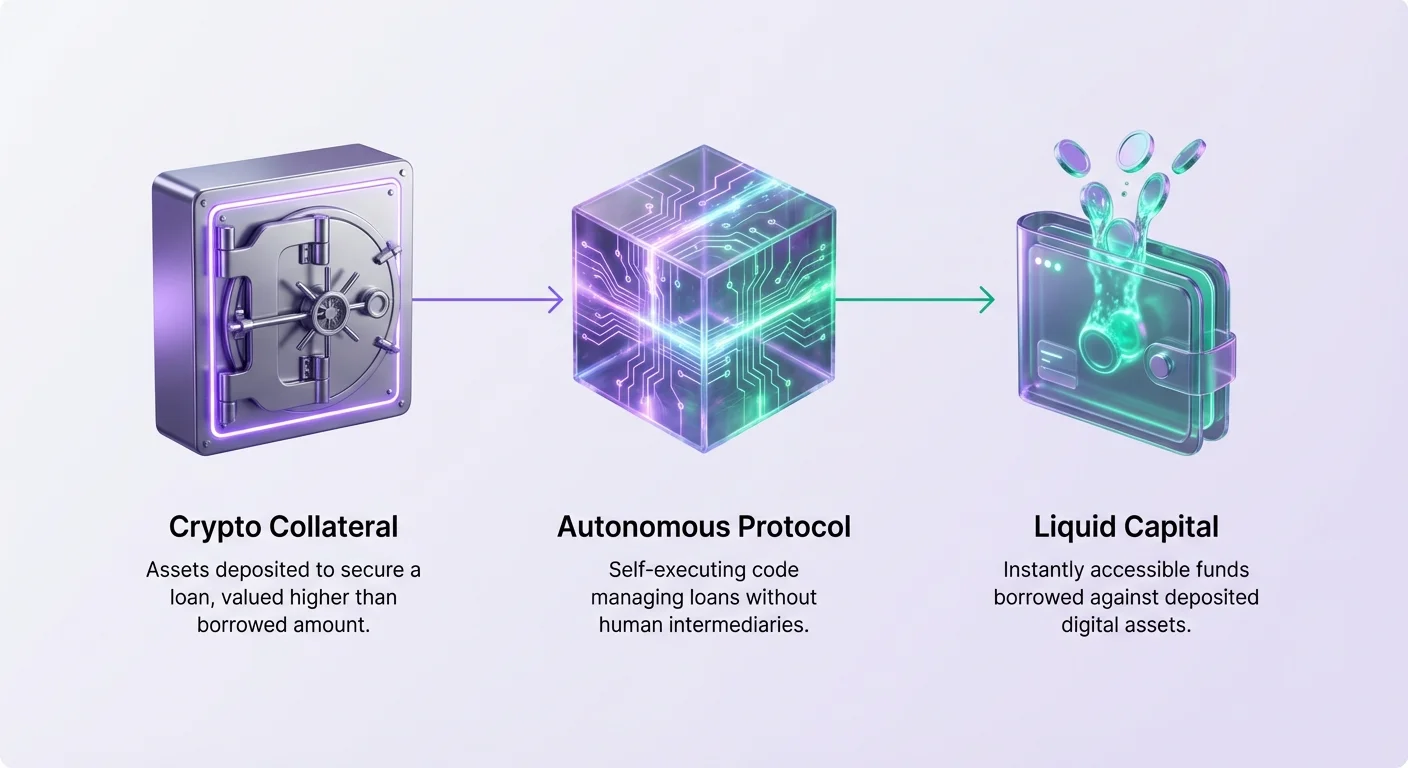
The foundation of this system lies in over-collateralization. Unlike traditional banks that rely on credit scores, decentralized protocols require borrowers to deposit more value than they withdraw. This ensures the safety of the lending pool and eliminates the need for trust between parties.
Understanding these mechanisms is essential for anyone looking to maximize capital efficiency. The ability to lend assets for yield and simultaneously borrow against them opens doors to advanced strategies previously reserved for institutional players.
The Mechanics of Decentralized Protocols
Understanding Liquidity Pools
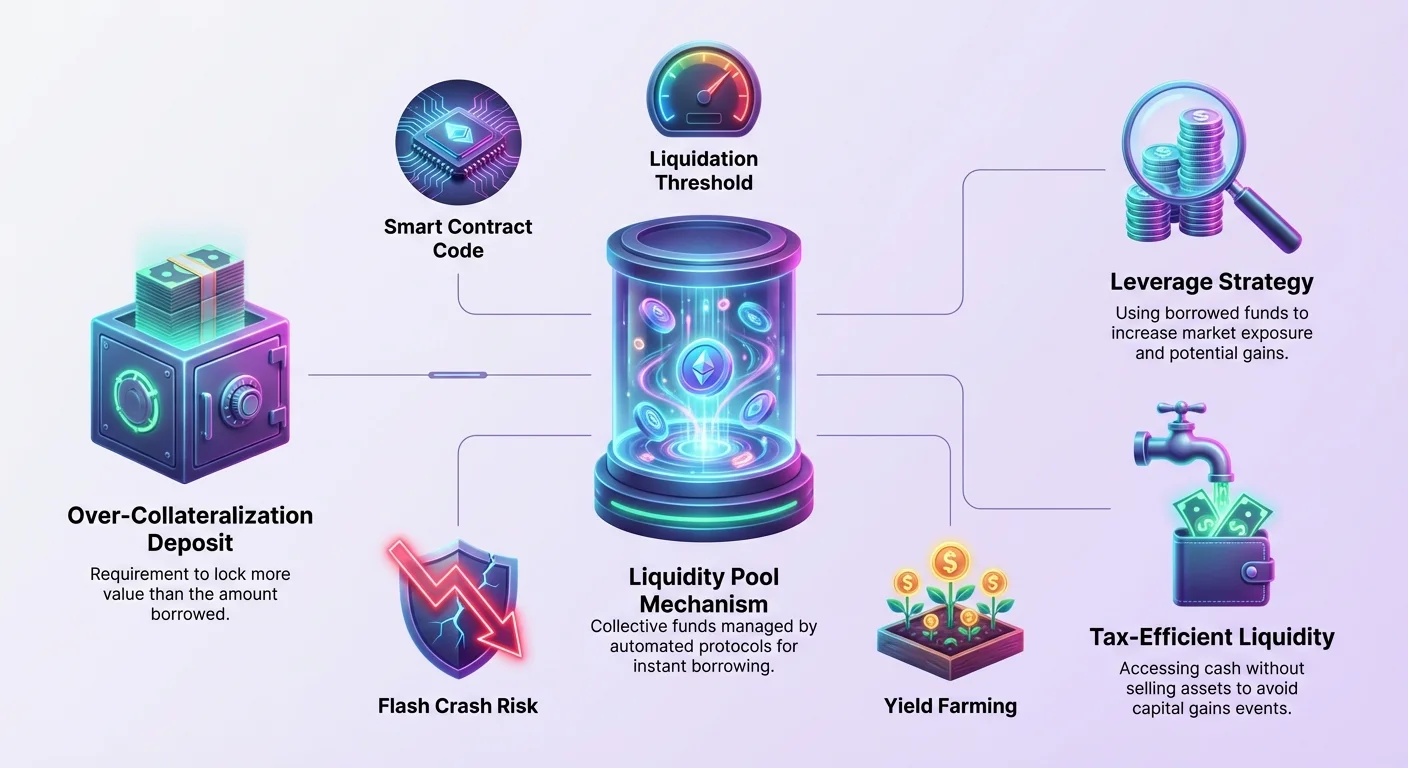
Traditional lending relies on a direct match between a lender and a borrower. Decentralized finance (DeFi) changes this model by using liquidity pools. When users deposit assets into a protocol like Aave, those funds enter a collective smart contract. Borrowers do not negotiate with lenders directly. Instead, they interact with the pool to withdraw liquidity instantly based on set parameters.
This pool-based structure ensures that funds are usually available on demand. Lenders receive interest derived from the payments made by borrowers. The rates fluctuate dynamically based on supply and demand. If many people want to borrow a specific asset, the interest rate rises to encourage more deposits.
The Role of Over-Collateralization
To borrow in a trustless environment, you must provide security. This is achieved through over-collateralization. If a user wants to borrow a specific amount of cryptocurrency, they must first deposit a greater value of assets into the protocol. This deposit acts as insurance for the protocol and its liquidity providers.
For example, to borrow $1,000 worth of a stablecoin, a user might need to deposit $1,500 worth of Ethereum. If the value of the collateral drops below a certain threshold, the protocol automatically liquidates a portion of the deposit to repay the debt. This mechanism protects the system from insolvency without human intervention.
Smart Contract Automation
The entire process is governed by smart contracts. These are self-executing lines of code that live on blockchains like Ethereum or Avalanche. When a user connects their digital wallet to a decentralized application (dApp), they are interacting directly with these contracts.
Smart contracts handle every aspect of the transaction. They calculate interest rates, monitor collateral values, and execute liquidations if necessary. This automation removes the need for a middleman, allowing the platform to operate 24/7 with high efficiency and transparency.
Leveraging Market Positions
Amplifying Long Exposure
One of the most common uses of crypto borrowing is to create leverage. Traders who are bullish on a specific asset can use borrowing to increase their position size without adding fresh capital from a bank account. This is often referred to as "looping."
In this scenario, an investor deposits an asset, such as Ethereum (ETH), into a lending protocol. They then use this collateral to borrow a stablecoin like USDC. The borrowed stablecoins are used to purchase more ETH, which is then deposited back into the protocol.
This increases the total amount of ETH held by the investor. If the price of ETH rises, the investor gains appreciation on both the original deposit and the newly purchased amount. However, this strategy also amplifies risk. If the price falls, the liquidation threshold is reached much faster.
Executing Short Strategies
Borrowing also enables traders to profit from falling prices, known as shorting. In a decentralized environment, this involves borrowing an asset that you expect to decline in value. The borrower immediately sells the borrowed asset for a stablecoin.
If the price of the asset drops as predicted, the borrower can repurchase it later at a lower price. They then repay the loan to the protocol and keep the difference as profit. This mechanism allows traders to hedge their portfolios against market downturns.
Managing Loan-to-Value Ratios
Effective leverage requires careful management of the Loan-to-Value (LTV) ratio. This metric represents the percentage of the loan relative to the value of the collateral. Protocols set maximum LTV limits for each asset.
Maintaining a healthy buffer is critical. If market volatility causes the collateral value to drop, the LTV rises. If it hits the liquidation point, the protocol sells the collateral to cover the debt. Strategic borrowers constantly monitor their LTV to ensure it remains at a safe level, often keeping it well below the maximum allowance to account for sudden price swings.
Arbitrage and Yield Generation
Interest Rate Arbitrage
The fragmented nature of DeFi creates opportunities for arbitrage. Interest rates for borrowing and lending often vary across different platforms and blockchains. A savvy user might identify a situation where the borrowing rate for an asset on one protocol is lower than the lending yield on another.
By borrowing the asset at the lower rate and supplying it to the platform offering a higher yield, the user can pocket the difference. This strategy, while theoretically simple, requires attention to transaction fees. The costs of moving assets between protocols or chains can eat into potential profits.
Staking Borrowed Assets
Another form of arbitrage involves borrowing assets to participate in staking or yield farming opportunities. Many networks offer rewards for staking tokens to secure the blockchain or provide liquidity. If the reward rate for staking is significantly higher than the cost of borrowing the asset, a user can generate a net profit.
For instance, a user might borrow a token with a 2% annual interest rate. If that same token can be staked elsewhere for a 6% return, the user earns a 4% spread. This strategy allows users to farm yields on assets they do not wish to purchase outright, reducing exposure to long-term price fluctuations of that specific token.
Cross-Chain Opportunities
Different blockchains often have different demands for liquidity. A leading lending dApp like Aave exists on multiple chains, including Ethereum and Avalanche. The cost to borrow USDT on Ethereum might differ from the cost on Avalanche due to local market conditions.
Users with multichain wallets can exploit these discrepancies. By borrowing on a chain with ample liquidity and low rates, and moving funds to a chain with high demand, they can optimize their capital efficiency. Tools like WalletConnect facilitate these interactions by allowing secure connections to dApps across various networks.
Tax Management and Efficiency
Accessing Cash Without Selling
For many investors, the primary benefit of borrowing is tax efficiency. In many jurisdictions, selling cryptocurrency is considered a taxable event that triggers capital gains tax. This can be a significant cost for long-term holders who have seen substantial appreciation in their assets.
Borrowing allows investors to unlock the value of their holdings without selling them. By depositing crypto as collateral and borrowing stablecoins, users get liquid cash to pay for expenses or make other investments. Since no sale occurred, no capital gains tax is typically triggered at the time of the loan.
Debt Repayment Dynamics
When the borrower is ready to repay the loan, they can do so using fiat currency or other stablecoins. The original collateral is then unlocked and returned to the wallet. This strategy is particularly useful for holders who believe their assets will continue to appreciate over time.
Instead of selling an asset that might double in value next year to pay a bill today, the investor keeps the asset and the potential upside. The cost of this strategy is the interest paid on the loan, which must be weighed against the potential tax savings and expected asset appreciation.
Estate Planning and Long-Term Holding
Borrowing against assets aligns well with a strategy of generational wealth transfer. By avoiding sales, investors maximize the size of their portfolio. The assets remain in their control, compounding in value or earning yield while acting as collateral.
This approach mirrors strategies used in traditional real estate and high-net-worth wealth management. The digital nature of crypto assets makes this accessible to anyone with a smartphone and a digital wallet, democratizing access to sophisticated financial planning tools.
| Strategy | Primary Goal | Risk Level |
|---|---|---|
| Leverage Long | Amplify gains from price increases | High |
| Short Selling | Profit from price decreases | High |
| Tax Liquidity | Access cash without capital gains | Low/Medium |
Operational Risks and Safety
Liquidation Cascades
The most significant risk in crypto borrowing is liquidation. Crypto markets are notoriously volatile. A sudden flash crash can reduce the value of collateral by double-digit percentages in minutes. If the collateral value falls too low, the smart contract triggers a liquidation.
When this happens, the protocol sells the collateral at a discount to liquidators to repay the loan. The borrower loses a portion, or sometimes all, of their deposited assets. It is vital to maintain a conservative health factor and not maximize borrowing capacity. Leaving a wide margin for error protects against normal market turbulence.
Smart Contract Vulnerabilities
While smart contracts remove human error from transaction processing, they introduce code risk. If a lending protocol has a bug or vulnerability in its code, hackers may exploit it to drain funds from the liquidity pools. This is a risk inherent to all DeFi interactions.
Users should stick to reputable, battle-tested platforms that have undergone multiple security audits. Established protocols with billions in Total Value Locked (TVL) generally offer higher security assurances than new, untested platforms.
Wallet Security
The security of the borrowing operation also depends on the user's wallet. Self-custodial wallets give users full control, but also full responsibility. If a user loses their private keys or interacts with a malicious site, their funds can be stolen.
Using a hardware wallet or a trusted mobile application adds layers of security. It is important to only connect to legitimate dApps and to double-check URLs. Features like WalletConnect add safety by establishing secure links between mobile wallets and desktop interfaces without exposing private keys.
Essential Tools for Borrowing
Choosing the Right Wallet
To participate in DeFi borrowing, you need a Web3-enabled wallet. The best options are self-custodial, meaning the user holds the private keys. A custodial wallet, where a third party controls the funds, generally cannot interact directly with decentralized lending protocols.
The wallet acts as the passport to the DeFi ecosystem. It holds the collateral, signs the transactions, and receives the borrowed funds. Modern wallets support multiple blockchains, allowing users to chase the best rates on Ethereum, Polygon, or other networks seamlessly.
Navigating Lending Platforms
Success requires selecting the right platform. Users should look for protocols that accept a wide range of quality cryptoassets as collateral. The platform should offer competitive Annual Percentage Yields (APY) for deposits and reasonable rates for borrowing.
Interfaces should be transparent, clearly displaying the health factor of loans and the current LTV. A good dashboard allows users to track interest accrued and manage their positions easily.
Transaction Fees and Gas
Every interaction with a blockchain incurs a transaction fee, paid in the network's native currency (e.g., ETH for Ethereum). When planning a borrowing strategy, these fees must be calculated into the cost.
On congested networks, fees can be high. This makes frequent adjustments to positions expensive. Users often prefer networks with lower fees for strategies that require active management, such as high-frequency arbitrage or yield farming.
Practical Steps to Borrow
Establishing a Connection
The process begins by navigating to the lending platform's website. Users must connect their Web3 wallet to the dApp. This is usually done via a "Connect Wallet" button, often utilizing protocols like WalletConnect for mobile integration.
Once connected, the platform reads the wallet's balances and displays available assets. The user interface will show which assets are supported for deposit and borrowing.
Supplying Collateral
Before borrowing can occur, assets must be supplied. The user selects an asset from their wallet to deposit. This transaction requires approval from the wallet and payment of a network fee.
Once the transaction is confirmed on the blockchain, the user begins earning interest on the deposit immediately. This supplied asset now creates a "borrowing power" limit based on the protocol's parameters for that specific asset.
executing the Borrow
With collateral in place, the user navigates to the borrowing section. They select the asset they wish to borrow and the amount. The interface will typically show a preview of the new health factor and LTV.
Confirming the borrow initiates another blockchain transaction. Once processed, the borrowed funds appear directly in the user's wallet. These funds are now liquid and can be moved, swapped, or cashed out as needed.
Monitoring and Repayment
The loan remains active indefinitely as long as the collateral remains sufficient. Interest accrues periodically, increasing the debt obligation over time. Users must monitor their position regularly.
To close the position, the user repays the borrowed amount plus accrued interest. This can be done in whole or in part at any time. Repayment unlocks the collateral, allowing it to be withdrawn back to the wallet.
Conclusion
Strategic borrowing in decentralized finance offers a powerful alternative to traditional asset management. By utilizing over-collateralized loans, investors can unlock the value of their portfolios without surrendering ownership. Whether the goal is leveraging a market position for greater returns, executing complex arbitrage strategies, or managing tax liabilities, the tools are available to anyone with a self-custodial wallet.
However, these capabilities come with distinct responsibilities. The absence of safety nets means that risk management is entirely up to the user. Monitoring health factors, understanding liquidation thresholds, and selecting secure protocols are non-negotiable requirements for success. As the ecosystem matures, these financial primitives will likely become standard components of personal finance for the digital age.
Borrowing against your crypto allows you to access cash or amplify gains while keeping your long-term assets.