
The evolution of digital asset markets has fundamentally changed how individuals approach financial speculation and investment. Unlike traditional stock markets that close for the evening and weekends, cryptocurrency markets operate continuously. This non-stop nature creates a unique challenge for human traders who require sleep and rest. Consequently, the industry has seen a massive shift toward automation.
Automated trading systems allow participants to execute strategies twenty-four hours a day without manual intervention. These systems range from simple recurring buy orders to complex algorithms that analyze market structure in real-time. For sophisticated traders, the goal is to build custom solutions that can interpret data and execute orders faster than any human could.
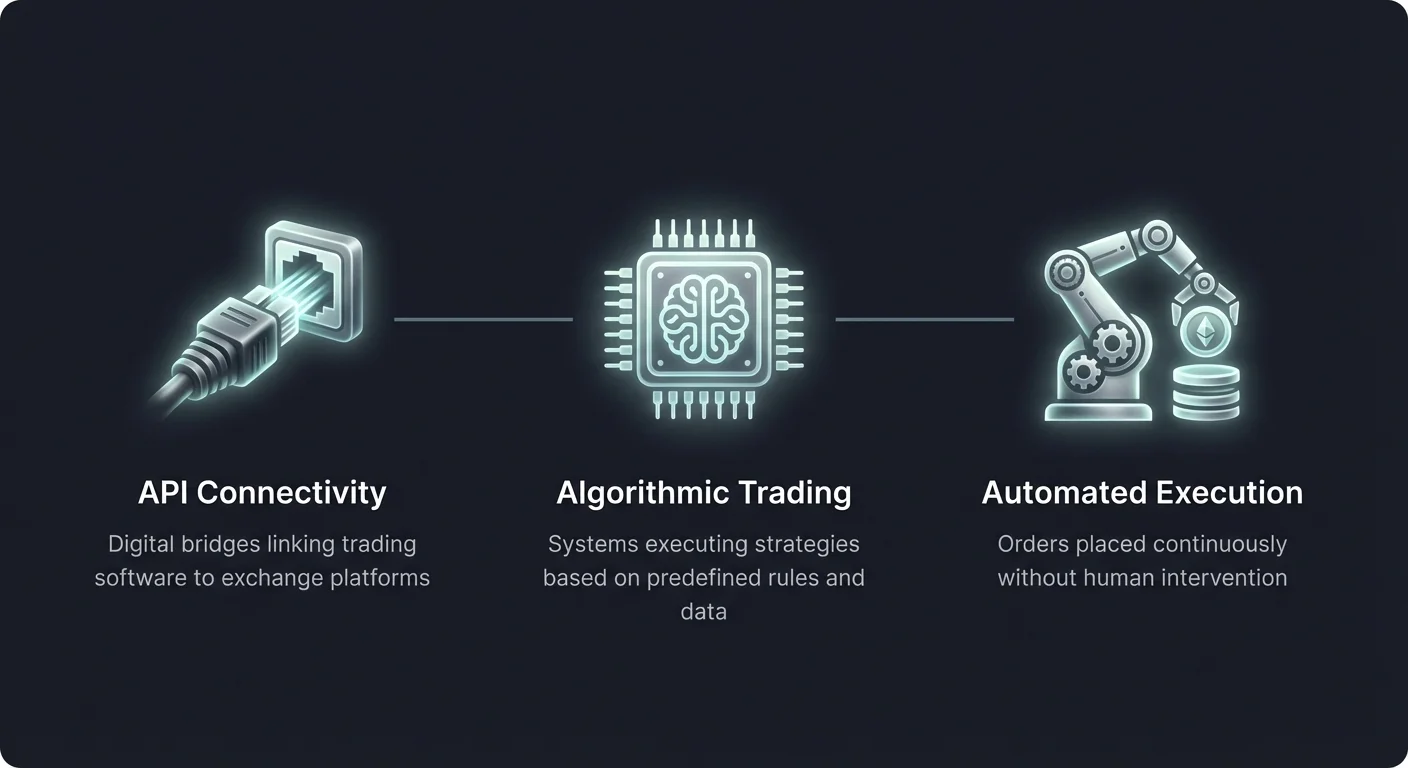
The foundation of this automation lies in Application Programming Interfaces, or APIs. These digital bridges allow external software to communicate directly with an exchange's matching engine. Through APIs, a custom algorithm can request price data, check account balances, and submit trade instructions. Understanding how to utilize these interfaces is the first step in building a custom trading setup.
However, writing code from scratch is not the only path to automation. A growing ecosystem of backtesting platforms and bot services has emerged to bridge the gap. These platforms provide the infrastructure needed to design, test, and deploy algorithms without requiring deep software engineering knowledge. They offer a middle ground where strategy takes precedence over syntax.
The Architecture of Algorithmic Trading
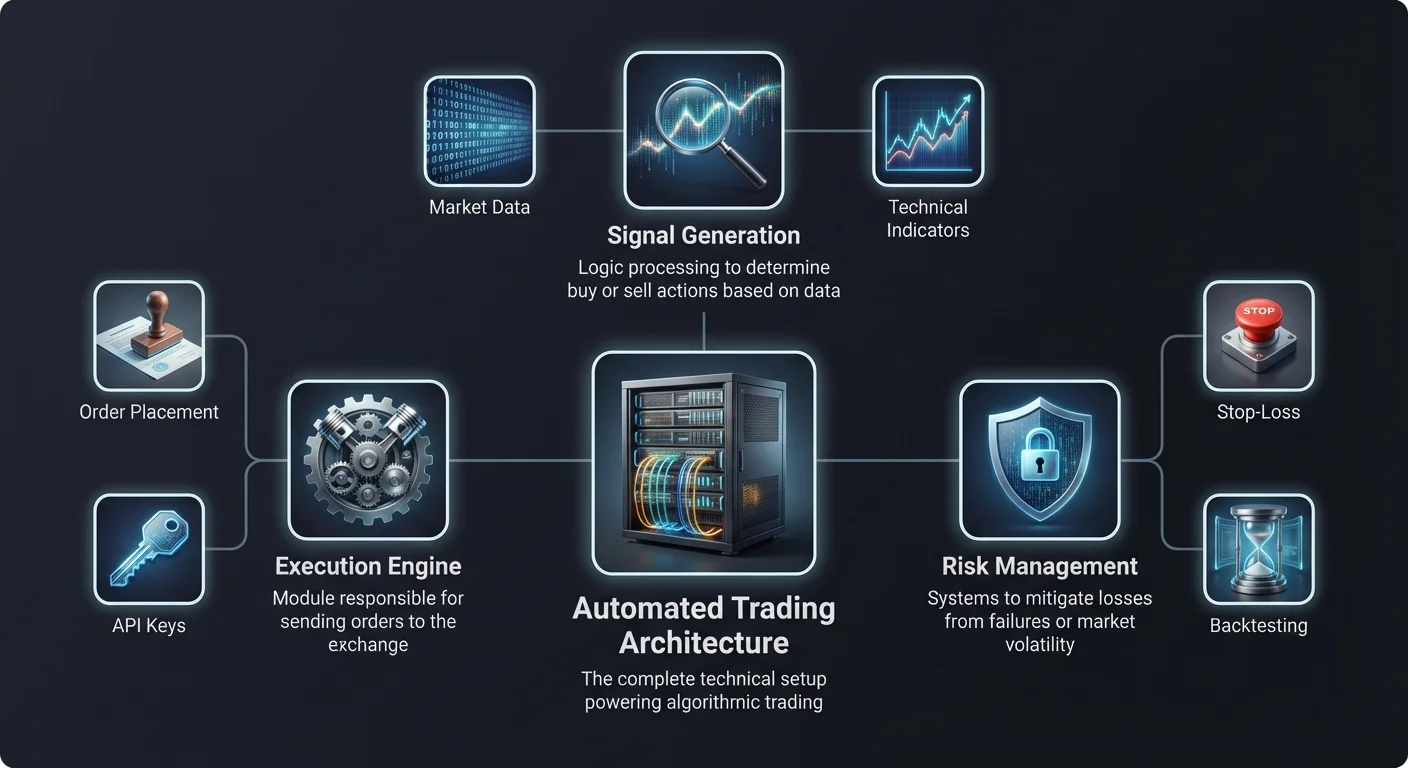
To build a custom crypto algorithm, one must understand the underlying architecture that powers automated trades. This involves more than just a strategy; it requires a robust technical setup that ensures reliability and speed. The core component is the connection between the trader's logic and the exchange's execution engine.
API Connectivity and Management
An API acts as the messenger between your algorithm and the cryptocurrency exchange. When you create an account on platforms like Binance, Coinbase, or Kraken, you can generate API keys. These keys serve as authentication credentials, allowing your software to access your account programmatically.
Security is paramount when handling these keys. Most exchanges offer granular permission settings. You can define exactly what the API key is allowed to do. For a trading bot, you typically enable "read" permissions to view balances and "trade" permissions to execute orders. You should almost never enable "withdrawal" permissions for a trading algorithm.
Rate limits are another critical technical constraint. Exchanges limit the number of requests an API can make per minute to prevent server overload. A well-designed algorithm must respect these limits. Exceeding them can result in temporary bans or failed orders, which can be disastrous during volatile market movements.
Latency and Execution Speed
In the world of algorithmic trading, speed is often synonymous with profit. Latency refers to the time delay between a signal being generated and the order being filled. High latency can lead to slippage, where the execution price differs significantly from the expected price.
Professional algorithmic traders often host their servers in data centers located physically close to the exchange's servers. This reduces the travel time for data packets. While this level of optimization is critical for high-frequency trading, casual algorithmic traders still need reliable internet connections. Cloud-based bot platforms often handle this by hosting their infrastructure in optimized environments.
Data Analysis and Signal Generation
The brain of any algorithm is its signal generation logic. This component ingests raw market data and applies mathematical models to determine when to act. Data sources can include price candles, order book depth, and recent trade history.
Reliable data is essential. If an algorithm receives delayed or inaccurate price feeds, it will make poor decisions. Advanced platforms provide historical data access, allowing traders to test their theories against past market behavior. This process, known as backtesting, helps verify if a strategy has statistical merit before real capital is at risk.
| Component | Function | Importance |
|---|---|---|
| API Keys | Authentication | Grants secure access to exchange accounts |
| Signal Engine | Logic Processing | Determines buy/sell actions based on data |
| Execution Module | Order Placement | Sends commands to the exchange matching engine |
Core Trading Strategies for Automation
Algorithms operate based on specific sets of rules or strategies. Unlike human traders who might act on intuition or news headlines, bots adhere strictly to their programming. Several distinct strategies have become popular within the crypto automation space due to their suitability for algorithmic execution.
Grid Trading Mechanics
Grid trading is a quantitative strategy designed to profit from market volatility rather than directional trends. It involves placing a series of buy and sell orders at predetermined price intervals. This creates a "grid" of orders covering a specific price range.
When the market price drops, the algorithm triggers buy orders at lower levels. As the price rebounds, it triggers sell orders at higher levels. The profit comes from the difference between the buy and sell levels. This strategy is particularly effective in sideways markets where prices fluctuate within a channel but do not trend strongly in one direction.
The effectiveness of a grid bot depends on the parameters set by the trader. Key variables include the upper and lower price limits and the number of grid lines. A tighter grid with more lines results in more frequent trades with smaller profits per trade. A wider grid captures larger moves but trades less frequently.
This strategy requires careful monitoring of market conditions. If the price breaks out of the grid range, the bot may be left holding a losing position or may sell its holdings too early. Many modern platforms allow users to set "stop-loss" and "take-profit" triggers to automatically halt the grid if the market moves unexpectedly.
Arbitrage Opportunities
Arbitrage is the practice of exploiting price differences for the same asset across different markets. Cryptocurrency markets are fragmented, meaning the price of Bitcoin on one exchange might differ slightly from its price on another. Arbitrage bots are designed to identify and capitalize on these discrepancies instantly.
Cross-exchange arbitrage involves buying an asset on Exchange A where the price is low and selling it immediately on Exchange B where the price is high. This requires holding funds on both exchanges to execute the trades simultaneously. Speed is the critical factor here, as price gaps tend to close quickly as other traders spot them.
Triangular arbitrage is a more complex variation that occurs within a single exchange. It involves trading three different assets in a loop to exploit pricing inefficiencies between trading pairs. for example, trading Bitcoin for Ethereum, then Ethereum for Litecoin, and finally Litecoin back to Bitcoin. If the exchange rates are misaligned, the trader ends up with more Bitcoin than they started with.
Trend Following and Momentum
Trend-following algorithms aim to capitalize on sustained market movements. These bots rely on technical indicators such as Moving Averages (MA), the Relative Strength Index (RSI), or the Moving Average Convergence Divergence (MACD). The logic is relatively straightforward: buy when the trend is up and sell when the trend reverses.
A common implementation is the Moving Average Crossover. The bot buys when a short-term moving average crosses above a long-term moving average, signaling upward momentum. It sells when the short-term line crosses below.
These strategies perform well during strong bull or bear markets. However, they often suffer in "choppy" or sideways markets. In such conditions, the bot may generate false signals, leading to a series of small losses known as "whipsaws." Advanced algorithms incorporate filters to detect market volatility and pause trading during uncertain periods.
Review of Bot and Backtesting Platforms
Building an algorithm from scratch using Python or C++ offers maximum control, but it requires significant coding skills. For the majority of traders, third-party platforms provide a more accessible route. These services offer pre-built frameworks where users can design, backtest, and deploy strategies using visual interfaces or simplified code.
3Commas and Smart Trading
3Commas has established itself as a robust platform for automated trading management. It connects to multiple exchanges via API, allowing users to control all their accounts from a single interface. Its primary strength lies in its versatility, offering tools for Dollar Cost Averaging (DCA), grid trading, and custom signal integration.
The platform's "Smart Trade" terminal allows users to set up complex order types that exchange interfaces might not natively support. For instance, a trader can set a buy order with a simultaneous stop-loss and a trailing take-profit. A trailing take-profit allows the position to remain open as long as the price continues to rise, only closing when the price reverses by a set percentage.
3Commas also creates a marketplace for strategies. Users can view the performance of algorithms created by others and choose to copy them. This social aspect helps beginners understand what successful configurations look like. However, past performance on the marketplace does not guarantee future results.
CryptoHopper and Cloud Automation
CryptoHopper is a cloud-based trading bot that operates 24/7, ensuring that strategies run even when the user's computer is off. It features a visual strategy designer that allows users to drag and drop indicators to create custom logic. This "no-code" approach makes algorithm building accessible to non-programmers.
One of CryptoHopper's defining features is its extensive backtesting capability. Users can run their designed strategies against historical data to see how they would have performed. The platform provides detailed reports on maximum drawdown, win/loss ratios, and total profit.
The platform supports a wide range of exchanges and offers features like "Exchange Arbitrage" and "Market Making." For advanced users, it allows the use of AI strategies that can automatically analyze markets and switch between different trading pairs based on trend strength.
Quadency for Institutional-Grade Tools
Quadency targets a slightly more sophisticated audience, offering a terminal that unifies portfolio management and automation. It provides a library of pre-configured bots, including market making, accumulation, and Bollinger Band strategies.
The platform places a strong emphasis on data analytics. It allows traders to monitor performance across all connected exchanges in real-time. Quadency's "Strategy Coder" feature is particularly notable for developers. It allows users to write custom bots in Python while Quadency handles the infrastructure and exchange connectivity.
This hybrid approach appeals to those who have some coding ability but do not want to manage their own servers. By abstracting away the connectivity layer, Quadency allows traders to focus strictly on the logic of their algorithms.
Exchange-Native Automation Tools
In response to the popularity of third-party bot platforms, many cryptocurrency exchanges have begun integrating automation tools directly into their interfaces. This simplifies the process by removing the need for API keys and external subscriptions.
Bitget and Social Automation
Bitget has carved out a niche by heavily integrating copy trading and automated tools. The platform allows users to execute grid trading strategies directly from the exchange dashboard. This native integration often results in lower latency since the orders originate within the exchange's own ecosystem.
The platform's copy trading engine is a form of social automation. Instead of programming logic based on indicators, the "algorithm" is the behavior of another human trader. Users can set parameters for risk management, such as maximum position size, to ensure they maintain control while mirroring the actions of professionals.
Pionex and Built-in Bots
Pionex differentiates itself by being an exchange designed specifically for bot trading. It offers over a dozen built-in trading bots completely free of charge. These include Grid Trading bots, Infinity Grids for long-term trends, and DCA bots.
Because the bots are internal to the exchange, Pionex eliminates the common issues associated with API connectivity. There are no API rate limits to worry about, and the connection is inherently stable. This model is particularly attractive for beginners who want to experiment with automation without the technical overhead of setting up API keys on a third-party site.
Binance and Advanced Order Types
As one of the largest exchanges globally, Binance offers a comprehensive suite of automation tools. Its trading interface supports algorithmic order types like TWAP (Time-Weighted Average Price) and VP (Volume Participation). These are primarily used by institutional traders to execute large orders without spiking the market price.
Binance also offers grid trading and strategic algorithmic orders for retail users. Its API is considered the industry standard due to its depth and documentation, making it the primary target for most custom bot developers. The platform's high liquidity ensures that automated orders are filled quickly and at predictable prices.
The Role of Backtesting in Algorithm Development
Building a strategy is only half the battle; verifying its effectiveness is equally important. Backtesting is the process of feeding historical market data into an algorithm to simulate how it would have performed over a specific period. This simulation helps identify potential flaws before real money is risked.
Data Quality and Simulation
The accuracy of a backtest is entirely dependent on the quality of the data used. High-quality data includes granular detail, such as tick-by-tick price movements and order book depth. Using simple "closing price" data can lead to misleading results, as it ignores the intra-day volatility that might have triggered stop-losses.
Platform choice plays a significant role here. Platforms like CryptoHopper and 3Commas provide historical data access, but dedicated backtesting software often offers more precision. Advanced backtesting engines account for trading fees and slippage, providing a more realistic net profit calculation.
Paper Trading for Forward Testing
Once a strategy proves successful in backtesting, the next step is "paper trading" or forward testing. This involves running the algorithm in real-time using virtual funds. The bot interacts with the live market, processing real-time data and placing simulated orders.
Paper trading is crucial for verifying the technical execution of the bot. It ensures that the logic triggers correctly under current market conditions. It also helps the trader understand the psychological aspect of watching an algorithm operate. Seeing a bot enter a drawdown period in real-time can be stressful, and paper trading helps build confidence in the system.
Most major bot platforms and some exchanges offer paper trading modes. It is highly recommended to run a strategy in paper trading mode for at least a few weeks before deploying actual capital. This observation period allows for fine-tuning parameters and catching edge cases that historical data might have missed.
Upravljanje tveganj v avtomatiziranih sistemih
Avtomatizacija ne odpravlja tveganj; spremeni njihovo naravo. Medtem ko boti odstranijo čustveno odločanje, uvedejo tehnična in sistemska tveganja. Napaka v kodi ali prekinitev API-ja lahko povzroči znatno finančno izgubo, če ni pravilno upravljana.
Tehnične točke odpovedi
Najpogostejša tehnična težava je izguba povezljivosti. Če strežnik, ki gosti bota, gre offline ali če API borze postane neodziven, je bot dejansko slep. Ne more upravljati odprtih pozicij ali zapirati izgubljenih trgov.
Da to omilimo, morajo trgovci uporabljati platforme, ki zagotavljajo garancije za razpoložljivost, ali gostiti svoje lastne skripte na zanesljivih oblakovnih strežnikih (VPS). Poleg tega lahko nastavitev stop-loss naročil na strani borze deluje kot varnostna mreža. Če bot pade, bo domači sistem borze še vedno izvedel stop-loss, če cena pade.
Likvidnost trga in bliskoviti padci
Algoritmi delujejo na podatkih, vendar so lahko podatki trga včasih ekstremni. »Bliskoviti padci« se zgodijo, ko cena sredstva znatno pade v nekaj sekundah, preden se opomore. Slabo konfiguriran bot bi lahko prodal na dnu bliskovitega padca, kar zaklene izgubo, ki bi jo človek morda počakal.
Likvidnost je še ena skrb. Na nelikvidnih trgih lahko bot, ki postavi veliko tržno naročilo, trpi zaradi hude zdrsa. Algoritmi bi morali biti programirani za preverjanje globine knjige naročil pred izvedbo ali uporabo limitnih naročil namesto tržnih naročil za nadzor cen vstopa.
| Vrsta tveganja | Opis | Strategija omilitve |
|---|---|---|
| Odpoved API | Izguba povezave z borzo | Rezervacija strežnikov, stop-lossi na strani borze |
| Bliskoviti padec | Nenaden, ekstremen padec cene | Filtri volatilnosti, zakasnjena logika izvajanja |
| Preoblikovanje | Strategija deluje samo na preteklostnih podatkih | Naprejšnje testiranje (papirnato trgovanje) |
Evaluating Exchange APIs
When building custom algorithms, the choice of exchange is often dictated by the quality of its API. Not all APIs are created equal. Some offer faster data streams, while others provide more comprehensive documentation or higher rate limits.
Coinbase for Reliability
Coinbase is frequently cited for its reliability and security. Its API is robust and well-documented, making it a strong choice for developers who prioritize safety and compliance. The platform's "Advanced Trade" API provides access to deep liquidity and advanced order types.
Because Coinbase is a publicly traded company with strict regulatory adherence, its infrastructure is designed to be stable. This stability is vital for institutional-grade algorithms that require consistent uptime. However, developers must be aware that fee structures on major regulated exchanges can sometimes be higher, which impacts the profitability of high-frequency strategies.
Kraken and Asset Diversity
Kraken offers a powerful API that supports a vast array of trading pairs. It is particularly known for its futures and margin trading capabilities. For algorithms that rely on shorting (betting on price drops) or leverage, Kraken provides the necessary endpoints to manage these complex positions.
The exchange provides WebSocket APIs, which push data to the algorithm in real-time. This is faster than standard REST APIs, where the algorithm must repeatedly ask for data. This speed advantage is crucial for arbitrage and scalping strategies.
Binance for Scalability
Binance offers one of the most extensive API ecosystems in the crypto space. It supports spot, margin, futures, and options trading through its interface. The sheer volume of trading on Binance means that liquidity is rarely an issue for retail algorithms.
For developers, Binance provides testnets. These are sandbox environments that mimic the real exchange but use fake money. Developers can write and test their code against the testnet API without risking real funds or paying trading fees. This feature is invaluable during the development phase of a custom algorithm.
Alternatives: Copy Trading vs. Custom Algos
For many investors, the complexity of building and maintaining a custom algorithm is a barrier. Copy trading serves as a viable alternative, offering the benefits of automation without the technical requirements.
Mechanics of Social Trading
Copy trading platforms allow users to browse profiles of experienced traders. These profiles display historical performance, risk metrics, and preferred assets. Once a user selects a trader to copy, the platform automatically replicates that trader's moves in the user's account.
This creates a symbiotic relationship. The copier gets a hands-free trading experience, while the master trader earns a commission on the profits generated for their followers. Platforms like Bitget and eToro have popularized this model, creating social networks centered around financial performance.
Pros and Cons Compared to Custom Bots
The primary advantage of copy trading is simplicity. There are no APIs to configure, no scripts to write, and no servers to maintain. It is a "set and forget" solution. Additionally, human traders can adapt to fundamental news—like a regulatory ban or a technological breakthrough—that a technical algorithm might miss.
However, copy trading lacks customization. You are bound by the decisions of another person. If they panic sell, you panic sell. With a custom algorithm, you have complete control over the logic. You know exactly why a trade was made. Furthermore, copy trading involves additional fees, usually a percentage of profits, which can reduce overall returns compared to running your own efficient bot.
Conclusion
The landscape of cryptocurrency trading has shifted decisively toward automation. Tools that were once the exclusive domain of hedge funds—sophisticated algorithms, high-speed APIs, and institutional-grade backtesting—are now accessible to retail traders. Whether through building custom scripts that interact directly with exchange APIs or utilizing user-friendly platforms like 3Commas and CryptoHopper, the barriers to entry have lowered significantly.
However, accessibility does not guarantee profitability. The most successful algorithmic traders combine robust technical infrastructure with sound financial strategy. They understand that an algorithm is a tool for execution, not a magic wand for wealth. Rigorous backtesting, careful risk management, and a deep understanding of market mechanics remain the prerequisites for success.
As the market matures, we can expect AI and machine learning to play a larger role in signal generation, potentially making static grid and trend strategies obsolete. Traders who stay educated on these evolving technologies and maintain a disciplined approach to system testing will be best positioned to navigate the future of digital asset markets.
The most effective trading algorithm is not the one that takes the most risks, but the one that survives all market conditions through rigorous testing and risk management.