
When learning about cryptocurrencies, we often focus on the promise of decentralization, speed, and finality. But how do we know these promises are backed up by reality? In the traditional financial system, security is guaranteed by central banks and government laws. In the world of Bitcoin, security is guaranteed by two immutable forces: physics and economics.
Bitcoin’s robustness is not a matter of trust; it is a measurable resource. The network is secured by a global computational effort known as the hash rate, powered by hardware and electricity. For Bitcoin to fail, an attacker must overcome this physical barrier, requiring immense capital and energy—a cost so staggering that it makes an attack irrational and unprofitable.
This analysis pivots from simply describing Bitcoin’s components to quantifying its defense. We will explore the primary failure point—the 51% attack—and calculate the necessary economic resources required to execute it successfully. By understanding the cost of failure, we gain a deeper appreciation for why Bitcoin remains the most secure, self-sovereign ledger in the digital economy.
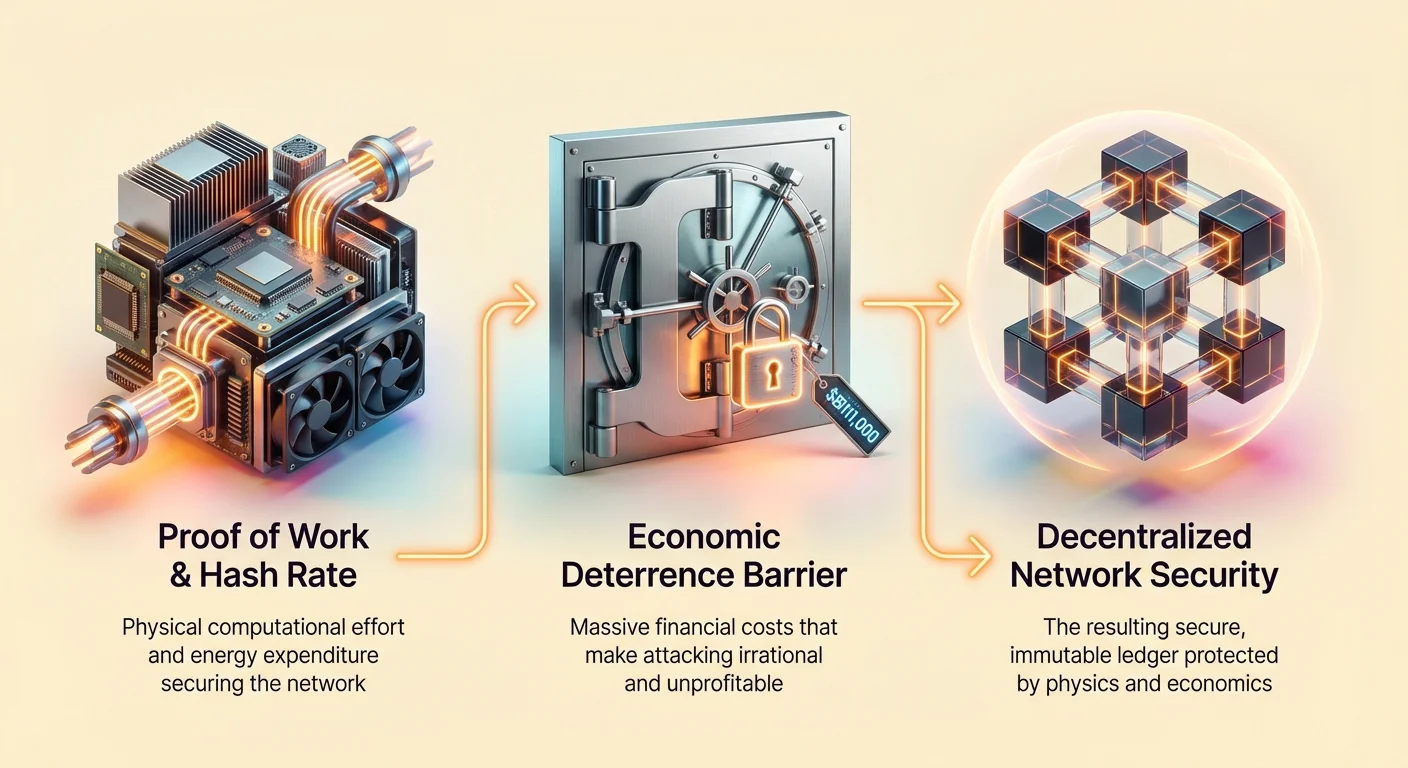
The Economics of Decentralized Security
To analyze potential attacks, we must first recognize what an attacker must overcome. Bitcoin uses the Proof of Work (PoW) consensus mechanism, which requires miners to expend real-world energy (electricity) to secure the network. This energy expenditure translates directly into a defense mechanism.
Defining Proof of Work and Network Hash Rate
Proof of Work is Bitcoin’s answer to the "Byzantine Generals Problem"—how can a distributed group agree on a single, undeniable truth without a central authority? The solution is to make lying extremely expensive.
Miners compete to solve a complex cryptographic puzzle. The first miner to find the solution gets to bundle the latest batch of transactions into a new "block" and append it to the existing blockchain. This successful miner is rewarded with newly minted bitcoin (the block subsidy) and transaction fees.
The hash rate is the total computational power dedicated to solving these puzzles. It is measured in hashes per second (H/s) and represents the collective force protecting the network. A high hash rate means greater security because an attacker needs a proportional amount of computational power to gain control. The hash rate is the security perimeter; the economic cost is the price tag of breaching that perimeter.
The Role of Economic Incentives
The entire system relies on cryptoeconomics—the study of combining cryptography with economic incentives to secure decentralized systems. Miners are rational economic actors. They invest millions in hardware and continuously pay for electricity. They participate because the rewards (block subsidies and fees) outweigh their costs.
For the system to remain secure, the economic incentive to play honestly must always be far greater than the incentive to cheat. The 51% attack is only successful if the attacker can generate a profit after accounting for the colossal capital and operational costs required to acquire half of the network’s global hashing power.
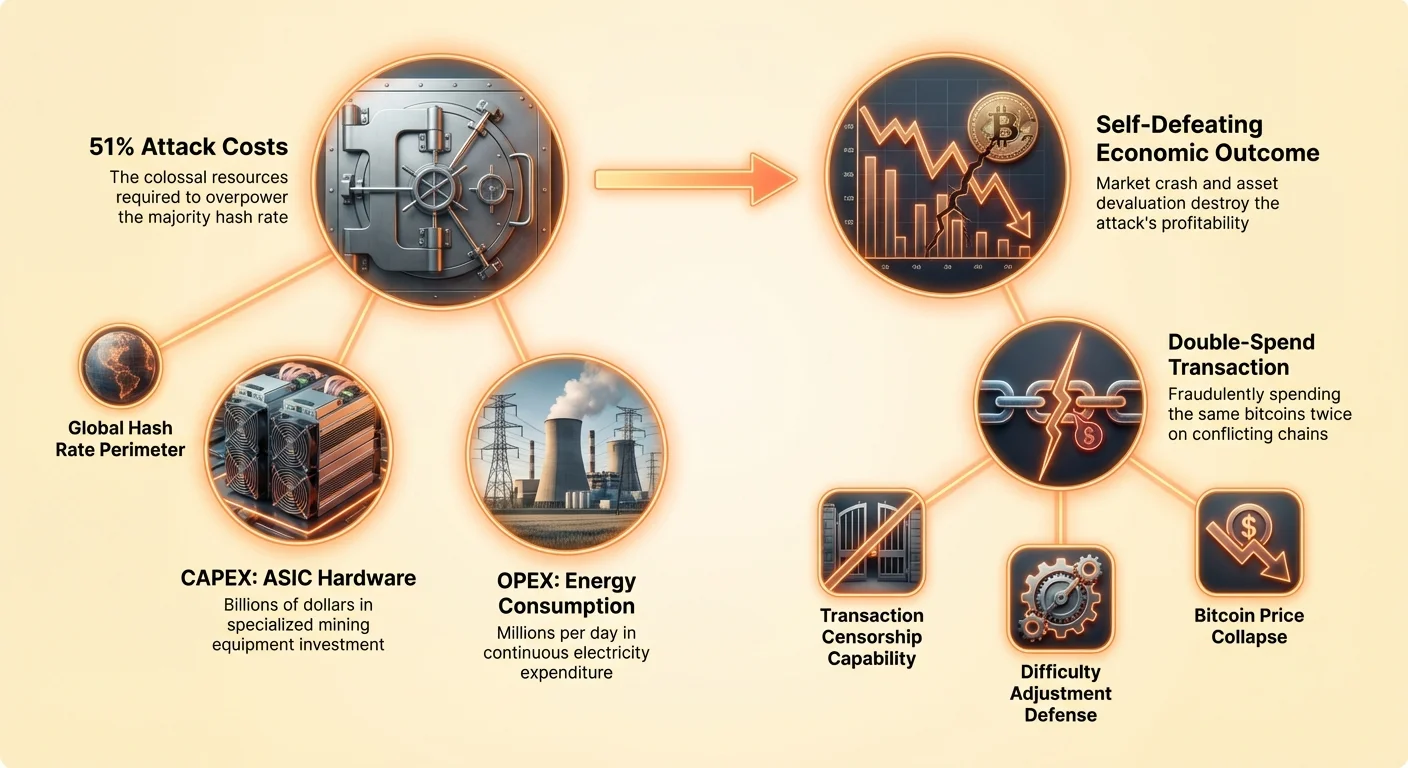
Understanding the 51% Attack Dynamics
The 51% attack is the primary, quantified threat model for all Proof of Work blockchains. It refers to a single entity, group, or coordinated nation-state gaining control of more than 50% of the network’s total mining hash rate.
Crucially, owning 51% of the hash rate does not grant the attacker the ability to:
- Steal existing coins from other people’s wallets.
- Change the rules of the protocol (e.g., increase the 21 million supply limit).
- Reverse transactions that have already been deeply confirmed (e.g., blocks buried 100 deep).
What an attacker can do is control the ordering and confirmation of new transactions. This leads to two major forms of malicious activity: double-spending and transaction censorship.
Double Spending: The Primary Financial Threat
The most profitable and concerning result of a 51% attack is the double spend. This is a specific form of fraud that allows the attacker to spend the same bitcoins twice.
Scenario:
- The attacker (A) sends 1,000 BTC to a large exchange (B) in exchange for fiat currency or another asset. This transaction (Transaction 1) enters the public memory pool and is eventually included in Block N by the honest network.
- Because the attacker controls 51% of the hash rate, they are simultaneously mining a private chain beginning just before Block N. In this private chain, they include a conflicting transaction (Transaction 2) that sends the same 1,000 BTC back to one of their own internal wallets.
- Once the attacker’s private chain becomes longer than the public chain (which requires 51%+ hash power), they broadcast their private chain to the public network.
- The longest chain always wins. When the network adopts the attacker’s longer chain, Transaction 1 (the payment to the exchange) is erased, and Transaction 2 (the return to the attacker’s wallet) is confirmed.
The result: The attacker received the exchange’s assets but retained the 1,000 BTC, effectively spending the same coins twice. For this attack to be successful and profitable, the victim (the exchange or vendor) must accept the transaction with very few confirmations (e.g., 1-2 blocks) before the attacker can overtake the chain.
Transaction Censorship: The Social Threat
A second major capability of a 51% attacker is transaction censorship. By controlling the majority of the mining power, the attacker dictates which pending transactions are included in new blocks.
If a government, cartel, or powerful entity wished to block transactions originating from a specific country, wallet, or person, they could execute this form of soft attack. Any transaction they wish to censor would be continually rejected from new blocks, preventing it from ever being confirmed.
While financially less catastrophic than a double spend, censorship undermines the core promise of Bitcoin as an open, permissionless network, creating a systemic failure that compromises its foundational value proposition.
Quantifying the Cost: The Economic Deterrence Model
The most effective barrier against a 51% attack is the immense economic cost required to succeed. This cost is so high that it serves as an effective deterrent, making the attack economically irrational.
The cost of a 51% attack can be broken down into three major components: Capital Expenditure (CAPEX), Operational Expenditure (OPEX), and Opportunity Cost.
Calculating the Capital Expenditure (CAPEX): Hardware
CAPEX involves the initial investment needed to acquire the necessary hardware. To achieve 51% of the hash rate, the attacker needs to purchase half of the total computational power currently securing the network.
1. Sourcing the Hardware: As of a given date, assume the Bitcoin network has a hash rate of 600 Exahashes per second (EH/s). An attacker needs 301 EH/s.
If the best available, modern ASIC mining machine (e.g., a high-end S21 miner) provides 200 Terahashes per second (TH/s), the calculation is:
- Required Hash Rate: 301,000,000 TH/s (301 EH/s)
- Miner Efficiency: 200 TH/s per machine
- Total Machines Needed: 1,505,000 ASIC units.
2. Acquisition Cost: If each high-end ASIC costs $5,000 (a reasonable, often conservative estimate for new hardware), the hardware cost alone is:
- 1,505,000 units * $5,000/unit = $7.525 Billion USD (approx.)
This calculation often overlooks logistical challenges. An attacker would not only need billions of dollars, but they would also need to procure roughly 1.5 million highly specialized machines, which are produced by only a handful of manufacturers globally. Attempting to purchase this quantity instantly would immediately alert the market, drive up prices significantly (making the attack even more expensive), and potentially lead to manufacturers refusing the sale for security reasons.
Calculating the Operational Expenditure (OPEX): Energy
Once the hardware is acquired, it must be powered. This is the continuous cost of the attack, usually calculated hourly or daily. This OPEX must be sustained for the entire duration of the double-spend attempt.
The energy consumption of an ASIC miner is substantial. If we assume the required fleet of 1.5 million machines draws an average of 3,500 Watts (3.5 kW) each:
- Total Power Draw: 1,505,000 machines * 3.5 kW/machine = 5,267,500 kW (or 5.27 Gigawatts).
- Comparison: This is the equivalent energy consumption of a large metropolitan city or several nuclear power plants.
- Cost: Assuming an industrial energy cost of $0.05 per kilowatt-hour (kWh), the daily electricity cost is:
- 5,267,500 kW * 24 hours * $0.05/kWh = $6.32 Million USD per day.
To execute a profitable double-spend attack (which may require several days or weeks of sustained effort to maximize profits), the attacker must be willing to burn tens or hundreds of millions of dollars in electricity alone.
The Opportunity Cost and Expected Profit
Beyond the tangible costs of CAPEX and OPEX, the attacker faces an enormous opportunity cost—the value of the rewards they forfeit by attacking the network instead of mining honestly.
When an attacker dedicates their $7.5 billion worth of hardware to a hostile chain, they forgo the regular block rewards (subsidy + fees) they would have earned by mining honestly. This honest revenue can easily reach tens of millions of dollars daily.
The Economic Deterrence Principle:
- Massive Upfront Cost: Billions in hardware required.
- Sustained Negative Cash Flow: Millions in electricity burned daily.
- Self-Defeating Outcome: The primary goal of a double-spend is to profit from a high Bitcoin price. However, the moment a 51% attack is successfully executed and confirmed by the public, confidence in Bitcoin would plummet. The price of BTC would crash, potentially erasing the entire value of the attack itself, including the coins the attacker tried to double-spend.
The attacker is forced to calculate: Is the profit gained from a temporary double-spend worth the immediate loss of billions in hardware investment and the destruction of the asset’s underlying value? For Bitcoin, the answer is demonstrably no.
Secondary Vulnerabilities: Censorship and Resource Exhaustion
While the 51% attack represents the existential, quantified threat, other attack vectors exist that do not require majority control but still compromise network function. These are often focused on manipulating the fee market or exhausting network resources.
Transaction Fee Manipulation and Spam Attacks
Bitcoin transactions include a network fee, which is paid to the miner who confirms the transaction. This fee determines the priority of the transaction. Attackers can attempt a resource exhaustion attack, often called a "spam attack," to clutter the transaction memory pool (mempool).
Mechanism:
- An attacker broadcasts millions of tiny transactions (or transactions with very low fees) to fill up the mempool.
- The backlog of unconfirmed transactions swells.
- Honest users wishing to get their transactions confirmed quickly must now bid significantly higher fees to jump ahead of the backlog.
Economic Cost to Attacker: The attacker must pay the minimum required fee for every spam transaction they broadcast. While they lose money on these low-value transactions, the goal is to drive up costs for everyone else, making the network temporarily unusable or extremely expensive for ordinary users.
However, the network effectively defends against this by making the spam attack increasingly expensive. Since miners always prioritize the transactions with the highest fees, a sustained, high-volume spam attack quickly becomes prohibitively costly for the attacker, as they are effectively outbidding themselves to maintain the congestion.
The Cost of Censorship Without 51% Control
Achieving absolute transaction censorship requires 51% control. However, a powerful mining cartel controlling, say, 30% of the hash rate could attempt targeted censorship.
Limitations of Partial Censorship: If 30% of the miners decide to ignore a specific person’s transactions, the remaining 70% of honest miners will eventually confirm those transactions. Censorship would simply mean a delay, forcing the censored transaction to wait a few extra blocks until an honest miner wins the block reward.
The economic cost of maintaining this partial censorship is primarily the opportunity cost. These cartel members would have to coordinate, potentially losing customers (pool members), and accept the public scrutiny that follows, while gaining no immediate financial benefit other than achieving a political goal (which is notoriously hard to monetize).
Regulatory and Social Attacks
The physical nature of mining creates a regulatory attack vector. Mining facilities are stationary, visible, and require licenses and energy contracts. A coordinated global regulatory effort could attempt to shut down or seize large mining operations.
Impact: A massive, coordinated shutdown would suddenly reduce the hash rate. While this doesn't constitute a 51% attack (it’s a hash rate reduction), it significantly lowers the bar for a subsequent attack by decreasing the total computational power an aggressor needs to acquire.
Bitcoin's Defense: The Difficulty Adjustment Mechanism (DAM). If the hash rate drops dramatically, the DAM automatically adjusts the difficulty downward approximately every two weeks (or every 2016 blocks). This ensures that blocks continue to be found at the targeted rate of one every ten minutes, stabilizing the network and restoring security by making the remaining hash rate more powerful relative to the adjusted difficulty.
The System's Defense Mechanisms: Game Theory and Incentives
Bitcoin’s security is often compared to a digital shield, but it is more accurately described as a self-healing economic organism that punishes bad actors. The three most critical defenses against economic attacks are the Difficulty Adjustment, the collective self-interest of honest miners, and the market reaction.
The Difficulty Adjustment Mechanism (DAM)
The DAM is Bitcoin's automatic stabilizing factor. It recalculates the complexity of the PoW puzzle based on the time it took to find the previous 2016 blocks.
How it Deterred Attackers:
- An attacker dedicates 51% of the hash rate to their private, fraudulent chain.
- The honest network suddenly sees the block production rate slow down (as the honest miners only have 49% of the power).
- If the attack continues for more than two weeks, the DAM will reduce the difficulty for the honest chain, making it easier for the honest 49% to find blocks quickly, increasing their efficiency, and forcing the attacker to dedicate even more computational power to stay ahead.
The DAM ensures that sustaining a 51% attack is an escalating arms race for the attacker, constantly raising their OPEX requirements.
Economic Self-Correction and Market Game Theory
The most fundamental deterrent is the market itself. The value of Bitcoin is inextricably linked to its integrity.
If an attacker successfully double-spends 10,000 BTC worth $500 million, the initial profit is $500 million. However, the moment the attack is verified, news agencies, exchanges, and self-custody adopters would recognize the network has been compromised.
Consequences of a Successful Attack:
- Price Collapse: The price of BTC would likely crash by 80% or more, instantly wiping out the vast majority of the attacker's profit and turning their $7.5 billion CAPEX investment (the hardware) into worthless metal, as the hardware is only valuable for mining a valuable cryptocurrency.
- Forking: If a 51% attack were successful, the community, developers, and honest miners would immediately coordinate a soft or hard fork to revert the fraudulent blocks and potentially change the underlying mining algorithm to render the attacker’s specialized hardware useless (e.g., if they moved from SHA-256 to another algorithm).
In this scenario, the attacker would have spent billions to achieve a short-term profit (the double spend) while guaranteeing the total destruction of their long-term assets (the hardware and any remaining BTC holdings). The risk-reward calculation makes the attack suicidal.
Summary: Bitcoin's Defense is Quantified Deterrence
Bitcoin’s security model is a masterpiece of game theory. It demonstrates that a decentralized system can achieve far greater security than centralized systems because its defense is public, quantifiable, and based on real-world energy expenditure rather than the shifting politics of regulation.
The core finding is that the cost of attacking Bitcoin—measured in billions of dollars in specialized hardware (CAPEX) and millions of dollars per day in energy (OPEX)—dwarf the potential short-term profits derived from a double-spend attempt. Furthermore, the attacker must face the near-certainty that a successful attack would destroy the underlying asset's value, rendering their massive investment obsolete.
This analysis confirms that Bitcoin is not secured by lines of code alone, but by a carefully balanced economic structure where the incentive to remain honest is mathematically superior to the incentive to cheat. The price of an attack is high, and the potential reward is negligible, solidifying Bitcoin's status as a fortress of digital self-sovereignty.
Actionable Takeaways for Users
- Prioritize Confirmation Depth: Never accept highly valuable Bitcoin payments based on zero or one confirmation. The greater the confirmation depth (6 blocks is standard, 60 blocks for high-value transactions), the exponentially higher the cost for an attacker to reverse the transaction.
- Monitor Hash Rate: Use public explorers to monitor the Bitcoin network's hash rate. While a high hash rate confirms security, any sudden, massive, and sustained drop could signal unusual activity or a regulatory crackdown, which increases vulnerability.
- Understand the Limits: Recognize that Bitcoin’s primary security guarantees are transaction ordering and finality, not key security. Your biggest security failure point is always the security of your private keys, not the network's consensus mechanism.