
When a payment is made using a traditional bank, the fee is generally static and determined by the institution or regulator. In the decentralized world of Bitcoin, however, the concept of a transaction fee is far more complex and dynamic. It is not a fixed tax levied by a central authority; rather, it is a highly volatile price determined minute-by-minute by pure supply and demand.
To truly understand Bitcoin’s security model and the competitive landscape of decentralized finance, one must analyze the fee market. This mechanism acts as a critical economic driver for the network, ensuring that only the most time-sensitive and economically relevant transactions are processed quickly during times of high stress.
This analysis views the Bitcoin fee structure as a congestion pricing mechanism. Much like surge pricing for a ride-share service during peak demand, fees rise when the system is full, effectively rationing scarce block space. By analyzing how this competitive market operates within the network’s waiting area—the mempool—we gain actionable knowledge for navigating the system efficiently and understanding the core incentives that secure the Bitcoin blockchain.
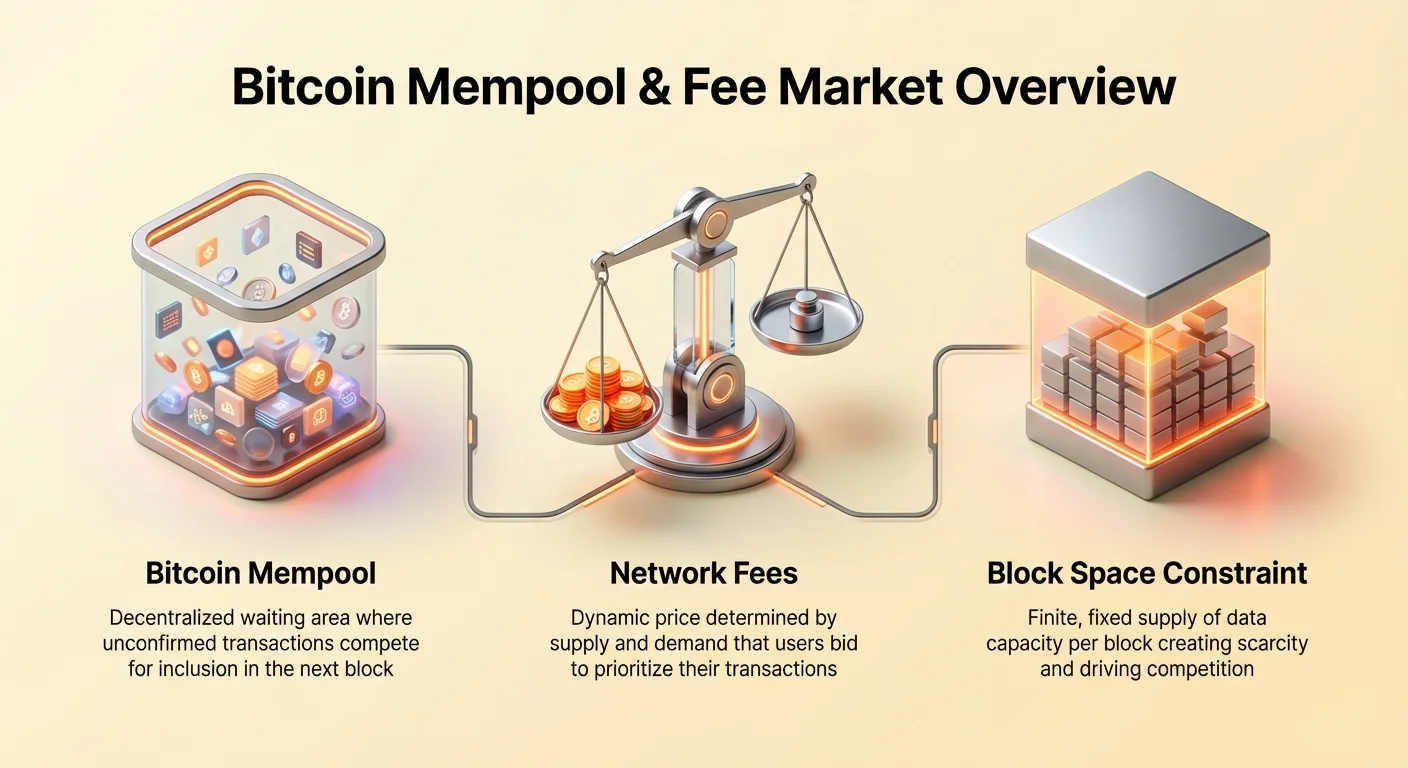
The Mempool: Bitcoin’s Waiting Room
Before any transaction is finalized on the Bitcoin blockchain, it must pass through a crucial staging area known as the memory pool, or mempool. The mempool is, quite simply, a collection of all valid, unconfirmed transactions floating across the decentralized network.
Imagine the mempool as a digital waiting room or a temporary parking lot. When you broadcast a transaction from your wallet, it doesn't immediately enter the blockchain; it first goes into the mempool of every node (computer) that heard the broadcast. It waits there, competing with every other pending transaction for the right to be included in the next valid block.
Visualizing the Mempool: The High-Stakes Auction
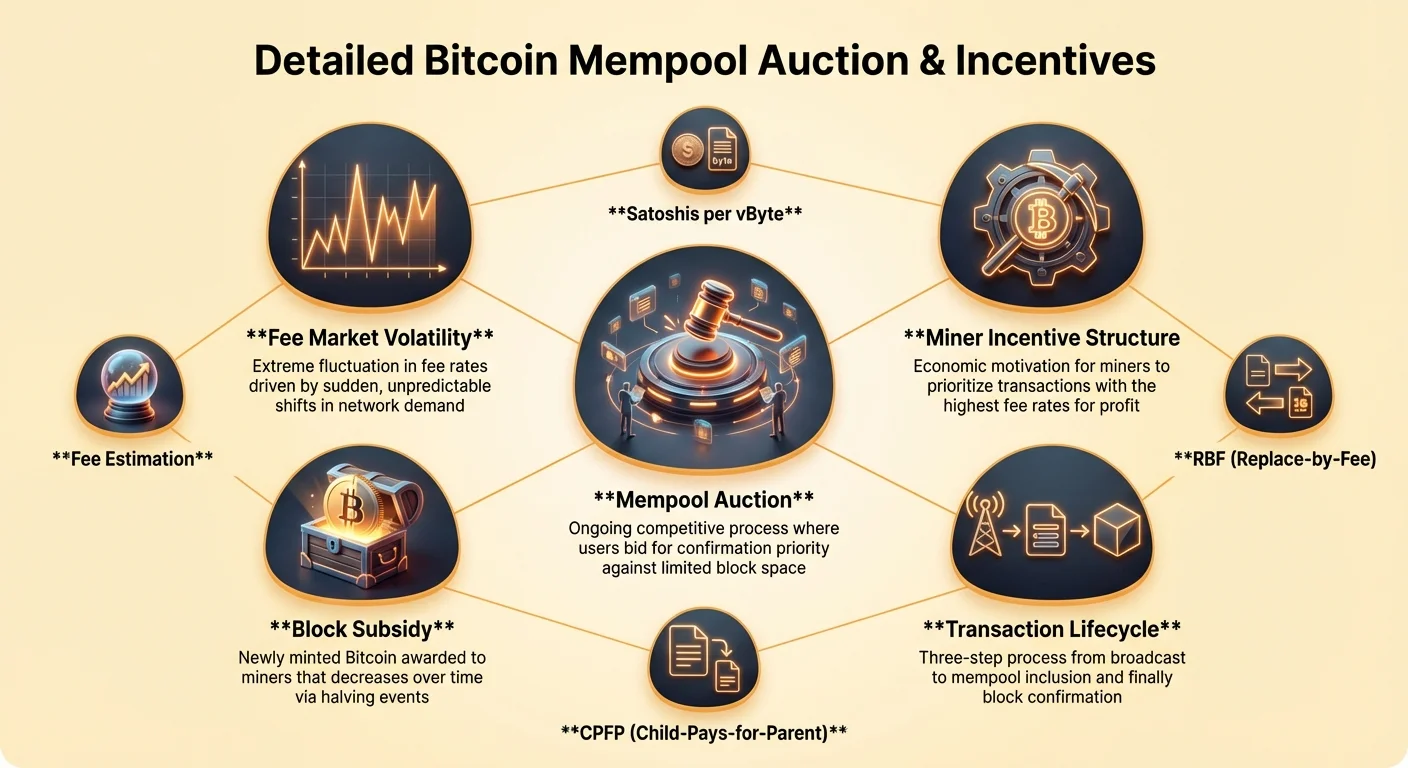
The mempool is best understood as a constant, ongoing auction house where users bid for confirmation priority.
Every transaction in the mempool is stamped with a fee rate, defining how much the sender is willing to pay per unit of data used. Since block space is limited (supply is fixed), miners—the entities responsible for creating the next block—naturally prioritize the transactions that offer the highest fees, maximizing their immediate profit.
This visualization clarifies why transactions can sometimes sit unconfirmed for hours or days: if the current demand for space is higher than the fee you offered, your bid is simply too low to win the auction.
The Transaction Lifecycle: From Broadcast to Confirmation
A Bitcoin transaction follows a standard, three-step lifecycle:
- Broadcast: The sender’s wallet creates a cryptographically signed transaction and sends it out to the nearest connected network nodes.
- Mempool Inclusion: Participating nodes validate the signature and format of the transaction. If valid, they add it to their local copy of the mempool and relay it to other nodes. This is where the waiting begins.
- Block Confirmation: A miner selects a batch of high-fee transactions from the mempool (enough to fill a block, generally limited to 1-4 megabytes of data), calculates the Proof of Work solution for that batch, and broadcasts the confirmed block to the network. Once the transaction is included in this block, it is considered confirmed.
Every transaction must eventually be selected by a miner, and that selection is governed almost exclusively by the fee rate relative to the existing mempool backlog.
Network Fees as Congestion Pricing
The defining characteristic of the Bitcoin network is its fixed supply of new blocks. On average, a new block is generated roughly every ten minutes. This creates a finite, predictable supply of "block space." When this fixed supply encounters variable demand, the price (the fee) becomes the mechanism for rationing.
The Block Space Constraint: The Supply Side
The fundamental constraint driving the fee market is the block size limit, which restricts how much data (how many transactions) can be included in any single block. This limit is essential for network stability and decentralization, ensuring that average users can still run a full node without excessive storage or bandwidth demands.
Since the supply of block space is rigidly constrained, high demand cannot be met by simply producing more space. Instead, users must compete using fees.
Analogy: Consider a popular one-lane toll bridge open only at peak hours. If a thousand cars (transactions) want to cross in a single minute, but the bridge can only handle fifty, the toll authority (the miners) will simply raise the price until only the fifty cars most desperate to cross are willing to pay. The fee acts as a filter.
Fee Rates vs. Transaction Value: Understanding Satoshis per vByte
When assessing fees, the dollar value of the transaction is irrelevant. A transfer of $1 million requires the same amount of physical space in a block as a transfer of $10, assuming both have the same number of inputs and outputs (governed by the UTXO model).
Therefore, the key metric for determining competitiveness is the fee rate, measured in:
- Satoshis (sats): The smallest unit of Bitcoin (1 BTC = 100,000,000 sats).
- Virtual Byte (vByte): A standardized unit representing the weight or size of the transaction data.
Miners look at the number of satoshis paid for every byte of data space used. If Transaction A pays 50 sat/vB and Transaction B pays 10 sat/vB, a miner will prioritize Transaction A, regardless of the USD value of the BTC being moved. This ensures the market is fair and focused purely on maximizing the miner's return on their limited resource: block space.
The Miner’s Incentive Structure: Profit Maximization
Miners are highly competitive, economically rational actors. Their goal is to maximize the revenue derived from confirming a block. This revenue comes from two sources:
- The Block Subsidy: Newly minted BTC (currently 6.25 BTC, which halves approximately every four years).
- Transaction Fees: The sum of all fees from the selected transactions.
As the block subsidy consistently decreases over time due to the Halving mechanism, transaction fees become an increasingly vital component of the miner's revenue stream. Therefore, miners have a powerful economic incentive to:
- Select the highest-paying transactions: Miners are constantly optimizing their block templates to include the set of transactions that yield the absolute highest
sat/vBratio. - Keep the network secure: High fees reinforce the economic security of the network, ensuring that miners continue to dedicate substantial energy and hardware (hashpower) to validating the chain, thereby preventing attacks.
Decoding Fee Market Volatility and Estimation
The Bitcoin fee market is famous for its extreme volatility. Fees can swing from under 5 sat/vB during quiet periods to hundreds of sat/vB when the network is under load. Understanding the drivers of these spikes and how estimation tools work is crucial for efficient self-custody.
Factors Driving Fee Spikes
Fee volatility is directly tied to sudden, unpredictable shifts in network demand. Several common events trigger high congestion:
1. Speculative Frenzies and Market Events
When crypto markets experience high volatility (sharp moves up or down), traders rush to move funds between exchanges or wallets. This creates a massive, coordinated demand for confirmations, overwhelming the mempool and driving fee rates sharply upward.
2. Network Innovation and New Use Cases
The introduction of new protocols that utilize block space creatively, such as the rise of Ordinals and Inscriptions, can dramatically increase the baseline demand. These mechanisms involve storing non-financial data directly on the blockchain, treating the block space as a storage medium rather than just a transfer ledger, leading to sustained periods of higher competition.
3. Large Transaction Backlogs
If fees are low for an extended period, many users may attempt to process large batched transactions or lower-priority payments. If a sudden demand spike occurs, all the previously "cheap" transactions remain in the mempool, contributing to a large backlog. Clearing this backlog requires even higher fees, creating a feedback loop of congestion.
How Fee Estimation Works: Predicting the Cut-Off Price
For the average user, setting the "right" fee can feel like guesswork. Fortunately, wallets and services utilize sophisticated algorithms to estimate the competitive rate.
Fee estimation algorithms analyze the state of the mempool in real-time. They look at the size of the backlog (how many bytes are waiting) and the distribution of current fee rates being offered. They calculate what the lowest accepted fee rate was in the last few confirmed blocks (the "cut-off price") and project what fee is likely needed to clear a transaction in the next 1, 3, or 6 blocks.
- Fast Confirmation (1-3 Blocks): Requires bidding above the median rate of the entire mempool to ensure immediate selection.
- Economical Confirmation (6+ Blocks): Requires bidding slightly above the rate of the oldest transactions, assuming future demand does not increase dramatically.
The Risk of Underpaying: The Cost of Being Stale
When a user underpays the fee, the transaction remains in the mempool. If the congestion persists, the transaction risks being dropped entirely.
Nodes are programmed to enforce memory limits and often discard transactions older than 72 hours if they have not been confirmed, effectively clearing out the lowest-bidding "stale" transactions. A dropped transaction is not lost; the funds return to the sender's wallet to be spent again, but the user is forced to re-broadcast the transaction with a higher, current fee, wasting time and effort.
Advanced Fee Strategies for the Self-Sovereign User
One of the benefits of self-custody is having full control over transaction creation. If you find your transaction stuck in the mempool, you have active strategies available to accelerate its confirmation, treating the fee market as a dynamic variable rather than a static cost.
RBF (Replace-by-Fee): Speeding Up Transactions
Replace-by-Fee (RBF) is a crucial mechanism that allows a user to replace an unconfirmed, low-fee transaction with a new transaction that pays a higher fee.
How it Works:
- You send Transaction A with a low fee (e.g., 5 sat/vB).
- The mempool becomes congested, and Transaction A stalls.
- You create Transaction B, which is structurally identical to A (same sender, same recipient, same amount) but includes a significantly higher fee (e.g., 50 sat/vB).
- Transaction B is broadcast. Miners see that Transaction B pays them more than Transaction A and, by economic self-interest, they will select B and discard A.
RBF is a highly effective way to mitigate the risk of underpaying during volatile periods. However, the original transaction must have been broadcast with the RBF flag enabled, otherwise, many nodes will reject the replacement attempt, viewing it as a double-spend.
CPFP (Child-Pays-for-Parent): Bumping Fees Collaboratively
Child-Pays-for-Parent (CPFP) is an advanced strategy used when the original sender cannot or will not bump the fee. This strategy is possible because Bitcoin transactions use the UTXO (Unspent Transaction Output) model.
How it Works:
- The Parent Transaction (A) is sent with a low fee and is unconfirmed. The recipient receives the output (the change of ownership) but cannot spend the funds until A confirms.
- The Recipient (now the owner of the unconfirmed UTXO) creates a Child Transaction (B) where they immediately spend the funds received in A.
- The recipient sets an extremely high fee on Transaction B.
- Miners recognize that to validate Transaction B (the high-fee Child), they must first include Transaction A (the low-fee Parent) in the block. Miners are incentivized to include both transactions together to claim the high fee of the child.
CPFP shifts the responsibility for accelerating confirmation to the recipient, turning a stuck transaction into a mutual opportunity for confirmation.
Actionable Tips for Optimal Fee Selection
For users practicing self-custody, navigating the fee market requires vigilance:
| Strategy | When to Use It | Actionable Tip |
|---|---|---|
| Batching | Sending funds to multiple recipients. | Combine multiple outputs into a single transaction to save on fees, as you only pay for one set of inputs. |
| Time Preference | Sending high-priority vs. low-priority payments. | Always estimate fees based on your urgency. If confirmation in 24 hours is acceptable, use a low fee; check the mempool depth first. |
| Enable RBF | Preparing for potential congestion. | Always enable the RBF feature in your wallet settings for any non-final transaction (like payments to exchanges), giving you an escape route if your transaction stalls. |
| Monitoring | Sending any time-sensitive transaction. | Use a reliable third-party mempool visualization tool before broadcasting to assess current congestion levels and median fee requirements. |
The Economic Necessity of High Fees
While high fees are often seen by users as an annoyance or a barrier to entry, they are an absolutely critical component of Bitcoin's long-term economic sustainability and security model.
Securing the Network Post-Halving
As established by Satoshi Nakamoto, the issuance of new Bitcoin (the block subsidy) is cut in half approximately every four years. Eventually, the subsidy will drop to zero, and no new Bitcoin will be created. At that point, the only source of revenue for miners will be transaction fees.
If transaction fees were consistently near zero, miners would lack the incentive to spend billions of dollars on hardware and electricity necessary to secure the network. The resulting low hashrate would make the network vulnerable to a 51% attack.
Therefore, the existence of a competitive fee market that can generate substantial revenue (even if volatile) is the fundamental long-term cryptoeconomic mechanism ensuring Bitcoin’s security after the subsidy ends. High fees are not just a market function; they are the price paid for decentralized, unchangeable security. The congestion pricing model ensures that those who use and value the network pay for its maintenance and defense.
Zaključek
Trg bitcoinskih provizij je čist primer decentralizirane gospodarske uprave. Gre za realnočasovno, globalno dražbo, ki dinamično ceni končen, neproizvodljiv vir: prostor na blockchainu. Z razumevanjem mempoola kot čakalne sobe, prepoznavanjem provizij kot cenitve gneče in obvladovanjem strategij, kot sta RBF in CPFP, lahko uporabniki preidejo od preproste plačevanja provizij k aktivni udeležbi in navigaciji po spodbudnih strukturah, ki podpirajo najvarnejšo digitalno valuto na svetu.