
Bitcoin is often described as digital money run by code. This is true, but it leaves out a crucial element: who controls the code? Unlike a traditional corporation, which operates under hierarchical management, or a government, which relies on parliamentary voting, Bitcoin’s protocol changes are governed by a unique, messy, and highly decentralized political process. This system is designed specifically to make major changes difficult, ensuring the currency’s stability and predictability over the long term.
Understanding Bitcoin governance is essential for grasping its true resilience. It explains why radical changes, even those potentially beneficial, take years to implement, requiring debates that stretch across developer mailing lists, mining pools, and the homes of individual users running validation nodes. This high-friction political economy acts as a constitutional safeguard, protecting the network from hasty decisions and malicious actors.
This analysis dives deep into the mechanisms of protocol change, examining the lifecycle of an idea—from its initial proposal as a Bitcoin Improvement Proposal (BIP) to its eventual adoption via consensus mechanisms like Soft Forks. We explore the delicate balance of power between developers, miners, and the users who run the full nodes, ultimately revealing why Bitcoin’s resistance to change is its most powerful feature.
The Foundation of Change: The Bitcoin Improvement Proposal (BIP) System
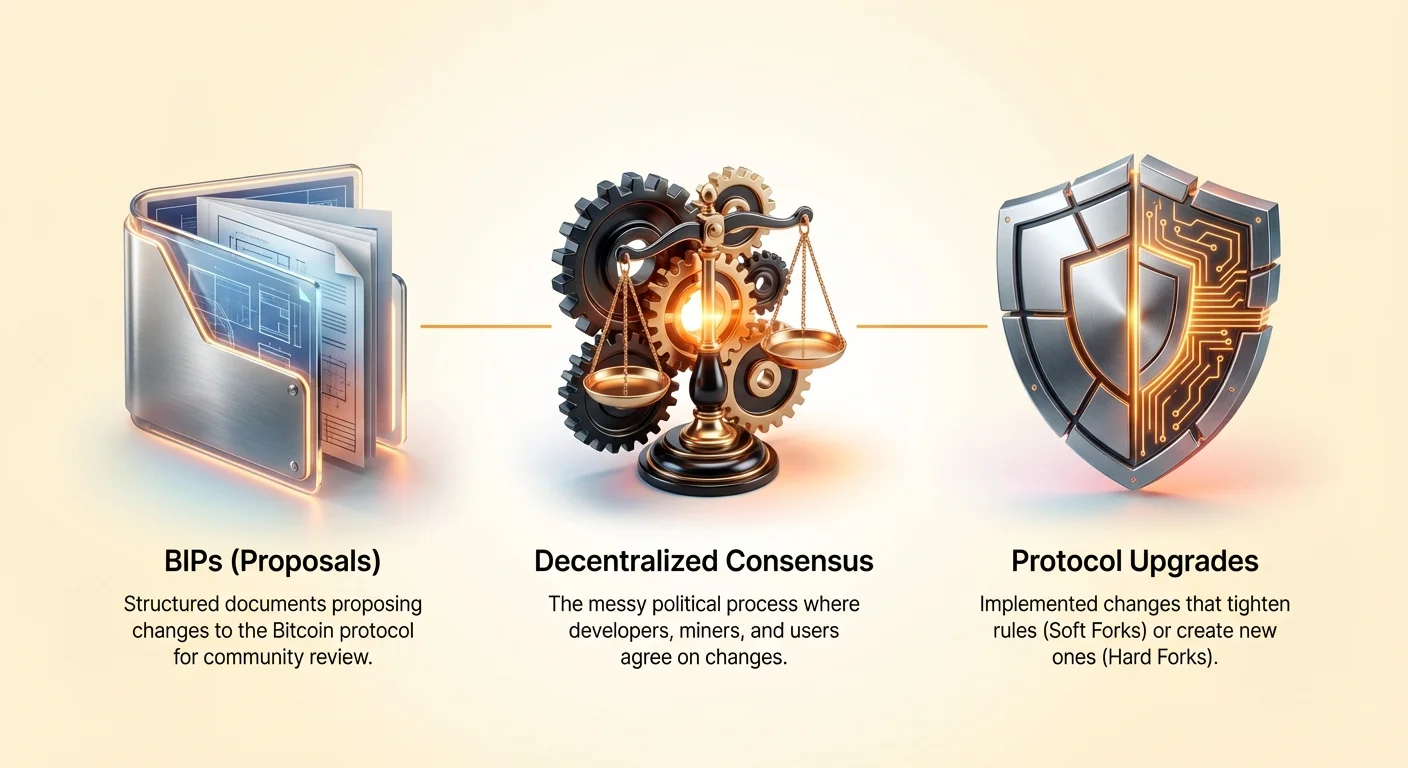
Since Bitcoin has no centralized authority, it needed a formal, public process for proposing, discussing, and documenting changes to the protocol. This mechanism is known as the Bitcoin Improvement Proposal, or BIP. The BIP system provides the necessary structure to manage technical consensus, turning abstract ideas into formal proposals ready for community scrutiny.
Think of the BIP system as the constitutional drafting room for Bitcoin. It is a mandatory starting point for any significant non-trivial change, from slight adjustments to fee calculations to sweeping changes in how transactions are validated.
Anatomy of a BIP
A BIP is a structured document that describes a specific change, feature, or design improvement for Bitcoin. Each BIP is assigned a sequential number (e.g., BIP 1, BIP 341) and must meet strict requirements to be considered valid. These requirements ensure clarity, technical soundness, and thorough consideration of side effects.
There are generally three types of BIPs, though the most relevant for governance are the "Standards Track" BIPs, which propose changes affecting the protocol itself (like transaction format or consensus rules). A successful BIP must clearly define:
- Motivation: Why is this change necessary? What problem does it solve?
- Specification: The technical details of how the change will be implemented in the code. This must be precise enough for developers globally to code against it.
- Backwards Compatibility: Will this change break compatibility with older versions of the software? (This determines whether the change requires a Soft Fork or a Hard Fork.)
The existence of the BIP process enforces transparency. It ensures that every critical technical adjustment is subjected to open-source scrutiny, often by hundreds of independent cryptographers and developers who analyze the code for flaws, economic side effects, and security vulnerabilities. This public review phase is the essential friction that protects the system.
The Role of Core Developers and Maintainers
While anyone can propose a BIP, its development, refinement, and eventual merge into the reference implementation (Bitcoin Core) are overseen by a small, dedicated group known as Bitcoin Core developers and maintainers. These individuals are not an official ruling body; rather, they are trusted volunteers whose primary function is code review, maintenance, and risk assessment.
Bitcoin Core is the foundational software that most nodes and infrastructure services run, making its codebase highly influential. The maintainers are responsible for assessing whether a BIP is technically ready and whether it has garnered sufficient social consensus within the development community.
Crucially, developers cannot force adoption. They write the software, but the miners and, more importantly, the users must voluntarily download and run the updated software. If the developers were to implement a change the community hated, users would simply reject the code and find alternative software, effectively stripping the developers of their influence. Their power rests solely on trust, expertise, and technical neutrality.
Why the BIP Process is Necessary Friction
In fast-moving centralized technology companies, agility is paramount. Changes are pushed quickly. For Bitcoin, the opposite is true. The BIP process is intentionally slow and argumentative because the network's primary value is its immutability and predictability.
If Bitcoin were easy to change, it would lose its credibility as an immutable store of value. The slow, multi-year discussion inherent in the BIP process acts as a political filter:
- Vetting Economic Impact: Slow rollout allows economists and analysts to study potential impacts, such as changes to transaction fees or the incentives for mining.
- Preventing Centralization: By requiring broad agreement across different political, economic, and geographic interests, the process prevents any single powerful entity (like a massive mining pool or a centralized exchange) from unilaterally dictating policy.
- Ensuring Quality: Time allows code to be reviewed, stress-tested, and audited repeatedly, reducing the risk of catastrophic bugs entering the core protocol.
The difficulty of passing a BIP is a feature, not a bug, ensuring that only changes with overwhelming technical and social support ever move forward.
The Two Paths of Protocol Change: Soft Forks vs. Hard Forks
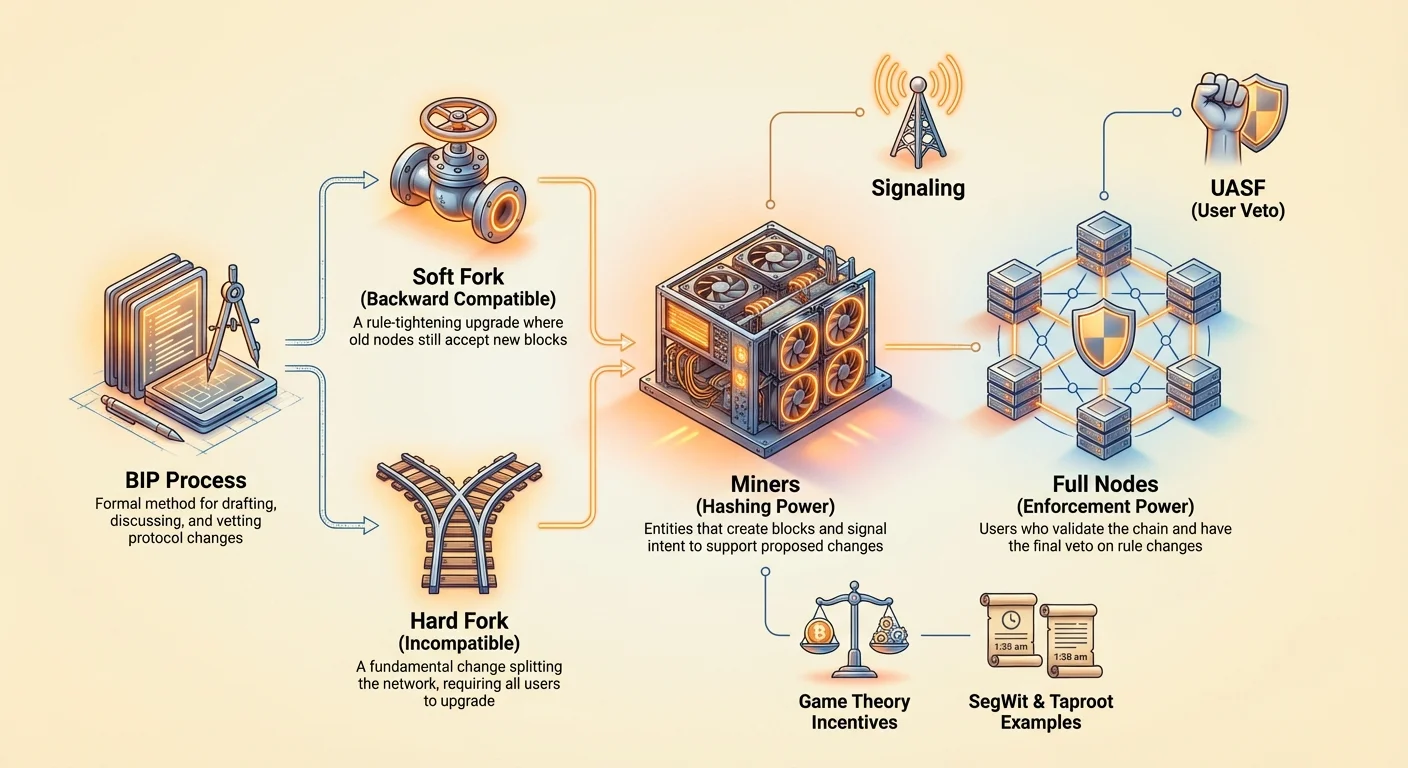
Once a BIP has been drafted and discussed, developers must decide how to implement it. This implementation strategy defines the level of network coordination required and, critically, the potential risk of splitting the community. This choice boils down to two main types of protocol upgrades: Soft Forks and Hard Forks.
These forks are not merely software updates; they represent fundamentally different approaches to achieving consensus and maintaining backward compatibility.
Soft Forks: The Backward-Compatible Upgrade
A Soft Fork is a change to the Bitcoin protocol that tightens the rules, meaning the new rules are compatible with the old rules.
Imagine upgrading a software application so that the new version can read all the old files, but the old version cannot necessarily read all the new files. In the context of Bitcoin:
- New Rules: Nodes running the upgraded software (the Soft Fork) enforce the new, stricter set of rules.
- Old Rules: Nodes running the old software (pre-upgrade) still accept the transactions validated by the upgraded nodes, because the upgraded nodes are following a subset of the original rules.
For example, if a Soft Fork states that all blocks must now be slightly smaller than they were before (tightening the rule), the older nodes will still consider these smaller blocks valid, as they still adhere to the original, maximum size limit.
Soft Forks are the preferred method of upgrading Bitcoin because they require only a majority of the network (typically miners representing 95% of hashing power or a majority of nodes) to adopt the change. The remaining minority of older nodes can continue to operate without breaking the chain, though they may not be able to fully validate or use the new features. This inherent backward compatibility greatly reduces the risk of a messy chain split.
Hard Forks: The Nuclear Option
A Hard Fork is a fundamental change to the protocol that makes the new rules incompatible with the old rules. It requires every single participant—miners, nodes, and wallets—to upgrade their software to follow the new consensus.
If a Hard Fork is activated, the network literally splits into two separate chains:
- The New Chain: Follows the new set of rules (e.g., significantly larger block sizes).
- The Old Chain: Continues following the original rules.
Nodes that have not upgraded will reject any blocks created under the new rules, believing them to be invalid. If a significant group continues to mine and validate the old chain, two separate versions of Bitcoin will exist simultaneously.
Hard Forks are highly disruptive and carry immense economic risk. Because the split is permanent unless one chain is completely abandoned, the community must be near-unanimous before a Hard Fork is attempted. If successful, users on the old chain suddenly find themselves holding a potentially worthless asset, while the new chain becomes the dominant version of Bitcoin. The threat of an economic split means Hard Forks are reserved only for critical fixes or changes where backward compatibility is impossible.
The Governance Test: Why Hard Forks are Feared
The primary function of a Hard Fork in Bitcoin governance is to serve as a massive deterrent against conflict. The potential for a split forces competing interests—such as miners who want higher fees versus users who prioritize decentralization—to compromise.
The classic example illustrating this fear occurred during the 2017 scaling debates. A group attempted to force a Hard Fork (known as SegWit2x) to increase the block size limit significantly. The proposal ultimately failed because the user community and core developers rejected the risk of fracturing the brand and liquidity of Bitcoin. The market made clear that preserving Bitcoin’s unified identity was more valuable than accommodating a technical change that lacked overwhelming consensus.
This dynamic demonstrates that the economic value of the network—the combined trust and liquidity—acts as the ultimate constraint on governance. Any group pushing a Hard Fork risks losing all economic support if the broader community decides to stick with the established, proven chain.
Achieving Consensus: Signaling, Auditing, and Enforcement
While developers draft the code and choose the fork type, the political act of adoption requires a complex three-stage process involving miners, full nodes, and time-based mechanisms. This interplay of signaling (voting intention), auditing (checking the code), and enforcement (rejecting invalid blocks) is the heart of decentralized governance.
The key insight here is that power is distributed: miners propose, but users dispose.
Miners vs. Nodes: The Two Forms of Validation Power
In Bitcoin governance, it is critical to distinguish between two types of power holders:
1. Miners (Hashing Power)
Miners, who execute the Proof-of-Work (PoW) algorithm, have the power to create blocks. When a Soft Fork is proposed, developers define a mechanism for miners to signal their support. This signaling is typically done by embedding a specific piece of data (a "flag") into the block header they produce.
If 95% of all mined blocks within a defined period signal support for the Soft Fork, the change is considered ready for activation. Miners' signaling is important because they are the ones enforcing the new rules when creating blocks. However, miner signaling is merely an intent to comply, not the final authority. Miners can be pressured by economic incentives to signal support, even if they dislike the change.
2. Full Nodes (Enforcement Power)
Full nodes are computers running the entire Bitcoin software, downloading and validating every single transaction and block since the network’s inception. Nodes are primarily run by users, exchanges, businesses, and wallets. Nodes do not signal support like miners; they enforce the rules.
If miners were to activate a change that the majority of nodes found unacceptable, the nodes would simply reject any blocks created under the new, unwanted rules. By rejecting those blocks, the nodes effectively remove the miners’ reward, as the block is orphaned and the transaction fees are lost.
In essence, miners must follow the rules set by the nodes, because if the nodes reject their blocks, their mining effort is economically wasted. The full nodes act as the ultimate auditors and gatekeepers of the monetary policy.
Activation Mechanism: The Role of Signaling
To manage the chaotic process of decentralized activation, Soft Forks utilize time-locked activation mechanisms designed to ensure adequate network preparedness.
A common approach involves a multi-period signaling phase, often called "Flag Day" signaling:
- Start of Signaling: The new code is released, and miners begin signaling their readiness via block headers.
- Threshold Period: The network watches a fixed number of blocks (e.g., 2,016 blocks, or roughly two weeks).
- Activation: If the required threshold (e.g., 95%) of those blocks signal readiness, the clock starts ticking for the actual lock-in. A few thousand blocks later (providing a grace period), the new rule permanently activates.
This mechanism ensures that the change is deployed predictably and only after a clear, measured demonstration of support from the economically powerful mining sector. This process formalizes the political compromise: developers write the code, miners vote for its activation, and users prepare their nodes to enforce it.
User Activated Soft Forks (UASFs): When Users Take the Wheel
The balance of power was famously tested during the debates surrounding Segregated Witness (SegWit), a Soft Fork designed to improve transaction efficiency. When miners resisted signaling for SegWit’s activation, citing economic concerns, the community had to prove that the full nodes held the ultimate power.
This led to the concept of a User Activated Soft Fork (UASF).
A UASF is a Soft Fork where the activation trigger is based on time, not miner signaling. In a UASF, nodes (the users) unilaterally decide on a future date to begin enforcing the new rule, regardless of what the miners signal.
The most famous example is BIP 148, which proposed activating SegWit by a specific date. The nodes running BIP 148 stated: "After Date X, we will only accept blocks that are signaling SegWit readiness."
The game theory here is critical. If 51% of the hashing power refused to signal, but a large portion of the economically relevant nodes (exchanges, payment processors, major wallets) were running the UASF software, the miners would face a tough choice:
- Continue mining non-signaling blocks: These blocks would be rejected by the UASF nodes, leading to financial loss.
- Start signaling and adopt the rule: Preserve their mining income and align with user consensus.
The UASF threat successfully forced the mining pools to adopt the change, demonstrating that in Bitcoin’s decentralized political economy, user preference and node enforcement trump miner signaling when push comes to shove. The UASF solidified the principle that running a full node is the final veto power in the Bitcoin ecosystem.
Case Studies in Bitcoin Governance: Lessons Learned
Examining successful and tumultuous governance events provides crucial context for understanding the high-friction environment of protocol change. These events are economic battles waged through code, proving that consensus is costly and requires significant political effort.
SegWit (BIP 141): A Study in Friction and Compromise
Segregated Witness, or SegWit, was perhaps the most hotly contested Soft Fork in Bitcoin’s history. Proposed in 2015 and eventually activated in 2017, the two-year debate highlights the sheer difficulty of making non-trivial changes.
The Conflict: SegWit was designed to fix transaction malleability and increase transaction capacity indirectly. However, many large mining interests opposed it, preferring a straightforward Hard Fork increase of the block size (the SegWit2x proposal). The conflict was fundamentally political: centralized mining interests versus decentralized developer and user interests.
The Resolution: The resolution involved three parallel governance strategies:
- Developer Consensus (Soft Fork Choice): Developers insisted on a Soft Fork (BIP 141) to avoid the risk of splitting the chain.
- Economic Consensus (The New York Agreement): A compromise, primarily with centralized businesses, was attempted (SegWit2x), but ultimately failed because it lacked user adoption.
- User Power (UASF/BIP 148): The threat of the UASF was the decisive factor. By signaling the willingness of users to reject non-compliant blocks, the users demonstrated that they held the ultimate power over the network rules.
The success of SegWit proved that while miners can slow down activation, they cannot unilaterally block a change that has overwhelming technical and user support, especially when critical infrastructure depends on the update.
Taproot (BIPs 340, 341, 342): The Quiet Success of Speedy Trial
Contrast the tumultuous SegWit activation with Taproot, a major upgrade activated in 2021. Taproot provided significant improvements to privacy, efficiency, and smart contract capabilities. Due to the lessons learned from SegWit, the governance process for Taproot was streamlined using a new activation method: Speedy Trial.
The Speedy Trial Mechanism: Instead of the typical fixed-time lock-in, Speedy Trial set a 90% signaling threshold over a two-week period, but it also included an expiration date.
- If 90% of miners signaled support within the window, the change would lock-in quickly (Speedy Trial success).
- If the threshold was not met, the process would fail, forcing the community to return to the drawing board—potentially considering a contentious UASF approach later.
This structured, time-limited approach put pressure on miners to reach consensus quickly, knowing that failure to signal would force a return to difficult governance negotiations. Taproot achieved the 90% signaling threshold relatively quickly, demonstrating that when a change is technically sound, non-controversial, and well-supported by developers, the network can upgrade efficiently.
Taproot proved that Bitcoin governance is evolving. While still messy, the community learned to structure political incentives to encourage timely activation, while still maintaining the requirement for high-threshold consensus.
The Crux of Decentralization: Why Governance Must Be Messy
We have established that Bitcoin governance is not sleek or efficient. It is often slow, agonizing, and highly argumentative. This inefficiency is, paradoxically, the source of its strength and its appeal as a hard money asset. The resistance to change ensures the integrity of the core value proposition: reliable, predictable, and finite issuance.
The high-friction governance model ensures that Bitcoin remains politically decentralized, incapable of being steered by a single powerful corporate entity or government.
The Cost of Change vs. The Value of Predictability
In the world of finance, unpredictability equals risk. Bitcoin’s value proposition is based on its hard-coded monetary policy—the supply limit of 21 million coins. If the protocol rules were easy to change, the promise of this fixed limit would be undermined.
The governance process requires potential changes to clear a massive hurdle of social, technical, and economic vetting. This "cost of change" guarantees:
- Monetary Policy Integrity: It is nearly impossible to alter the 21 million supply limit or the issuance schedule without causing a catastrophic chain split that would destroy the coin’s economic value.
- Predictability: Businesses, exchanges, and institutional investors can commit capital to the Bitcoin ecosystem knowing that the fundamental rules will not change unexpectedly.
- Trustlessness: Users don’t have to trust a CEO or Board of Directors to maintain the rules; they trust the political inertia and the economic deterrents embedded in the governance model.
The inefficiency of governance is the price paid for achieving monetary finality and decentralized trust.
The Game Theory of Protocol Adherence
The security of Bitcoin governance ultimately rests on Game Theory—the study of strategic decision-making among competing entities.
Every participant in the Bitcoin network (miners, developers, and users) has a distinct incentive:
- Developers: Incentivized to propose high-quality, secure code that preserves the network’s reputation.
- Miners: Incentivized to maximize profit, meaning they must choose the chain that the majority of users (nodes) will accept, ensuring their mined blocks earn rewards.
- Users (Nodes): Incentivized to maintain the rules they initially signed up for, preserving the integrity of their investment.
This creates a Nash Equilibrium where the optimal strategy for every party is to adhere to the rules enforced by the full nodes. If any powerful entity attempts to break consensus (e.g., a mining pool trying to push a contentious Hard Fork), the economic punishment (forking the chain and destroying liquidity) is so severe that it outweighs any potential short-term technical gain.
Therefore, the messy process of Bitcoin governance, characterized by BIPs, contentious debates, and the ever-present threat of User Activated Soft Forks, is not a failure of design. It is the successful implementation of cryptoeconomic security, ensuring that political decentralization is maintained alongside technical decentralization. The code runs the money, but consensus runs the code.