
Dobrodošli v končni vodnik po varnosti kripto. Ko držite kriptovaluto, postanete svoja lastna banka, kar pomeni, da ste v celoti odgovorni za zaščito svojih sredstev. V digitalni ekonomiji največja grožnja običajno ni napaka v verigi blokov, temveč ogroženost vaše osebne varnosti.
Za nove uporabnike je najpomembnejši korak k samo-suverenosti razumevanje razlike med »vročim shranjevanjem« (denarnicami, povezanimi z internetom, kot so mobilne aplikacije ali borze) in »hladnim shranjevanjem«. Hladno shranjevanje se nanaša na katero koli metodo shranjevanja vaših zasebnih ključev popolnoma brez povezave, s čimer jih izolirate pred ranljivostmi interneta.
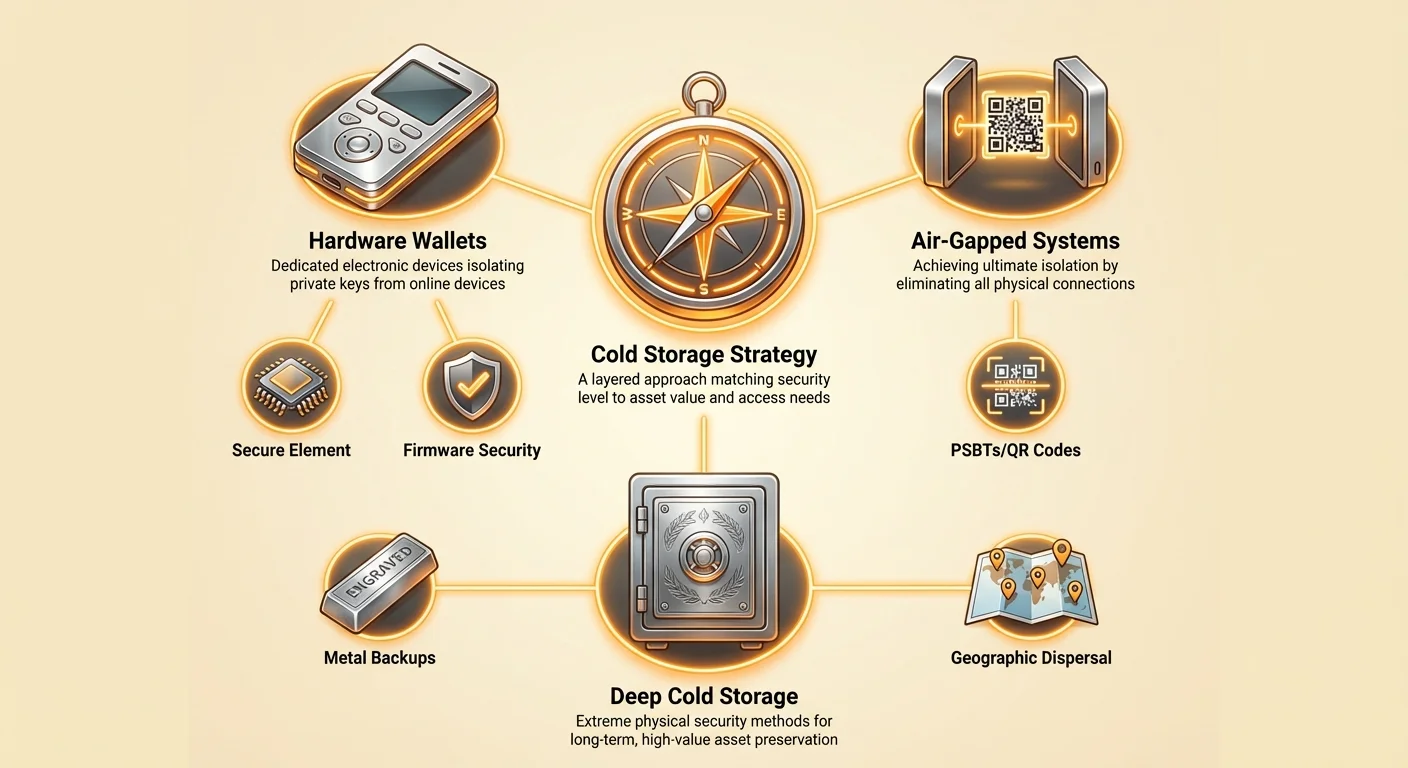
Ta vodnik presega preproste definicije. Ustanovili bomo hierarhijo rešitev za hladno shranjevanje, začnemo s široko sprejetimi strojnimi denarnicami in se premaknemo v ekstremne, napredne varnostne nastavitve, kot so zračno ločeni sistemi. Z razumevanjem te varnostne hierarhije lahko ustrezno raven zaščite prilagodite vrednosti svojih skupnih sredstev in vaši osebni toleranci do tveganj.
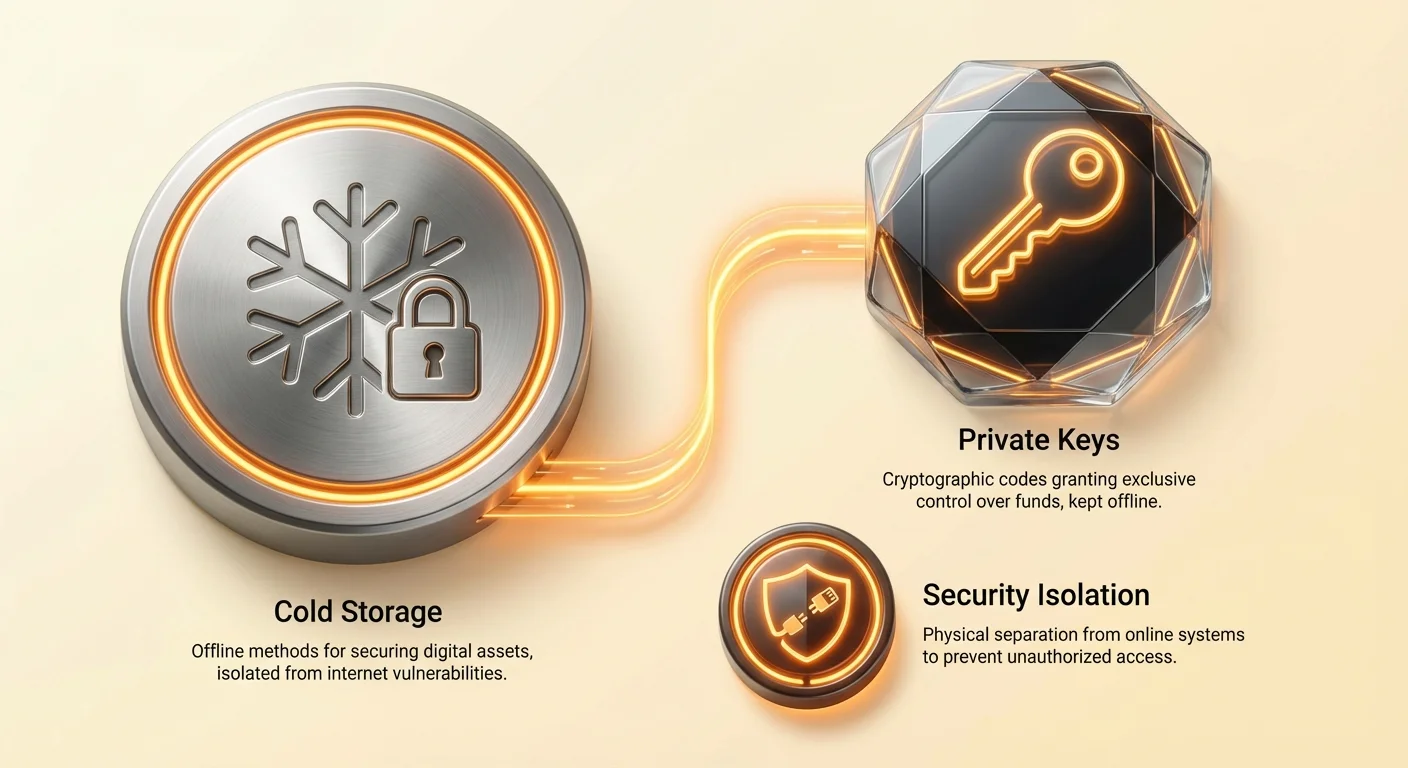
Defining Cold Storage and the Necessity of Isolation
The core concept of cold storage is simple: keep the key to the vault (your private key or seed phrase) physically separated from potential thieves (hackers, malware, and online phishing scams).
In traditional banking, if a criminal accesses your bank’s server, they might see your account balance, but they cannot walk away with physical cash. In crypto, if a criminal accesses your private key, they can walk away with your money instantly. Therefore, physical isolation is the only reliable defense against sophisticated online attacks.
The Core Principle: Hardware Wallets as the Standard Bearer
A hardware wallet is a dedicated electronic device, typically resembling a small USB drive, built for one purpose: protecting your private keys. It is the gold standard for cold storage because it isolates the critical security information from your internet-connected computer or smartphone.
How Hardware Wallets Isolate Your Private Keys
Imagine your hardware wallet as a locked safe deposit box. When you want to send crypto, you do not open the safe deposit box on the internet. Instead, you plug the safe into a computer (which is connected to the internet).
- Transaction Creation: Your computer creates a transaction request (e.g., "Send 1 BTC to Address X").
- Offline Signing: This request is sent to the hardware wallet via a USB or Bluetooth connection. The hardware wallet verifies the details on its internal screen. Crucially, the private key never leaves the device.
- Key Isolation: The transaction is signed using the private key stored securely inside the device’s chips.
- Broadcast: The signed transaction is sent back to the computer, which then broadcasts it to the blockchain.
Since the private key remains locked within the hardware wallet’s secure chips during the entire process, even if your computer is infected with sophisticated malware, the thief cannot steal the key necessary to authorize the transfer.
The Trade-off: Security vs. Convenience (Cold vs. Hot)
Choosing cold storage involves accepting a trade-off: security always comes at the expense of convenience.
| Feature | Hot Wallet (Mobile/Exchange) | Cold Wallet (Hardware/Air-Gapped) |
|---|---|---|
| Connectivity | Always online | Always offline (except when signing) |
| Vulnerability | Phishing, malware, exchange hacks | Physical loss, device failure, user error |
| Transaction Speed | Instant | Requires device connection and PIN entry |
| Ideal Use Case | Small spending amounts, trading | Long-term savings, large wealth storage |
For maximum security, 95% of your crypto holdings should reside in cold storage, leaving only small amounts in a hot wallet for daily spending or quick trades.
Analyzing Hardware Wallet Security Standards (The Technical Deep Dive)
Not all hardware wallets are created equal. As the value of the assets stored in these devices increases, so does the incentive for sophisticated attackers to try to compromise them. This led to the development of specific standards and technologies to increase the physical and digital resilience of hardware devices.
When selecting a hardware wallet, you should focus on three critical components: the Secure Element, the security certification level, and the firmware process.
The Role of the Secure Element (SE) Chip
The Secure Element (SE) is a specialized chip embedded within high-security hardware wallets. It is essentially a separate computer-within-a-computer, built specifically to resist physical tampering and digital extraction.
- What it is: The SE is a certified chip (similar to those used in passports or modern credit cards) designed to securely store and process confidential data.
- Why it matters: In devices without a Secure Element, the private key is often stored in the device's standard microcontroller (MCU). While safer than a regular PC, an MCU is still more vulnerable to side-channel attacks (monitoring the device's electrical signals or heat signatures) or invasive physical probing. The SE is designed with active countermeasures to detect and destroy data if physical intrusion is attempted.
If a wallet advertises "enterprise-grade security," it usually implies the use of a high-quality, dedicated Secure Element.
Understanding Security Certification Levels (EAL Ratings)
To provide objective proof of security, manufacturers often submit their Secure Elements and overall devices for evaluation by independent bodies. One of the most common certifications is the Evaluation Assurance Level (EAL).
EAL is a numerical rating (EAL1 through EAL7) given under the Common Criteria Recognition Arrangement (CCRA). It measures how rigorously a product has been tested and verified to meet security requirements.
| EAL Level | Description | Relevance to Crypto |
|---|---|---|
| EAL1–EAL3 | Functionally tested, basic development standards. | Low relevance; easily compromised by dedicated attackers. |
| EAL4 | Methodically designed, tested, and reviewed. Provides a good baseline security layer. | Used in many consumer electronics; acceptable for basic crypto use. |
| EAL5 | Semi-formally designed and tested. Requires clear architectural documentation and rigorous penetration testing. | The minimum recommended standard for high-value crypto storage. |
| EAL6–EAL7 | Formally verified design and tested for highly sensitive data (military/government). | Extremely high standard; rarely needed for consumer crypto wallets due to high cost and complexity. |
For long-term storage of significant wealth, seeking a wallet with an EAL5+ certified Secure Element provides a robust, third-party verified defense against both remote and physical attacks.
Firmware and Supply Chain Attack Mitigation
Firmware is the permanent software embedded in your hardware device that controls its core functions. Firmware security is vital because an attacker who can alter the firmware can potentially steal your keys when you try to sign a transaction.
Two major security concerns related to firmware are:
- Initial Compromise (Supply Chain Attack): An attacker intercepts the device between the factory and the customer and installs malicious firmware.
- Future Compromise (Remote Attack): An attacker forces a malicious firmware update after the user has received the device.
High-quality hardware wallets use security mechanisms to mitigate these risks:
- Attestation: When you first set up the wallet, it should perform an integrity check to verify that the original, trusted firmware is running. This process confirms the authenticity of the device and confirms it hasn't been tampered with in transit.
- Signed Updates: All firmware updates must be digitally signed by the wallet manufacturer. The hardware wallet checks this cryptographic signature before applying the update. If the signature doesn’t match (meaning the update is coming from a hacker), the wallet refuses to install it.
- Open Source Code: Many top-tier wallets make their firmware code publicly available (open source). This allows the global security community to audit the code constantly, identifying vulnerabilities much faster than a closed, proprietary system might.
Air-Gapping: Achieving Ultimate Transaction Isolation
While a standard hardware wallet provides excellent cold storage, it still requires a physical connection (USB or Bluetooth) to an internet-connected device (your PC or phone) to send transactions. For users managing extremely high value assets or those operating in high-risk geopolitical environments, this connection represents a potential, albeit small, attack vector.
Air-gapping eliminates this final physical connection entirely, achieving the absolute highest level of practical security available to non-institutional users.
What is an Air-Gapped Setup?
An air-gapped system is defined by its physical and logical isolation from all insecure networks, most importantly the internet.
In a crypto context, an air-gapped setup involves two separate devices:
- The Cold Device (Signer): A dedicated, non-networked device (often a specialized hardware wallet, an offline laptop, or a custom-built computer) that holds the private key and only performs the cryptographic signing. This device is never connected to the internet.
- The Hot Device (Broadcaster): An online computer or phone that prepares the transaction details and broadcasts the final signed transaction to the blockchain.
The physical gap (the "air gap") between these two devices means data must be transferred manually, usually via non-networked methods.
The Transaction Signing Process (PSBTs and QR Codes)
How do you communicate between the hot and cold devices without cables or Wi-Fi? This is achieved using standardized formats and visual communication.
The most common modern method uses Partially Signed Bitcoin Transactions (PSBTs), often transferred using QR codes or secured SD cards.
Here is the four-step process for an air-gapped transaction:
- Preparation (Hot Device): The user uses the online computer to create the basic transaction details (amount, recipient address). The computer then generates a Partially Signed Bitcoin Transaction (PSBT)—an unsigned digital file containing all the necessary data except the signature—and displays it as a QR code or saves it to an SD card.
- Transfer and Verification (Cold Device): The user scans the QR code using the cold device’s camera (or inserts the SD card). The cold device loads the transaction details, verifies them on its screen, and prompts the user for approval and PIN entry.
- Signing (Cold Device): The cold device signs the transaction using the offline private key. It then generates a new QR code containing the now-complete, signed transaction data.
- Broadcast (Hot Device): The user scans this signed QR code back onto the hot device. The hot device receives the fully authorized transaction and broadcasts it to the blockchain.
At no point does the sensitive private key information touch an online network.
Practical Use Cases for Air-Gapped Systems
Air-gapping is generally overkill for a user holding a few thousand dollars in crypto. It is an investment in complexity and time designed for maximum security.
Ideal Candidates for Air-Gapping:
- High-Net-Worth Individuals (HNWIs): For individuals storing assets valued above six or seven figures. The inconvenience is justified by the catastrophic risk of loss.
- Institutional Custody: Companies, funds, or organizations managing pooled client assets where fiduciary responsibility demands the highest security.
- Extreme Privacy Users: Individuals concerned about state-level actors or targeted surveillance, as the system provides resilience against sophisticated network penetration.
The Historical and Extreme End of Deep Cold Storage
Before sophisticated hardware wallets were widely available, and even today for certain niche situations, users relied on analog and physical forms of deep cold storage. While these methods offer extreme isolation, they introduce a host of new risks primarily related to physical decay, disaster, and recovery.
Paper Wallets: Why Physical Storage Isn’t Always Safer
A paper wallet is simply a printout of your public address and corresponding private key (usually as a QR code and text).
Initial Appeal: A piece of paper cannot be hacked. It is perfectly air-gapped from the moment it is printed.
Major Downsides:
- Creation Risk: The process of creating a paper wallet is fraught with risk. If the computer used to generate the keys or print the paper is compromised with malware, the key is stolen before it becomes "cold." Furthermore, printers maintain memory caches, potentially leaving a digital copy of the private key on a volatile device.
- Physical Decay: Paper can be easily destroyed by fire, flood, insects, or simple fading. Lamination can preserve it but does not protect against catastrophic disasters.
- Spend Risk: Spending a paper wallet is difficult and dangerous. To move the funds, the user must input the private key into an online device, momentarily turning the storage method "hot" and exposing the key to malware. Modern hardware wallets eliminate this risk entirely.
Conclusion on Paper Wallets: For almost all users, the high risks associated with creation and spending mean that dedicated hardware wallets are overwhelmingly safer and more practical than paper wallets.
The Extreme Alternative: Mental and Seed Storage Practices
The absolute deepest form of cold storage relies on human memory: the mental wallet. This involves memorizing the 12 or 24 words of the seed phrase, or memorizing a primary phrase and using advanced techniques like Shamir’s Secret Sharing to split the seed across multiple memories or locations.
Appeal: The ultimate security against physical seizure or destruction, as the key exists only in the user’s mind.
Major Downsides:
- Human Error: Forgetting one word, misspelling a word, or failing to recall the correct order results in permanent loss of funds.
- Physical Trauma: Memory loss due to age, injury, or extreme stress can lead to irretrievable loss.
- Inheritance Issues: Passing on a mental wallet to heirs is nearly impossible without compromising security before death.
Mental wallets are typically only considered by extreme self-sovereignty advocates who have perfected specialized mnemonic techniques. For 99% of the population, physical documentation protected by robust security measures is safer than reliance on memory.
The Deep Cold Storage Risk Assessment (Fire, Water, Decay)
When moving to deep cold storage, the focus shifts entirely from digital defense to physical resilience and survivability.
Best Practices for Physical Resilience:
- Material: Do not rely on paper. Engrave your seed phrase onto durable materials like titanium, steel, or specialty alloys that can withstand extreme heat (fire) and corrosion (water damage).
- Dispersal: Utilize redundancy and geographic separation. Never store your only copy in a single location. Best practices involve splitting the seed phrase or using solutions like Shamir’s Secret Sharing and storing the components in secure, widely separated physical locations (e.g., a bank vault in City A and a safe in City B).
- Durability and Testing: Invest in high-quality storage solutions (like fireproof safes) and test the resilience of your engraved material against high heat before storing the critical information.
Building Your Cold Storage Strategy: A Risk Hierarchy Framework
The goal is not simply to achieve the "most secure" method, but to achieve the right level of security proportionate to your wealth and your required frequency of access. We can categorize the security hierarchy based on cost, complexity, and access speed.
| Security Tier | Primary Method | Risk Profile | Cost & Complexity | Access Speed |
|---|---|---|---|---|
| Tier 1 (High) | Standard Hardware Wallet (EAL4/5) | Excellent defense against remote hackers and common malware. | Low to Moderate (one-time device purchase). | Fast (requires plugging in). |
| Tier 2 (Extreme) | Air-Gapped Hardware Wallet (PSBT/QR) | Near-absolute defense against remote and local malware. | Moderate (requires specialized devices and rigorous setup). | Slow (requires physical scanning/transfer). |
| Tier 3 (Deep Offline) | Metal Plate Storage + Geographic Dispersal | Absolute defense against digital threats; resilience against physical disasters. | Low (material cost) to High (storage rental/travel). | Very Slow (requires physical retrieval). |
| Tier 4 (Legacy/Avoid) | Paper Wallets | High risk of creation compromise and physical decay. | Very Low. | Slow and High Risk upon spending. |
Matching Security Level to Asset Value and Activity
Use this framework to decide where your assets belong:
- For your retirement savings (90%+ of total crypto): Use Tier 2 or Tier 3 solutions. Assets stored here should be those you do not plan to touch for years. Geographic dispersal and hardware wallet with EAL5+ rating are highly recommended.
- For emergency funds (5–10% of total crypto): Use Tier 1. A standard, high-quality hardware wallet provides strong security without the excessive friction of air-gapping.
- For trading/daily transactions (less than 1% of total crypto): Use a regulated hot wallet or reputable software wallet. The risk of convenience is outweighed by the need for speed and liquidity.
Actionable Tip: Regularly audit your physical storage locations. Ensure your metal backup plates are secure, legible, and that the recovery process is understood by you and, if appropriate, your trusted legal executor.
Conclusion
Understanding the cold storage hierarchy is the single most important lesson in crypto security. While hot wallets offer speed and accessibility, true self-sovereignty is built on the foundation of physical isolation.
For the vast majority of users, a well-audited, EAL-certified hardware wallet (Tier 1) provides the perfect balance of security and usability. However, as your crypto wealth grows, the complexity and rigor of air-gapped systems (Tier 2) and dispersed, engraved backups (Tier 3) become necessary steps toward achieving ultimate security and peace of mind in the digital economy. By moving your private keys offline and implementing these advanced techniques, you fully assume control over your assets, securing them against virtually all modern attack vectors.