
Bitcoin holds the undisputed title of the first successful cryptocurrency and the most secure, decentralized network globally. Its foundational design prioritizes security, immutability, and decentralization above all else. However, this intentional constraint—the 10-minute block time and limited data capacity—means that direct, high-volume transactional use on the main chain (Layer 1) is inherently slow and expensive during periods of heavy demand.
For years, the industry has debated how to scale Bitcoin without compromising its core philosophical tenets. Solutions like the Lightning Network revolutionized rapid, cheap payments, but the complexity required for advanced applications, such as smart contracts or decentralized finance (DeFi), remained a challenge.
The answer lies in next-generation Layer 2 (L2) solutions, specifically the concept of Rollups integrated with Zero-Knowledge (ZK) Proofs. This technology, often associated with networks like Ethereum, is now being adapted to transform Bitcoin from merely "digital gold" into a high-throughput global settlement layer capable of running complex financial applications securely—all while leveraging the unparalleled security of the underlying Bitcoin blockchain. This guide delves into what these sophisticated scaling tools are and how they are unlocking Bitcoin's untapped potential.
Understanding the Need for Advanced Scaling
To appreciate the sophistication of rollups, we must first revisit the fundamental trade-offs inherent in Bitcoin’s architecture and the limitations of previous scaling attempts.
The Bitcoin L1 Constraint: Security Above Speed
The Bitcoin Layer 1 (L1) network is designed to be highly reliable and resistant to attack. It achieves this by intentionally restricting the amount of data processed in each block. This limitation ensures that anyone, anywhere in the world, can download and verify the entire history of the blockchain using standard consumer hardware. This principle is crucial for decentralization.
However, high security comes at the cost of throughput. When everyone tries to use the main chain simultaneously, fees soar, and confirmation times lengthen. While this inefficiency is acceptable for securing large amounts of value or settling final transactions, it prevents the everyday use cases required for a modern digital economy.
The Evolution of Layer 2 Solutions
Layer 2 solutions were born out of the necessity to move transaction volume off the L1 while still retaining its security properties.
- Payment Channels (e.g., Lightning Network): These are fantastic for high-frequency, small payments. They allow two parties to transact repeatedly without ever recording every transaction on the main chain, only posting the initial deposit and the final balance.
- Sidechains and Federated Systems: These solutions attempt to bring smart contract functionality to Bitcoin. However, they typically rely on their own independent set of validators (or a federated group known as a "custodian multisig"), creating a separate trust model. While they are connected to Bitcoin, they do not inherently inherit the L1's full security guarantees. If the sidechain's validators collude, the funds are at risk.
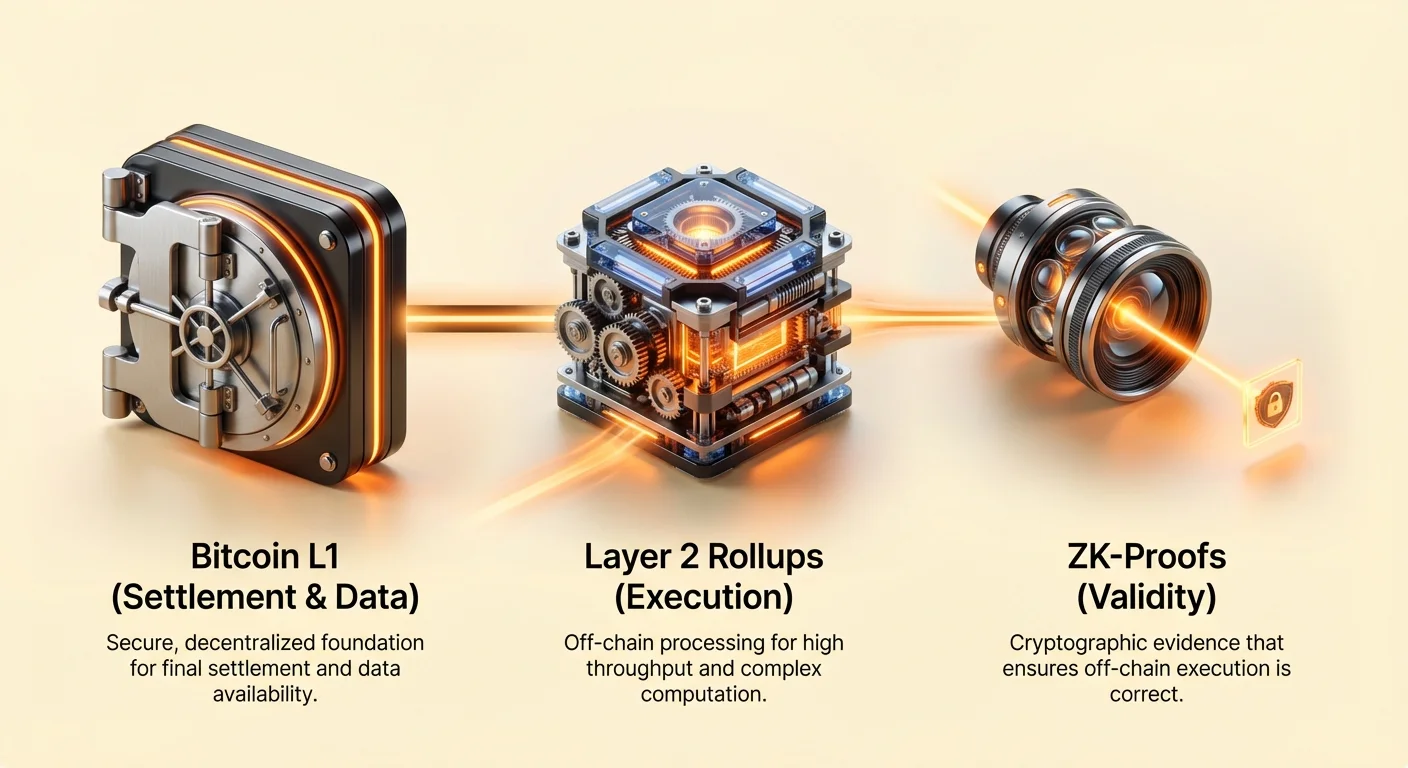
Rollups solve the trust problem by ensuring that even though execution happens off-chain, verification and data availability are rooted directly in Bitcoin L1.
Introducing Rollups: Scaling with Security Inheritance
A Rollup is a cryptographic mechanism that batches (rolls up) thousands of transactions executed off-chain into a single, highly compressed transaction or "proof," which is then posted back to the Layer 1 chain.
The genius of the rollup architecture is that users do not need to trust the L2 operators; they only need to trust the L1 (Bitcoin). If the L2 operator tries to cheat or censor, the L1 network has the data and the necessary proof mechanism to correct the state or release the user's funds.
The Core Rollup Mechanism
Rollups operate in three key phases, regardless of whether they are Optimistic or ZK-based:
- Execution Off-Chain: Thousands of transactions (e.g., swaps, loans, game moves) are processed by the Rollup operators on a dedicated Layer 2 environment. This is cheap and fast.
- Compression and Aggregation: The Rollup aggregates all the resulting state changes into a single, compressed data structure.
- Settlement on L1: This compressed data and the accompanying Proof (either validity or fraud) are posted onto the Bitcoin L1. This step is expensive, but because the cost is amortized across thousands of transactions, the cost per individual transaction is dramatically lowered.
The Security Breakthrough: Data Availability
A critical component of a robust rollup is data availability. Even if the L2 operator disappeared or stopped running the chain, users must still be able to retrieve the raw transaction data posted to the L1. This data, stored on Bitcoin’s immutable ledger, allows users to reconstruct the L2 state, verify the transactions, and submit a proof to withdraw their funds back to L1 if necessary. This mandatory step ensures that the L2 state is always auditable and recoverable.
Validity vs. Fraud: The Two Families of Rollups
The primary differentiation between rollup technologies lies in how they verify the correctness of the transactions submitted to L1. This difference determines the speed of finality and the level of security inherent in the system.
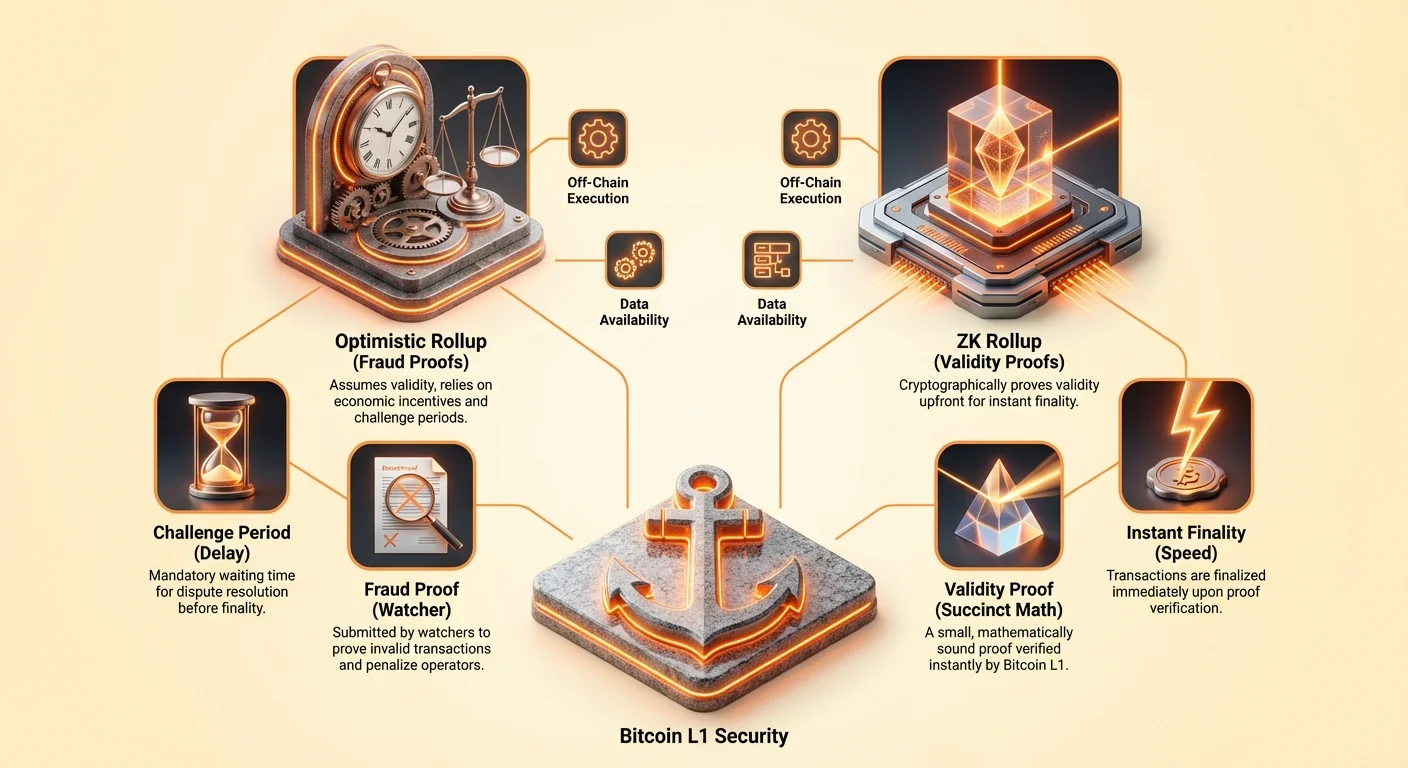
Optimistic Rollups and Fraud Proofs
Optimistic rollups assume that all transactions executed off-chain are valid by default. They rely on an "innocent until proven guilty" philosophy.
How Fraud Proofs Work:
- The Rollup operator posts the new state root (summary of changes) to Bitcoin L1, along with the compressed data.
- There is a fixed challenge period (typically one to two weeks). During this period, anyone on the network can act as a "watcher" and check the transaction data.
- If a watcher detects a malicious or incorrect state transition, they can submit a Fraud Proof to the L1 contract.
- If the Fraud Proof is successful, the fraudulent state is reverted, and the cheating operator is penalized (their staked collateral is slashed).
Trade-off: Optimistic rollups are generally simpler to build and deploy, but they introduce a significant withdrawal delay. Users must wait until the challenge period expires before they can move funds securely back to Bitcoin L1, making them less suitable for time-sensitive financial operations.
ZK Rollups and Validity Proofs (The Cutting Edge)
ZK Rollups (Zero-Knowledge Rollups) use advanced cryptography to provide mathematical proof of validity before the transaction state is ever accepted by the L1. They operate on a "guilty until proven innocent" philosophy.
How Validity Proofs Work (Zero-Knowledge):
- The Rollup operator executes the transactions off-chain.
- They then generate a cryptographic proof—a Validity Proof—that confirms that all operations within the batch were executed correctly according to the L2 rules. This proof is extremely small and computationally simple to verify.
- The Rollup operator posts the new state root, the compressed data, and the Validity Proof to the Bitcoin L1.
- The L1 contract immediately verifies the mathematical proof. If the proof is valid, the new state is instantly accepted.
Trade-off: ZK Rollups require significantly more complex computation to generate the proof (which happens off-chain), but the benefit is instant finality and superior security. Once the L1 verifies the proof, there is no waiting period because the validity is mathematically guaranteed.
Zero-Knowledge Proofs: Revolutionizing Bitcoin Scaling
Zero-Knowledge technology is the cornerstone of next-generation Bitcoin scaling because it solves two critical problems: complexity verification and finality time.
The Magic of ZKPs: Succinctness and Integrity
A Zero-Knowledge Proof allows a 'Prover' to convince a 'Verifier' that a statement is true without revealing any actual information about the statement itself (hence "zero-knowledge").
For rollups, the statement is: "I executed these 10,000 transactions correctly, and the resulting change in the chain's state is accurate."
The key cryptographic features are:
- Succinctness: The resulting validity proof is minuscule, meaning it consumes very little space on the Bitcoin block, saving enormous amounts of fee expense.
- Integrity: The proof is mathematically sound. If the prover attempts to cheat, the proof will fail the verification test every time.
Contextualizing ZK-Proofs for Bitcoin's Architecture
Applying ZK technology to Bitcoin is a unique challenge because Bitcoin utilizes the UTXO (Unspent Transaction Output) model, which is fundamentally different from the account model used by Ethereum. Additionally, Bitcoin's scripting language (Bitcoin Script) is intentionally limited, making complex contract logic difficult to execute directly on L1.
ZK-Rollups bridge this gap:
- Enabling Complex Logic Off-Chain: By using ZK-Proofs, sophisticated smart contract logic (which Bitcoin L1 cannot handle) can be executed on the L2. The ZK-Proof then translates the result of that complex computation into a simple, verifiable statement that Bitcoin L1 can process and anchor.
- Securing State Transitions: The proof confirms that the correct UTXOs were spent and new UTXOs created according to the L2 rules, thereby securing the funds within the L2 environment using the L1's consensus rules.
Key Benefits: Instant Finality and Privacy Potential
- Instant Finality: Unlike Optimistic solutions, ZK-Rollups provide cryptographic finality as soon as the proof is validated by the L1—potentially minutes after the batch is posted. This is essential for financial primitives requiring rapid settlement.
- Privacy (Conditional): While ZK-Proofs don't automatically provide privacy, the technology inherently allows systems to prove knowledge (e.g., "I have a balance greater than $1,000") without revealing the underlying data (e.g., the exact balance or the specific address). This capability holds enormous potential for private transactions and regulatory compliance within L2 environments.
Architectural Challenges and Implementation on Bitcoin
While the theory of ZK Rollups is sound, integrating them into the Bitcoin environment requires overcoming specific architectural hurdles related to the L1 protocol’s conservative design.
Limitations of Bitcoin Script
Bitcoin Script is a non-Turing complete language, meaning it cannot handle arbitrary complex computation like Ethereum's Solidity. This intentional limitation is a security feature, preventing infinite loops and ensuring every transaction’s cost is predictable.
For ZK Rollups to work securely on Bitcoin, the L1 must be able to verify the succinct proof. This has necessitated protocol improvements like Taproot, which enhance Bitcoin’s scripting capabilities without fundamentally changing its secure nature. Taproot allows for complex conditions (like verifying a ZK proof) to be bundled into a simple-looking transaction, saving block space and making the verification process feasible on L1.
The Modular Blockchain Philosophy
The widespread adoption of Rollups signals a major shift toward the modular blockchain architecture.
- Monolithic (Older Model): One chain (L1) tries to handle everything: execution, consensus, data availability, and settlement. This leads to bottlenecks.
- Modular (New Model): The chain is specialized. Bitcoin L1 focuses solely on Settlement and Data Availability—ensuring absolute security and storing the raw data. The high-volume, complex computations (the Execution) are outsourced to specialized L2 Rollups (the ZK Rollup chain).
This approach ensures that Bitcoin L1 remains minimal, secure, and decentralized, while simultaneously allowing for immense scaling potential on L2, effectively turning Bitcoin into a global settlement layer.
Practical Application: The Future Landscape of Bitcoin L2 Security
As next-generation L2s mature, users will need to evaluate them based on their underlying security guarantees. The philosophical trade-off between Optimistic and ZK solutions remains the most important factor.
Trust Assumption Comparison
When choosing a solution to custody your assets or execute financial contracts, understanding the trust assumptions is vital:
| Feature | ZK Rollups (Validity Proofs) | Optimistic Rollups (Fraud Proofs) |
|---|---|---|
| Security Mechanism | Mathematical Proof (Verification) | Economic Incentive (Challenge Period) |
| Trust Assumption | Zero trust required after proof verification. | Trust the operators unless proven otherwise. Must trust a majority of watchers/challengers. |
| Withdrawal Time | Instant (as soon as L1 validates the proof). | Delayed (Must wait 7-14 days for the challenge period). |
| Ideal Use Case | High-value, immediate financial settlement, core DeFi primitives. | General purpose contracts, applications where delays are acceptable. |
For applications requiring the highest level of security and near-instant finality—which is often the case when leveraging Bitcoin’s deep liquidity—ZK Rollups offer a clear philosophical advantage, relying on immutable mathematics rather than trusting human challengers and economic incentives.
Identifying Robust L2s for Self-Sovereignty
For users seeking self-sovereignty and low-trust execution, here are the key criteria when evaluating a Bitcoin L2 solution:
- Maximize Data Availability on L1: Ensure the L2 commits the full transaction data (or state diffs) back to the Bitcoin chain. If the data is only stored off-chain or by a centralized committee, the L2 is operating more like a trust-required sidechain than a true rollup.
- Verify the Proof Mechanism: Favor solutions that utilize ZK Validity Proofs over simple multi-sig federations or optimistic models, especially for large transfers. Validity proofs minimize the need for active monitoring by the user.
- Check the Withdrawal Path: Ensure there is a clear, permissionless, and open-source mechanism for users to submit a proof and force a withdrawal back to Bitcoin L1, even if the L2 operator fails or tries to censor.
Actionable Tip: Start Experimenting Safely
As these sophisticated L2 solutions deploy on Bitcoin, the primary risk for newcomers is complexity and smart contract bugs.
Best Practice: When exploring new Bitcoin L2 ecosystems utilizing rollups, always start with a small, disposable amount of BTC. Focus first on understanding the withdrawal and deposit mechanisms. Ensure you can successfully move funds between the L1 and L2 using the documented proof system before committing substantial assets. This methodical approach ensures you benefit from the speed of L2 while retaining the safety guarantees of self-custody.
Zaključek
Uvedba tehnologije rollupov in ZK-dokazov nakazuje veliko evolucijo v ekosistemu Bitcoina. Dokazuje, da Bitcoin ni zamrznjen v času, ampak je sposoben sprejeti visoko napredne kriptografske rešitve za skaliranje njegove uporabnosti, ne da bi ogrozil svojo jedrno vrednostno ponudbo.
Z odlaganjem težkega računskega bremena pametnih pogodb in visoke prepustnosti transakcij na specializirane plasti L2 Bitcoin krepi svoj položaj kot ultimativna brez zaupanja Plast poravnave za decentralizirano gospodarstvo. L2 nove generacije, zlasti tiste, zgrajene na dokazih veljavnosti z ničelnim znanjem, spreminjajo Bitcoin v robustno in skalabilno osnovo, na kateri bo zgrajena prihodnost samouverjenih digitalnih financ.