
The fundamental promise of cryptocurrency is control: you hold the keys, you control the assets. However, this control comes with a massive, terrifying caveat: if you lose your single private key or seed phrase, your funds are permanently gone. This is the "single point of failure" that has cost crypto holders billions.
Multi-Party Computation (MPC) is a revolutionary cryptographic technique that seeks to solve this central dilemma. It is an advanced form of security that allows multiple independent parties to jointly compute a function—like signing a cryptocurrency transaction—without any single party ever revealing their individual data or accessing the entire private key.
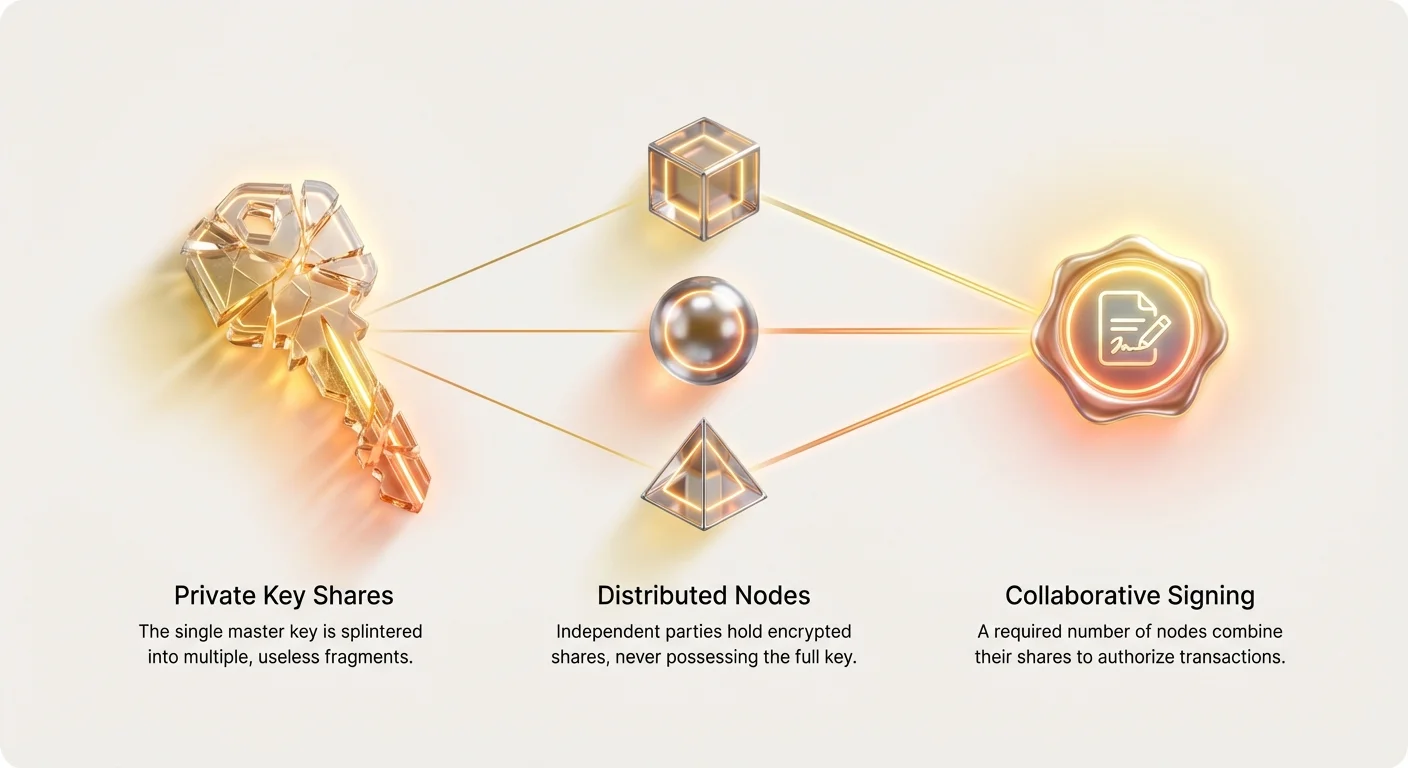
In the context of crypto wallets, MPC eliminates the need for a single, vulnerable private key. Instead, the key is shattered into multiple, encrypted pieces (called "shares") and distributed across different locations, devices, or individuals. This approach offers the security of multi-signature technology with the speed and efficiency of a standard single-signature wallet, making it one of the most powerful tools available today for securing digital assets for both institutions and everyday users.
Understanding Wallet Keys and the Need for Better Security
Before diving into the complexities of MPC, it is essential to revisit how standard crypto wallets function and why they present such a major risk when relying on traditional self-custody.
The Core Vulnerability: Private Keys
Every Bitcoin or Ethereum wallet is controlled by a private key—a massive, randomly generated number that acts as the cryptographic proof of ownership. This key is mathematically linked to your public address.
In a standard self-custody wallet, this key (or the seed phrase that generates it) exists as a single, complete entity.
- Risk: If a hacker obtains this key, they instantly control your assets. If you lose the physical copy, the assets are lost forever. This "all or nothing" scenario is the single point of failure that MPC is designed to mitigate.
Moving Beyond Simple Custody Models
Traditional crypto security is often categorized along a continuum:
- Fully Custodial: A third party (like an exchange) holds the key. High convenience, zero control.
- Self-Custodial (Hot/Cold): The user holds the key. High control, high responsibility (and risk).
MPC introduces a third, sophisticated model: Distributed Custody. It gives users the sovereignty of self-custody while distributing the catastrophic risk associated with holding a single, complete key.
What Exactly is Multi-Party Computation (MPC)?
Multi-Party Computation, at its core, is a cryptographic discipline that allows independent parties to collaboratively process data or execute a function based on their inputs, without revealing those inputs to anyone else, not even the other participants.
Think of it this way: MPC is about calculating the result of a mathematical problem without ever showing your work.
Analogy: The Secret Recipe
Imagine four chefs need to bake a very specific, secret cake for which only a master baker knows the complete recipe. The master baker doesn't trust any single chef with the full instructions.
- The master baker breaks the recipe into four encrypted parts (MPC shares).
- Each of the four chefs receives one part.
- To bake the cake (sign the transaction), they agree that they need at least three out of the four chefs (a 3-of-4 threshold) to combine their partial, encrypted instructions.
- They work together, each contributing their piece of the encrypted recipe. The final cake is baked (the signature is generated), but no individual chef ever saw the complete recipe or even the complete set of ingredients used by the others.
This analogy perfectly illustrates MPC: the private key (the full recipe) is never assembled or seen by any party, yet the output (the signature) is successfully generated through collaboration.
Threshold Cryptography Explained
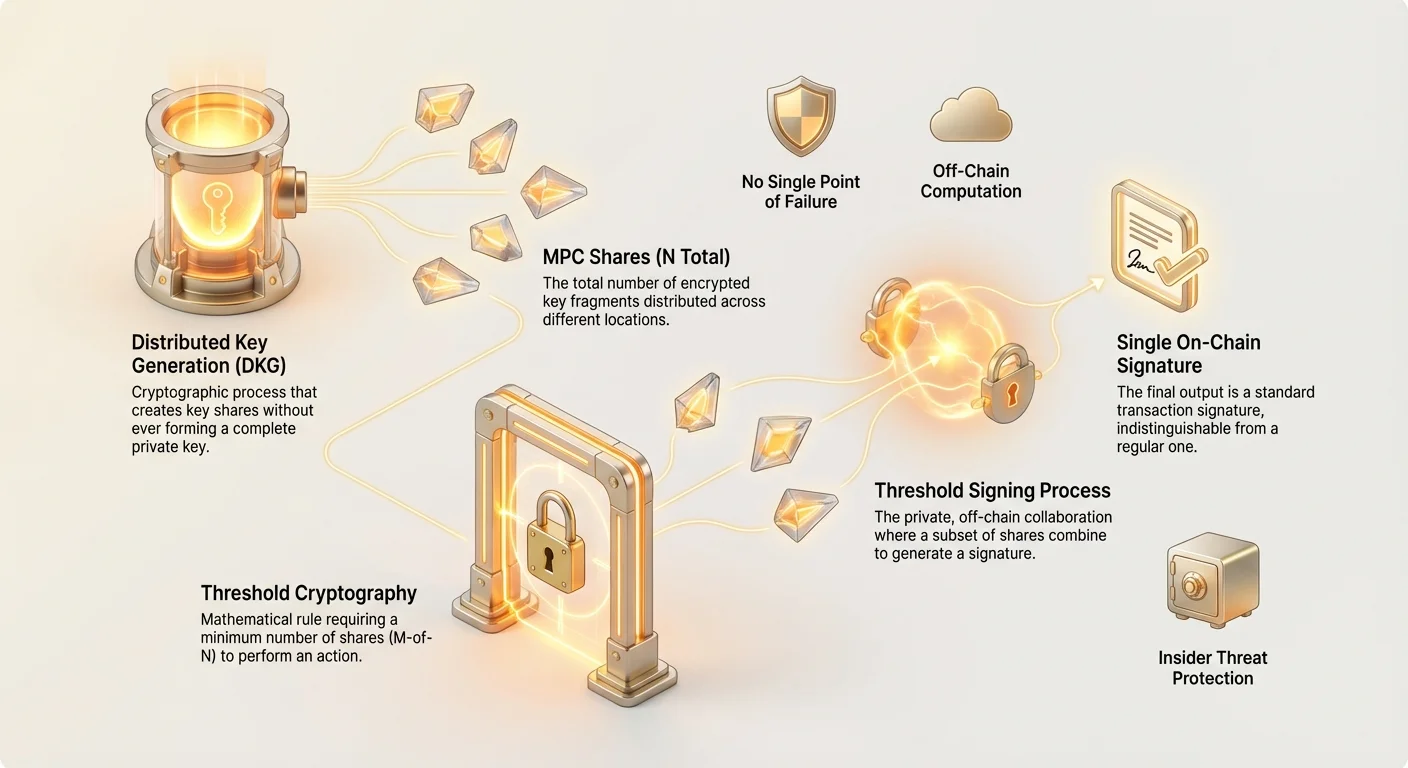
MPC wallets rely heavily on Threshold Cryptography. This is the mathematical framework that dictates how many shares are required to perform an action.
When setting up an MPC wallet, you define an M-of-N threshold:
- N (Total Shares): The total number of key shares created.
- M (Required Shares): The minimum number of shares required to collaborate and create a valid signature.
If the threshold is 2-of-3 (M=2, N=3), the private key is split into three shares. To sign a transaction, any two of those three shares must be used simultaneously. If one share is lost or stolen, the assets are safe because the attacker still needs one more share to meet the threshold.
MPC’s Core Mechanism: Secret Sharing
The specific technique used to break the key into these shares is often based on Shamir's Secret Sharing (SSS). SSS is a mechanism that divides a secret (in this case, the private key) into N parts. The mathematical property of SSS ensures two key things:
- The secret can only be reconstructed if M or more parts are present.
- Any M-1 parts provide absolutely no information about the secret. This is critical for security, as a hacker who obtains one or two shares in a 3-of-5 setup gains zero usable data.
The Technical Engine: Distributed Key Generation (DKG)
The true breakthrough of MPC—and its key differentiator from older security methods—lies in how the key is created in the first place. This process is called Distributed Key Generation (DKG).
Generating a Key Without Ever Fully Forming It
In traditional self-custody, the wallet generates the entire private key, displays the seed phrase (the human-readable form of the key), and then encourages you to back it up securely. The key exists whole, even if only for a few milliseconds, making it susceptible to interception or failure of the secure generation process.
DKG completely avoids this vulnerability.
In a DKG ceremony, the parties (e.g., your phone, a recovery server, and the MPC provider’s server) collaborate cryptographically to determine the parameters of the key. Each party generates its own share, and these shares are mathematically linked such that when they are combined at the threshold (M-of-N), they produce the correct signature for the blockchain.
Crucially, the full, complete private key is never calculated, stored, or revealed to any single party at any point during its creation or its use.
This means there is literally no single location, device, or server that a hacker can target to steal the entire private key. They would have to compromise M devices simultaneously, each located in a different geographical or digital environment.
How DKG Prevents Collusion
The distributed nature of the key generation and signing process inherently prevents malicious collusion between the parties involved.
Consider a corporate treasury using a 3-of-5 MPC setup, where five directors each hold a share.
- During Generation: No single director can claim they generated the key alone, as the key is the cryptographic result of all five inputs.
- During Signing: If one director’s device is compromised, the attacker only has one share. They cannot spend the funds. Furthermore, the directors must actively, and perhaps physically, collaborate to sign a transaction, making unauthorized transactions extremely difficult to pull off without massive coordination and fraud.
This distribution of power enhances corporate governance and removes insider risk associated with single signers.
MPC vs. Multi-Signature (Multi-Sig): A Critical Comparison
Multi-Signature wallets were the original decentralized solution to the single-point-of-failure problem. Multi-sig requires multiple distinct private keys to authorize a transaction. While conceptually similar to MPC, their technical implementations and resulting security trade-offs are vastly different.
| Feature | Multi-Signature (Multi-Sig) Wallets | Multi-Party Computation (MPC) Wallets |
|---|---|---|
| Key Status | Multiple, distinct private keys (PKA, PKB, PKC) exist completely on their own. | A single, logical private key is cryptographically shattered into shares. |
| Blockchain Footprint | Transactions require a specific, recognizable Multi-Sig script. They are publicly identifiable. | Transactions look like standard single-signature transactions. Invisible on-chain. |
| Efficiency & Fees | Higher gas fees (requires more computational data on-chain). | Lower fees (equal to standard single-sig transactions). |
| Security Risk | Requires managing and backing up M different keys securely. If one key is compromised, it still exists whole and is a target. | Requires securing N shares, none of which can spend funds alone. The key never exists whole. |
| Setup Complexity | Can be complex; requires specific wallet software to manage distinct addresses/keys. | Seamless setup; often integrated directly into user-friendly apps, masking the complexity. |
| Asset Compatibility | Limited; must be supported by the specific network’s multi-sig contract script. | Universal; compatible with nearly all cryptocurrencies because the signature looks standard. |
Multi-Sig’s Mechanics and Limitations (The "Blockchain Footprint")
A multi-sig wallet works by creating a specialized smart contract or script on the blockchain itself. This script defines the M-of-N requirement.
- Transparency: When you inspect a multi-sig transaction on a block explorer, it explicitly shows that it required multiple keys. This transparency can be a downside for users or organizations seeking privacy regarding their security structure.
- Cost and Speed: Because the multi-sig requirements are written and executed on the blockchain, these transactions are inherently larger in data size and thus more expensive in gas fees than simple single-signature transactions. They are also slower to deploy and update.
MPC: Invisible Security and Transaction Efficiency (Anti-Collusion Superiority)
MPC wallets handle all the signing computation off-chain. The distributed shares coordinate to generate a single, final signature.
- Off-Chain Coordination: The parties collaborate privately to prove they meet the M-of-N threshold.
- Single Signature Output: They generate one standard cryptographic signature.
- On-Chain Submission: This single signature is submitted to the blockchain.
Because the final transaction looks exactly like one signed by a single person using a single key, MPC transactions are efficient, fast, cost-effective, and—most importantly—do not reveal the complex M-of-N structure to the public. This stealth makes auditing and targeting the assets far more difficult for malicious actors.
Practical Applications of MPC Wallets
The security and efficiency benefits of MPC have made it the preferred custody standard across several critical crypto use cases, spanning from institutional treasury management to consumer key recovery.
Enhancing Enterprise and Institutional Security
For exchanges, custodians, venture funds, and large corporate treasuries, securing massive amounts of crypto requires both ironclad security and operational flexibility. MPC excels here:
1. Preventing Insider Threats
A crucial risk for institutions is the potential for an employee (or a small group of employees) to steal funds. By using an MPC setup, the shares can be held by different organizational units:
- Share 1: Held by the CEO’s device.
- Share 2: Held by the CFO’s device.
- Share 3: Held by the Legal department’s secure hardware module.
To move funds, all three must agree. This highly distributed structure makes it mathematically impossible for a single rogue director or compromised terminal to empty the treasury, regardless of their access level.
2. Geographic Distribution and Disaster Recovery
MPC enables geographically separate key management. If a data center or physical office in one location experiences a natural disaster or seizure, the institution can still access their funds by meeting the M-of-N threshold using shares located in other regions. This robust redundancy is vital for business continuity.
Consumer Key Recovery and Social MPC
For the average retail user, MPC offers a paradigm shift in self-custody by potentially eliminating the dreaded seed phrase. This is often marketed as "Social Recovery."
The Problem with Seed Phrases
The seed phrase is currently the only recovery mechanism for a self-custody wallet. If you forget it, write it down incorrectly, or lose it, your funds are lost. It is a single, complete point of failure.
MPC as the Recovery Solution
With a consumer-focused MPC wallet, the private key is split, perhaps into three shares:
- Share 1: User Device: Stored on the user’s primary phone or desktop.
- Share 2: Cloud Backup: Encrypted and stored in a personal cloud service (e.g., Google Drive, iCloud).
- Share 3: MPC Provider: Held by the service provider, specifically designated for recovery purposes.
If the user loses their phone (Share 1), they can use the cloud backup (Share 2) and verify their identity with the provider (Share 3) to meet the 2-of-3 threshold and regain access.
This model allows users to retain self-custody (they control the shares) while leveraging familiar, secure recovery methods (like cloud backups and identity verification) instead of relying on a cryptic, vulnerable 12-word phrase.
The Custody Continuum: Trade-offs in MPC
While MPC is technologically superior to multi-sig and offers significant security advantages over single-key custody, it does not erase the fundamental trade-off in the crypto world: convenience versus control.
Convenience vs. Control: Who Holds the Shares?
The security profile of an MPC wallet depends entirely on the distribution model you choose. The more centralized the share storage, the higher the convenience, but the lower the sovereignty.
1. Fully Self-Sovereign MPC (Maximum Control)
The user retains all N shares across their own devices and hardware wallets (e.g., three separate hardware wallets storing one share each).
- Benefit: Highest level of non-custody. The user maintains complete control.
- Drawback: Higher user responsibility. If the user loses two out of three hardware devices, the funds are lost.
2. Delegated MPC (Hybrid Control)
The user delegates one or more shares to a specialized MPC security provider. This is common in consumer wallets offering social recovery.
- Benefit: High convenience and excellent recovery options. The user avoids the hassle of physical seed phrase backup.
- Drawback: Introduces a degree of trust in the MPC service provider. If the provider is hacked or goes offline, the user’s ability to recover their funds may be jeopardized, depending on how many shares the user retains.
When selecting an MPC solution, novices must be clear about which parties hold the shares. A true "non-custodial" MPC wallet ensures that the provider holds a recovery share that cannot, by itself, sign a transaction (i.e., the provider's share is M-1 shares away from the threshold).
Best Practices for Utilizing MPC Security
Implementing an MPC wallet requires careful planning regarding the distribution and security of the shares, regardless of whether you are an individual or an institution.
- Choose the Right Threshold: A 2-of-3 setup is common for retail users (device, cloud, provider). Enterprises often prefer 3-of-5 or higher. The threshold must balance security (higher M) against operational friction (lower M).
- Separate Physical and Digital Shares: If you are holding multiple shares yourself, never store them on the same physical device or network. Store Share 1 on a phone, Share 2 on a desktop, and Share 3 in an encrypted file off-site. The key is diversification of failure points.
- Use Strong Authentication: Ensure every device or party holding a share is protected by robust security measures (e.g., strong biometric locks, two-factor authentication, or secure hardware modules). Since the only way to steal the funds is to compromise M independent shares, making each share difficult to access is essential.
- Understand the Provider’s Role: If using a delegated MPC provider, clearly understand their specific security protocols, how they secure the key share they hold, and the identity verification steps required for you to use that share for recovery.
Conclusion
Multi-Party Computation wallets represent the next major evolution in digital asset security and custody. By utilizing distributed key generation and threshold cryptography, MPC completely eliminates the traditional single point of failure that has plagued self-custody since the invention of Bitcoin.
For both enterprise users seeking enhanced corporate governance and retail users looking for secure alternatives to the vulnerable seed phrase, MPC offers a powerful combination: the non-custodial sovereignty of owning your keys, coupled with the efficiency and robust security typically associated with centralized, managed solutions. As this technology matures, MPC is set to become the standard mechanism for secure and recoverable self-custody across the entire crypto ecosystem.