
Ceļojums digitālo aktīvu pasaulē sākas ne tikai ar pirmā Bitcoin vai Ethereum iegādi, bet ar kritisku stratēģisku izvēli: kur jūs veiksim šīs darījumus? Atšķirībā no tradicionālajām finansēm, kur dominē regulētās bankas un brokera kompānijas, kripto ainava piedāvā fundamentālu dualitāti: centralizētas platformas (CEX) un decentralizētus protokolus (DEX).
Jaunpienācējiem atšķirība var šķist niecīga — abas ļauj tirgot. Tomēr pašsaimniecības piekritējam, nopietnam finanšu profesionālim vai stratēģiskam ieguldītājam, kurš koncentrējas uz efektivitāti un atbilstību, tirdzniecības vietas izvēle nosaka visu — no jūsu drošības stāvokļa un regulatīvā sloga līdz pieejamajiem tirdzniecības rīkiem un aktīvu izvēlei.
Šis ceļvedis piedāvā visaptverošu ietvaru CEX pret DEX lēmuma navigācijai. Mēs pārejam pāri vienkāršām definīcijām, lai analizētu, kuras platformas arhitektūra vislabāk saskan ar specifiskiem mērķiem, riska tolerances līmeni un atbilstības vajadzībām, izveidojot pamatu optimizētai aktīvu pārvaldībai jaunajā digitālajā ekonomikā.
Foundational Concepts: Understanding the Core Differences
To make a strategic choice, we must first establish the operating mechanics and fundamental philosophies that separate Centralized Exchanges (CEXs) from Decentralized Exchanges (DEXs).
Custody: The Difference Between “Not Your Keys” and “Your Keys”
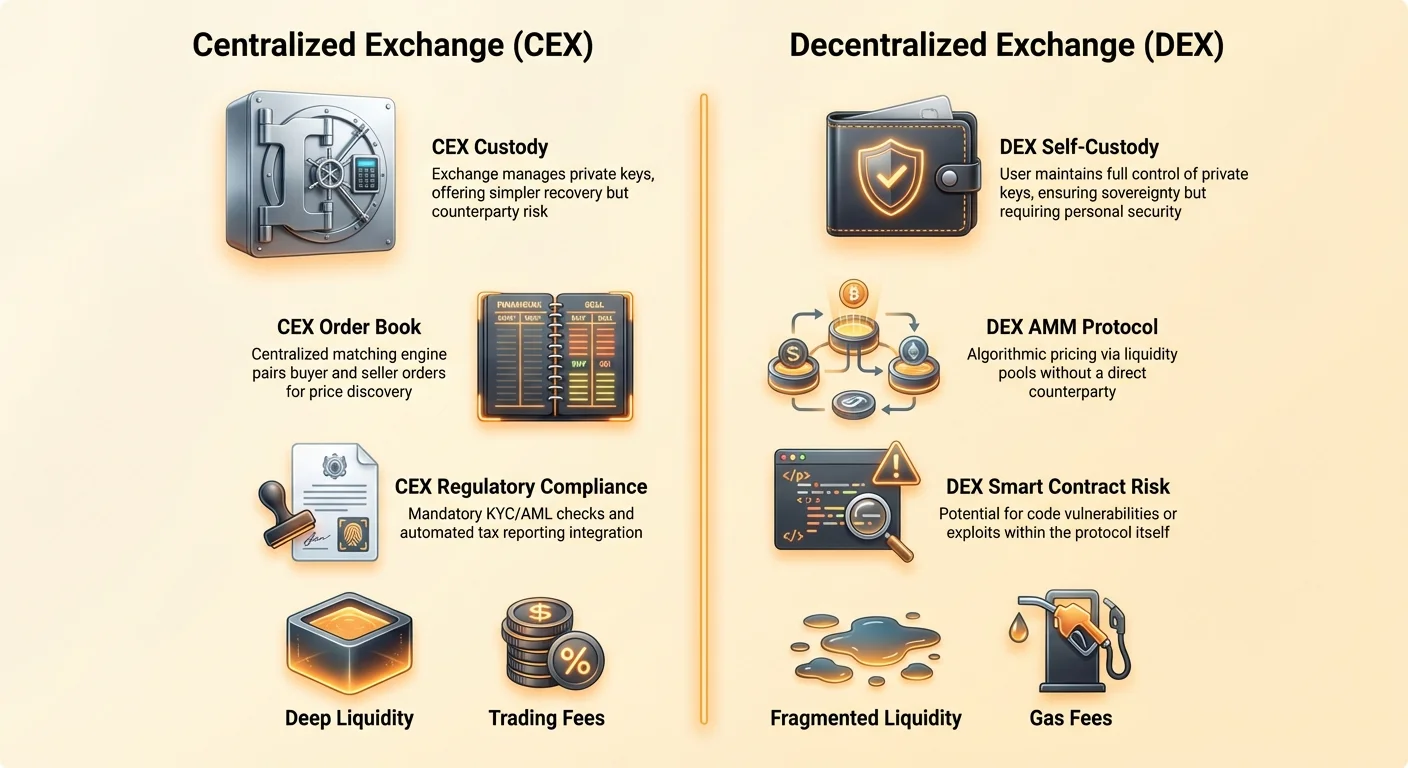
The single most important distinction between a CEX and a DEX is asset custody—who holds the private keys necessary to spend the cryptocurrency.
Centralized Exchanges (CEX): Custodial Control
A CEX operates much like a traditional brokerage or bank. When you deposit assets onto a platform like Coinbase, Binance, or Kraken, you are transferring your crypto into the custody of the exchange. The exchange holds the private keys in large, often insured, internal wallets.
- Implication: You rely entirely on the exchange’s security measures to protect your funds. If the exchange is hacked, becomes insolvent, or decides to freeze your account (due to a legal order or regulatory violation), you lose access to your funds. This is often summarized by the phrase: "Not your keys, not your crypto."
- Trade-off: This provides simplicity and recovery options. If you forget your password, the CEX has a standard process to verify your identity and restore access.
Decentralized Exchanges (DEX): Non-Custodial Control
A DEX is a peer-to-peer trading protocol built directly on a blockchain (like Ethereum or Solana). When you use a DEX (such as Uniswap or SushiSwap), you connect your personal, self-custody wallet (like MetaMask or Ledger) to the platform.
- Implication: Your funds never leave your personal wallet. They are held only by you, and the trade is executed via a smart contract that automatically swaps tokens between counterparties. The DEX protocol itself cannot freeze, seize, or lose your assets.
- Trade-off: You bear full responsibility for security. If you lose your private keys or seed phrase, no third party, including the DEX, can help you recover your funds.
Operating Mechanics: Order Books vs. Automated Market Makers (AMMs)
The way trades are facilitated fundamentally impacts execution quality, available assets, and pricing models.
CEX: The Centralized Order Book Model
CEXs utilize the traditional order book model familiar in equity and commodity markets. Buyers place "bid" orders (offers to buy at a certain price) and sellers place "ask" orders (offers to sell). The CEX’s matching engine brings these orders together, providing deep insight into market depth.
- Advantages: High speed, precise limit ordering, and centralized price discovery across all users.
- Disadvantages: Requires high server infrastructure and relies on market makers to consistently supply liquidity.
DEX: The Automated Market Maker (AMM) Model
Most modern DEXs do not use an order book. Instead, they rely on Liquidity Pools. These pools are funded by regular users (Liquidity Providers or LPs) who deposit pairs of tokens (e.g., ETH and USDC). The pricing of the swap is determined algorithmically by a mathematical formula, most famously $x * y = k$ (where $x$ and $y$ are the quantities of the two tokens, and $k$ is a constant).
- Advantages: Trades can occur instantly without needing a direct counterparty, enabling access to highly niche or newly created tokens.
- Disadvantages: Pricing can become inefficient in volatile markets, leading to potential slippage, and LPs risk "impermanent loss" (a topic covered in greater depth in our advanced liquidity guide).
Access and On/Off-Ramps (Fiat Integration)
The primary barrier for CEXs is their integration with the fiat world—the traditional banking system.
CEXs, due to their centralized structure and compliance obligations, seamlessly connect to banks, allowing users to deposit USD, EUR, or other national currencies directly and purchase crypto. They are the essential "on-ramp" for nearly every newcomer.
DEXs, being permissionless protocols, cannot legally interface directly with traditional banking systems. To use a DEX, you must already possess crypto in your wallet. If you want to convert crypto back to fiat, you usually need to route the assets through a CEX or a specialized crypto-to-fiat service.
Security, Risk, and Transparency Frameworks
Risk management is central to strategic asset placement. CEXs and DEXs mitigate risk using completely different mechanisms, requiring distinct security protocols from the user.
Centralized Exchange Security Models
When assessing a CEX, security is about mitigating counterparty risk and ensuring institutional strength.
Institutional Security and Proof-of-Reserves
Top-tier CEXs invest millions in cybersecurity, offering features like multi-factor authentication (MFA), cold storage solutions for the vast majority of assets (keeping them offline), and segregated accounts.
Following major industry failures, many CEXs have begun adopting Proof-of-Reserves (PoR) mechanisms. PoR attempts to provide cryptographic proof that the exchange holds the assets they claim to hold on behalf of their users.
- Strategic Takeaway: While CEXs offer strong technical security, their primary risk remains solvency and regulatory misconduct. Strategic users should prioritize exchanges with transparent auditing and clear insurance policies (if applicable).
Regulatory Compliance and KYC/AML Implications
Due to their control over customer funds and their function as fiat on-ramps, CEXs are required by global regulations (such as FATF and local government bodies) to implement rigorous Know Your Customer (KYC) and Anti-Money Laundering (AML) checks.
- KYC: Requires users to submit government-issued ID, proof of address, and often facial verification.
- AML: Requires monitoring transaction patterns for suspicious activity and reporting large cash conversions.
For strategic actors, KYC/AML offers both a benefit and a burden. It creates a paper trail linking assets directly to identity, which is crucial for compliant funds or professional investors. Conversely, it eliminates privacy and introduces censorship risk (the risk of a government or court ordering the seizure of assets).
Decentralized Exchange Smart Contract Risk
DEXs remove counterparty risk but introduce a new type of risk: Code Risk.
Smart Contract Vulnerabilities
A DEX’s entire operation is governed by smart contracts deployed on the blockchain. If the code contains a bug, a flaw, or a malicious back-door, hackers can exploit it, potentially draining the entire liquidity pool.
- Mitigation Strategy: Professional investors should only use DEX protocols that have undergone rigorous, third-party security audits (e.g., by firms like Certik or Trail of Bits). Furthermore, understanding the governance structure is vital, as protocols governed by a handful of centralized keys pose a greater risk than those with broad, decentralized governance.
Front-Running and Miner Extractable Value (MEV)
A subtle but significant risk on public blockchains like Ethereum is Front-Running (or MEV). Since transactions are broadcast publicly before they are finalized, sophisticated actors (often specialized bots) can see a large pending trade on a DEX and rapidly insert their own transaction ahead of it, often slightly raising the price and resulting in a poorer execution price for the original user.
- Strategic Takeaway: While MEV is complex, it highlights that transparent block production creates performance risks that are non-existent on the proprietary, centralized servers of a CEX. Users performing extremely large swaps on DEXs must consider this cost.
Evaluating Trading Efficiency and Execution
For the high-frequency trader or institutional fund, the primary concern shifts from security basics to execution quality, cost efficiency, and speed. This is where the liquidity and fee structures diverge sharply.
Liquidity Aggregation: Where Are the Assets?
Liquidity is the measure of how easily an asset can be bought or sold without significantly affecting its price (slippage).
CEX: Deep, Centralized Liquidity
A major CEX aggregates buy and sell orders from users globally into one massive, cohesive order book. This results in deep liquidity for major pairs like BTC/USD or ETH/USD.
- Benefit for Large Trades: Large-volume orders (Whales) can be filled quickly with minimal price impact because there is immense depth near the market price.
- Asset Focus: CEX liquidity is strongest for established, blue-chip assets. Niche or newly launched tokens often have fragmented liquidity or are not listed at all.
DEX: Fragmented, Long-Tail Liquidity
DEX liquidity is fragmented across thousands of specific liquidity pools. While a pool for ETH/USDC might be deep on Uniswap V3, the pool for a brand-new, niche asset might be shallow.
- Benefit for Niche Trades: DEXs excel at the "long tail" of crypto—any token created on that blockchain can instantly be listed and traded via an LP.
- Execution Risk: Because liquidity is spread out, large trades must often be routed across multiple pools using sophisticated aggregators (like 1inch). If the aggregate liquidity is shallow, large orders will incur significant slippage (the difference between the expected price and the final execution price).
Transaction Costs and Fee Structures Compared
The cost model for trading on CEXs and DEXs is fundamentally different.
CEX Fee Structure: Trading Fees and Spreads
CEXs typically charge a percentage trading fee based on the volume of the trade (e.g., 0.1% of the transaction value). They often use a "Maker/Taker" model, where users who provide liquidity (Makers) pay lower fees than those who remove liquidity (Takers). Fees are generally predictable and competitive, especially for high-volume institutional accounts.
DEX Fee Structure: Gas Fees and Protocol Fees
DEX trades have two core costs:
- Gas Fees: This is the cost paid to the blockchain network (e.g., the Ethereum network) to process and confirm the transaction. Gas fees are highly variable, spiking during network congestion, potentially making small trades prohibitively expensive.
- Protocol Fees: A small percentage fee (e.g., 0.3%) charged by the DEX protocol, which is then distributed back to the Liquidity Providers (LPs).
- Strategic Implication: For high-frequency traders executing hundreds of small trades, the fixed trading fees of a CEX are vastly preferable. For large, infrequent trades, a DEX may be competitive, provided gas fees are low (or if the DEX operates on a low-cost, high-speed Layer 2 network like Arbitrum or Polygon).
Tools for Automation and Advanced Trading
The complexity of institutional trading often necessitates sophisticated tooling, APIs, and access to derivatives.
CEX Support for Advanced Trading
CEXs are built to mimic traditional finance. They offer robust features critical for professional traders:
- APIs: Extensive Application Programming Interfaces (APIs) allow traders to connect automated trading bots, sophisticated market monitoring software, and arbitrage strategies directly to the exchange’s order book.
- Derivatives: CEXs overwhelmingly dominate the derivatives market (futures, margin trading, perpetual swaps, and options trading), which are essential for hedging and complex risk management strategies.
- Copy Trading: Some CEXs offer integrated social trading or copy-trading features, allowing users to automatically mirror the positions of successful traders.
DEX Limitations in Advanced Trading
DEXs are primarily focused on spot market token swaps. While the ecosystem is growing, native support for advanced tools remains nascent:
- API Limitations: While data can be pulled from the blockchain, manipulating automated positions requires smart contract interaction, which is more complex and costly than using a CEX API.
- Derivatives Access: Decentralized derivatives platforms (like dYdX or GMX) exist, but they are separate protocols, requiring different interfaces, collateral, and management than centralized offerings.
- Automation: Automation usually relies on complex external bots or sophisticated decentralized autonomous organizations (DAOs) running specific on-chain strategies, requiring intermediate to advanced technical skill.
Strategic Decision-Making: Matching Venue to User Profile
The optimal choice between a CEX and a DEX depends entirely on the user's goals, technical skill, risk tolerance, and relationship with regulatory compliance. We can define four strategic profiles.
Profile 1: The High-Frequency Trader (HFT) or Arbitrageur
Goal: Execute many trades rapidly and cost-effectively, exploiting tiny price differences across markets. Needs access to high-volume derivatives.
| Venue Preference | Rationale | Key Requirements |
|---|---|---|
| CEX (Primary) | Superior infrastructure for speed and cost control. APIs allow for automated bots to interact directly with deep order books and central matching engines. Fees are low for high-volume accounts. | Deep Liquidity, Robust APIs, Low Latency, Access to Margin/Futures. |
| DEX (Secondary/Specialized) | Only used for unique arbitrage opportunities between blockchain networks (cross-chain swaps) or to exploit price differences between a CEX price and a specific DEX pool. | Requires advanced knowledge of MEV mitigation and gas optimization. |
Strategic Tip: HFTs should utilize CEXs for all primary pairs and reserves, while maintaining a small, highly optimized fund on Layer 2 DEXs for fast-moving, niche opportunities where the token is not CEX-listed.
Profile 2: The Privacy-Focused Investor or Self-Sovereignty Adopter
Goal: Maintain full self-custody over assets and transact without linking identity to funds (avoiding KYC/AML compliance).
| Venue Preference | Rationale | Key Requirements |
|---|---|---|
| DEX (Primary) | Non-custodial nature is paramount. Transactions are pseudonymous, linked only to a wallet address, not a legal identity. | Requires strong personal security (hardware wallets), comfort with complex wallet interfaces, and reliable gas management. |
| CEX (Avoided) | KYC linkage defeats the goal of financial privacy and self-sovereignty. If a CEX must be used for a fiat on-ramp, use minimum necessary amounts and transfer immediately to self-custody. | Fiat on-ramp, if necessary, must be tightly controlled and limited. |
Strategic Tip: Adopt a dedicated hardware wallet (like Ledger or Trezor) as the standard operating procedure. Never store assets long-term on any venue—CEX or DEX—that is not a self-custody wallet.
Profile 3: The Institutional or Compliant Fund
Goal: Manage large pools of capital with full regulatory adherence, ensuring clear reporting, clear tax liability, and access to segregated accounts and deep liquidity.
| Venue Preference | Rationale | Key Requirements |
|---|---|---|
| CEX (Primary) | Compliance and reporting requirements make CEX mandatory. Institutional CEXs offer specific reporting packages (like 1099 forms in the US), segregated accounts, and direct communication with regulatory bodies. Deep liquidity mitigates major execution risks. | Full KYC/AML compliance, Regulatory clarity in jurisdiction, Insurance/Custodian offerings, Large block trade capabilities. |
| DEX (Avoided/Specialized) | DEXs introduce significant reporting complexity and often lack the insurance and regulatory assurances required by institutional mandates. | May use private, permissioned DeFi protocols (if available) for niche yield farming, but standard DEXs are typically off-limits. |
Strategic Tip: Institutions must choose CEXs that provide tailored corporate accounts and detailed transactional records that integrate directly with established accounting and tax software (a critical element for accurate crypto tax reporting).
Profile 4: The Beginner or Casual Investor
Goal: Simplicity, ease of access, low stress, reliable customer support, and easy connection to fiat banking.
| Venue Preference | Rationale | Key Requirements |
|---|---|---|
| CEX (Primary) | CEXs provide the necessary hand-holding. User interfaces are intuitive, customer support is available, and the custodial nature removes the fear of losing a seed phrase (though introducing counterparty risk). | User-friendly mobile app, easy fiat transfers, comprehensive educational resources, readily available customer support. |
| DEX (Avoided Initially) | The technical barriers (wallet setup, managing gas, dealing with smart contract approvals) are too high for a new user and often lead to costly mistakes. | Should only be approached after mastering self-custody basics and understanding Layer 2 solutions. |
Strategic Tip: Start with a highly regulated CEX known for its beginner interface (e.g., Coinbase). Once comfortable, practice moving small amounts to a self-custody wallet before exploring DEXs.
Advanced Considerations for Decentralized Finance (DeFi) Engagement
The true competitive advantage of DEXs lies in their integration into the wider Decentralized Finance (DeFi) ecosystem, offering utility far beyond simple trading.
Understanding Token Listing and Availability
DEXs offer unrestricted access to tokens, driving the "long-tail" effect of crypto asset discovery.
On a CEX, a token must undergo a rigorous, costly, and time-consuming vetting process before listing. This gatekeeping ensures quality and regulatory safety but severely limits choice.
On a DEX, anyone can create a token and immediately pair it with another asset in a liquidity pool. This is essential for:
- Early Access: Investors looking to participate in new projects (IDOs—Initial DEX Offerings) must use a DEX.
- Asset Diversity: Accessing unique governance tokens, niche ecosystem tokens, or assets built on specific layer-2 networks.
- Risk Note: This freedom comes with the high risk of scams, "rug pulls" (where developers drain the liquidity pool), and poorly coded tokens. Strategic traders on DEXs must exercise extreme due diligence.
Yield Generation Mechanisms: Farming, Staking, and Lending
A CEX primarily offers interest on deposited assets, often earning the yield by lending assets to institutional partners. This is passive and custodial.
DEXs are the gateway to active, non-custodial yield generation via DeFi protocols:
- Liquidity Providing (LP): Users deposit assets into a DEX pool and earn the protocol fees generated by every trade. This exposes the LP to impermanent loss (the possibility that the value of the pooled assets declines relative to simply holding them).
- Yield Farming: Moving LP tokens or collateral to secondary protocols to earn additional governance tokens as rewards, stacking multiple layers of yield.
- Decentralized Lending: Depositing assets into non-custodial lending markets (like Aave or Compound) to earn interest from borrowers.
Strategic Implication: Professional asset managers seeking optimized, non-custodial yield must master the DEX ecosystem, understanding the complex risk/reward profile of these sophisticated on-chain strategies.
The Importance of Wallet Management and Gas Optimization
Using a DEX means mastering your wallet. This includes:
- Connecting and Disconnecting: Understanding which permissions a DEX protocol requires (e.g., "approve spending" for a token) and revoking approvals when necessary to mitigate security risks.
- Transaction Speed (Gas): Learning how to manually adjust gas fees (or "priority fees") to ensure transactions are confirmed in a timely manner without overpaying. Using the correct Layer 2 or side-chain solution (Polygon, Solana, Arbitrum, etc.) for lower gas costs is critical for cost-efficient DEX trading.
Compliance and Reporting: Navigating Crypto Taxes
For sophisticated users, compliance is non-negotiable. The venue chosen for trading drastically alters the complexity and burden of tax reporting.
Centralized Reporting Requirements
CEXs simplify tax reporting because they are legally obligated to track and report specific user data to tax authorities in many jurisdictions.
Automated Record Keeping
The exchange tracks every trade, currency conversion, deposit, and withdrawal, calculating the cost basis for each asset. In jurisdictions like the US, large CEXs often issue Form 1099-B, which summarizes capital gains and losses, significantly simplifying the process for the end-user.
- Strategic Benefit: For compliant funds and professional finance users, this automated record-keeping is often worth the trade-off of giving up custody, as it reduces audit risk and administrative overhead.
- Caveat: CEX reporting is usually limited to transactions that occur on their platform. If you transfer assets off-platform, the CEX cannot track the subsequent transactions.
Decentralized Tracking Challenges
DEX transactions, while recorded permanently on the blockchain, lack a central authority to aggregate them and define the legal cost basis.
The Transactional Complexity
A single DEX activity can involve multiple taxable events:
- Swapping Token A for Token B: A taxable capital gains event (realizing gain/loss on Token A).
- Paying the Gas Fee (in ETH): A separate taxable event (using ETH as consideration for a service).
- Providing Liquidity: Often not a taxable event, but withdrawing liquidity might be.
- Earning Protocol Fees: Taxable income.
Since no single entity tracks this, users must utilize specialized crypto tax software (like Koinly, TokenTax, or CryptoTaxCalculator, as referenced in industry sources) that connects to the public blockchain via wallet addresses.
Best Practices for Transaction Reconciliation
Regardless of your chosen venue, combining CEX data with DEX data is essential for accurate compliance:
- Use Tax Software Integrators: Connect your CEX API keys and input your DEX wallet addresses into a dedicated crypto tax platform.
- Maintain Consistent Cost Basis Method: Ensure you apply the same tax lot identification method (e.g., FIFO, LIFO, or Specific Identification) consistently across both CEX and DEX transactions, as required by your jurisdiction.
- Document Off-Chain Activity: Keep records of any trades or transfers that occurred off-chain (e.g., P2P trades, or initial fiat purchase records) to ensure a complete transactional history.
Secinājums: Izveidojot savu personalizēto stratēģiju
Izvēle starp centralizēto biržu (CEX) un decentralizēto biržu (DEX) nav vai/vai dilemma; tā ir stratēģiska lēmuma pieņemšana, kas jāizmanto katras vietas stiprajām pusēm, balstoties uz uzdevumu.
CEX paliek nepārspīlēti čempioni fiat ieiešanai, dziļai likviditātei galvenajiem aktīviem, uzlabotiem tirdzniecības rīkiem (API, derivātiem) un vienkāršotai regulatīvai atbilstībai. Tās ir droši, augstas veiktspējas dzinēji augstas frekvences tirdzniecībai un institucionālai fondu pārvaldībai.
DEX ir decentralizētās frontes, piedāvājot patiesu pašsaimniecību, finanšu privātumu, neierobežotu piekļuvi aktīvu garajai astei un ne-saimniecisku ienesīguma ģenerēšanu (DeFi). Tās ir būtiskas pašsuverenitātes pieņemējam un izsmalcinātam stratēģim, meklējot optimizētus ienesīgumus ārpus tradicionālajām finanšu sliedēm.
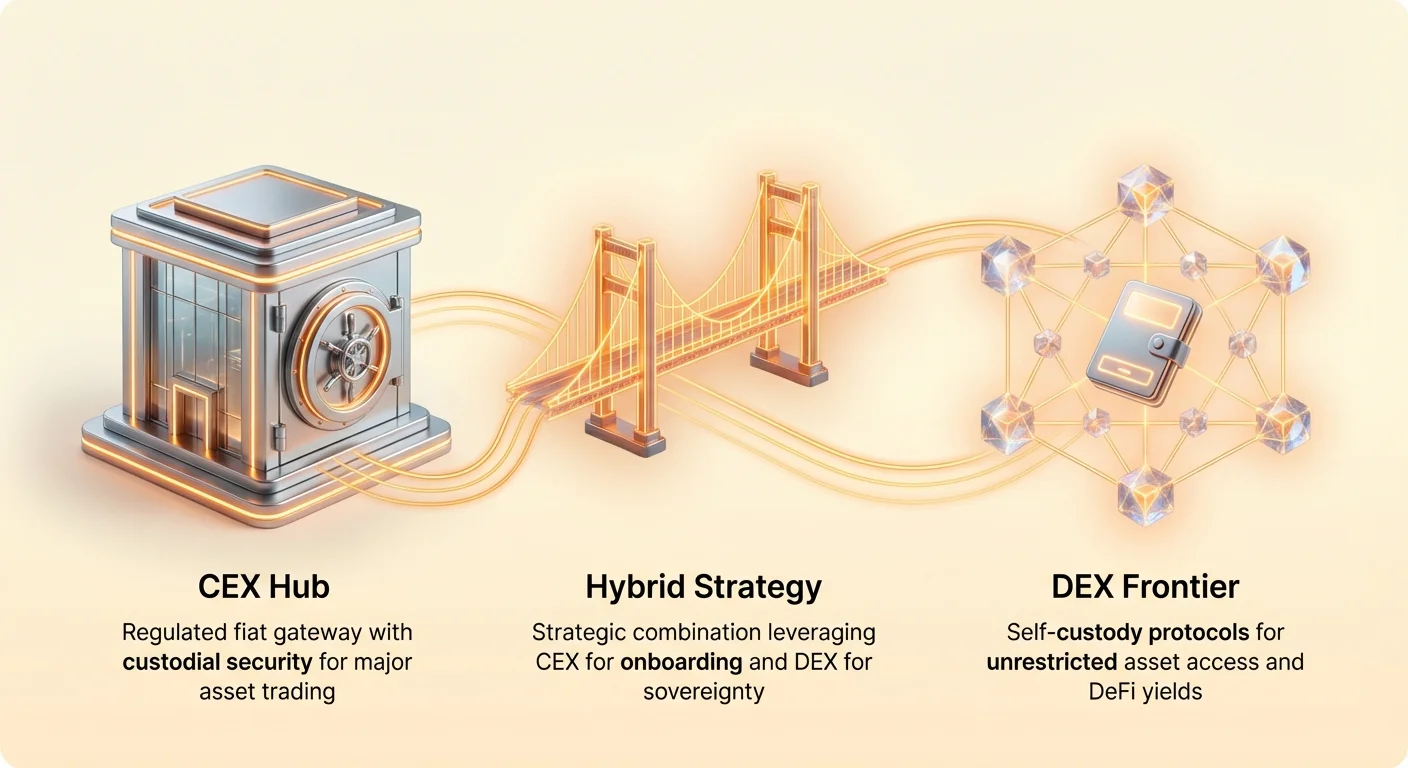
Visefektīvākā stratēģija izmanto hibrīdu pieeju:
- CEX kā centrs: Izmantojiet regulētu CEX sākotnējai fiat konvertācijai, nodokļu atbilstošai dokumentācijai un liela apjoma galveno žetonu tirdzniecībai.
- DEX kā spiegs: Nekavējoties pārnesiet aktīvus uz pašsaimniecības maciņu un izmantojiet DEX (ideāli uz Layer 2 tīkliem) ne-saimnieciskai ienesīguma ģenerēšanai, piekļuvei jauniem žetoniem un privātumam orientētiem darījumiem.
Izprotot atšķirīgos drošības modeļus, likviditātes ietvarus un atbilstības slogus CEX un DEX, jūs pārejat pāri vienkāršajai „iesācēja rokasgrāmatai” un iegūstat stratēģisko meistarību, kas nepieciešama digitālo aktīvu ekonomikas sarežģītību un iespēju navigācijai.