
Cryptocurrency introduces a fundamental shift in how assets are owned and managed. Unlike traditional banking where a centralized institution safeguards your funds and can reset a password if you forget it, digital assets rely on self-custody. This model grants you absolute control over your wealth, but it also imposes a strict responsibility. If you lose access to your wallet and do not have a proper backup, the funds are irretrievable. There is no customer support hotline for the blockchain that can reverse a mistake or restore lost data.
Developing a robust recovery strategy is not merely a precaution. It is a necessary requirement for anyone holding Bitcoin or other cryptocurrencies. A comprehensive plan must account for various scenarios, including device failure, accidental loss of private keys, and the eventual transfer of assets to heirs. Without a plan, you are gambling with the permanence of your investment. This guide explores the mechanics of wallet recovery, the hierarchy of backup methods, and the strategies needed to ensure your digital wealth survives unexpected events.
The Mechanics of Ownership and Access
To understand recovery, one must first understand what is actually being stored. A cryptocurrency wallet does not hold coins inside it like a physical leather wallet holds cash. Instead, the wallet stores a private key. This key is a sophisticated form of cryptography that allows you to sign transactions and prove ownership of an address on the blockchain. If you possess the private key, you own the assets associated with it. If you lose the key, the assets remain on the blockchain, but they become mathematically impossible to spend.
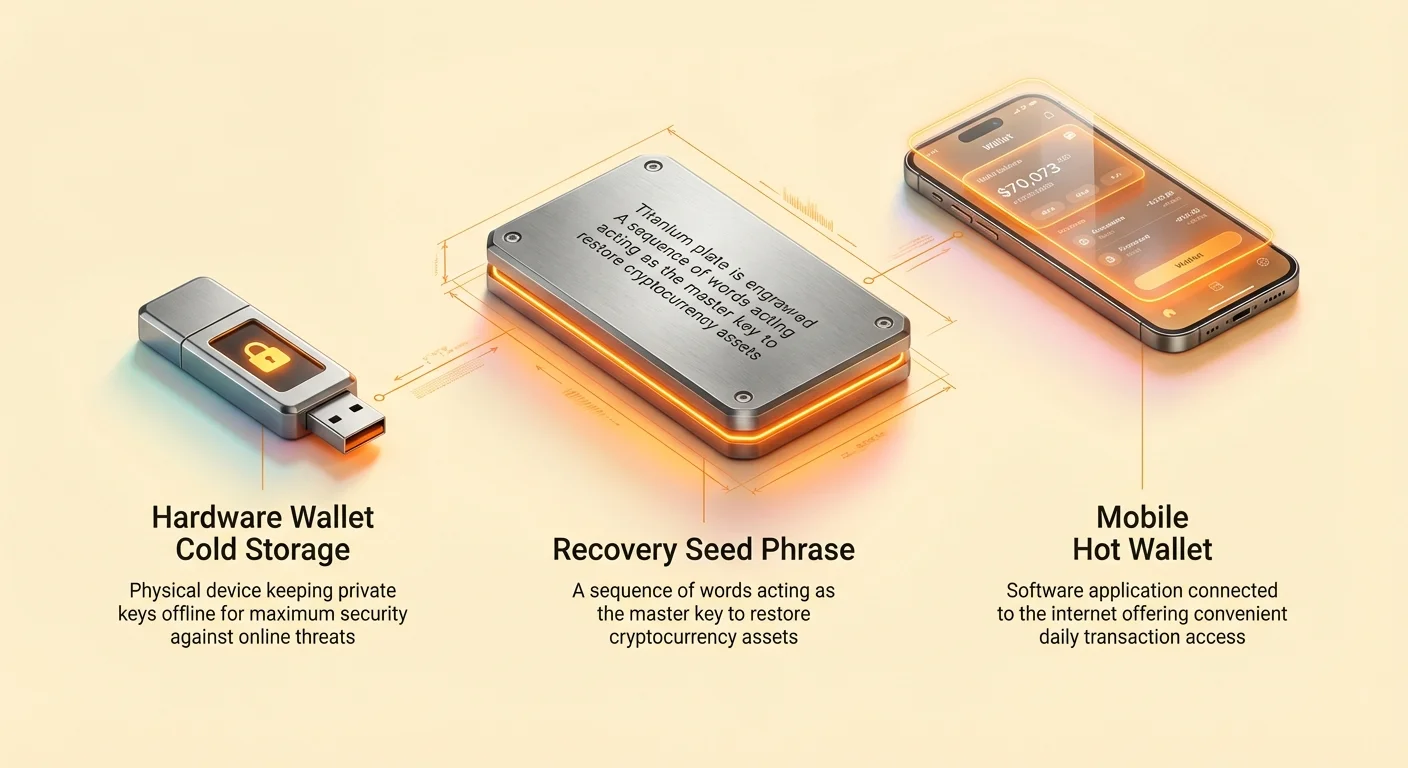
Most modern wallets simplify this complex cryptography using a recovery phrase, often called a seed phrase. This is typically a list of 12 or 24 random words generated when you first set up the wallet. This sequence of words acts as a master key. It can regenerate your private keys and restore your balance on any compatible device, regardless of the original hardware or software used.
Protecting this seed phrase is the primary objective of any recovery strategy. It must be kept offline to prevent hacking, but it must also be accessible enough that you can retrieve it if your primary device is destroyed. The balance between security and accessibility is where most users struggle. A seed phrase stored in a password manager is vulnerable to malware. A seed phrase written on a napkin is vulnerable to fire or water damage.
Strategies for Hot Wallet Recovery
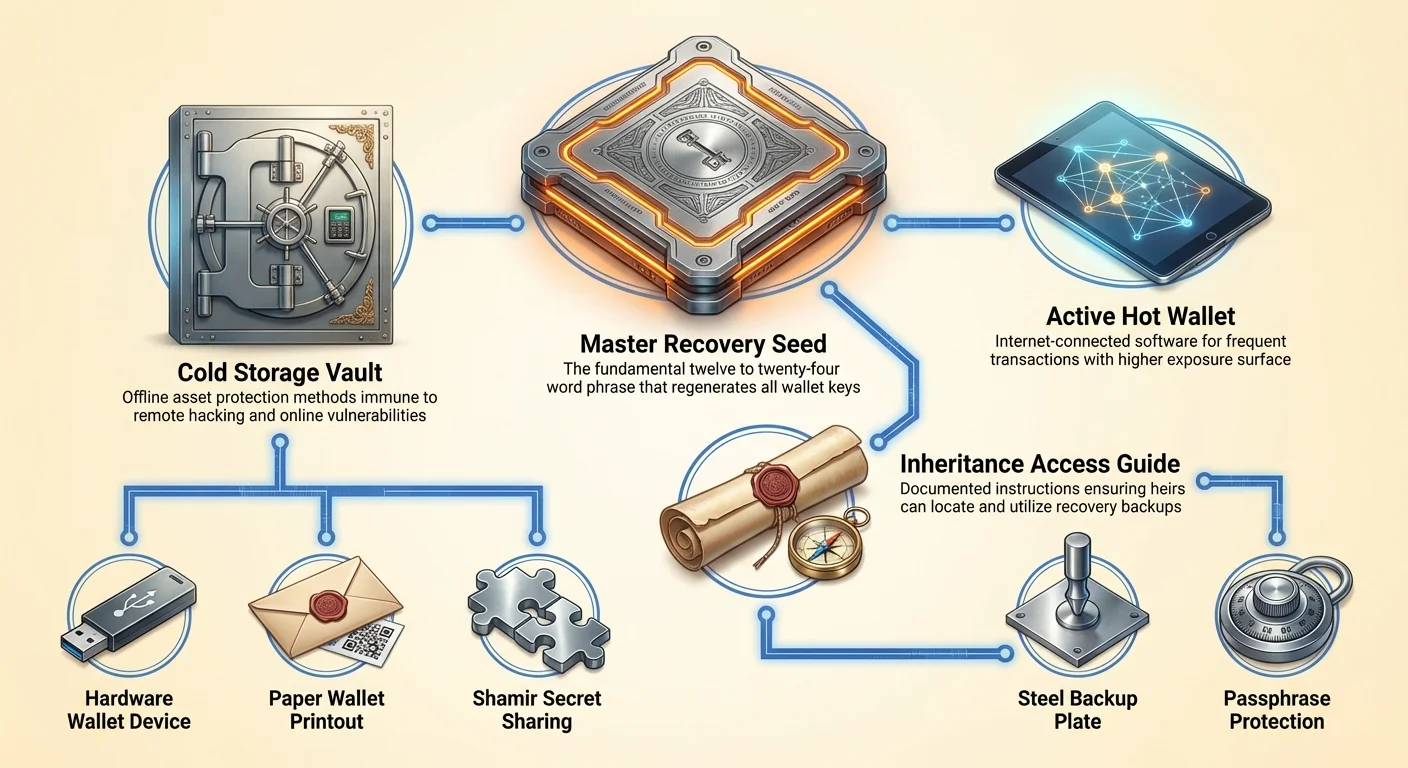
Hot wallets are software applications connected to the internet, running on mobile devices, desktops, or web browsers. They offer convenience for daily transactions but introduce specific risks regarding recovery. Since the device is online, the attack surface is larger. However, the recovery process remains standardized across most non-custodial platforms.
When you create a mobile or desktop wallet, the software will ask you to write down the seed phrase. This is the only time the phrase is shown. If your phone is lost, stolen, or broken, your funds are safe as long as you have that backup. To recover, you simply download the wallet application on a new device and select the option to "Import Wallet" or "Restore from Backup." You then enter the words in the exact order they were generated.
It is critical to verify your backup immediately after creation. Some users write down a word incorrectly or illegibly. A good practice is to wipe the wallet app immediately after setting it up (before sending significant funds) and attempt to restore it using your written backup. This "fire drill" confirms that your recovery plan actually works.
| Recovery Factor | Mobile Wallet | Desktop Wallet | Browser Extension |
|---|---|---|---|
| Primary Risk | Phone loss/damage | Malware/Hard drive failure | Phishing/Browser exploits |
| Backup Method | 12-24 word seed phrase | 12-24 word seed phrase | 12-24 word seed phrase |
| Recovery Speed | Instant (App install) | Fast (Software install) | Instant (Extension install) |
Cold Storage and Physical Backups
Cold storage involves keeping private keys offline, significantly reducing the risk of digital theft. This category includes hardware wallets and paper wallets. Recovery for these devices relies entirely on physical backups, as there is no digital footprint to hack.
Hardware Wallet Redundancy
Hardware wallets are physical devices that store private keys in a secure element. They are immune to computer viruses because the keys never leave the device. If the hardware wallet itself is lost or destroyed, you are not out of luck. The device is merely a portal. As with software wallets, the 12 or 24-word seed phrase allows you to clone your wallet onto a new device.
However, hardware wallets offer advanced recovery features. Many support a passphrase, which is an optional word added to the seed phrase. This creates a completely hidden wallet. If you use a passphrase, it is essential to back it up separately from the seed phrase. If you have the seed but forget the passphrase, the funds in the hidden wallet are lost forever.
The Paper Wallet Approach
A paper wallet is a physical printout of a public and private key pair. This method is one of the ultimate forms of cold storage because it is generated offline and never touches the internet. To set one up securely, you should use a trusted generator tool, save the page, disconnect your computer from the internet, and then generate the keys.
The recovery process for a paper wallet is different from a seed phrase. To access the funds, you must "sweep" the wallet. This involves using a mobile or desktop wallet app to scan the QR code of the private key printed on the paper. This action transfers the entire balance from the paper wallet to the software wallet. Once a paper wallet has been swept, it should not be reused, as the private key has been exposed to an online device.
Advanced Security: Shamir Backups and Fragmentation
For those holding significant value, a single paper backup presents a risk. If that single piece of paper is stolen or destroyed in a fire, the funds are gone. To mitigate this, advanced strategies involve splitting the backup. One method is Shamir’s Secret Sharing, supported by certain high-end hardware wallets.
Shamir backups allow you to split your recovery phrase into multiple unique shares. For example, you might create a "2 of 3" setup. This generates three separate lists of words. To recover the wallet, you need any two of the three lists. You can store one list at your home, one in a bank safety deposit box, and one with a trusted family member.
This approach offers redundancy and security. If a thief finds one share, they cannot access your funds. If a fire destroys your home share, you can still recover the wallet using the other two. This method essentially decentralizes the physical security of your assets, removing the single point of failure associated with a standard seed phrase list.
Planning for Inheritance and Digital Succession
One of the most overlooked aspects of crypto management is inheritance. Because cryptocurrencies do not rely on identity verification, your next of kin cannot simply present a death certificate to a bank to claim your Bitcoin. If they do not have the keys, the wealth dies with you. Planning for this scenario requires a delicate balance between security and accessibility.
Documentation and Education
The first step in inheritance planning is documentation. Your heirs need to know that the assets exist and where the backups are located. However, you should never include your actual seed phrase in a will. Wills often become public records upon probate, which would expose your funds to the public.
Instead, use a tiered system. Your will can describe the existence of the assets and point to a secure location where the keys are stored. This might be a physical safe or a safety deposit box. Inside that secure location, you should provide clear, non-technical instructions. Assume your heirs know nothing about cryptocurrency.
The Instructional Letter
Write a detailed guide explaining what hardware or software is required. Explain the difference between the PIN code for the device and the seed phrase for recovery. If you use a passphrase or a multi-signature setup, these details must be explicitly stated. Without a roadmap, a hardware wallet looks like a USB drive, and a paper wallet looks like a receipt. Many fortunes have been discarded simply because the heirs did not recognize the value of the items they found.
| Inheritance Item | Purpose | Storage Recommendation |
|---|---|---|
| The Will | Legal transfer of ownership | Lawyer/Public Record |
| Access Guide | Instructions on how to use keys | Sealed envelope in safe |
| Seed Phrase | The actual keys to funds | Steel plate in fireproof safe |
Social Recovery Implementation
Social recovery is a strategy that allows you to regain access to your account with the help of trusted contacts, rather than relying solely on a piece of paper. While some smart contract wallets offer automated social recovery, you can implement a manual version using multi-signature (multi-sig) wallets or split backups.
In a multi-sig setup, a wallet requires multiple keys to authorize a transaction. For example, a "2 of 3" multi-sig wallet creates three keys. You might hold one key, a family member holds the second, and a lawyer holds the third. To move funds, two signatures are needed. If you lose your key, the family member and the lawyer can combine their keys to move the funds to a new wallet you control.
This method is powerful because it protects against both loss and coercion. If you are threatened, you cannot move the funds alone. If you lose your backup, you are not locked out. However, this requires trusted participants who understand their role. You must ensure that your social recovery partners maintain their own security standards so their keys are not compromised.
Environmental Protection and Material Durability
A recovery strategy is only as good as the material it is written on. Paper degrades over time. It is susceptible to humidity, silverfish, and ink fading. For long-term cold storage, relying on a standard piece of printer paper is a risk.
To professionalize your recovery plan, consider upgrading your storage medium. Metal backups are a popular standard for long-term storage. These are stainless steel or titanium plates where you punch or engrave your seed phrase. Metal backups are fireproof, waterproof, and corrosion-resistant. They can survive a house fire that would turn a paper backup into ash.
If you must use paper, use high-quality, acid-free paper and laminate it. Store the document in a fireproof and waterproof document bag or safe. Avoid taking photos of your backup to store on cloud drives or your phone gallery. Digital copies defeat the purpose of cold storage and expose you to cloud leaks and hacks.
The Importance of Routine Verification
A recovery plan is not a "set it and forget it" system. Over time, memory fades, ink blurs, and hardware becomes obsolete. It is essential to perform routine checks on your recovery strategy. At least once a year, you should physically inspect your backups. Check for signs of fading or damage.
If you are using a hardware wallet, ensure that the device firmware is updated, but always have your seed phrase nearby before clicking update. Firmware updates rarely fail, but if they do, the device may reset, requiring the seed phrase for restoration.
Furthermore, verify that your instructions for inheritance are still accurate. If you have moved funds to a new wallet or changed your security setup (e.g., added a passphrase), your old instructions might lead your heirs to an empty wallet. Keeping your documentation in sync with your actual security practices is vital for ensuring the continuity of your wealth.
Conclusion
Securing cryptocurrency requires a shift in mindset from passive reliance on institutions to active personal responsibility. The tools for storage—ranging from mobile apps and hardware devices to paper wallets—offer varying degrees of convenience and security. However, the common denominator across all these methods is the recovery seed. This string of words is the absolute guardian of your digital assets. Protecting it from physical destruction, loss, and theft is the primary directive of any wallet strategy.
Planning for loss and inheritance transforms crypto holding from a speculative gamble into a durable financial strategy. By implementing redundancies like Shamir backups, utilizing durable materials like metal plates, and documenting clear instructions for heirs, you ensure that your assets remain accessible regardless of life's unpredictability. Regular testing and verification of these plans prevent the catastrophe of discovering a flaw only after a crisis has occurred.
A secure wallet is not just about keeping hackers out, but ensuring you can always get back in.