
The emergence of Bitcoin in 2009 marked the beginning of a profound shift in how society perceives value, ownership, and financial sovereignty. Born from the ashes of a global financial crisis, this decentralized protocol offered an alternative to the traditional banking system. It proposed a model where trust in fallible human institutions is replaced by cryptographic proof and immutable code. Over the years, this digital asset has evolved from an experimental technology into a robust financial instrument with significant geopolitical implications.
As the network grows, it creates a hypothetical future where individuals and potentially nation-states operate within a fortified economic structure. This structure is often metaphorically referred to as a citadel of digital finance. The foundation of this system lies in its ability to function without intermediaries. In the traditional world, banks and governments act as gatekeepers. They control the issuance of money and the validation of transactions.
Bitcoin removes these gatekeepers entirely. It operates on a peer-to-peer network that is open to anyone with an internet connection. No permission is required to participate, and no central authority can shut it down. This resistance to external control forms the bedrock of its value proposition. It suggests a future where financial inclusion is determined by connectivity rather than geography or political status.
The Architecture of Digital Sovereignty
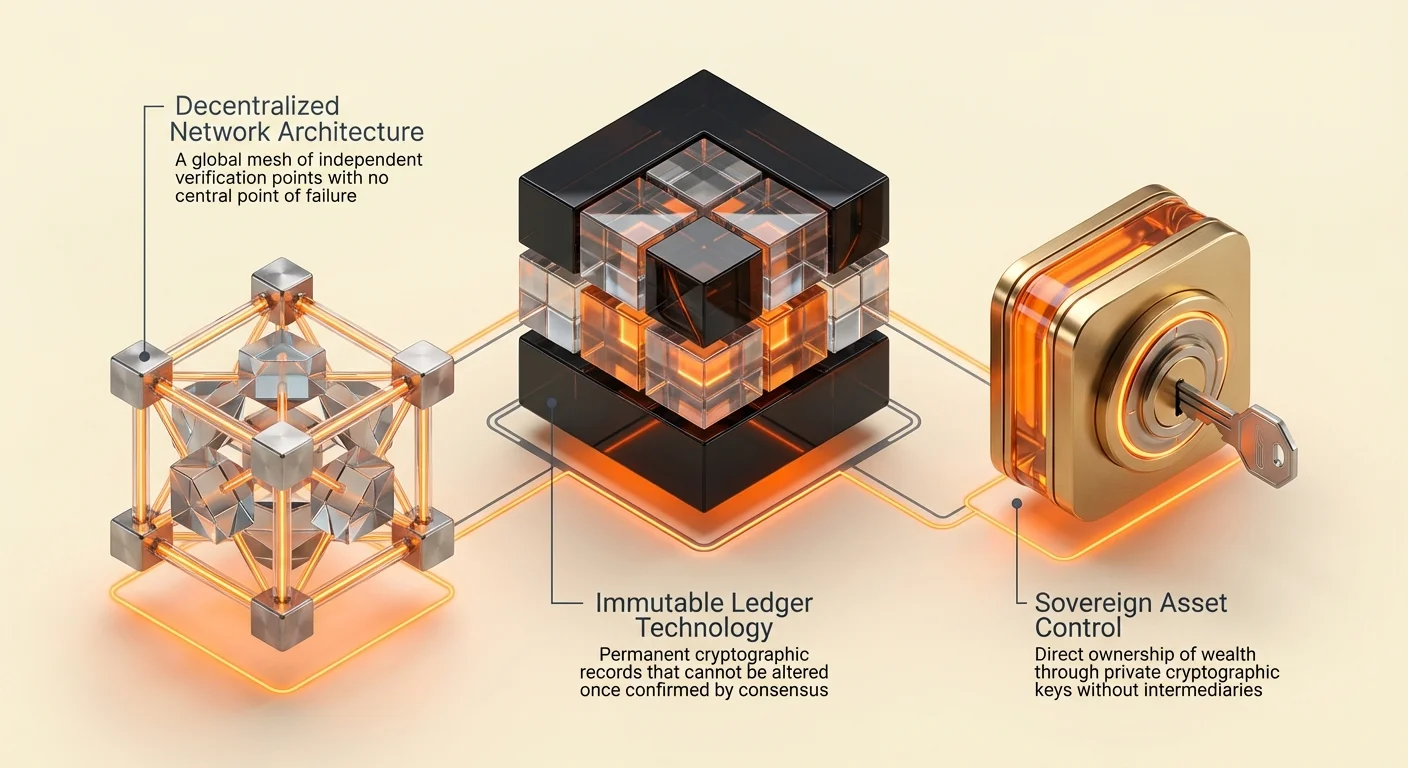
The strength of the Bitcoin network is derived from its decentralized architecture. Unlike centralized databases managed by a single company, the ledger is maintained by thousands of independent computers known as nodes. These nodes are distributed globally, creating a mesh of verification that is incredibly difficult to disrupt. Each node contains a full history of every transaction ever made. This redundancy ensures that even if large portions of the internet were to go offline, the record of ownership would remain intact.
This structure provides a level of security that is unparalleled in the digital realm. To alter the history of the ledger, an attacker would need to control more than half of the network's computational power. This is a feat that becomes increasingly expensive and logistically impossible as the network expands. The result is a system where property rights are enforced by mathematics rather than legal decrees. For individuals living in regions with unstable governments or weak property laws, this offers a unique form of protection.
Absolute Scarcity in an Inflationary World
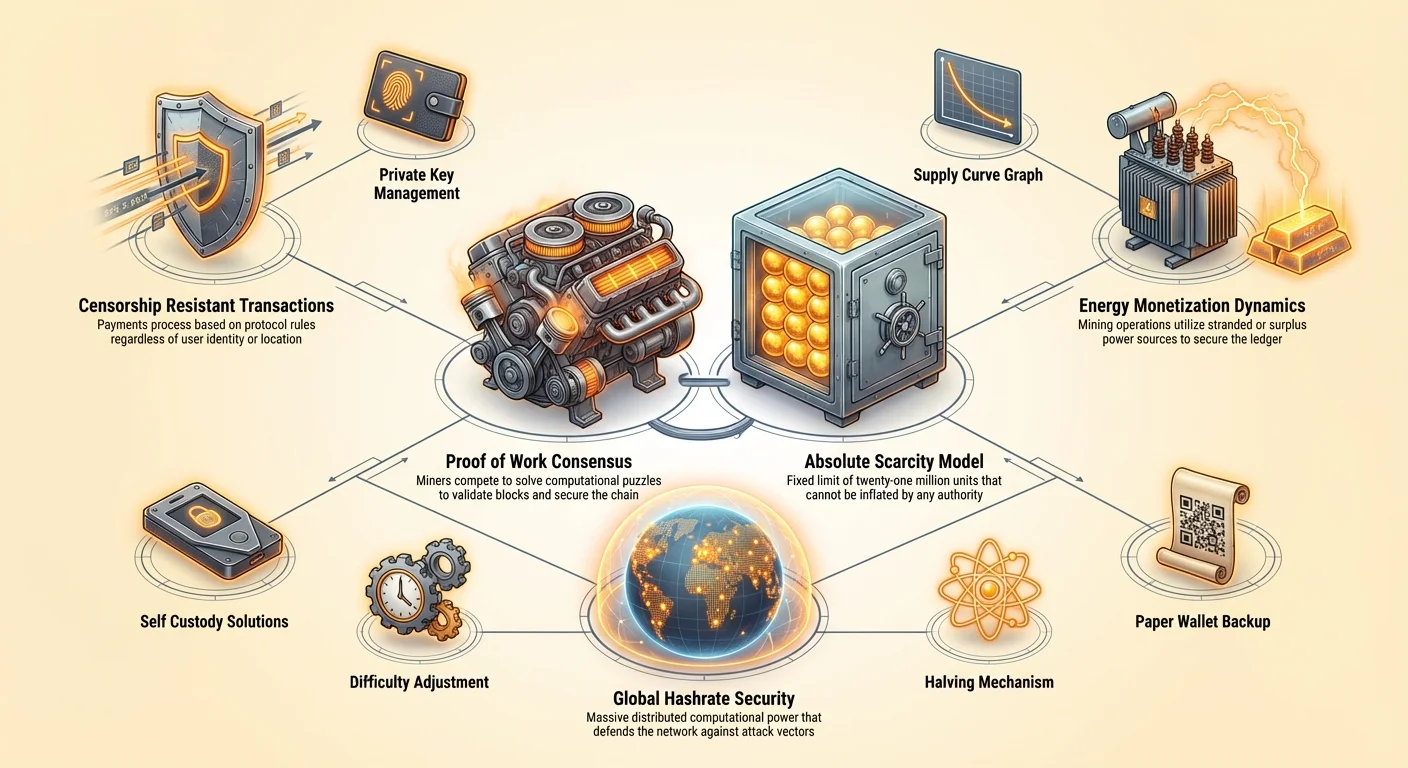
A defining characteristic of this digital citadel is its monetary policy. The protocol dictates that there will never be more than 21 million coins in existence. This fixed supply is hard-coded into the software and enforced by the consensus of the network participants. It stands in stark contrast to fiat currencies, which can be printed in unlimited quantities by central banks. The ability to inflate the money supply allows governments to manage economies, but it also leads to the erosion of purchasing power over time.
When money is not rare, it loses value. This phenomenon forces individuals to seek ways to preserve their wealth. Bitcoin's scarcity makes it a deflationary asset by design. As demand increases against a fixed supply, the purchasing power of the asset tends to rise over long timeframes. This dynamic challenges the traditional economic model based on perpetual inflation. It introduces a savings technology that cannot be debased by political decisions or economic mismanagement.
The issuance of new coins is also predictable. It occurs through a process called mining, where the reward for processing transactions is cut in half approximately every four years. This mechanism, known as the halving, ensures that the inflation rate of the asset decreases over time until it reaches zero. This predictability allows long-term planning that is difficult to achieve with fiat currencies subject to changing monetary policies.
The Erosion of Centralized Trust
The necessity for a decentralized alternative becomes apparent when analyzing the vulnerabilities of the traditional financial system. Modern finance relies entirely on trusted third parties. When money is deposited in a bank, it is no longer strictly the property of the depositor. It becomes a liability of the bank. The depositor essentially loans their money to the institution in exchange for the promise of future access. This model works well when institutions are solvent and stable.
However, history is replete with examples of institutional failure. Banks can make poor investment decisions that lead to insolvency. In such cases, depositors may lose access to their funds or face significant restrictions on withdrawals. This creates a counterparty risk that is inherent to all centralized finance. The Bitcoin network eliminates this risk through self-custody. Users who hold their own private keys maintain direct control over their assets without relying on a third party to honor a promise.
Furthermore, centralized systems are susceptible to censorship. Financial institutions effectively act as deputies for government enforcement. They can be ordered to freeze accounts, block transactions, or confiscate funds without due process. This power can be used to combat crime, but it can also be used to suppress political dissent or marginalize specific groups. A decentralized system is agnostic to the identity of the user. It processes transactions based on adherence to protocol rules rather than the social or political standing of the participants.
Geopolitics and the Separation of Money and State
The rise of a stateless currency introduces complex dynamics into international relations. For centuries, the control of money has been a primary tool of state power. Nations use currency manipulation to gain trade advantages and impose economic sanctions to exert geopolitical pressure. A neutral monetary asset disrupts these traditional levers of power. It allows for the transfer of value across borders without passing through the choke points of the global banking system.
Sanction Resistance and Capital Controls
Economic sanctions rely on the cooperation of centralized financial intermediaries. By cutting off a nation's access to the global banking network, dominant powers can isolate adversaries economically. However, a decentralized network has no central point of failure that can be pressured to comply with sanctions. Transactions occur directly between peers. This capability makes it difficult to enforce total economic blockades. While liquidity constraints currently limit the ability of major nations to bypass sanctions entirely using crypto, the potential remains for smaller actors or individuals to maintain financial connectivity.
Similarly, capital controls are often used by struggling economies to prevent wealth from fleeing the country. Citizens facing hyperinflation often attempt to convert their local currency into stable foreign assets. Governments may restrict this movement to prop up the local exchange rate. Bitcoin provides a mechanism to bypass these controls. It allows individuals to exit a failing monetary system and preserve the value of their labor. This creates a check on government mismanagement, as excessive inflation may accelerate the adoption of non-sovereign alternatives.
The Global Hashrate War
The security of the Bitcoin network relies on a process called Proof of Work. Miners compete to solve complex mathematical problems to validate transactions and mint new coins. This process requires significant energy and hardware infrastructure. As the strategic importance of the asset grows, nation-states may view mining capacity as a matter of national interest. Controlling a significant portion of the global hashrate does not give a nation control over the network rules, but it does provide economic revenue and influence.
This could lead to a scenario where countries compete to attract mining operations. Nations with abundant energy resources may leverage mining to monetize stranded power or stabilize their electrical grids. Conversely, countries that view the asset as a threat may attempt to ban mining or restrict access to hardware. This geopolitical tug-of-war creates a landscape where the physical infrastructure of the network becomes a strategic asset. The distribution of mining power acts as a decentralized defense mechanism, preventing any single jurisdiction from dominating the system.
Economic Implications of Hard Money
The narrative of Bitcoin as a store of value has gained significant traction among institutional investors and corporations. In a world of near-zero interest rates and expanding monetary supplies, traditional safe havens like bonds offer diminishing returns. This has led to a search for assets that can protect purchasing power. The comparison to gold is frequent and apt. Both assets share the properties of scarcity, durability, and independence from sovereign issuers.
Inflation Hedge and Purchasing Power
An inflation hedge is an asset that is expected to maintain or increase its value when the purchasing power of fiat currency declines. The logic is straightforward. If the supply of dollars or euros doubles, but the supply of Bitcoin remains fixed, the price of the digital asset should theoretically rise in fiat terms. This relationship has driven adoption during periods of high monetary expansion. Investors view it as insurance against the devaluation of paper money.
However, volatility remains a significant factor. Unlike gold, which has thousands of years of price history, the crypto market is relatively young. Prices can fluctuate dramatically in short periods. This volatility makes it a risky store of value over short timeframes. Yet, over longer horizons, the asset has historically outperformed most traditional investments. This suggests that while the path is volatile, the long-term trajectory reflects the growing monetization of a scarce digital commodity.
The Store of Value Narrative
For an object to function as a store of value, it must be liquid and widely accepted. It must be easy to exchange for other goods or currencies. Bitcoin's liquidity has improved drastically over the last decade. It is traded on major exchanges worldwide and accepted by a growing number of merchants. Its digital nature gives it a distinct advantage over physical stores of value like real estate or gold bars. It is portable and divisible.
A billion dollars worth of value can be stored on a device smaller than a deck of cards or even memorized as a seed phrase. This portability allows wealth to be transported across borders effortlessly. In contrast, moving physical gold or selling real estate involves significant friction, costs, and time delays. This unique combination of scarcity and portability positions it as a premier collateral asset for the digital age.
Energy Independence and Mining Dynamics
The environmental impact of the network is a subject of intense debate. Critics point to the high electricity consumption of the mining process. It is true that securing a global decentralized ledger requires a massive amount of energy. This expenditure is the cost of maintaining a trustless system without a central authority. However, focusing solely on total consumption misses the nuance of how that energy is sourced and utilized.
Utilizing Wasted Energy
Miners are geographically agnostic. They can operate anywhere there is an internet connection and a power source. This flexibility allows them to seek out the cheapest electricity available. Often, the cheapest power is energy that would otherwise be wasted. This includes hydroelectric power in remote regions where supply exceeds local demand. It also includes flared natural gas from oil extraction sites.
By monetizing this stranded energy, mining can improve the economics of renewable energy projects. It provides a consistent buyer for excess power, making wind and solar installations more financially viable. In this view, the network acts as a battery of sorts. It converts surplus electricity into digital value. This dynamic suggests a future where mining is integrated into energy grids to balance load and reduce waste.
The Environmental Debate
The ethical question often posed is whether the utility of the network justifies its environmental footprint. Critics argue that the energy could be better used elsewhere. Proponents argue that providing a permissionless, censorship-resistant financial system for the world is a high-value utility. Furthermore, comparisons to the existing financial system are often skewed. The traditional banking system also consumes vast amounts of energy through physical branches, data centers, and transportation, though these costs are less transparent.
As the industry matures, there is a strong trend toward sustainable energy sources. Miners have a financial incentive to use renewables, which are often the cheapest form of generation. This shift could lead to a scenario where the network becomes one of the greenest industrial sectors in the world. The debate ultimately hinges on whether one views sound money as a public good worthy of resource expenditure.
The Fortress of Censorship Resistance
In the context of a "Bitcoin Citadel," censorship resistance is the wall that protects the inhabitants. It refers to the inability of any third party to prevent a transaction from occurring. In traditional finance, transactions are requests that must be approved by intermediaries. These intermediaries can deny service based on regulatory pressure, risk appetite, or political alignment.
Immutable Transactions
Once a transaction is confirmed on the blockchain, it is permanent. It cannot be reversed or altered. This immutability is secured by the Proof of Work consensus. Changing a past record would require redoing all the work that has been done since that block was mined. This feature eliminates the risk of charge-backs and fraud that plagues traditional commerce. It functions as a push system, similar to physical cash.
When you hand someone cash, the transaction is final. You cannot claw it back without the recipient's consent. Digital payments in the fiat world are pull systems, where merchants are authorized to pull funds from an account. Bitcoin restores the finality of cash to the digital realm. This creates a predictable and reliable settlement layer for global commerce.
Freedom from Confiscation
The most radical aspect of this technology is the protection it offers against seizure. Assets stored in a bank can be confiscated with a keystroke. Real estate can be seized or regulated. Physical gold can be taken by force. Bitcoin, when properly secured, is immune to these vectors of attack. If a user holds their private keys and keeps them secret, the funds cannot be moved without their permission.
This property empowers individuals in authoritarian regimes. It allows dissidents to protect their resources from government appropriation. It enables refugees to flee conflict zones with their wealth intact, preserved in a password. This freedom from confiscation fundamentally alters the relationship between the individual and the state. It shifts the balance of power toward the sovereign individual.
Privacy and the Digital Panopticon
While the network offers freedom from control, it does not inherently offer freedom from observation. There is a common misconception that cryptocurrency is anonymous. In reality, it is pseudonymous. Transactions are not tied to real-world identities on the ledger, but they are tied to public addresses. The entire history of every address is visible to the world.
If a user's identity is linked to their public address—often through a centralized exchange that requires ID verification—their entire financial history can be traced. Blockchain analysis firms specialize in mapping these connections. They track the flow of funds to identify users and monitor activity. This creates a privacy paradox. The system is open and transparent, which builds trust, but that same transparency can facilitate surveillance.
To maintain privacy within this digital citadel, users must employ specific tools and practices. Using new addresses for every transaction helps break the link between activities. Privacy-focused wallets and coin mixers can obscure the trail of funds. These tools are essential for those who wish to keep their financial lives private in an age of digital monitoring. However, they also attract scrutiny from regulators concerned about illicit finance. The tension between the right to privacy and the state's desire for oversight will be a defining conflict of the future.
Comparing Financial Safe Havens
To understand the potential of this digital asset, it is useful to compare it with traditional stores of value. Each asset class offers different trade-offs regarding scarcity, liquidity, and security.
| Feature | Bitcoin | Gold | Fiat Currency | Real Estate |
|---|---|---|---|---|
| Scarcity | Absolute (21M) | Relative | None (Unlimited) | High (Location) |
| Liquidity | High (24/7) | Medium | High | Low |
| Portability | Extreme | Low | High (Digital) | None |
Gold has been the standard for wealth preservation for millennia. It is durable and scarce. However, it is heavy and difficult to transport in large quantities. It is also hard to divide for small transactions. Real estate offers utility and scarcity, but it is illiquid. Selling a property takes months. It is also immovable and subject to local property taxes and seizure.
Fiat currency is highly liquid and accepted everywhere. However, it is a poor store of value due to infinite supply and inflation. It is also subject to the highest degree of censorship and control. Bitcoin combines the scarcity of gold with the portability of information. It is harder to seize than real estate and more liquid than gold. Its primary drawback is its volatility and technical learning curve. As adoption grows, the volatility is expected to dampen, potentially cementing its status as the superior collateral of the digital age.
Future Challenges to the Citadel
Despite its robust architecture, the path forward is not without peril. The primary threat comes from regulatory intervention. Governments around the world are grappling with how to classify and control digital assets. Some have embraced them, while others have attempted outright bans. While a ban cannot kill the network, it can severely hamper adoption and drive usage underground.
There are also technical risks. Software bugs, though rare, are a possibility. The network relies on the diligence of developers to maintain the code. Furthermore, the theoretical threat of a 51% attack remains. If a single entity were to gain control of the majority of mining power, they could censor transactions or double-spend coins. While the economic incentives make this unlikely, it is a risk vector that must be monitored.
Finally, the rise of Central Bank Digital Currencies (CBDCs) presents a competitive challenge. CBDCs offer the convenience of digital payments but with increased central control and surveillance. The future financial landscape will likely be a competition between these state-sponsored tools of control and the decentralized tools of freedom. The outcome of this contest will determine the nature of financial privacy and sovereignty for generations to come.
Conclusion
The emergence of this decentralized network represents a pivotal moment in the history of money. It challenges the monopoly of the state over the issuance and control of value. By providing a system based on mathematical proof rather than political trust, it offers a citadel for those seeking financial autonomy. The geopolitical implications are vast, ranging from the disruption of sanctions to the reshaping of energy markets.
As the world becomes increasingly digital, the demand for a native digital currency that is secure, scarce, and censorship-resistant is likely to grow. The volatility and regulatory hurdles are significant, but the fundamental properties of the network provide a compelling alternative to the eroding trust in centralized institutions. Whether it replaces fiat or exists alongside it, its impact on the global order is undeniable.
Bitcoin provides a sovereign financial anchor in a turbulent world, empowering individuals to preserve wealth and transact freely without permission.