
Managing digital assets requires a fundamental shift in how individuals approach financial security and data preservation. Unlike traditional banking systems where a centralized authority can reset a password or reverse a fraudulent transaction, the cryptocurrency ecosystem operates on the principle of finality. Once a transaction is confirmed on the blockchain, it is permanent. This reality makes the concept of disaster recovery not just an IT policy, but a critical survival skill for anyone holding Bitcoin, Ethereum, or other digital currencies.
The loss of access to a crypto wallet is one of the most common ways investors lose their capital. This does not always result from malicious theft or sophisticated hacking attempts. Often, funds become inaccessible due to hardware failure, lost mobile devices, corrupted software, or simply forgetting a PIN. Without a robust recovery strategy in place, these minor inconveniences transform into permanent financial losses. Understanding the mechanisms of wallet recovery is the first line of defense in preserving wealth.
A cryptocurrency wallet does not actually store coins in the way a physical wallet stores cash. Instead, it stores the cryptographic keys required to access and move assets that live on the blockchain. The wallet is an interface, a tool that manages these keys and signs transactions. Therefore, backing up a wallet is not about saving the software itself, but about preserving the keys. If the device hosting the wallet is destroyed, the funds remain safe on the blockchain, provided the user possesses the correct recovery credentials to regain access via a new device or interface, which is the core of digital ownership.
The Mechanics of Private Keys and Ownership
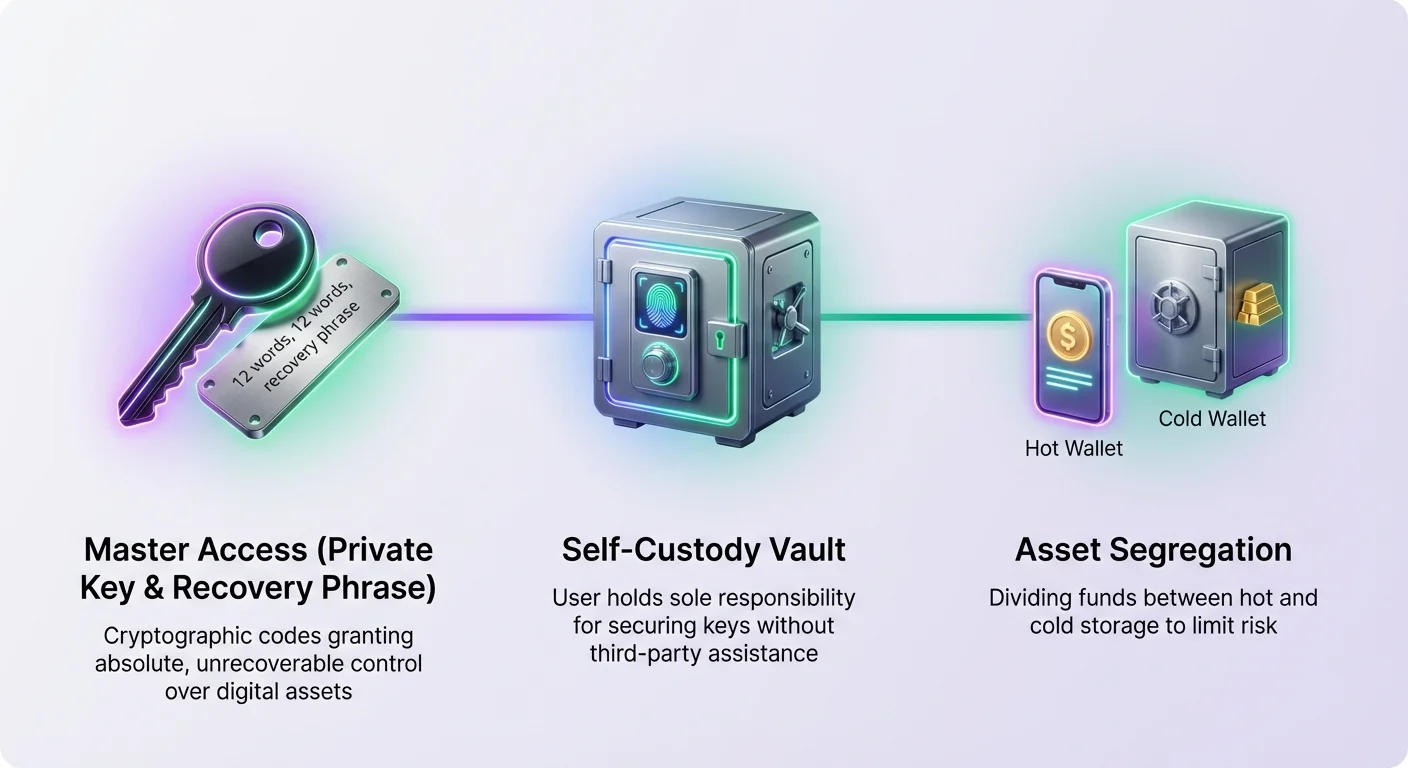
At the core of every non-custodial wallet lies the private key. This alphanumeric string functions as the ultimate password, granting absolute control over the associated funds. When a wallet is created, it generates this key using complex cryptographic algorithms. In modern wallets, this raw data is converted into a human-readable format known as a recovery phrase, seed phrase, or mnemonic seed. This phrase usually consists of 12, 18, or 24 random words generated in a specific order.
The relationship between the private key and the recovery phrase is mathematical and deterministic. The wallet software uses the specific list of words to mathematically derive the private keys for multiple cryptocurrencies. This is why a single recovery phrase can restore access to Bitcoin, Ethereum, and Solana accounts simultaneously on a new device. The software simply recalculates the keys based on the input words. Consequently, anyone who discovers this sequence of words effectively owns the assets, regardless of who originally set up the wallet.
Protecting this seed phrase is the single most important aspect of disaster recovery. It must be recorded offline, as storing it in cloud storage, emails, or digital notes exposes it to online attackers. If a computer is infected with malware, a text file containing a seed phrase can be scraped in seconds. Physical storage, such as writing the phrase on paper or stamping it into metal plates, ensures that the backup remains immune to digital threats while being available for deep cold storage.
Custodial Versus Non-Custodial Recovery
The recovery process differs significantly depending on who holds the keys. In a custodial arrangement, such as holding funds on a centralized exchange, the user does not possess the private keys. The exchange acts as a bank, managing security on behalf of the customer. Recovery in this scenario relies on traditional identity verification methods. If a user loses their login credentials, they must prove their identity to the platform's support team to regain access.
Custodial recovery offers a safety net for those uncomfortable with technical responsibility. Platforms often employ safeguards like two-factor authentication resets or "vault" services that allow for key replacement through identity checks. For example, some services provide assisted self-custody, where the user holds one key and the platform holds another. This allows the platform to co-sign a recovery transaction if the user loses their primary access method, bridging the gap between autonomy and support.
However, custodial recovery introduces counterparty risk. If the platform itself fails, shuts down, or pauses withdrawals, the user's recovery options vanish. In contrast, non-custodial wallets place full responsibility on the user. There is no support hotline that can restore a lost seed phrase. If the backup is lost and the device fails, the funds are mathematically unrecoverable. This absolute control necessitates a disciplined approach to backup management, ensuring that the user acts as their own competent bank vault.
Hardware Wallets: The Gold Standard for Cold Storage
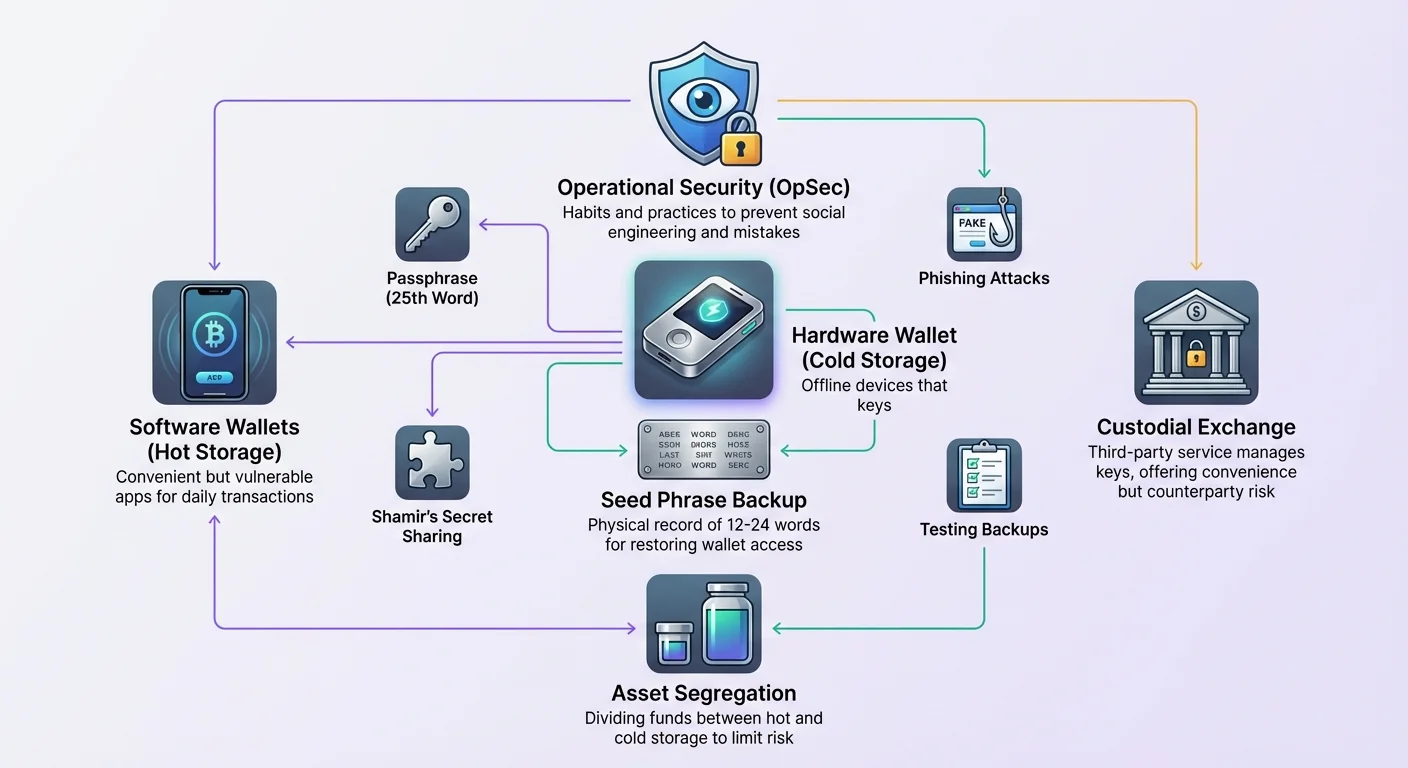
For individuals holding significant value in cryptocurrency, hardware wallets represent the most secure method of storage and recovery. These physical devices keep private keys offline, isolated from internet-connected environments that might be compromised by viruses or hackers. Even when plugged into a computer to transact, the signing of the transaction happens inside the device, ensuring the private key never leaves its secure element.
Recovering a hardware wallet is a standardized process. If the physical device is lost, stolen, or damaged, the user purchases a new device—or uses a compatible software wallet—and initiates the restoration process using their backup seed phrase. Because the device adheres to industry standards (such as BIP-39), a seed phrase generated on one brand of hardware wallet can often be restored on a device from a different manufacturer, provided they support the same cryptographic curves and derivation paths.
Advanced Backup Methods
Modern hardware wallets have introduced advanced recovery features to mitigate the risks of a single point of failure. One such method is Shamir’s Secret Sharing. This cryptographic technique allows a user to split their master seed into multiple unique "shares" or parts. To restore the wallet, a specific number of these shares must be combined. For instance, a user might create five shares and require three of them to recover the wallet.
This distribution model offers profound advantages for disaster recovery. A user can store one share at home, one in a bank safety deposit box, and one with a trusted family member. If a fire destroys the home copy, the wallet can still be recovered using the remaining shares. Conversely, if a thief manages to steal just one share, they cannot access the funds because they lack the required threshold number of shares to reconstruct the master key.
Another layer of security often used in conjunction with hardware wallets is the passphrase. This functions as a "25th word" added to the standard 24-word seed phrase. The passphrase is not stored on the device or written down with the seed phrase. It acts as a mental extension of the key. If an attacker finds the physical backup of the seed phrase but does not know the passphrase, they cannot access the specific "hidden" wallet associated with it. This feature protects against physical theft of the backup but introduces the risk of human memory failure.
Physical Device Protection
While the seed phrase is the ultimate backup, protecting the physical hardware wallet is also part of disaster recovery planning. These devices are often small and easily misplaced. Users should keep them in secure, climate-controlled locations to prevent damage from humidity or extreme temperatures. Although the devices are PIN-protected, relying solely on the PIN is risky if the device falls into sophisticated hands, though modern secure elements are designed to resist physical tampering.
Many hardware wallets now feature touchscreens and haptic feedback to improve the user experience during the setup and recovery process. Verifying the seed phrase on the device's screen, rather than typing it into a computer, is a critical security step. It prevents keyloggers—malware that records keystrokes—from intercepting the recovery words as they are being typed. When performing a recovery, users should always prioritize entering data directly onto the hardware device whenever possible.
Software and Mobile Wallet Recovery Tactics
Software wallets, which run as apps on mobile phones or desktop computers, offer convenience for daily spending and interaction with decentralized applications (dApps). However, because they reside on general-purpose devices connected to the internet, they face different recovery vectors and risks. The primary threat to software wallets is the loss or corruption of the host device, such as a phone breaking or a hard drive crashing.
Most mobile wallets provide a straightforward recovery process. Upon installation on a new phone, the app will ask if the user wants to "Create a New Wallet" or "Import an Existing Wallet." Choosing the import option prompts the user to enter their 12-word or 24-word recovery phrase. Once verified, the app scans the blockchain for transaction history associated with those keys and updates the balance. It is vital to download the official app from a legitimate source during this process to avoid phishing apps that look identical to the real version.
Cloud Backup Risks and Benefits
To simplify the user experience, some mobile wallets offer encrypted cloud backups. This feature saves an encrypted version of the recovery phrase to the user's cloud storage account (like iCloud or Google Drive). While this makes recovery extremely easy—often requiring just a login and a decryption password—it introduces a significant attack vector. If the cloud account is compromised, the attacker could potentially download the backup file.
If the decryption password for the cloud backup is weak, the attacker can brute-force it and gain access to the wallet. Users opting for cloud backups must ensure their cloud accounts are secured with strong, unique passwords and hardware-based two-factor authentication (like a YubiKey) to prevent unauthorized access. For maximum security, many experts recommend avoiding cloud backups entirely for high-value wallets, defaulting instead to manual pen-and-paper backups of the seed phrase.
The Importance of App Updates
Software wallets require regular updates to maintain security and functionality. Developers frequently release patches to fix vulnerabilities or ensure compatibility with network upgrades. In a disaster recovery scenario, using an outdated version of a wallet app to restore a seed phrase might result in errors or a failure to display balances correctly. This can cause panic, leading users to make rash decisions.
If a wallet app is no longer supported or has been removed from app stores, the standardized nature of seed phrases becomes the user's safety net. Because most wallets use the same standards, a user can typically take their recovery phrase from the defunct app and import it into a different, currently supported wallet app. This interoperability is a key feature of the decentralized ecosystem, preventing user funds from being locked into a single proprietary software interface.
Operational Security and Phishing Prevention
Disaster recovery is not only about technical restoration but also about avoiding the disasters that make recovery impossible. Phishing attacks are the leading cause of irreversible crypto loss. In these scenarios, users are tricked into voluntarily revealing their seed phrases to a malicious website that mimics a legitimate service. Once the attacker has the phrase, they empty the wallet immediately. No amount of backup planning can recover funds stolen in this manner.
Users must cultivate a habit of verifying every connection. When looking for a wallet recovery service or a web interface, one should never rely on sponsored search results or links sent via direct messages on social media. Imposter sites often buy ad space at the top of search engines, appearing identical to the real brand. The most effective defense is to navigate through trusted aggregators or bookmark valid URLs immediately upon first use.
| Attack Vector | Mechanism | Prevention Strategy |
|---|---|---|
| Phishing Email | Fake "Security Alert" links | Check sender domain; never click links. |
| Search Ads | Imposter sites in ad slots | Use ad blockers; verified bookmarks. |
| Fake Support | DMs asking for validation | Support never asks for seed phrases. |
Verifying Sources
Before downloading a wallet for recovery or entering a new ecosystem, users should cross-reference the website with established industry resources. Platforms that track market capitalization and project data often list the official websites for wallets and exchanges. Starting the journey from these high-traffic, monitored hubs reduces the risk of landing on a malicious clone site designed to harvest recovery credentials.
Additionally, users should be wary of "wallet validation" scams. Scammers often patrol support forums and social media, offering to help users recover "stuck" transactions if they "validate" their wallet on a specific website. These sites invariably ask for the seed phrase. It is a universal rule in crypto: no legitimate support agent, developer, or administrator will ever ask for a private key or recovery phrase. Recognizing this request as an immediate red flag is a crucial component of behavioral security.
Strategic Asset Segregation
A robust disaster recovery plan involves not just backing up keys, but also structuring holdings to minimize the impact of a single breach. Segregating assets involves dividing funds between different wallets based on their intended use and risk level. This concept, often described as "hot" and "cold" storage, ensures that a mistake with one wallet does not compromise the entire portfolio. This requires effective asset segregation.
Active assets—funds intended for trading, swapping, or interacting with decentralized applications—should be kept in a "hot" wallet. This is typically a mobile or browser extension wallet that is convenient to use but carries higher risk due to its constant connectivity. Users should only keep the amount they are willing to lose in these wallets. If a malicious smart contract drains the wallet, the loss is limited to this smaller, active portion of the portfolio.
The Role of Cold Storage
Inactive assets, or long-term holdings, belong in "cold" storage. This is usually a hardware wallet or a securely generated paper wallet that rarely, if ever, interacts with smart contracts. The recovery phrase for this wallet should be stored with the highest level of security. By separating these funds, a user creates a firebreak. Even if their computer is infected with malware that captures the keys to their hot wallet, the cold storage remains untouched because its keys were never exposed to the infected environment.
Creating multiple wallets is straightforward in most modern applications. Users can generate new addresses or entirely new seed phrases for different purposes. For example, one might have a "Vault" wallet for savings, a "Trading" wallet for daily activity, and a "High Risk" wallet for testing new, unverified protocols. Each should have its own backup documentation. Labeling these backups clearly is essential to avoid confusion during a recovery process.
Managing Cross-Chain Recovery
The cryptocurrency landscape is composed of many different blockchains, each with its own rules and address formats. Moving assets between these chains adds complexity to disaster recovery. A common error involves sending funds to the wrong chain or using an incompatible network. For instance, sending Bitcoin Cash to a Bitcoin address, or sending an Ethereum-based token to a different network like Polygon without using a bridge.
In some cases, these errors are recoverable. Because many blockchains share the same address structure (like Ethereum and Ethereum-compatible chains), a user might own the same address on multiple networks. If tokens are sent to the "wrong" network, the user can often recover them by configuring their wallet to connect to that specific network using the same private key. The funds aren't gone; they are just sitting at the same address on a different map, waiting to be accessed.
The Risks of Bridging
Bridges are protocols that allow assets to move between incompatible blockchains. They work by locking assets on one chain and issuing a representation on another. If a bridge protocol is hacked or fails, the assets may become irrecoverable because the backing funds are gone. Disaster recovery in this context involves understanding the nature of the assets being held. Are they native tokens, or are they "wrapped" versions dependent on a third-party bridge?
When entering a new chain, users often need the native token of that chain to pay for transaction fees (gas). Without this gas, funds can appear stuck. A user might bridge a stablecoin to a new network but find themselves unable to move or swap it because they lack the native coin to pay for the transaction. Recovery here involves finding a "faucet" or a method to onboard a small amount of the native currency to unstuck the wallet.
Developing a Comprehensive Recovery Plan
A disaster recovery plan is only effective if it is documented and tested. Relying on memory is a recipe for failure. A formal plan should exist physically, detailing where seed phrases are stored, which wallets hold which assets, and any additional security measures like passphrases or multi-signature requirements. This document effectively becomes a treasure map for the user—or their heirs—to reconstruct the financial portfolio.
The plan should list the specific hardware or software used, but it should arguably not contain the seed phrases themselves alongside the location data. A common security practice is to separate the "what" (the seed phrase) from the "how" (the instructions). For example, the seed phrase might be in a safe, while the instructions on which wallet software to use and which derivation paths to select are stored in a digital document.
Testing the Backups
The most overlooked step in disaster recovery is testing. Many users diligently write down their seed phrase but never verify it works until a crisis occurs. It is not uncommon for a user to have transcribed a word illegibly or in the wrong order. To prevent this, users should perform a "dry run" recovery immediately after setting up a new wallet.
This can be done by sending a small amount of crypto to the new wallet, wiping the device (or deleting the app), and then attempting to restore it using only the backup paper. If the funds reappear, the backup is valid. If they do not, the user knows the backup is flawed before they have committed significant capital. This verification step confirms that the safety net is functional and ready for an actual emergency.
Inheritance Planning
Crypto assets present a unique challenge for estate planning. Unlike bank accounts, which can be claimed by next of kin through legal processes, a crypto wallet dies with its owner if the keys are not passed on. A disaster recovery plan must consider how loved ones can access the funds if the primary user is incapacitated.
This is a delicate balance between security and accessibility. Handing over keys prematurely creates security risks, while hiding them too well risks total loss. Solutions range from leaving instructions in a sealed will, using "dead man's switch" software services, or utilizing the Shamir backup method where family members hold shares that are useless individually but effective when combined.
Conclusion
The immutable nature of blockchain technology dictates that responsibility for asset protection lies entirely with the individual. Disaster recovery is not a product one can buy, but a process one must practice. It requires a clear understanding of private keys, a disciplined approach to seed phrase storage, and the foresight to plan for device failure, physical loss, and human error.
By combining robust hardware security with strategic asset segregation and verified backups, users can immunize themselves against the most common threats in the crypto space. The goal is to create a system where the loss of a physical device or a software glitch is a temporary inconvenience rather than a catastrophic financial event.
True ownership requires the discipline to secure, back up, and recover your assets without reliance on third parties.