
The foundational promise of decentralized networks—to provide global, permissionless, and censorship-resistant money and computation—is inherently challenged by the reality of speed and data management. This challenge is known as scaling.
Scaling is not merely a technical race to achieve the fastest transaction speed; it is a profound ideological argument about the nature and purpose of a decentralized network. Should the primary blockchain prioritize absolute, immutable security at the expense of speed, or should it prioritize versatility and high transaction throughput?
Bitcoin and Ethereum, the two largest and most influential crypto networks, have taken fundamentally different paths to answer this question. Bitcoin has adopted a highly conservative, minimalist approach, externalizing almost all computation and complexity to secondary layers. Ethereum, conversely, initially embraced a “monolithic” design, attempting to handle all operations internally, before pivoting toward a “modular” approach enabled by Layer-2 solutions.
Understanding these divergent scaling philosophies—Bitcoin's cautious conservatism versus Ethereum's ambitious adaptability—is crucial for grasping the architectural future of the digital economy. It reveals trade-offs concerning security budgets, network decentralization, and the definition of a "full node."
Defining the Blockchain Layers: The Foundation of Scaling
To understand how Bitcoin and Ethereum scale, we must first define the concept of layers (L1 and L2), which represent different levels of trust, security, and execution within the crypto ecosystem.
The Core Functions of Layer 1
Layer 1 (L1), or the base layer, is the main blockchain. It is the fundamental trust anchor of the entire system.
The primary functions of any L1 are limited but essential:
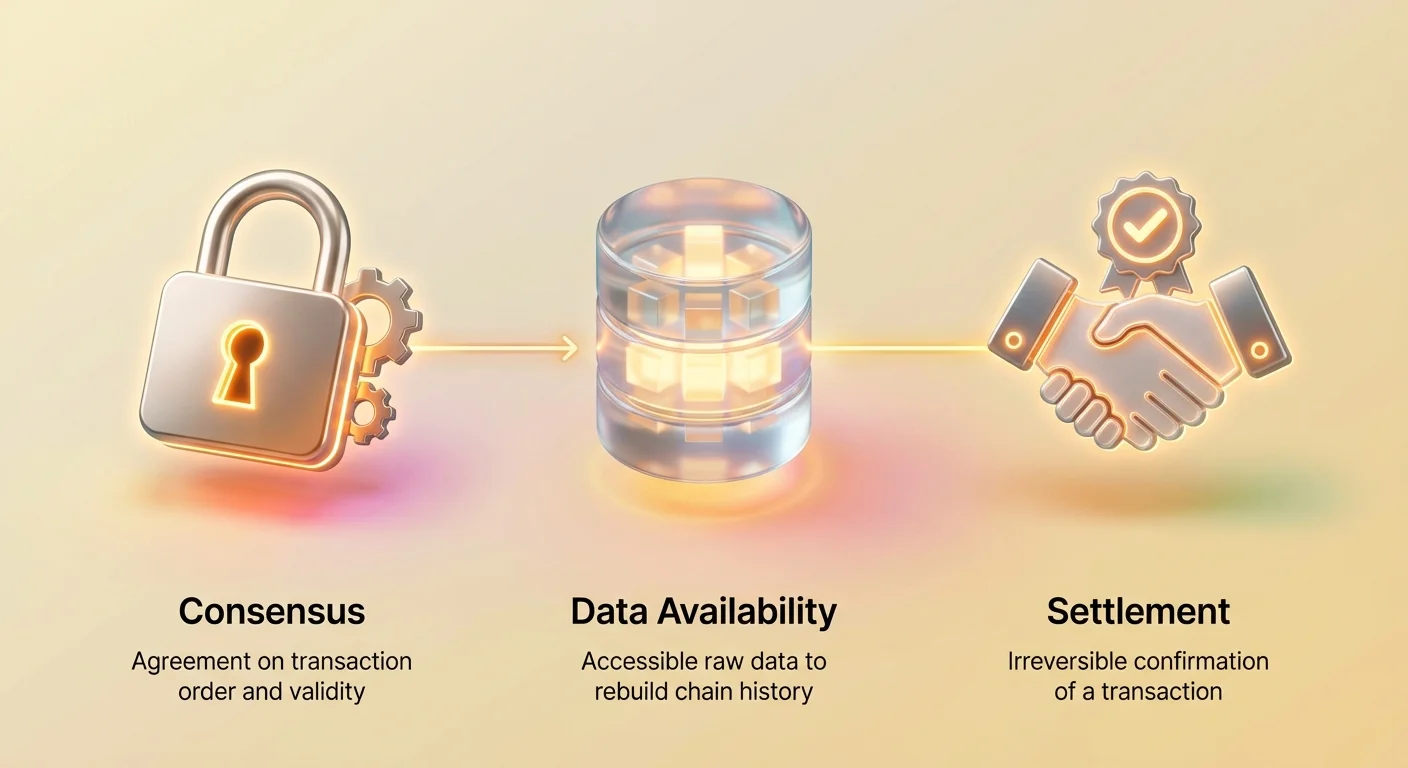
- Consensus: Establishing agreement among all network participants on the order and validity of transactions (e.g., Proof-of-Work in Bitcoin, or Proof-of-Stake in Ethereum).
- Data Availability: Ensuring that the raw transaction data required to rebuild the blockchain history is accessible to anyone.
- Settlement and Finality: Providing the ultimate, irreversible confirmation that a transaction has occurred.
Both Bitcoin and Ethereum strive for maximum security and decentralization on L1. However, they define what constitutes "security" and "decentralization" differently, leading to conflicting scaling models.
Why Layer 2 Solutions Exist
The core problem with L1 scaling is the Blockchain Trilemma tradeoffs: a decentralized network can only maximize two of these three traits: Decentralization, Security, or Scalability (Speed/Throughput). Maximizing L1 security requires limiting block size and transaction throughput.
Layer 2 (L2) solutions are protocols built on top of the L1 chain. They are designed to offload the burden of transaction processing and state management from the L1.
L2s achieve massive scalability by processing thousands of transactions quickly and cheaply, bundling the proof of those transactions into a single, highly compressed cryptographic receipt, and then submitting that receipt back to the L1 for final settlement. They inherit the security of the L1 without requiring every node on the L1 to process every individual transaction.
Bitcoin's Scaling Philosophy: The Minimalist Approach
Bitcoin's scaling ideology is defined by extreme conservatism. Its primary goal is not to be a fast, global payment processor, but to be the most secure, uncensorable digital monetary base layer—the digital gold.
The Focus on Store of Value and Security Budget
Bitcoin’s architecture reflects its primary function: security and reliability above all else. Its consensus mechanism, Proof-of-Work (PoW), requires tremendous energy expenditure (the "security budget") to prevent malicious actors from rewriting history.
This focus dictates that the Bitcoin L1 must be simple, robust, and maximally decentralized. Complexity, especially smart contract execution that could introduce unforeseen bugs or increase the network's processing requirements, is strictly avoided. Every node must be able to verify every transaction cheaply and quickly.
Key Principle: The Bitcoin L1 should handle only simple monetary transfers (UTXOs) and the minimum required scripting necessary to support higher layers. All attempts at complex functionality (like advanced financial applications) must be relegated to L2s.
Externalizing Complexity: Layer 2 Solutions
Bitcoin's scaling strategy is inherently modular. It refuses to increase its L1 block size significantly to maintain decentralization (allowing anyone to run a full node). Instead, it externalizes volume and complexity to specialized L2 networks.
- Lightning Network: The most famous L2, designed for instant, cheap, high-volume micro-payments. Lightning uses off-chain payment channels that only touch the L1 when opening or closing a channel. This handles throughput without burdening the main chain.
- Sidechains and Other L2s: Newer solutions, sometimes utilizing Bitcoin's scripting language improvements (like Taproot and Ordinals), allow for more complex applications and smart contracts to be executed outside the core L1, while periodically pegging back to the main chain for security guarantees.
This externalized approach ensures that the core security guarantees of the Bitcoin L1 are never compromised by the experimental, high-throughput nature of the L2 applications.
The Concept of "Monetary Primitives"
Bitcoin is often described as a network of monetary primitives—basic, unchangeable building blocks necessary for robust money. These primitives include:
- Checking cryptographic signatures.
- Verifying ownership (UTXOs).
- Enforcing supply limits.
Any functionality beyond these basic primitives is considered "feature creep" that introduces potential security vulnerabilities and reduces the network's decentralization by increasing the resource cost of running a full node. This ideological commitment to simplicity is the foundation of its modular scaling model.
Ethereum's Scaling Philosophy: The Initial Monolith
In contrast to Bitcoin, Ethereum was designed from day one to be a "World Computer." Its purpose was not merely to be digital money, but to be a platform for complex, programmable smart contracts, decentralized finance (DeFi), and decentralized applications (DApps).
The Goal of a "World Computer" (Smart Contracts)
Ethereum’s original design was highly ambitious. It sought to embed computation and general-purpose scripting directly into the Layer 1. Smart contracts—self-executing agreements whose terms are written directly into code—were hosted and executed by every single node on the Ethereum mainnet.
This fundamental design choice meant that Ethereum required a much more complex L1 than Bitcoin. Where Bitcoin only manages simple balances and transaction history, Ethereum manages a constantly changing state based on the actions of thousands of interacting smart contracts.
The Monolithic Trade-Off: Speed, Cost, and State Bloat
Ethereum's early scaling model was a monolithic execution model: the L1 was responsible for all three core functions (execution, data availability, and settlement).
This monolithic design led to severe scaling limitations as the network grew popular:
- High Transaction Costs (Gas): When the network was busy, users had to pay extremely high fees (gas) to outbid others for limited block space.
- Low Throughput: The complexity of processing every contract state change meant L1 throughput was slow (around 15-30 transactions per second).
- State Bloat: The collective memory of all deployed smart contracts and their current variables rapidly increased the burden on full nodes, threatening decentralization.
This crisis of scalability forced Ethereum to fundamentally shift its ideological and architectural roadmap.
Shifting Consensus: Proof-of-Stake and Security
Ethereum’s move from Proof-of-Work (PoW) to Proof-of-Stake (PoS) during "The Merge" was partially driven by the need to support its new scaling strategy. PoS is often argued to be less resource-intensive and more adaptable to advanced scaling techniques like sharding (though sharding has largely been replaced by focusing on L2s).
However, the change in consensus also represented a trade-off in security ideology. While PoS offers economic finality and can technically support higher transaction rates, some argue it introduces new centralization vectors, such as the capital requirements to become a validator, compared to the open resource requirements of PoW mining. This highlights Ethereum’s willingness to embrace complex engineering solutions on L1 to maximize utility, even if it introduces new trade-offs concerning decentralization.
The Architectural Crossroads: Monolithic vs. Modular Design
The ideological conflict between Bitcoin and Ethereum scaling centers on the concept of architectural design: whether a blockchain should be a single, complex engine or a system of specialized, interacting components.
What is a Monolithic Blockchain?
In a monolithic architecture, a single Layer 1 blockchain is tasked with fulfilling all critical roles simultaneously: executing transactions, storing data, achieving consensus, and providing final settlement.
Characteristics of Monolithic Design (e.g., Early Ethereum, Solana, and other high-throughput chains):
- Single Point of Failure (Scaling): If the L1 is congested, the entire ecosystem slows down and fees skyrocket.
- High Barrier to Entry for Nodes: To handle the massive computational load of execution and state storage, full nodes often require powerful, expensive hardware (high CPU, vast SSD storage, high bandwidth).
- Tightly Coupled: Execution logic is inseparable from the consensus mechanism.
While monolithic chains can offer excellent speed until they hit peak demand, the heavy computational requirements often mean only institutions or specialized service providers can afford to run full nodes, leading to reduced verifier decentralization.
What is a Modular Blockchain?
A modular blockchain architecture breaks down the four core functions (Execution, Data Availability, Consensus, Settlement) into specialized layers or components.
Bitcoin's Modular Model (L1 + L2): Bitcoin has always been implicitly modular, even before the term was popularized.
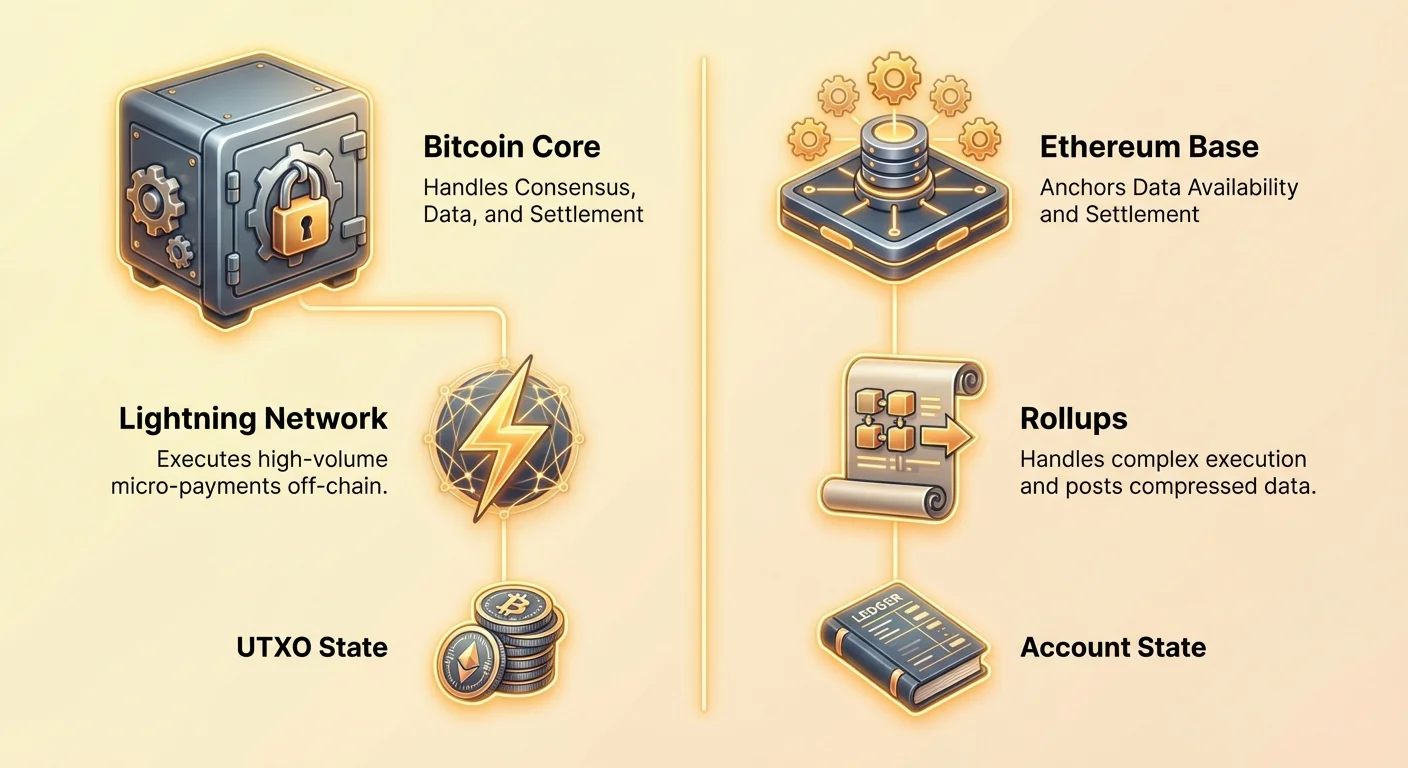
- L1 (Bitcoin Core): Handles Consensus, Data Availability, and Settlement (simple monetary transfers).
- L2 (Lightning Network, etc.): Handles Complex Execution (transaction routing, smart contract logic).
Ethereum's Modular Evolution (L1 + Rollups): Modern Ethereum is explicitly transitioning to a modular scaling strategy via "Rollups."
- L1 (Ethereum Base): Primarily focuses on Data Availability (storing L2 transaction data) and Settlement.
- L2 (Optimism, Arbitrum, etc.): Handles Execution (running smart contracts) and posting compressed data back to L1.
By delegating execution away from the L1, modularity dramatically improves throughput. The L1 doesn't have to re-execute every transaction; it only needs to verify the proof that the L2 execution was correct, or simply store the compressed data.
Security Delegation and Trust Assumptions in L2s
A crucial difference in scaling ideology lies in how trust is delegated to L2s:
Bitcoin's L2 Trust: Bitcoin’s most widely adopted L2, Lightning, uses cryptographic channels secured by HTLCs (Hash Time-Locked Contracts). If a dispute arises, the funds are always secured by the L1 rules, allowing users to "force close" their channel and settle on the main chain. The L1 always remains the final authority and security guarantor.
Ethereum's L2 Trust (Rollups): Ethereum Rollups rely on two main types of proof to maintain L1 security:
- Optimistic Rollups: Assume transactions are valid by default ("optimistic") but require a challenge period during which anyone can submit a "fraud proof" to the L1 if they detect a malicious state transition.
- Zero-Knowledge (ZK) Rollups: Use advanced cryptography to generate a succinct proof of validity that the L1 can verify almost instantly, without needing to re-execute the transactions.
While both approaches allow L2s to inherit L1 security, the complex trust architecture of Rollups is a necessary trade-off for Ethereum to achieve high utility, whereas Bitcoin's model ensures L1 simplicity by requiring L2s to fit within its highly restrictive monetary scripting language.
The State Bloat Dilemma and Decentralization
One of the most pressing concerns guiding scaling decisions is "State Bloat"—the perpetual growth of the data required to understand the current, verifiable condition (the "state") of the blockchain. This directly impacts decentralization.
Why State Bloat Harms Decentralization
For a blockchain to be truly decentralized, it must be easy for ordinary users to run a "full node." A full node downloads and verifies every transaction and maintains the current state of the chain.
If the resources required to run a full node become too high (e.g., massive disk space, intense processing power, high bandwidth), only professional entities (data centers, exchanges, etc.) can afford to participate in verification. When fewer people can verify the chain independently, decentralization is compromised, and the network becomes more susceptible to regulatory capture or censorship.
State bloat increases the synchronization time and hardware costs for new participants, raising this barrier to entry.
Bitcoin's UTXO Model and State Management
Bitcoin utilizes the Unspent Transaction Output (UTXO) model. Instead of tracking user accounts, it tracks specific units of Bitcoin that haven't yet been spent.
Advantages of UTXO:
- Simple State: The "live state" of Bitcoin only includes the current set of unspent UTXOs, which is relatively small and manageable.
- Clean Verification: Transactions can be validated quickly because a node only needs to verify that the specified UTXO was truly unspent.
- Inherently Pruned: As Bitcoins are spent, the data related to the previous transaction becomes historically irrelevant for the current state, helping to manage bloat.
Bitcoin’s strict limitation on L1 smart contracts and complex computations is fundamentally tied to keeping the UTXO state simple and small, ensuring the L1 remains highly accessible to hobbyists and individual users worldwide.
Ethereum's Account Model and State Growth
Ethereum utilizes the Account Model. The state consists of all user accounts and the code/storage associated with every deployed smart contract.
Challenges of the Account Model:
- Complex State: The live state includes all variable data within every smart contract (e.g., token balances, DAO votes, DeFi collateral levels). Every contract interaction potentially changes this state.
- Permanent Bloat: Unlike UTXOs which are spent and removed from the active state, smart contract storage persists. If a contract stores a large amount of data (e.g., NFTs or complex registry information), that data must be tracked forever by all full nodes.
- Execution Burden: Nodes must process complex virtual machine instructions (EVM) to calculate the new state after a transaction, which is far more CPU intensive than validating a simple UTXO transaction.
Ethereum's modular scaling shift (L2 rollups) is an existential necessity to manage this state bloat. By moving execution off-chain, Ethereum L1 can reduce the computational burden on its nodes, allowing them to focus primarily on checking the cryptographic proofs and storing L2 transaction data, rather than processing every smart contract action themselves.
Practical Implications for Users and Developers
The difference in scaling ideology dictates how users interact with the network and how developers choose where to build their applications.
Choosing the Right Layer for the Task
The philosophical divide manifests in how users prioritize trade-offs:
| Feature | Bitcoin L1 | Ethereum L1 | Ethereum L2 (Rollups) |
|---|---|---|---|
| Primary Use | Highly secure, final settlement. Store of Value. | Final settlement, Data Availability anchor. | Execution, DeFi, DApps, high-volume NFTs. |
| Transaction Speed | Slow (10 minutes) | Medium/Slow (12 seconds) | Fast (Instant to a few seconds) |
| Transaction Cost | Low/Variable (Medium if urgent) | High (Often prohibitively expensive) | Low (A fraction of L1 cost) |
| Complexity Allowed | Minimal Scripting (Monetary Primitives) | Full Smart Contracts (EVM) | Full Smart Contracts (EVM) |
| Decentralization | Highest (Easiest to run a full node) | Decreasing (High hardware demands) | Inherits L1 Decentralization |
For Users: If you need the ultimate security for holding large capital over decades, the simplicity and deep security budget of Bitcoin L1 (or L1 settlement via Lightning) is prioritized. If you need cheap, fast interaction with complex DeFi applications, Ethereum L2s are the only viable solution.
For Developers: Bitcoin’s restrictive L1 forces developers to be extremely creative with L2 structures (sidechains, channel networks). Ethereum’s L2s offer developers a familiar coding environment (EVM compatibility) with minimal restrictions on functionality, maximizing the speed of innovation.
Security and Finality Differences
The scaling ideology also affects the concept of transaction finality:
Bitcoin Finality: Transactions achieve increasing finality as more blocks are mined on top of them (usually considered fully final after 6 confirmations, or about one hour). The security is probabilistic, based on the cost of overriding the chain (PoW).
Ethereum Finality: Since the shift to PoS, Ethereum introduced "economic finality." Once two-thirds of validators attest to a block, that block is finalized. This is much faster than PoW confirmation but relies on the economic assumption that validators won't risk having their staked capital slashed.
L2 Finality: L2 transactions are considered instantly executed on the L2. However, achieving L1 finality requires a time delay. For optimistic rollups, this is the challenge period (often seven days) required to guarantee no fraud occurred. ZK rollups achieve much faster L1 finality because the cryptographic proof is instantly verifiable, providing a strong incentive for Ethereum’s ecosystem to move toward ZK vs Optimistic Rollups.
Conclusion: Two Paths to Self-Sovereignty
Bitcoin and Ethereum represent two distinct visions for the digital economy, reflected most clearly in their scaling ideologies.
Bitcoin, through its commitment to a modular and minimalist L1, seeks to build the most secure, unchangeable monetary base layer possible. It sacrifices immediate L1 utility for maximum decentralization and ideological purity, relying on specialized external layers (like Lightning) to handle the complexities of everyday transactions. Its focus is the long-term protection of the security budget and the simplicity of its "state."
Ethereum, initially attempting a monolithic "world computer," has embraced a necessary pivot to an L2-centric modular structure. This shift allows it to maintain its purpose as a platform for rich computation and smart contracts while minimizing the crippling state bloat on the L1. Ethereum sacrifices L1 simplicity and the security certainty of PoW for enhanced programmability and the rapid scalability required to host a global application ecosystem.
Ultimately, the choice between these scaling philosophies is a choice between maximizing security (Bitcoin) or maximizing utility (Ethereum). Both systems are innovating relentlessly on their secondary layers, proving that the future of decentralized networks is not about one monolithic chain doing everything, but about specialized, interacting layers anchored by an immutable base layer of trust.