
When you first begin your journey into cryptocurrency, a simple mobile wallet might suffice. But as your portfolio grows, so does the risk, transforming security from a convenience into a necessity. For users holding significant capital, standard security measures—like keeping your keys on a desktop or a basic single-key software wallet—become unacceptable liabilities. The digital equivalent of a bank vault is required.
This guide moves beyond basic self-custody and explores two pillars of institutional-grade security: the physical defense offered by Hardware Wallets and the decentralized control provided by Multi-Signature (Multisig) Schemes. We will compare the trade-offs, detail how to implement these systems, and outline sophisticated strategies for distributing keys and planning for recovery, ensuring your assets are protected against theft, loss, and single points of failure.
The Security Imperative for High-Value Portfolios
For high-net-worth individuals, companies, or decentralized autonomous organizations (DAOs), the primary goal shifts from merely protecting a small sum to ensuring continuous, secure access to generational wealth. The security models built for small portfolios simply cannot withstand targeted attacks or catastrophic personal failures.
Why Standard Wallets Fall Short
Most beginner wallets rely on a single private key controlled by one person on one device. This is known as a single-signer wallet. While effective for small amounts, this setup creates a devastating single point of failure:
- Physical Theft/Loss: If the physical device containing the private key is lost, stolen, or damaged, the funds are inaccessible (unless the seed phrase is recovered).
- Hacking/Malware: If the device is connected to the internet and compromised by malware or a phishing attack, the attacker can sign transactions and drain the entire wallet instantly.
- Coercion/Error: In a single-signer setup, one individual can make a disastrous mistake, or be coerced into signing a transaction, leading to total loss without any checks or balances.
Defining "Institutional Grade" Security
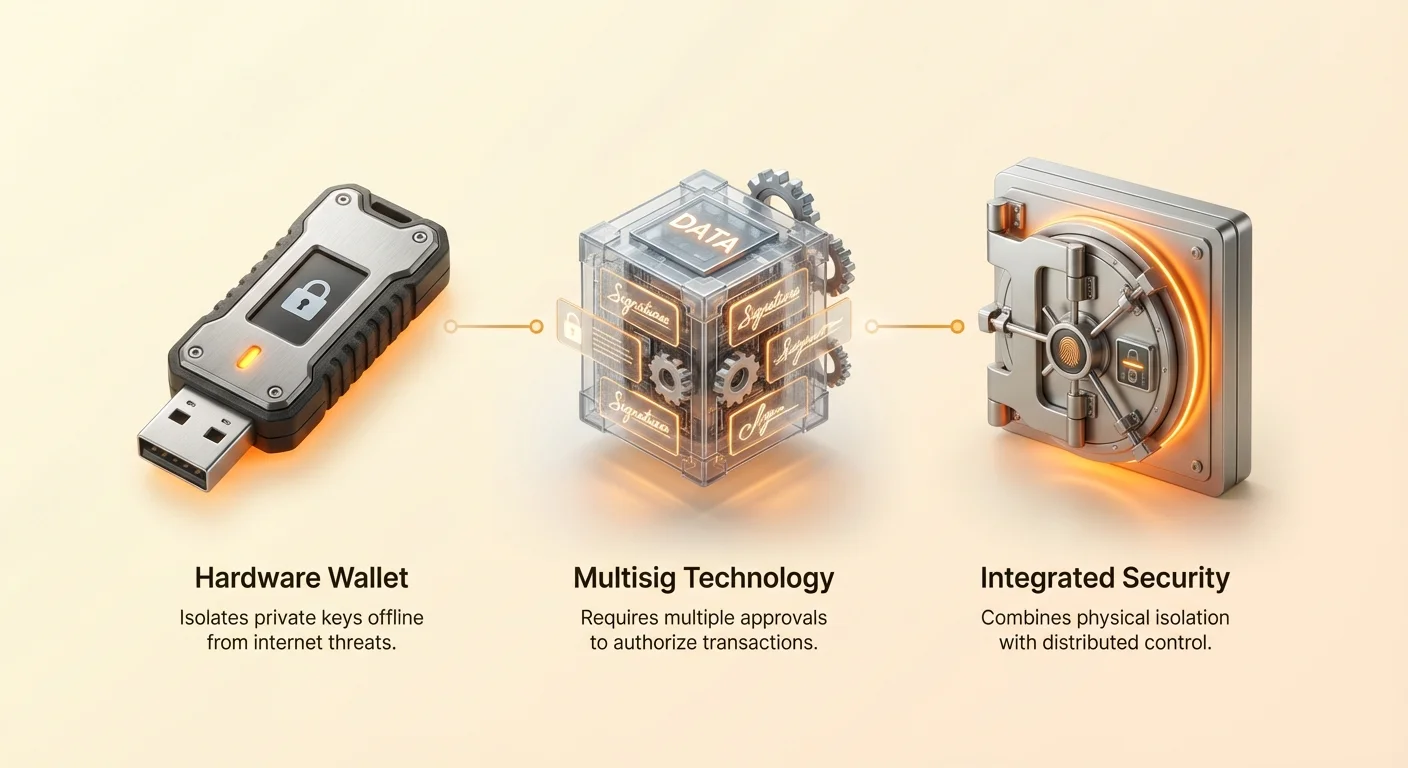
Institutional-grade security minimizes the risk of loss through two core concepts: Isolation and Redundancy.
- Isolation (Hardware Wallets): Ensuring the private key, the actual secret that controls the funds, never touches the internet or an operating system capable of running malicious code.
- Redundancy (Multisig): Eliminating the single point of failure by requiring multiple independent authorizations (keys) to validate any transaction. This means that losing one key, or having one signer compromised, does not lead to total loss.
Hardware Wallets: The Foundation of Self-Custody
A hardware wallet is a dedicated, specialized device (often looking like a USB stick) designed to do one thing: securely store your private keys offline and sign transactions. This offline storage is often referred to as "cold storage."
How Hardware Wallets Protect Private Keys
The core innovation of a hardware wallet is the Secure Element. This is a chip designed specifically to be tamper-proof, making it virtually impossible for malware, viruses, or physical attackers to extract the private key stored within.
When you want to send crypto:
- The transaction details are created on your computer (online).
- These details are transmitted to the hardware wallet (offline).
- You physically verify and approve the transaction on the device's small screen.
- The secure element uses the private key (which never leaves the device) to digitally sign the transaction.
- The signed transaction is sent back to your computer for broadcast to the blockchain.
Because the private key never leaves the isolated environment, the funds remain secure even if your computer is completely infected with malware.
Critical Hardware Wallet Recovery Planning
While the hardware wallet itself is robust, the ultimate security relies on the Seed Phrase (or Recovery Phrase)—typically a list of 12 or 24 words. This phrase is the master key to your funds. If the device is destroyed, this phrase can be entered into a new, compatible device to recover access to the wallet.
Best Practice: Layered Physical Security
- Material: Never store the seed phrase digitally (photos, cloud storage, email). Write it down on durable, fire-proof, and water-resistant material (such as steel plates).
- Location: Store the phrase physically isolated from the device itself. If the device is in your home, the phrase should ideally be in a high-security location elsewhere, such as a fireproof safe deposit box or a separate secure location.
- Splitting (The Shamir Backup): For truly extreme security, consider splitting the seed phrase using advanced techniques like Shamir's Secret Sharing (or simplified variations). This allows you to reconstruct the full seed phrase only if you have a certain number of the component parts (e.g., needing 3 out of 5 parts to restore).
Hardware Wallet Trade-offs
| Advantage | Disadvantage |
|---|---|
| Complete Isolation | Reliance on a single physical object. |
| High Barrier to Hacking | Potential for user error during setup or recovery. |
| Simple to Use | Loss of the seed phrase means permanent loss of funds. |
Understanding Multi-Signature (Multisig) Technology
If hardware wallets solve the problem of isolation, multisig solves the problem of redundancy and governance. Multisig wallets are not physical devices; they are special smart contracts deployed on a blockchain (most commonly Ethereum, but also available on Bitcoin and other chains) that require multiple keys to authorize any outgoing transaction.
How Multisig Works: The N-of-M Scheme
Multisig uses an N-of-M scheme, where:
- M is the total number of private keys (signers) associated with the wallet.
- N is the minimum number of keys required to approve a transaction.
A common setup for an individual holding significant wealth might be a 2-of-3 scheme: three keys exist, but only two of them are needed to send funds.
Scenario Example (2-of-3):
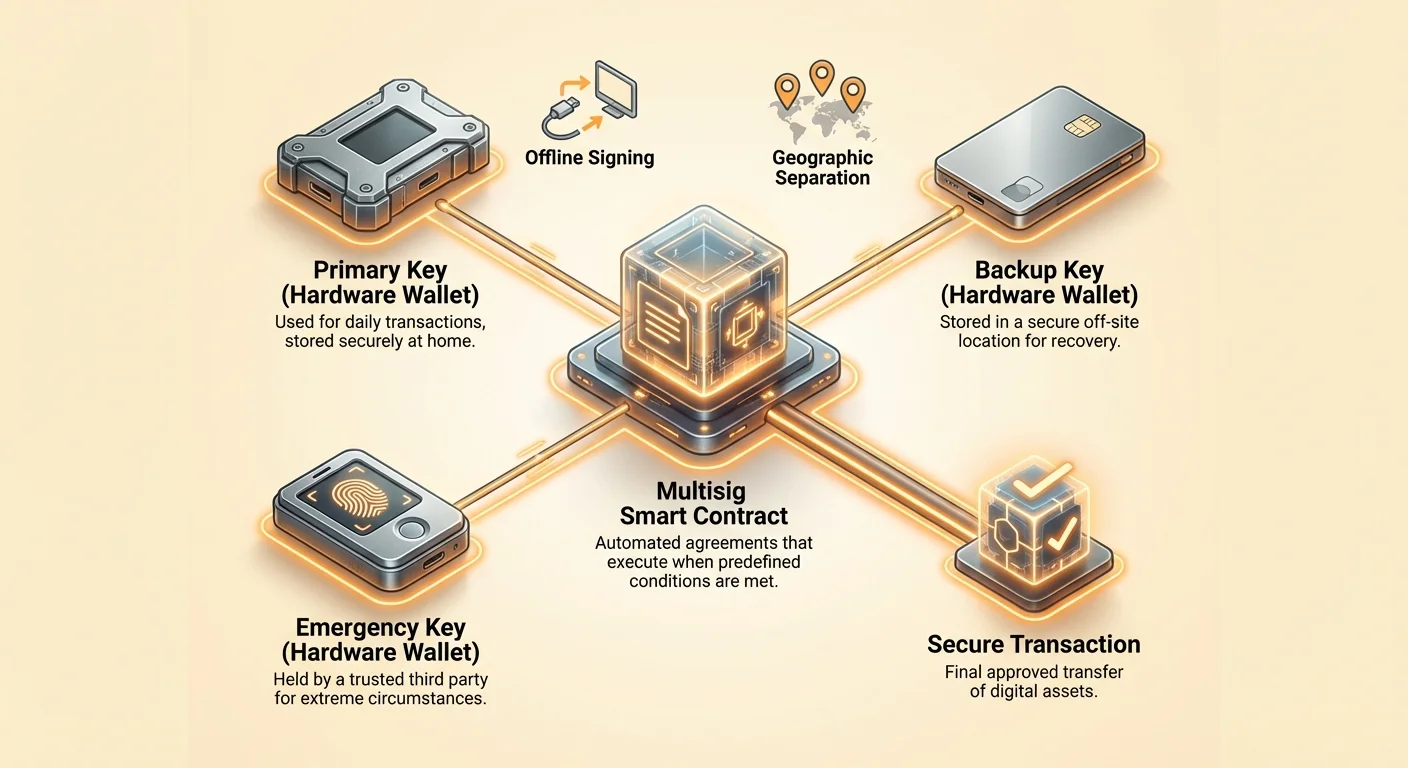
- Key 1: Held by the individual on Hardware Wallet A (Primary).
- Key 2: Held by the individual on Hardware Wallet B (Backup/Remote Location).
- Key 3: Held by a trusted family member or lawyer (Emergency Key).
If Key 1 is lost or compromised, the individual can still use Key 2 and Key 3 together to approve a transaction to a new, secure wallet, ensuring no single point of failure.
Ideal Use Cases for Multisig
Multisig is the standard security choice for any setup where control must be distributed or errors must be mitigated:
- Corporate Treasury Management: Requires multiple board members or executives to approve large expenditures, preventing rogue employees or simple internal theft.
- Decentralized Autonomous Organizations (DAOs): Used to govern community funds, requiring a majority of elected signers to approve proposals.
- Inheritance Planning/Estate Management: Allows an estate planner or designated trustee to act as one of the required signers, providing access to assets after a triggering event (such as the death or incapacitation of the primary holder).
- Advanced Personal Security: Protects the individual from loss of a single key, physical coercion, or temporary unavailability.
Multisig vs. Standard Single-Key Wallets
| Feature | Single-Key Wallet | Multisig Wallet |
|---|---|---|
| Control | Single individual/device | Distributed among multiple parties |
| Transaction Approval | One signature required | N-of-M signatures required |
| Security Type | Isolation (hardware) | Redundancy & Governance (software/contract) |
| Recovery | Dependent on one seed phrase | Dependent on having N out of M keys |
| Cost | Minimal (gas fees only) | Higher setup costs (deploying the smart contract) |
Practical Multisig Setup: A Gnosis Safe Guide
While various multisig solutions exist, Gnosis Safe (now known as Safe) is the industry standard for creating smart contract wallets on Ethereum and many L2 networks. It provides a highly audited, user-friendly interface for managing complex signing requirements.
Initial Setup and Configuration
Setting up a multisig safe involves deploying a specialized smart contract to the blockchain.
Step 1: Define Your Strategy (N-of-M) Before deployment, you must determine how many signers (M) you need and the threshold (N). For major personal portfolios, a 2-of-3 or 3-of-5 setup is common.
Step 2: Key Preparation Each signer address in the multisig should be derived from an independent, secure source. Crucially, every key involved in your multisig scheme should ideally be backed by its own, separate hardware wallet.
- Anti-Pattern: Using the same seed phrase or device for multiple keys in the multisig defeats the purpose of redundancy.
Step 3: Deploy the Safe Using the Safe interface, you designate the list of owner addresses and set the required confirmation threshold (N). Once deployed, this smart contract address is your permanent wallet address.
Step 4: Initial Funding and Test Transaction Fund the newly created Safe. Before moving significant capital, execute a small test transaction. This validates two things: 1) all designated signers can successfully connect and propose transactions, and 2) the N-of-M threshold works as expected.
Multisig Key Distribution Strategies
The effectiveness of a multisig setup hinges on the independence and security of the M keys. Sophisticated users must employ a strategy that minimizes the risk of a coordinated failure (e.g., a physical attack in one location).
1. Geographic Separation
Keys should be stored in physically disparate locations to mitigate against localized disasters (fire, flood, burglary).
- Example: Key 1 (Primary) in a home safe; Key 2 (Backup) in a secure bank vault 50 miles away; Key 3 (Emergency) with a trusted estate lawyer across the country.
2. Device and Vendor Independence
If possible, use hardware wallets from different manufacturers for different keys. If one manufacturer has a zero-day vulnerability, only one key is potentially compromised.
- Example: Key 1 on a Ledger; Key 2 on a Trezor; Key 3 on a specialized air-gapped computer running signing software.
3. Temporal Distribution (Use Cases)
Keys should only be brought out when necessary.
- Primary Key (Daily): Used for common transactions.
- Backup Key (Periodic): Stored cold and only used if the Primary Key is lost or compromised.
- Emergency Key (Rare): Held by a trusted third party, used only in extreme circumstances or as part of a death/incapacitation plan.
Key Management and Regular Audit
Multisig is not a "set-it-and-forget-it" solution. Regular, scheduled audits are essential:
- Verification: Ensure all owner addresses listed on the contract still correspond to the intended key holders and devices.
- Transaction Logs: Review all approved and pending transactions to catch unauthorized proposals quickly.
- Signer Health Check: Periodically require all signers to successfully approve a minor transaction (like a low-value self-transfer) to confirm they still possess access and understand the signing process.
Merging Security Models: Hardware Wallets as Multisig Signers
The most robust security architecture combines the strengths of both technologies. You achieve physical isolation and decentralized redundancy by having each required signature come from its own hardware-backed key.
The Ultimate Combo: Hardware-Backed Multisig
In this setup, the hardware wallet acts as the cryptographic device for one of the keys in the N-of-M scheme.
Protection Stack:
- Layer 1 (Physical): Each key is stored securely within a hardware wallet's Secure Element. The key never touches the internet.
- Layer 2 (Redundancy): The multisig smart contract requires 2 or more of these hardware-secured keys to approve any fund movement.
This setup means an attacker would need to physically compromise multiple, geographically separate hardware wallets and successfully obtain their corresponding signing authorization, making an attack exponentially more complex and expensive.
Implementing Social Recovery Mechanisms
One major concern for crypto holders is what happens if they become incapacitated or pass away. Multisig offers a powerful solution for this, often called Social Recovery.
Instead of relying on a single family member to hold your recovery phrase (creating a point of failure for your heirs), you can integrate trusted individuals into the multisig structure itself.
Social Recovery Example (3-of-5 Multisig):
- Keys 1 & 2: Held by the individual (Primary and Backup hardware wallets).
- Key 3: Held by a trusted estate attorney.
- Key 4: Held by a spouse or primary beneficiary.
- Key 5: Held by an independent financial planner.
If the individual is alive and active, they only need Keys 1 and 2 to move funds (a 2-of-5 threshold). If the individual is incapacitated, Keys 3, 4, and 5 can combine their authority to execute a transaction and move the assets according to estate instructions, providing a secure, trust-minimized path for inheritance.
Determining Your Advanced Security Strategy
Choosing the right security strategy depends entirely on the size of your portfolio, your personal tolerance for complexity, and the specific risks you are trying to mitigate.
The Security-Complexity Trade-Off
| Strategy | Risk Mitigation Focus | Complexity | Cost/Time Investment | Best For |
|---|---|---|---|---|
| Single Hardware Wallet | Hacking, Malware, Simple Loss | Low | Low | Mid-level portfolios, high risk of online attack. |
| Multisig (2-of-3) | Coercion, Single-Key Loss, Error | Medium | Medium | Large personal portfolios, requiring key redundancy. |
| Hardware-Backed Multisig (3-of-5) | Targeted Attacks, Geographic Disaster, Inheritance | High | High | Corporate treasuries, generational wealth, DAOs. |
Risk Matrix: When to Choose 2-of-3 vs. 3-of-5
Choosing 2-of-3:
- Focus: Simplicity and swift recovery.
- Benefit: Requires fewer signers to act, meaning fewer people need to coordinate to make a transaction. Ideal for a primary holder and one secure backup key, plus one emergency key.
- Risk: If two keys are lost or compromised, the wallet is locked forever.
Choosing 3-of-5:
- Focus: Extreme resilience and robust governance.
- Benefit: Allows two signers to be lost or unavailable without jeopardizing access (you still have three remaining keys). This setup is significantly more resilient to loss and coercion.
- Risk: Coordination is harder. If you need to make a fast transaction, getting three people or three devices ready takes time. This is best suited for long-term storage and treasury management, not active trading.
Actionable Tip: Prioritize Key Independence
Regardless of the N-of-M configuration you choose, the most important element is the independence of the keys. Each signer must be geographically, digitally, and often temporally independent from the others to prevent a single event (physical break-in, computer virus) from leading to total asset loss.
Conclusion
For crypto newcomers, the primary security lesson is self-custody. For advanced users managing significant portfolios, the lesson shifts to distributed self-custody. By strategically employing hardware wallets for fundamental isolation and integrating them into a robust multisig framework like Gnosis Safe, you move beyond relying on hope and simple passwords. You establish an institutional-grade security framework built on redundancy, distributed governance, and verifiable decentralized control, achieving true self-sovereignty over your digital assets.