
The digital economy is defined by the underlying architecture of its foundational ledgers. When Bitcoin first emerged, it introduced a revolutionary concept: a singular, decentralized database capable of tracking value. However, as the ecosystem expanded to include complex applications, speed and scalability became persistent challenges. The industry faces a fundamental choice in how to build the next generation of decentralized networks: Should a single blockchain handle every task, or should specialized layers cooperate?
This dilemma gives rise to the concepts of Monolithic and Modular blockchain architectures. Understanding this core design split is no longer an academic exercise; it is the most critical factor influencing network performance, security trade-offs, and—crucially—the investment strategy for advanced market participants.
This guide provides a comprehensive breakdown of these two design philosophies, analyzing how they affect key metrics like throughput and cost. For those building a strategic portfolio, we will transition from basic architectural definitions to practical investment theses, preparing you to evaluate the complex value proposition of assets across the growing specialized stack.
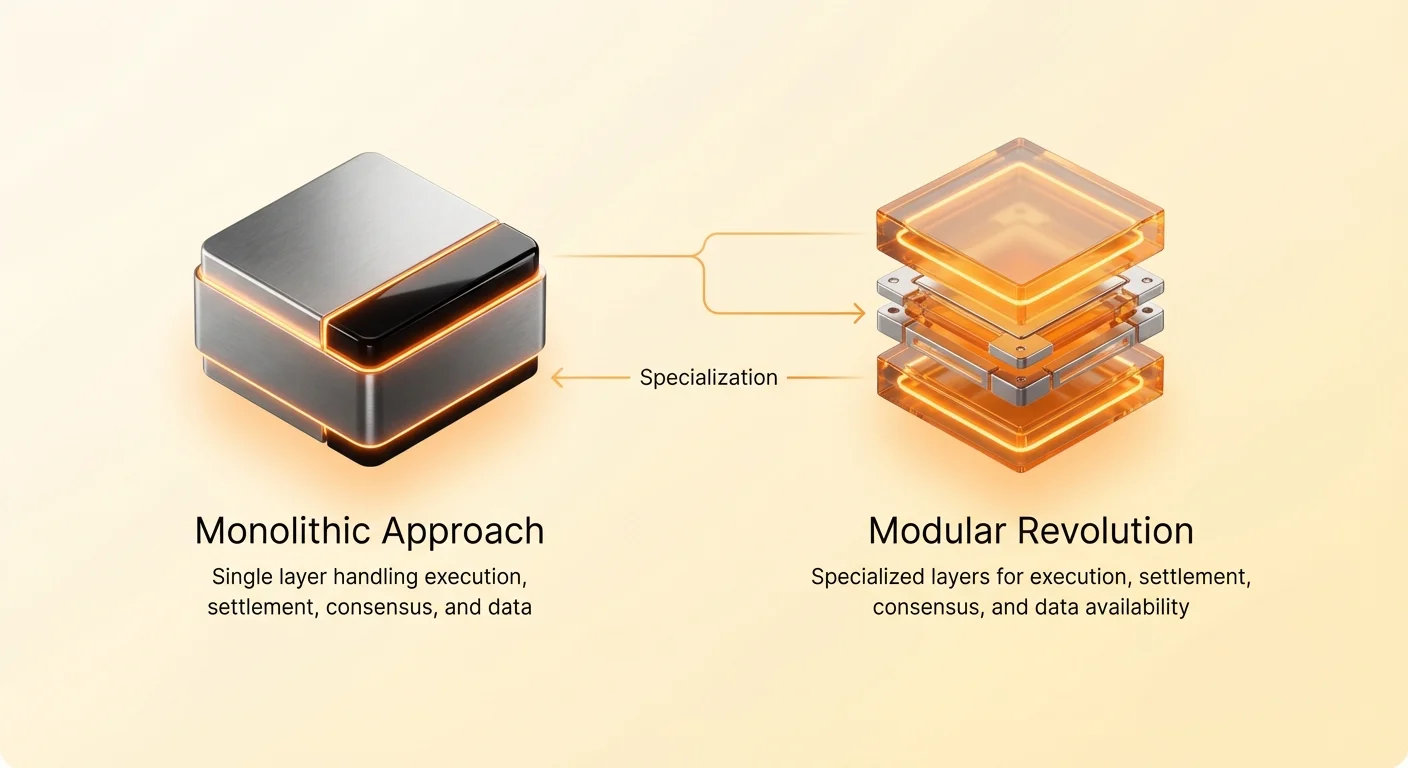
The Monolithic Approach: Doing It All
A monolithic blockchain is defined by its architectural simplicity: it attempts to perform all four necessary blockchain functions—Execution, Settlement, Consensus, and Data Availability—within a single layer.
Think of the monolithic design as a massive, centralized server that processes every transaction, verifies every state change, and secures the entire ledger simultaneously. While straightforward, this structure requires every participating node in the network to perform every single task.
In the early days of crypto, many chains, including Bitcoin and the original iteration of Ethereum, operated monolithically. Modern examples like Solana or Avalanche often follow a monolithic design philosophy, pushing hardware boundaries to achieve immense speed by tightly coupling these functions.
Speed Through Integration: The Monolithic Advantage
The primary benefit of the monolithic approach is its efficiency in communication. Because all core functions are handled by the same set of validators, there is minimal delay between processing a transaction (execution) and confirming its validity (consensus and settlement).
This integration allows monolithic chains to achieve very high transactional throughput (TPS) numbers, often measured in the thousands. For networks like Solana, the goal is to create a singular, high-speed global state machine where users experience transaction finality almost instantly.
- Simplified User Experience: Transactions happen directly on the main chain, simplifying the user’s journey and avoiding complex processes like bridging or interacting with multiple layers.
- Unified Security: The entire ecosystem—all applications and assets—benefits from the security provided by the single, large validator set, assuming that validator set is robust and decentralized.
The Cost of Congestion and Hardware Requirements
The drawback of the monolithic design is that scalability is limited by the physical constraints of individual nodes. If the blockchain experiences a sudden surge in demand (traffic), it creates immediate network congestion because all nodes must process the increased workload. This is often referred to as the "Scaling Trilemma" trade-off: to increase throughput, monolithic chains frequently must sacrifice either decentralization (by requiring more powerful, expensive hardware) or security.
As the network workload grows, so do the hardware demands on validators. If only high-end, professionally managed servers can afford to run a node, the validator set tends to centralize among those with significant capital, potentially compromising the overall decentralization and resilience of the network.
Practical Example: During high-traffic periods, a monolithic network might see transaction fees spike dramatically, or, in extreme cases, the network might slow down or temporarily halt because validators cannot keep up with the execution load required by applications like decentralized finance (DeFi) or large-scale non-fungible token (NFT) mints.
The Modular Revolution: Specialization for Scale
In contrast to the monolithic model, the modular blockchain architecture breaks the four core functions of a blockchain into separate, specialized layers. Instead of one chain doing everything, a modular system uses multiple optimized chains working in tandem.
This paradigm shift is inspired by traditional computer science, where complex systems are built from specialized components (like a CPU, GPU, and RAM) rather than a single generalized chip. In the crypto space, this specialization allows each layer to be independently optimized for its specific task.
The Four Pillars of Modularity
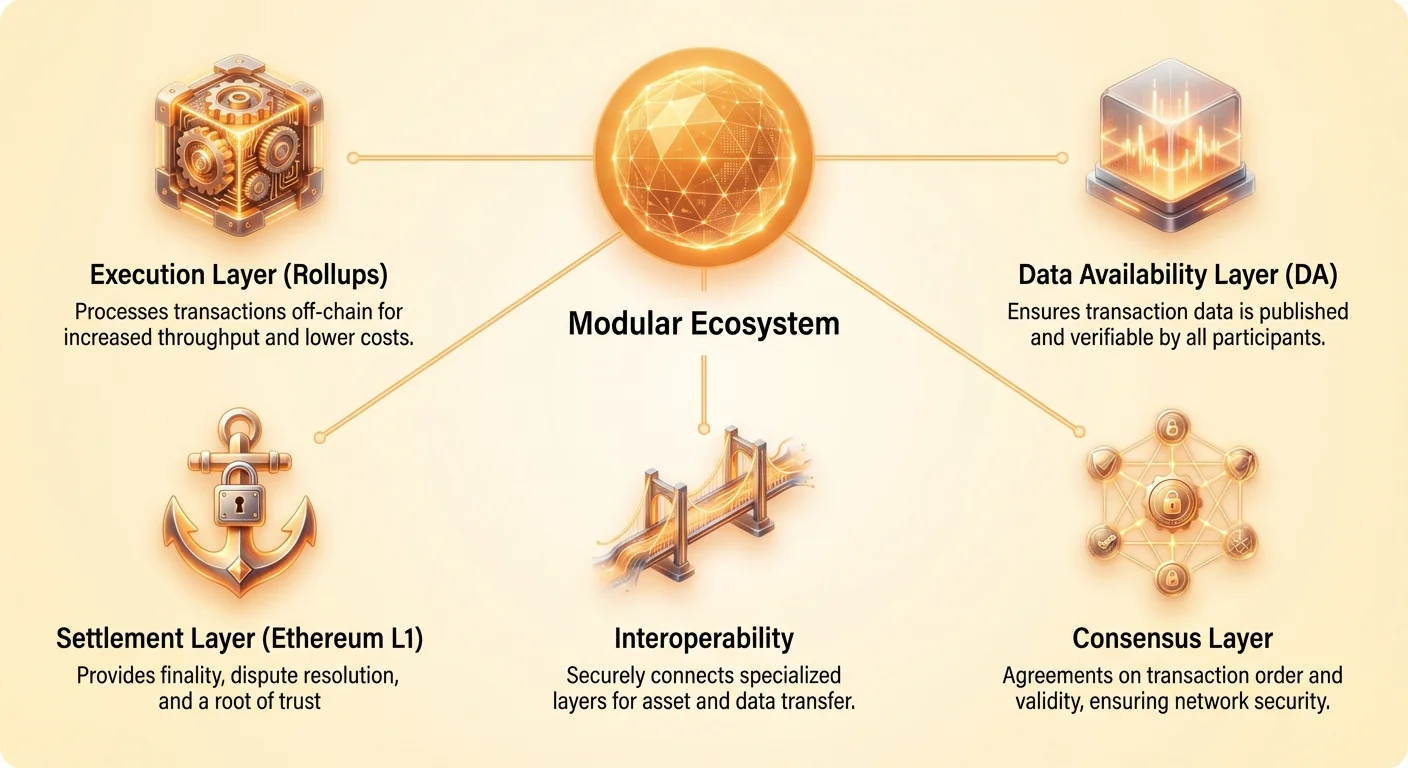
To understand a modular system, we must first define the four functions that are now separated:
- Execution Layer: Where transactions are processed, contracts are run, and the state of the applications is updated. Examples: Ethereum Rollups (Arbitrum, Optimism).
- Data Availability (DA) Layer: Ensures that the raw data necessary to verify transactions—and thus prevent fraud—is published and accessible to all network participants. This is the crucial layer that enables scalability. Examples: Celestia, or Ethereum's upcoming data shards.
- Settlement Layer: Provides a finality and dispute resolution hub. It settles the execution results and provides the root of trust. Example: The Ethereum Mainnet (L1).
- Consensus Layer: Handles the agreement on the order and validity of transactions. Example: Proof-of-Stake mechanism on the base chain.
Execution Layer Analysis: The Rise of Rollups
The most visible component of the modular stack today is the Execution Layer, predominantly implemented through rollups. Rollups are Layer 2 (L2) solutions that execute thousands of transactions off the main chain (L1) and then "roll up" or batch the results into a single, compressed transaction submitted back to the Settlement Layer (e.g., Ethereum).
Rollups dramatically reduce gas costs and increase throughput because the L1 is only responsible for checking the proof of the transaction batch, not executing every transaction within it.
There are two primary types of rollups:
- Optimistic Rollups: Assume transactions are valid by default ("optimistically") and rely on a fraud proving window, giving participants time to submit a "proof of fraud" if something malicious occurred.
- ZK (Zero-Knowledge) Rollups: Use advanced cryptographic proofs to mathematically prove the validity of every transaction batch submitted to the L1. This offers stronger, immediate security, though the computation required to generate the proofs is complex.
Interconnectedness: In a fully modular ecosystem, the execution layer might not even connect directly to the settlement layer; it might instead connect to a dedicated Data Availability Layer (DA) to publish its transaction data, vastly reducing its costs.
Deep Dive into Data Availability (DA): The Core Problem Solver
While execution layers (rollups) handle speed, the true bottleneck for scaling the entire modular ecosystem historically was Data Availability (DA). DA is the component that defines whether the architecture is truly scalable and secure.
If an execution layer processes millions of transactions off-chain, how can a user be absolutely sure that the rollup operator isn't hiding a fraudulent transaction? The answer is simple: the execution data must be available for verification.
Why Data Availability Matters
If a rollup processes a batch of transactions and submits the result to the L1, but refuses to publish the underlying data used to calculate that result, the L1 cannot verify the state change. This is the "Data Availability Problem." If the data is hidden, validators cannot challenge fraudulent activity, and the security of the entire chain is compromised.
Modular scaling requires cheap, verifiable data availability. If the L1 is forced to store the vast amounts of execution data needed by all its rollups, the L1’s block space quickly becomes expensive and scarce, negating the scaling benefits of the rollups themselves.
Celestia and the "Lazy Ledger" Concept
Celestia pioneered the concept of a dedicated, minimalist DA layer, often described as a "lazy ledger." Its design philosophy is simple: order transactions, but do not execute them.
Celestia only focuses on the consensus and data availability functions. It provides a highly efficient and inexpensive place for execution layers (rollups) to publish their transaction data. By using a technique called Data Availability Sampling (DAS), Celestia allows even lightweight nodes (light clients) to verify that the data has been published without having to download the entire dataset.
This separation of concerns offers radical benefits:
- Reduced Cost: Since Celestia doesn't perform complex execution, its block space is far cheaper than the block space of a traditional L1 like Ethereum.
- Sovereignty: Rollups built on Celestia are considered sovereign, meaning they control their own execution environment and state transition rules, offering greater flexibility to developers.
Ethereum’s Data Sharding Roadmap (Proto-Danksharding)
While Celestia built a new chain solely for DA, Ethereum is approaching modularity by fundamentally upgrading its existing L1 structure. Ethereum seeks to become the definitive Settlement and Data Availability layer for all its rollups.
Ethereum’s scaling roadmap includes implementations like Proto-Danksharding (EIP-4844), which introduces a new temporary data storage structure called "blobs" (Binary Large Objects).
Blobs are chunks of data attached to standard Ethereum blocks. Crucially, this blob data is processed separately from the core execution data, is much cheaper, and is automatically pruned (deleted) after a short period (e.g., two weeks).
- Impact: Rollups can now submit their raw transaction data into these cheap blobs instead of the expensive standard call data, drastically lowering the cost of using rollups and transferring the burden of long-term data storage away from the L1, making Ethereum highly scalable as a DA layer.
This architecture solidifies Ethereum's position not as a competing execution environment (where it is often too slow and expensive), but as the shared, secure, and decentralized settlement and data availability backbone for a network of thousands of specialized L2s.
Architectural Showdown: Monolithic vs. Modular Comparisons
The choice between a monolithic and a modular architecture is a choice between integrated performance and flexible specialization. Neither model is inherently superior; they represent different scaling philosophies.
| Feature | Monolithic Architecture (e.g., Solana) | Modular Architecture (e.g., Ethereum/Celestia Stack) |
|---|---|---|
| Primary Goal | Single, high-speed, integrated network. | Specialized, highly scalable, composable ecosystem. |
| Scaling Mechanism | Vertical Scaling (Better hardware, higher optimization). | Horizontal Scaling (Offloading execution to specialized L2s/layers). |
| Security | Unified; all applications rely on the single L1 validator set. | Inherited; L2s inherit security from the L1/Settlement Layer. |
| Decentralization | Requires high-end validator hardware, potentially limiting the number of participants. | Allows for lightweight nodes to verify data (DAS), improving verifier decentralization. |
| Complexity | Low for the user; high for L1 developers (must optimize all four functions). | High for the user (managing multiple layers, bridging); low for developers (focus on one layer). |
| Congestion Handling | Single point of failure; congestion on one application affects the entire chain. | Failure/congestion is localized to the specific execution layer (rollup). |
Security, Scalability, and Decentralization Trade-offs
The core difference boils down to how each architecture navigates the trade-offs of the Scaling Trilemma:
- Monolithic & Security: Monolithic chains aim for maximum security and speed by requiring highly synchronized, optimized validators. If the network is well-funded, security can be high, but the barrier to entry for participation increases.
- Modular & Scalability: Modular chains inherently prioritize scalability and decentralization. By separating execution from settlement, they allow for a massive increase in transaction throughput without sacrificing the decentralization of the core settlement layer. The complexity moves from the base layer to the interoperability of the layers.
- Modular & Decentralization: The ability of specialized DA layers like Celestia to use Data Availability Sampling (DAS) means that everyday users running light nodes can verify the integrity of the data stream without requiring expensive, high-throughput hardware. This lowers the barrier to entry for verification, enhancing decentralization.
The Role of Interoperability in Modular Stacks
The critical weakness of modularity is fragmentation. When value is spread across dozens of specialized execution environments (rollups), moving assets between them becomes crucial. This is where interoperability frameworks come into play.
In a modular world, the bridge becomes a critical piece of infrastructure—and often, a point of security vulnerability. Monolithic chains typically eliminate this problem by keeping all assets and transactions on the same ledger.
However, modern modular solutions are building unified communication standards:
- Shared Settlement Layer: For Ethereum-centric modularity, the L1 acts as the trust anchor. Rollups can communicate securely through the L1, provided the bridging mechanisms are robust and standardized.
- Inter-Blockchain Communication (IBC): In ecosystems like Cosmos (which fundamentally embraces modularity), IBC is a protocol standard that allows different sovereign chains (called zones) to communicate securely without relying on a central intermediary or a complex trust mechanism.
Investment Implications and Strategic Positioning
For the advanced crypto investor, understanding the Monolithic vs. Modular debate is essential for formulating a long-term investment strategy. The architectural choices dictate where value accrues and what risks you are taking.
In the past, investing was primarily about picking the best Layer 1 (L1). Today, it is about allocating capital across the specialized stack of modular components.
Evaluating Monolithic Tokens (L1 Risk/Reward)
Tokens associated with monolithic chains (like Solana) derive their value from the high usage fees, or transaction costs, captured by the single network.
Investment Thesis:
- High-Risk, High-Reward: Monolithic chains offer the potential for rapid growth and strong token appreciation if they successfully capture massive market share due to their speed and integrated user experience.
- Single Point of Failure: The value is entirely reliant on the health and security of that singular chain. If the network experiences major performance issues or prolonged outages, the investment thesis collapses quickly.
- Hardware Dependency: The token's long-term utility is dependent on its ability to maintain decentralization while simultaneously forcing hardware requirements up. If decentralization is compromised for speed, the token risks losing its core value proposition.
Strategic Action: Analyze hardware requirements, validator set concentration, and historical network uptime before investing in a monolithic L1.
Analyzing the Modular Stack: Valuation Beyond the Base Layer
Modular architecture fundamentally changes where value accrues. Instead of all fees flowing to the L1, fees are distributed across the execution, data availability, and settlement layers.
1. The Settlement/Data Availability Layer (e.g., ETH, TIA)
The base layer (like Ethereum) captures value not primarily through execution fees, but through its role as the ultimate guarantor of security and data availability.
- Value Accrual: A token like ETH accrues value because every transaction on every rollup must pay the L1 for settlement and data storage (even cheap blob storage). Increased activity on L2s directly translates to increased demand for L1 block space.
- Investment Thesis: Long-term, secure investment in the fundamental layer of trust. The valuation focuses on the total amount of economic activity it secures, rather than its own execution speed.
2. The Execution Layer (L2 Rollups)
Tokens associated with rollups (e.g., Arbitrum, Optimism) are valued based on their ability to capture users, dominate specific application sectors (e.g., DeFi, gaming), and optimize their fee structure.
- Value Accrual: Rollup tokens capture value from transaction sequencing fees (profit margin after paying the L1 for DA/settlement) and governance rights over the execution environment.
- Investment Thesis: Focused investment on niche sectors. L2 tokens represent a bet on user adoption and technical optimization within a specific, fast-growing subnet.
Risk Management in the Interconnected Ecosystem
The primary risk in modular investing is complexity and interoperability risk.
If you invest in a modular asset, you must understand the security model it relies on. A rollup’s security is only as strong as its connection to the DA and Settlement layers. This requires careful consideration of:
- Bridge Security: Are assets moving between layers using robust, audited bridges? A flaw in a cross-chain bridge can drain significant capital, even if the underlying L1 is perfectly secure.
- Validator Oversight: For newer DA-centric chains like Celestia, evaluate the growth and geographic distribution of the validator set, as the security of the modular stack is tied to the decentralization of its base components.
By breaking down the investment across the modular stack—investing in the secure base layer, the fast execution layers, and specialized DA providers—investors can better diversify risk and capture value from the specific scaling advantages each layer provides.
Conclusion
The evolution from monolithic to modular architecture represents a fundamental shift in how decentralized networks are built and scaled. The monolithic design offers simplicity and high integrated speed but struggles to maintain decentralization under load. The modular design, powered by specialized components like dedicated Data Availability layers and optimized execution rollups, prioritizes horizontal scalability and verifier decentralization.
For new market participants, recognizing this architectural divide provides a necessary framework for evaluating future projects. For the advanced investor, the modular stack demands a multi-layered valuation approach, where success is measured not by the performance of a single chain, but by the efficiency and security of the entire interconnected ecosystem. The future of the digital economy is specialization, and understanding how value flows across these specialized layers is the key to strategic success.