
When Bitcoin was first introduced, it offered a revolutionary solution to the problem of trust: a digital currency that could be securely transferred peer-to-peer without relying on banks or governments. However, as the network grew, a fundamental challenge emerged—how to handle global demand while preserving the very characteristics that made Bitcoin revolutionary in the first place?
This challenge is known as scaling, and it represents the greatest architectural debate in cryptocurrency. Scaling is not merely about making the network faster; it is about making difficult philosophical and engineering trade-offs. The resulting architectural solutions divide the Bitcoin ecosystem into two major categories: Layer 1 (L1), the foundation, and Layer 2 (L2), the extensions built atop it.
This guide serves as the foundational pillar for understanding modern Bitcoin development. We will define the constraints facing all decentralized systems—the infamous Trilemma—and analyze how the unique design choices of Bitcoin's core layer necessitate the creation of robust, yet distinct, external layers. By understanding the L1 vs. L2 architecture, you can move beyond simple technical definitions and analyze scaling solutions based on their fundamental ideological trade-offs: security versus speed, and decentralization versus convenience.
The Foundational Challenge: Understanding the Bitcoin Trilemma
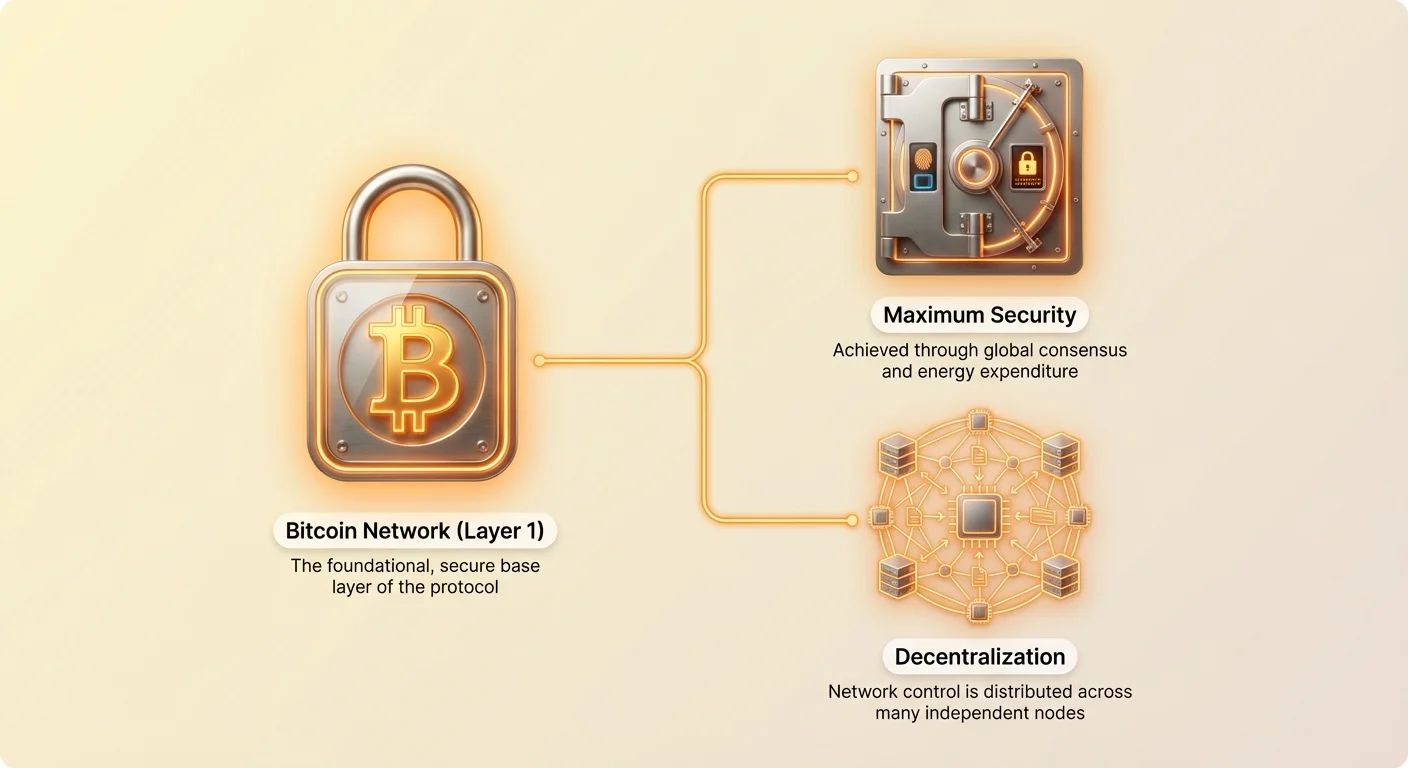
The core dilemma facing any decentralized, public blockchain system is that it seems impossible to optimize three key properties simultaneously: Decentralization, Security, and Scalability. This is widely known as the Blockchain Trilemma.
In theory, you can achieve any two of these properties, but the third must always be sacrificed or compromised to some degree. Bitcoin’s early design choices prioritized security and decentralization above all else. This choice defines why the network operates the way it does and why external layers are necessary.
Decentralization: Preserving Accessibility and Resistance
Decentralization refers to how distributed the control and operation of the network are. A highly decentralized network means that thousands of independent, inexpensive nodes can participate in verifying transactions and validating the chain.
The Trade-Off: High decentralization requires low barriers to entry. If the blockchain ledger gets too large or transactions happen too quickly, users require massive amounts of storage and computing power to run a full verifying node. If only large corporations or wealthy individuals can afford to run a node, control of the network centralizes, making it vulnerable to censorship, collusion, or regulatory pressure.
Bitcoin’s Choice: Bitcoin sacrifices raw speed (scalability) to ensure that the entire history of transactions can be validated and stored by anyone with a standard computer and internet connection. This ensures resilience and censorship resistance—its key value proposition.
Security: The Cost of Irreversibility
Security, in the context of Bitcoin, is achieved through its consensus mechanism, Proof-of-Work (PoW). Security is the guarantee that once a transaction is confirmed and added to a block, it cannot be reversed, censored, or tampered with without expending an enormous, computationally prohibitive amount of energy (the 51% attack threat).
The Trade-Off: High security requires economic investment (the energy spent by miners) and strict enforcement of the protocol rules. This level of security is inherently expensive and slow to achieve. Waiting for multiple block confirmations (the standard practice) adds latency, limiting the transactional speed of the system.
Bitcoin’s Choice: Bitcoin employs the most proven and economically costly security model in existence. Every transaction that lands on Layer 1 inherits this massive security budget, ensuring the immutability of the financial record.
Scalability: The Transaction Bottleneck
Scalability is the network's ability to handle an increasing number of transactions and users without causing latency or dramatic fee increases. Measured in transactions per second (tps), this is where Bitcoin L1 notoriously lags behind traditional payment systems (like Visa) or newer, high-throughput blockchains (like Solana or alternative L1s).
The Trade-Off: To increase scalability on Layer 1, you must either increase block size (compromising decentralization) or reduce the security requirements (compromising security). Since Bitcoin opted for maximum decentralization and security, its native scalability is intentionally capped.
The Necessity of L2: Because the core layer is optimized for security and decentralization, the only viable way to achieve mass-market scalability is to move the bulk of transactional activity off the core chain while still linking the results back to the L1 security model. This is the entire premise of Layer 2 solutions.
Layer 1 Scaling: The Pursuit of On-Chain Purity
Layer 1 (L1) refers to the base protocol and the core blockchain itself—the Bitcoin chain. When we talk about L1 scaling, we are discussing modifications or improvements made directly to the fundamental rules, structures, or capabilities of the Bitcoin network.
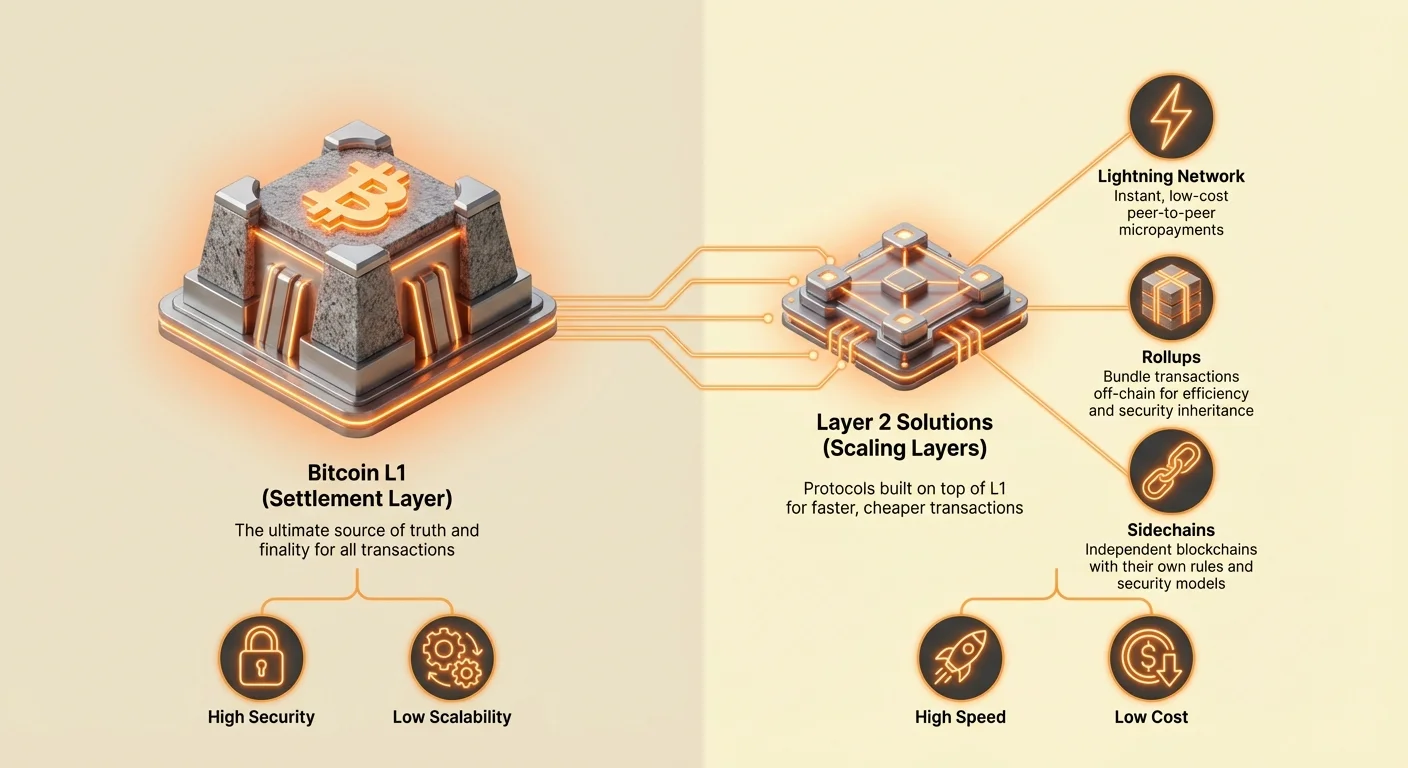
L1 is often called the Settlement Layer because it is the ultimate source of truth. It records the final, immutable state of all transactions and acts as the final judge for disputes originating in external layers.
Definition and Architectural Characteristics
An L1 transaction is an "on-chain" transaction. It is broadcast globally to all nodes, included in a block by a miner, and secured by the full economic weight of the Proof-of-Work network.
Key Characteristics of L1:
- Maximum Security: Transactions inherit the complete PoW budget.
- Global Consensus: Every node in the world validates the transaction.
- Finality: Once confirmed with sufficient blocks, the transaction is irreversible (true finality).
- High Cost, Low Throughput: Due to the global consensus requirement, transactions are expensive and slow (currently limited to around 7 transactions per second).
The Historical Scaling Debate: Block Size and SegWit
The history of Bitcoin scaling is marked by the ideological battle over block size. Early developers quickly realized the network’s capacity limits.
The Block Size Debate (The Scaling Wars): One faction argued for a simple solution: increase the size of the block limit (from the original 1MB). This would instantly increase throughput (scalability). However, this hard fork proposal was strongly opposed by those who argued that larger blocks would increase the bandwidth and storage requirements for running a full node, thus severely compromising decentralization. This philosophical impasse led to significant splits and the creation of different forks, such as Bitcoin Cash (which prioritized large blocks).
Segregated Witness (SegWit): The community eventually coalesced around a clever, non-controversial improvement called Segregated Witness (SegWit) (2017). SegWit did not fundamentally increase the strict 1MB limit, but it optimized how transaction data was stored. By moving the witness (signature) data out of the main transaction body, it effectively increased the transactional capacity of blocks without requiring massive hardware upgrades for nodes.
The Trade-Off: SegWit was an example of scaling through efficiency—making the existing rules work better—rather than scaling through capacity—changing the fundamental rules. This approach preserved the network's decentralization while offering modest, manageable throughput gains.
Innovations in Efficiency: Taproot and Scripting Limitations
More recent L1 developments, such as the Taproot upgrade (2021), continue the focus on efficiency, privacy, and flexibility, paving the way for more robust L2 solutions.
Taproot combines three proposals: Schnorr signatures, Tapscript, and MAST (Merkelized Abstract Syntax Trees). Its primary goal is to make complex transactions (like those involving multiple signatures or smart contracts) look identical to simple, single-signature transactions.
How Taproot Aids Scaling:
- Reduced Data Size: By making complex scripts smaller and requiring only the executed path to be revealed on-chain, Taproot reduces the data footprint of multisignature and smart contract activity. Less data per transaction means more transactions fit into a single block.
- Increased Privacy: The standardized look of transactions reduces traceability and enhances privacy.
- Foundation for Smart Contracts: While Bitcoin’s scripting language (Script) is intentionally limited compared to languages like Ethereum's Solidity (Source Inspiration), Taproot dramatically expands the potential for more complex covenants and conditions without sacrificing L1 security. It allows for the construction of more efficient and complex L2 infrastructures. (For more details, see: Taproot and MAST: The Foundation for Modern Bitcoin Development).
Layer 2 Architectures: Scaling Off-Chain, Settling On-Chain
Layer 2 (L2) solutions are protocols built on top of the Layer 1 blockchain. They handle transactions rapidly off-chain and only use the L1 network as an anchoring and dispute resolution system.
The philosophical shift is profound: instead of demanding that the core network validate every trivial transaction (like buying a coffee), L2s allow high-frequency interactions to occur privately and quickly, using the L1 only for the ultimate settlement of net balances.
The Philosophical Shift: Moving Computation, Preserving Security
L2s are essentially specialized micro-processing layers. They take a large number of transactions, bundle them together, and then record the aggregated proof of these transactions (a single, small summary) onto the main L1 chain.
The Core Concept: Anchoring and Security Inheritance A transaction that occurs on an L2 is fast and cheap, but it does not have the immediate finality of an L1 transaction. Its security is inherited from the L1 through cryptographic mechanisms:
- Entry: Funds are "locked" into a contract on L1, moving them to the L2 system.
- Off-Chain Activity: Transactions happen instantaneously on the L2 network.
- Exit/Settlement: A summary proof of the activity is sent back to the L1, which confirms the final balances and "unlocks" the funds.
If any party tries to cheat or submit a fraudulent summary, the L1 network (the judge) is used to verify the cryptographic proof and penalize the malicious actor.
The Security Spectrum of Layer 2s
Not all Layer 2s are created equal. The most crucial difference lies in how they inherit L1 security and what mechanisms they use to prevent fraud. This is often described along a spectrum:
1. Payment Channels (e.g., Lightning Network)
- Security Model: Trust-minimized, relying on time-locked contracts and cryptographic guarantees.
- Mechanism: Users lock funds into channels and update a shared balance sheet off-chain. If one party tries to broadcast an outdated, fraudulent balance, the other party has a limited time window (the revocation period) to submit the true, most recent balance to the L1, thus penalizing the cheater.
- Key Trade-Off: Requires liquidity setup (opening channels) and continuous monitoring (or using a watchtower service).
2. Sidechains and Drivechains
- Security Model: External or federated security.
- Mechanism: Sidechains (like Liquid or RSK) have their own block producers and consensus rules. They often rely on a federation (a small, trusted group of institutions) to manage the transfer of assets between L1 and the sidechain. While they offer high programmability and speed, their security is not fully inherited from Bitcoin PoW; it depends on the integrity of the federation or the security of the sidechain’s independent mining mechanism (e.g., merged mining).
- Key Trade-Off: High centralization/trust assumption in exchange for maximum speed and functionality. (For more details, see: Bitcoin Sidechain Security Models: Merged Mining vs. Custodial Federations).
3. Rollups and Validity Proofs (Emerging on Bitcoin)
- Security Model: Cryptographically proven inheritance.
- Mechanism: Rollups (common on Ethereum, emerging on Bitcoin) take thousands of transactions, process them off-chain, and generate a single, highly compressed cryptographic proof of correctness.
- Fraud Proofs (Optimistic Rollups): Assume transactions are valid but allow a challenge period where anyone can submit proof of fraud to the L1.
- Validity Proofs (ZK-Rollups): Use complex zero-knowledge cryptography to prove mathematical correctness instantly, offering immediate finality without a challenge period.
- Key Trade-Off: Requires significant computational power to generate the proofs but offers the highest level of trustlessness and security inheritance among non-custodial L2s.
Transaction Finality and Settlement Layers
The concept of finality is essential for differentiating L1 and L2 security.
L1 Finality: Absolute. Once a transaction has sufficient confirmations (e.g., 6 blocks), it is practically immutable. The global network agrees it happened.
L2 Settlement: Conditional. L2 transactions are considered settled within the L2 environment, but they are not final until the aggregated data or proof has been written to, and confirmed by, the Layer 1 chain.
The Role of L1 as the Court of Law: Think of Layer 1 as the Supreme Court. L2s are like municipal courts. Most daily disputes (transactions) are settled quickly and cheaply at the local level (L2). However, if there is a serious dispute (fraud), the case must be escalated to the Supreme Court (L1), which verifies the cryptographic evidence, enforces penalties, and guarantees the final outcome based on the fundamental L1 rules. This mechanism ensures that even though the activity happens off-chain, L1 remains the source of financial truth and security guarantee.
Case Study Comparison: The Lightning Network vs. L1 Transactions
The Lightning Network is the most successful and widely adopted example of a Bitcoin L2 solution. Analyzing it provides a clear, practical view of the L1 vs. L2 trade-offs.
Speed, Cost, and Efficiency Gains
| Feature | Bitcoin Layer 1 (On-Chain) | Lightning Network (Layer 2) |
|---|---|---|
| Speed (Finality) | 10 minutes (minimum), often 1 hour for high confidence | Instant (milliseconds to seconds) |
| Cost | Volatile, often $1 - $100+ (depending on network congestion) | Fractions of a penny |
| Throughput (tps) | ~7 tps globally | Theoretical capacity in the millions of tps |
| Security Inheritance | 100% PoW security; absolute finality | Security guaranteed by time-locked contracts; inherited finality |
| Privacy | Transactions and amounts are permanently public on the ledger | Transactions are private (peer-to-peer); only opening/closing is public |
Practical Example: Buying a Coffee
- L1 Transaction: Sending $5 to a coffee shop. You would pay $10 in fees and wait 30 minutes for confirmation. This is economically irrational and useless for retail.
- L2 Transaction (Lightning): Sending $5. You pay $0.001 in fees, and the payment is confirmed before the barista finishes pouring your drink. This is economically viable, but the settlement layer (the funds supporting the channel) is still secured by the L1.
Addressing Security Differences: Channels and Watchtowers
The Lightning Network does not inherit security automatically; it requires active participation and cryptographic enforcement.
The Active Security Model: L1 transactions are passively secured—you only need to receive the coins and wait for confirmation. L2 channels, however, require participants to be ready to act if their counterparty attempts to cheat.
If Alice and Bob have an open channel, and Alice tries to close the channel using an old balance that benefits her, Bob must have the means to publish the true, most recent balance within a specified time window (often 24-72 hours). If he fails to do so, the fraudulent transaction is finalized on L1.
Watchtowers: This active security requirement introduces complexity. Users must either keep their nodes online or rely on Watchtowers—third-party services that monitor the blockchain on behalf of users, ready to intervene instantly if a fraudulent channel close is attempted. While this reduces the burden on the user, it requires a minor degree of trust in the watchtower service, which acts as a protective agent.
Use Case Suitability: Where L1 Excels vs. L2
The critical takeaway from the scaling trade-offs is that L1 and L2 are not competitors; they are complementary, serving different economic purposes.
| Layer | Best Used For: | Why This Layer? |
|---|---|---|
| Layer 1 (L1) | High-Value Settlement: Large transactions, storing generational wealth, interbank transfers, cold storage (HODLing). | Requires the absolute highest degree of security, finality, and immutability. Fees, though high, are acceptable relative to the transaction size. |
| Layer 2 (L2) | Daily Commerce: Micro-payments, streaming services, retail purchases, small remittances. | Requires speed, low cost, and throughput, prioritizing user experience while minimizing exposure to L1 fee volatility. |
The Trade-Off Reframed: L1 is the secure vault, perfect for long-term storage of high-value assets. L2 is the high-speed cash register and rail network, designed for immediate, everyday economic activity.
Alternative Scaling Paradigms: Beyond Traditional Layers
The L1 vs. L2 dichotomy is foundational, but Bitcoin’s evolution also includes alternative architectural approaches that push the boundaries of programmability and security assumptions.
Sidechains and Merged Mining
Sidechains are independent blockchains that run parallel to the Bitcoin main chain and allow assets (like pegged Bitcoin or native tokens) to be transferred to them. The key scaling advantage is that the sidechain can implement its own rules—faster blocks, different consensus algorithms, or Turing-complete smart contracts—without compromising the L1.
Security Divergence: Unlike the Lightning Network, which uses cryptographic time-locks on L1 for security, many prominent sidechains utilize external security models:
- Federated Custody: A centralized group of approved entities (a federation) manages the lock-up of Bitcoin on L1 and issues equivalent tokens on the sidechain. The security relies on trusting that this group will not collude to steal the locked funds. This is a deliberate trade-off of decentralization for enhanced features.
- Merged Mining: The sidechain uses Bitcoin miners to secure its blocks. Miners calculate the PoW for both the Bitcoin chain and the sidechain simultaneously, using the same energy expenditure. While this leverages Bitcoin's security budget, it doesn't give the sidechain L1 finality; it just makes it expensive to attack the sidechain.
The Fundamental Trade-Off: Sidechains offer massive scalability and programmability (closer to what general-purpose L1s like Ethereum or Solana provide), but they fundamentally alter the security model, requiring users to accept a different set of trust assumptions than those governing the main Bitcoin chain.
Smart Contracts and Programmability
One of the defining differences between Bitcoin (L1) and alternative general-purpose L1 blockchains (like Ethereum) is their approach to smart contracts.
- Ethereum's Design: Ethereum was explicitly designed to be a "world computer," using the Turing-complete Solidity language to execute complex, arbitrarily defined smart contracts directly on its Layer 1. This prioritizes composability and versatility but adds major congestion, complexity, and a much larger attack surface to the L1.
- Bitcoin’s Design: Bitcoin’s Scripting language is intentionally restrictive and non-Turing complete. It is designed to handle simple financial logic (sender, receiver, time-locks, multisig) and prevent runaway complex code that could compromise the L1’s stability and security.
L2 as the Smart Contract Solution: For Bitcoin, generalized smart contract capability must happen on Layer 2 (e.g., through sidechains or more advanced rollups currently in development). By moving complexity off-chain, Bitcoin maintains its ideological commitment: the L1 is reserved for the simple, highly secure role of the monetary base and final settlement layer, while the L2s handle the experimental, complex, and potentially higher-risk applications.
Navigating the Trade-Offs: Choosing the Right Layer
As an adopter of the digital economy, understanding the scaling trade-offs allows you to make informed decisions about how and where to transact your funds. The decision between L1 and L2 usage should be based primarily on your risk tolerance, the value of the transaction, and the necessity of immediate speed.
Risk Tolerance and Custody Models
Different layers introduce different security risks, particularly related to the custody of funds:
1. Layer 1 (Cold Storage):
- Risk Profile: Lowest risk. Funds are secured by PoW and your private keys. The primary risk is loss of keys or human error.
- Custody: Non-custodial, self-sovereign. The only entity controlling the funds is you.
2. Layer 2 (Lightning Network):
- Risk Profile: Low risk, but involves active management. Funds are technically non-custodial (you hold the keys), but they are locked in a specific contract. Risks include potential counterparty fraud (if your node fails to monitor the chain) or channel routing failures.
- Custody: Non-custodial, contract-dependent.
3. Sidechains (Federated Model):
- Risk Profile: Moderate to High risk. If the sidechain uses a federation to manage the pegged assets, you introduce custodial risk—you must trust the members of the federation not to collude and steal the funds locked on L1.
- Custody: Custodial or Semi-custodial, depending on the sidechain's structure.
Actionable Tip: Always default to Layer 1 for the vast majority of your wealth (cold storage). Use L2s only for the funds you need for immediate spending (your digital "wallet cash"). Never risk your entire balance on the experimental complexities of higher layers unless you fully understand the specific trust assumptions.
Economic Implications: Fees and Resource Allocation
The fundamental trade-off also dictates resource allocation across the network:
The Fee Mechanism: L1 fees are directly tied to block space demand. When the network is congested, fees spike because users are bidding for limited space. This high cost is necessary; it ensures that only economically valuable transactions (or transactions requiring maximum security) compete for the limited L1 block space. This high cost protects the decentralization of the network by preventing the ledger from rapidly growing to unmanageable sizes.
L2 Efficiency: L2 fees are minimal because they only require tiny amounts of L1 block space for entry, dispute resolution, and settlement. They bundle the costs of thousands of transactions into one small fee. This massive efficiency gain allows Bitcoin to operate as a high-throughput economy without sacrificing the security guarantees of its base layer.
The Economic Trade-Off: High L1 fees are not a "bug"—they are a deliberate feature that monetarily enforces the Trilemma solution. They ration the use of the most secure, most decentralized resource (the L1 ledger) for only the most essential uses, pushing all other activity onto the more scalable, efficient, and cheaper L2 layers.
Conclusion
The architecture of Bitcoin scaling is a profound reflection of the network's core values. By prioritizing decentralization and security on its base layer (L1), Bitcoin made a deliberate choice to externalize scalability. This necessitated the creation of robust Layer 2 solutions—ranging from the peer-to-peer instant payments of the Lightning Network to the complex programmability of sidechains.
Understanding the Bitcoin scaling trade-offs—the Trilemma—is the key to navigating the modern crypto landscape. L1 transactions are expensive, slow, and final; they are the bedrock of security and trust. L2 transactions are cheap, fast, and conditionally secure; they are the engine of commerce.
By recognizing that L1 acts as the ultimate settlement layer and L2s act as the processing layers, users gain the power to choose the appropriate level of security, speed, and cost for every interaction, thus moving closer to true self-sovereignty in the digital economy. The evolution of Bitcoin is not about changing its secure foundation, but about building faster, smarter architectures upon it.