
The emergence of blockchain technology created a divergence in digital innovation. On one side stands Bitcoin, the pioneer of decentralized currency, designed primarily as a store of value and a medium of exchange. On the other stands Ethereum, a protocol that took the underlying technology of the blockchain and expanded it into a programmable ecosystem. While Bitcoin operates as a decentralized ledger for tracking payments, Ethereum functions as a decentralized world computer. This distinction is not merely semantic; it represents a fundamental difference in architecture, purpose, and capability.
To understand why Ethereum is often referred to as the world's computer, one must look beyond the concept of digital money. The platform was designed to facilitate peer-to-peer contracts and applications that run without control, permission, or interference from third parties. Unlike a traditional shared supercomputer, which might be used to process complex scientific data like an image of the night sky, Ethereum is not designed for raw speed or high-performance computing. Instead, it is a shared verification platform.
This platform relies on a global network of nodes to reach consensus on the state of the system. "State" refers to the current information stored in the computer at any given moment. For a simple currency, the state is just a list of balances. For a world computer, the state includes code, application data, ownership records, and complex contract interactions. To manage this complexity, Ethereum requires two critical components that Bitcoin does not utilize in the same way: a robust concept of global state and the Ethereum Virtual Machine.
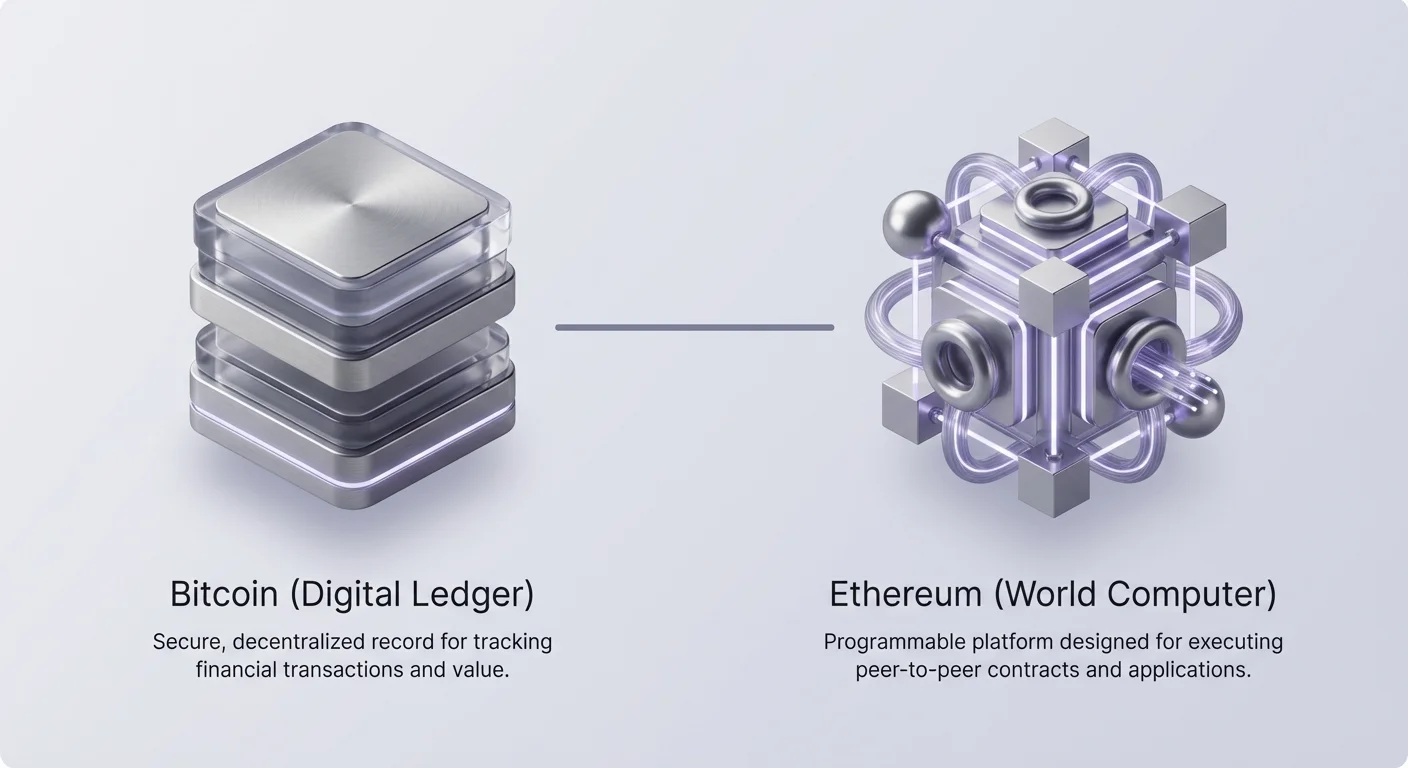
The Functional Divide: Ledger vs. Platform
Bitcoin was launched in 2009 by Satoshi Nakamoto to solve a specific problem: the need for a decentralized, censorship-resistant digital currency. Its architecture is intentionally rigid to maximize security for financial transactions. It uses a script language that is not Turing-complete, meaning it has limited programming capabilities. This design choice prevents infinite loops and complex logic errors, making the network incredibly secure for moving value but limited for building applications.
Ethereum, proposed by Vitalik Buterin in 2013 and launched in 2015, sought to remove these limitations. The goal was to create a Turing-complete blockchain. This is a system capable of running any type of application or algorithm, provided there are enough resources to compute it. While Bitcoin is often compared to digital gold due to its scarcity and store-of-value properties, Ethereum is better likened to a global operating system or a digital oil that powers a vast engine of applications.
The difference in purpose leads to a difference in mechanics. Bitcoin verifies that user A sent money to user B. Ethereum verifies that a piece of code executed correctly according to its pre-defined rules and updated the network's memory accordingly. This capability allows developers to use the blockchain's infrastructure to build their own projects, known as decentralized applications (dApps), which creates a diverse ecosystem beyond simple currency transfers.
Comparing Core Metrics
The technical specifications of these two giants reflect their differing goals. Bitcoin uses a Proof-of-Work consensus mechanism that prioritizes extreme security over throughput, historically handling around 7 transactions per second. Its supply is hard-capped at 21 million coins, reinforcing its deflationary nature.
Ethereum, originally built on Proof-of-Work, transitioned to Proof-of-Stake to improve energy efficiency and scalability. It aims for higher transaction throughput, historically around 30 per second, though this is being improved through upgrades like sharding and Layer-2 solutions. Its supply is not hard-capped, allowing the monetary policy to adapt to the needs of the network security, often resulting in low or negative inflation rates based on network usage.
| Feature | Bitcoin | Ethereum |
|---|---|---|
| Primary Purpose | Digital Money / Store of Value | Decentralized App Platform |
| Internal Logic | Limited Script (Non-Turing) | Turing-Complete (EVM) |
| Consensus Model | Proof-of-Work | Proof-of-Stake |
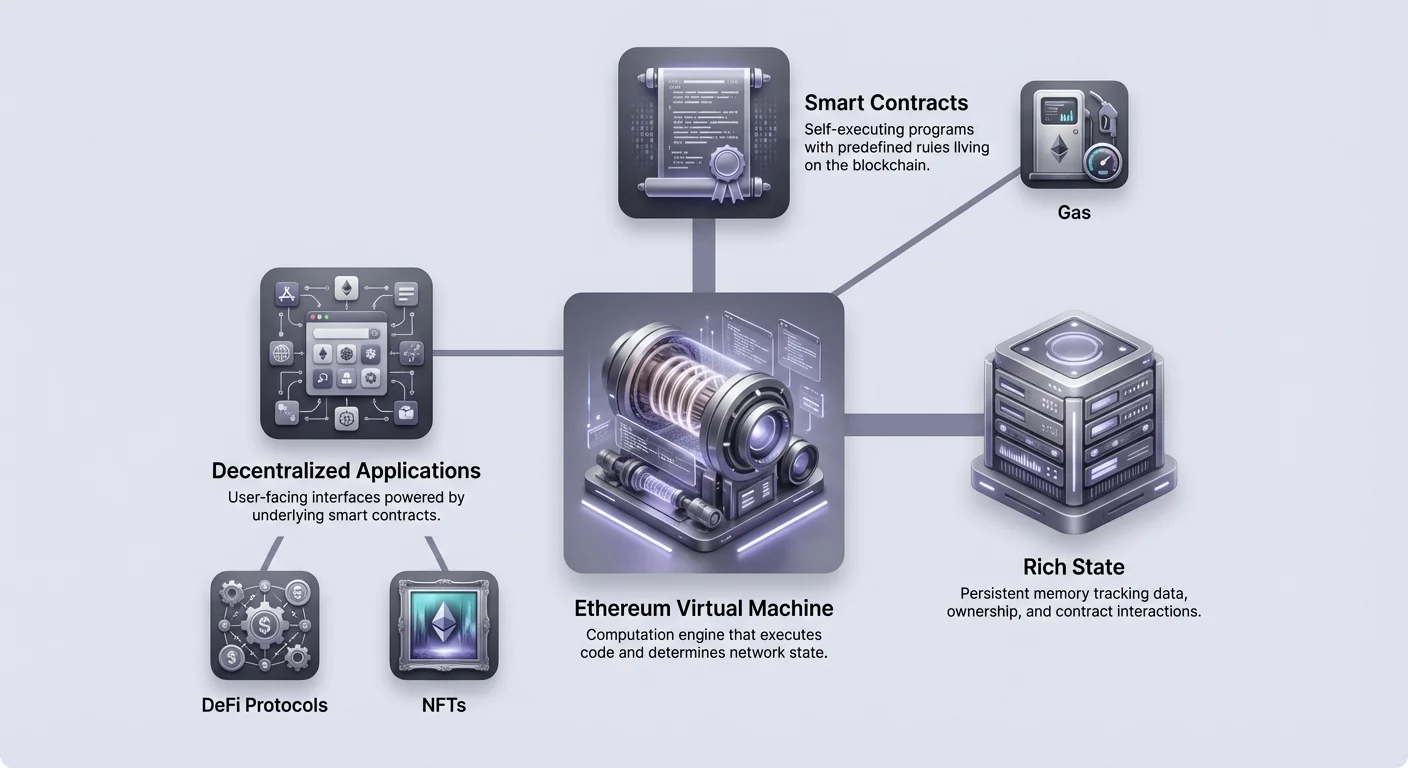
The Necessity of State in Computing
In computing terms, "state" is the memory of the system. It is the retained information that allows a program to remember what happened in the past and use that information to determine what happens next. A simple calculator is stateless; you type a calculation, get a result, and when you clear it, the memory is gone. A computer hard drive or a database is stateful; it remembers your files, your login settings, and your application history.
Bitcoin manages state in a very specific, simplified way called Unspent Transaction Outputs (UTXO). It tracks which coins have not been spent yet. Once a coin is spent, it is consumed, and new unspent outputs are created. It does not essentially care about "accounts" or "user data" in the traditional sense. It only cares about the movement of value. This is highly efficient for a currency but insufficient for complex applications.
For a world computer to function, it needs a "rich state." It needs to track not just balances, but also data variables, contract ownership, reputation scores, and the logic of ongoing agreements. Ethereum utilizes an account-based model that is similar to a bank account or an email address. Every address on Ethereum has a state associated with it. This allows smart contracts to maintain persistent storage.
Without this persistent state, decentralized finance (DeFi) would be impossible. A lending protocol needs to "remember" that you deposited collateral three months ago. It needs to track the accruing interest block by block. It needs to know the exact liquidation threshold. All of this requires a blockchain that can maintain and update a complex, shifting state over time, rather than just verifying simple transfers of coins.
The Ethereum Virtual Machine (EVM)
The heart of Ethereum's ability to process this state is the Ethereum Virtual Machine (EVM). The EVM is the engine that drives the entire network. It is a computation engine that acts like a virtual computer running inside every node on the Ethereum network. When a transaction involves a smart contract, the EVM is responsible for executing the code and determining the new state of the network.
Understanding the Sandbox Environment
The EVM operates as a "sandboxed" environment. This is a crucial security feature. It means that the code running inside the EVM is completely isolated from the rest of the network and the host machine's file system. A malicious smart contract cannot access the personal files of the node operator running the software, nor can it easily crash the underlying protocol.
This isolation ensures that while the network is open and permissionless—meaning anyone can upload any code they want—the network remains resilient. Even if a developer deploys a contract with fatal errors or malicious intent, the damage is generally contained within that specific contract's interaction context. The EVM processes the instructions, realizes the error or the valid output, and updates the blockchain state accordingly without compromising the integrity of the consensus rules.
From Solidity to Bytecode
Developers do not write code directly for the EVM. They use high-level programming languages, most notably Solidity, which looks somewhat like JavaScript or C++. However, the EVM cannot understand Solidity directly. The code must be "compiled" into low-level instructions called bytecode.
Bytecode is a series of opcodes (operation codes) that the machine can interpret efficiently. When a smart contract is deployed to the Ethereum network, this bytecode is what actually gets stored on the blockchain. When a user interacts with a dApp, they are essentially sending a message to the EVM telling it to locate specific bytecode at a specific address and execute a specific function within it.
This process is deterministic. This means that if everyone runs the same code with the same inputs, they will get the exact same result. This is vital for a decentralized network. Every node around the world must agree on the outcome of the computation. If the EVM behaved differently on different computers, the consensus would break, and the single "world state" would fracture into different versions of reality.
The Role of Gas in Computation
Because the EVM is Turing-complete, it allows for loops and complex recursive logic. In computer science, this introduces a risk known as the "halting problem," where a program might run forever, consuming infinite resources. To prevent someone from accidentally or maliciously clogging the world computer with an infinite loop, Ethereum introduced the concept of "Gas."
Gas is the unit of measurement for the computational work required to execute operations in the EVM. Every instruction in the bytecode—adding numbers, storing data, sending tokens—costs a specific amount of gas. Users must pay for this gas using Ether (ETH).
If a computation takes too long or is too complex, the transaction runs out of the gas provided by the user, and the EVM halts the operation. The changes are reverted, but the fee is still paid to the validators for their work. This economic mechanism ensures that the network cannot be spammed with infinite loops and that resources are allocated efficiently to those willing to pay for them.
Smart Contracts: The Software of the Future
The code executed by the EVM is packaged into "smart contracts." A smart contract is a computer program that lives on the blockchain. It contains both the code (functions) and the data (state) specific to that application. Once deployed, a smart contract is immutable; its logic cannot be changed (unless specific upgrade capability is coded in from the start), and it runs autonomously.
These contracts allow for "trustless" interactions. In traditional business, if you want to set up a trust fund that releases money to your child when they turn 18, you need a lawyer and a bank. You have to trust them to follow the rules and not mismanage the funds. With a smart contract, you trust the code. You can verify the logic yourself. If the condition (turning 18) is met, the action (release funds) happens automatically.
Smart contracts are the building blocks of decentralized applications. They can handle simple logic, like sending 1 ETH to a friend, or complex logic, like managing a decentralized exchange where thousands of users trade assets simultaneously. The EVM ensures that these contracts execute exactly as written, providing transparency and security that traditional centralized servers cannot match.
Decentralized Applications (dApps)
When you combine smart contracts with a user interface (frontend), you get a Decentralized Application, or dApp. To the end-user, a dApp might look like a standard website or mobile app. However, the backend is fundamentally different. Instead of connecting to a centralized database controlled by a company like Google or Amazon, the app connects to the Ethereum blockchain.
dApps are permissionless. Anyone can use them without asking for access. They are also censorship-resistant. Because the logic lives on a decentralized network of thousands of nodes, no single entity, government, or corporation can switch off the application or delete the data.
The architecture of a dApp typically involves three main components. First, the smart contracts that define the business logic. Second, the blockchain that stores the state and history. Third, the tokens that function as the fuel (gas) or the currency within the application. This structure puts the user in control. In a Web 2.0 application, the platform owns your data. In a Web 3.0 dApp, you own your data and assets, interacting with the application through your private wallet.
Use Cases Enabled by the EVM
The combination of a Turing-complete virtual machine and a rich state has given rise to sectors of the crypto economy that simply could not exist on Bitcoin's simpler architecture.
Decentralized Finance (DeFi)
DeFi is the most prominent example of Ethereum's utility. It aims to recreate the traditional financial system—banks, exchanges, lending desks, insurance—without intermediaries. Protocols like Aave or Uniswap are essentially sets of smart contracts.
In a DeFi lending protocol, the "bank" is a pool of funds locked in a smart contract. The "bank manager" is the EVM code that calculates interest rates based on supply and demand. The state capability of Ethereum tracks how much collateral a user has provided and automatically liquidates their position if the value drops too low. This happens transparently and mathematically, removing human bias and counterparty risk.
Non-Fungible Tokens (NFTs)
NFTs rely entirely on the ability to store unique state data. An ERC-721 token (the standard for NFTs) is a smart contract that tracks ownership of unique identifiers. When you buy a piece of digital art or a virtual real estate plot, the EVM updates the state of that contract to associate that specific item with your wallet address.
This technology extends beyond art into gaming and identity. In blockchain-based games, the sword or character you earn is an NFT. Because it lives on the public Ethereum state, you truly own it. You can sell it on a third-party marketplace, or potentially move it to a different game. This interoperability is only possible because of the shared, standardized environment of the EVM.
Decentralized Autonomous Organizations (DAOs)
DAOs represent a new way of organizing human coordination. They are organizations governed by code rather than corporate hierarchies. The rules of the organization are written into smart contracts. Members typically hold governance tokens that grant them voting rights.
When a decision needs to be made—such as how to spend the treasury funds—members vote on-chain. The EVM tallies the votes based on the token holdings recorded in the state. If the proposal passes, the smart contract can automatically execute the transaction, moving the funds to the designated project. This creates a transparent, democratic structure that enforces decisions without the need for a CEO or board of directors to manually authorize payments.
Scalability and Network Evolution
The immense popularity of these applications highlighted the limitations of the EVM's processing power. Since every node must process every transaction to maintain the synchronized state, the network can become congested. This leads to high gas fees, as users bid up the price to get their transactions processed first.
To address this, the Ethereum community has pursued aggressive upgrades. The shift to Proof-of-Stake (Ethereum 2.0) was a foundational step, reducing energy consumption by over 99% and setting the stage for future scaling improvements like sharding. Sharding aims to split the database horizontally, spreading the load so that not every node has to process every single piece of data.
Furthermore, Layer-2 scaling solutions have emerged. Technologies like Optimistic Rollups (used by Arbitrum and Optimism) and Zero-Knowledge Rollups allow transactions to be processed off the main chain. These layers handle the heavy computation and then post a compressed summary of the data back to the main Ethereum network. This leverages the security of the Ethereum mainnet while offering much faster and cheaper transactions for users.
EVM Compatibility and Standardization
The influence of Ethereum's design extends far beyond its own network. The Ethereum Virtual Machine has become the industry standard for smart contract execution. Because of the robust developer tools, documentation, and user base associated with Ethereum, many other blockchains have chosen to be "EVM-compatible."
Blockchains like BNB Smart Chain (BSC), Avalanche, and Polygon use the EVM architecture. This means that developers who write code for Ethereum can deploy the exact same applications to these other networks with minimal changes. It also means that users can use the same wallets, such as the Bitcoin.com Wallet or MetaMask, to interact with these different chains.
This standardization has created a massive network effect. Improvements made to the EVM benefit not just Ethereum, but an entire ecosystem of interconnected blockchains. It allows for a multi-chain future where different networks compete on speed, cost, or security, while still speaking the same fundamental language of code.
Origins and Token Distribution
The path to this decentralized ecosystem began with a crowdsale in 2014. Unlike Bitcoin, which was mined into existence by early adopters starting from zero, Ethereum launched with a pre-sale to fund development. Participants sent Bitcoin to receive Ether. This initial distribution resulted in 60 million ETH being allocated to contributors, with another 12 million set aside for the Ethereum Foundation and early contributors.
This distribution model has been a point of discussion regarding decentralization. In the early days, the supply was highly concentrated. However, over time, the distribution has widened as early buyers sold to new entrants and as new supply was issued through mining (and now staking).
The concept of "credible neutrality" remains central to Ethereum's ethos. Despite the initial concentration, the network has evolved into a diverse ecosystem where no single entity controls the protocol. The transition to a decentralized governance culture ensures that the "operating system" evolves to meet the needs of its users rather than the profits of a centralized corporation.
Conclusion
The distinction between Bitcoin and Ethereum represents the evolution of blockchain technology from a specific financial tool to a general-purpose utility. Bitcoin perfected the digital ledger, creating a secure, immutable record of value transfer. Ethereum took that foundation and added the critical layers of state and computation. By implementing the Ethereum Virtual Machine, it provided a standardized engine capable of executing complex logic.
By maintaining a rich, persistent state, Ethereum allowed that logic to remember the past and govern the future. This combination transformed the blockchain from a passive record-keeper into an active, programmable participant in the digital economy. It enabled the creation of entirely new asset classes, financial systems, and organizational structures that operate autonomously.
As the network continues to scale and evolve, the role of the EVM as the standard for decentralized computation seems increasingly secure. Whether through the main network or through the myriad of compatible layers and chains, the "world computer" provides the infrastructure for a new iteration of the internet where users own their data, and code executes faithfully without the need for trusted intermediaries.
The world computer allows us to replace trust in institutions with verification of code.