
Ethereum stands as the foundational layer for a vast ecosystem of decentralized finance and digital applications. As the second-largest cryptocurrency by market capitalization, it has pioneered the concept of programmable money through smart contracts. However, this success has introduced significant challenges. The network regularly processes over a million transactions daily, yet demand consistently outstrips capacity. This congestion leads to skyrocketing gas fees, effectively pricing out smaller users and limiting the utility of the platform.
To address these limitations, the network is undergoing a multi-phase evolution often referred to as Ethereum 2.0 or Eth2. This upgrade aims to solve the blockchain trilemma. This concept suggests that decentralized networks struggle to simultaneously achieve decentralization, security, and scalability. Typically, optimizing for two of these traits forces a compromise on the third.
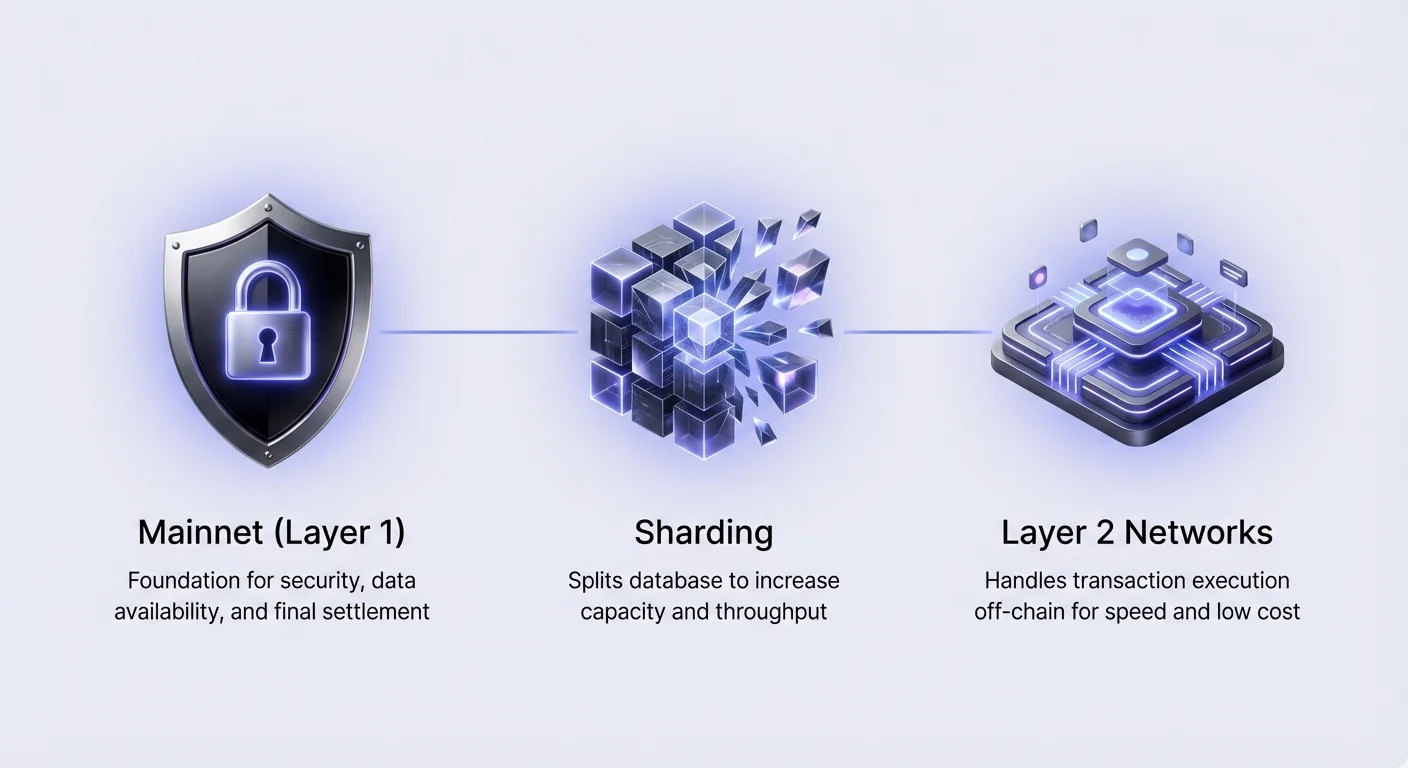
The current strategy involves a modular approach. Instead of trying to do everything on the main blockchain (Layer 1), the ecosystem is shifting. Heavy computation and transaction processing move to secondary layers (Layer 2), while the mainnet focuses on security and data availability. This shift is not just a software update but a fundamental restructuring of how the blockchain operates.
The Evolution of Consensus
The most significant structural change to Ethereum has been the transition from Proof of Work (PoW) to Proof of Stake (PoS). This shift alters how the network reaches agreement and secures itself against attacks. In the legacy PoW model, miners expended vast amounts of electricity to solve complex mathematical puzzles. This energy expenditure served as the economic cost to deter malicious actors.
Understanding Proof of Stake
Under the new consensus model, validators replace miners. To become a validator, a participant must lock up, or "stake," a specific amount of cryptocurrency within a smart contract. This capital acts as collateral to ensure honest behavior. Rather than competing with computing power, validators are selected randomly to propose new blocks. Other validators then attest to the validity of these blocks.
This system utilizes a "carrot and stick" approach to security. Validators earn rewards for successfully processing transactions and maintaining network uptime. Conversely, those who violate protocol rules or go offline face penalties. In severe cases, a portion or all of their staked assets can be forfeited—a process known as slashing.
The random selection process is critical for security. By shuffling validators, the protocol prevents any single group from effectively coordinating an attack on a specific part of the network. This randomness ensures that the influence of a validator is proportional to their stake but still unpredictable in the short term.
Economic and Environmental Implications
The move to PoS brings dramatic changes to the network's footprint. Estimates suggest that the energy consumption of the network drops by over 99% compared to the mining era. This efficiency removes the need for warehouses full of specialized hardware, which was a significant barrier to entry in the PoW era.
In theory, removing the hardware requirement aids decentralization. Anyone with the required capital can participate without needing engineering expertise or access to cheap electricity. However, this model faces criticism regarding wealth concentration. In a PoW system, miners must sell coins to pay for electricity, constantly redistributing supply. In PoS, validators can compound their rewards with near-zero operating costs.
Critics argue this leads to a "rich get richer" scenario where early accumulators maintain perpetual dominance. Proponents counter that the cost of attacking the network becomes significantly higher. To overwhelm the consensus, an attacker would need to acquire a majority of the staked supply, a feat that becomes increasingly expensive as the network grows.
The Foundation of Scaling: Sharding
Scaling a blockchain requires more than just changing the consensus mechanism. It requires increasing the actual capacity of the network to handle data. Sharding is the primary technique introduced to achieve this on Layer 1. It involves partitioning the network's entire database into smaller, manageable pieces called shards.
Breaking Down the Database
In a traditional blockchain, every node must process every transaction and store the entire history of the network. This requirement creates a bottleneck, as the speed of the network is limited by the processing power of its individual nodes. Sharding breaks this constraint by splitting the verification workload.
Each shard operates almost like a separate blockchain with its own state and transaction history. Instead of the entire network validating every action, nodes only need to manage the data relevant to their specific shard. This parallel processing capability massively increases the total throughput of the system.
Sharding does not make the shards completely independent. They must communicate and coordinate through the main chain to ensure consistency. This coordination layer ensures that the security properties of the entire network apply to each individual shard, preventing specific partitions from being corrupted.
Synergy with Rollups
The implementation of sharding is designed specifically to support Layer 2 solutions. While early visions of sharding involved code execution on each shard, the roadmap has shifted. The primary focus is now on "data availability." Shards will serve as massive data storage lanes that Layer 2 networks can use to anchor their transaction batches.
Validators play a crucial role here. They are randomly assigned to different shards for specific periods. This rotation ensures that no single shard is controlled by a static group of validators, which could lead to collusion. By constantly shuffling who secures which data, the network maintains high security even as it fractures its database.
This architecture allows Layer 2 solutions to reference data stored on shard chains without congesting the main execution layer. It effectively turns Ethereum into a settlement layer for other, faster networks.
Defining Layer 2 Architecture
Layer 2 is an umbrella term for solutions designed to help scale applications by handling transactions off the main Ethereum chain (Layer 1). These solutions derive their security from the mainnet but perform the heavy lifting elsewhere. The relationship is symbiotic: Layer 1 provides security, decentralization, and data availability, while Layer 2 provides speed and low costs.
The necessity for this architecture stems from the limitations of the mainnet. When demand spikes, the network becomes a bidding war for block space. Simple transfers can cost exorbitant amounts, and complex smart contract interactions become unfeasible for regular users. Layer 2 solutions alleviate this by processing thousands of transactions off-chain and bundling them together.
By submitting only the essential data or proof of validity back to the mainnet, these solutions reduce the burden on the primary network. This allows users to remain within the secure Ethereum ecosystem without suffering from its congestion. It preserves the decentralized nature of the settlement layer while offering the user experience required for mass adoption.
The Mechanisms of Off-Chain Scaling
Different Layer 2 technologies take varied approaches to off-chain scaling. Each method offers a unique balance of security, speed, and functionality. The earliest iterations focused on simple payment channels, while newer solutions support full smart contract capabilities.
State Channels and Plasma
Channels are conceptually similar to Bitcoin's Lightning Network. They allow two parties to transact indefinitely off-chain while only submitting the first and last transactions to the blockchain. This method offers nearly instant speeds and negligible fees. However, it requires users to lock up funds and remain online to protect their assets.
Plasma creates "child chains" that are anchored to the main Ethereum chain. These child chains can process transactions cheaply but rely on the main chain for trust and arbitration. Users can move assets to a Plasma chain, transact there, and eventually withdraw back to the mainnet.
The downside of Plasma is the withdrawal process. Because the main chain needs to verify that no fraud occurred on the child chain, withdrawals can be subject to long waiting periods. Additionally, Plasma chains generally support limited transaction types, making them less suitable for complex decentralized finance (DeFi) applications.
Independent Sidechains
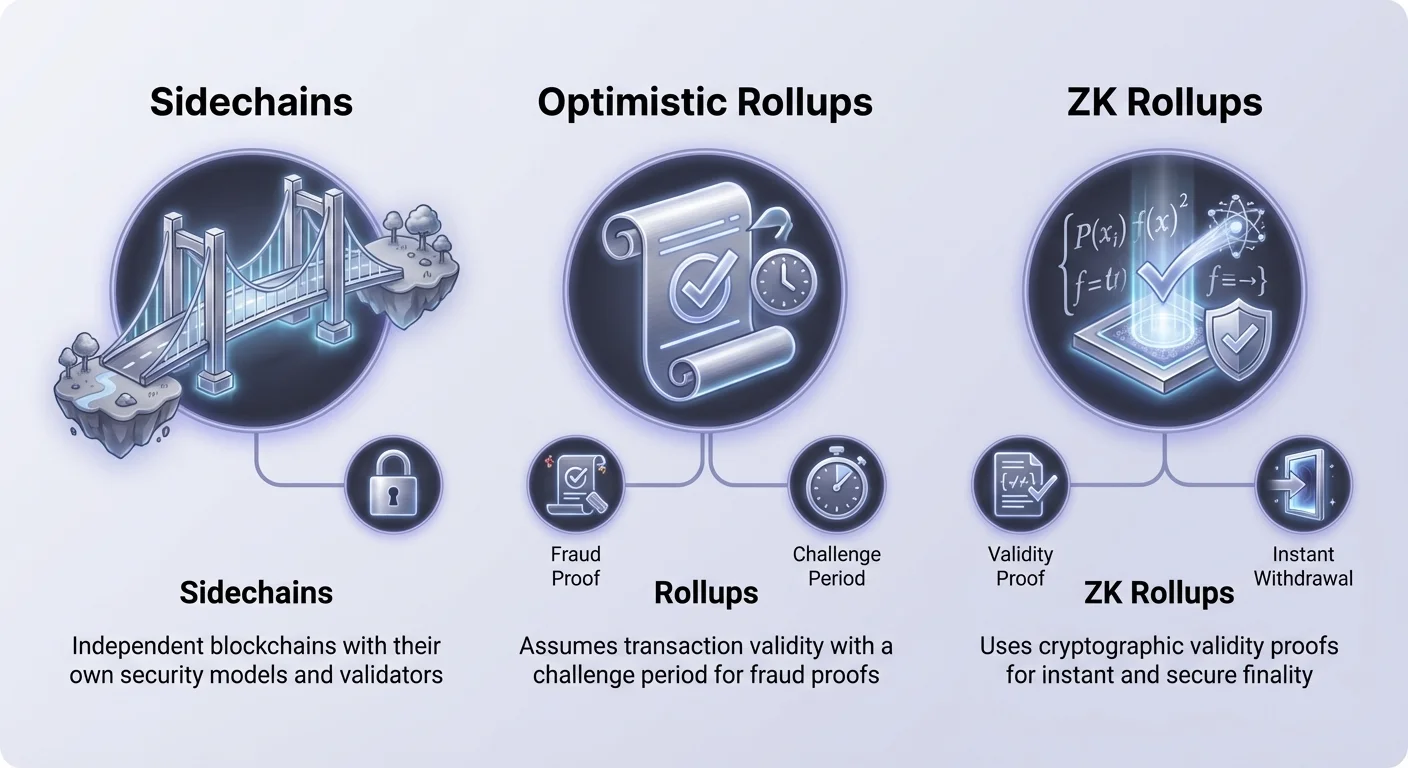
Sidechains represent a pragmatic approach to scaling. These are independent blockchains that run in parallel to Ethereum and are connected via a two-way bridge. Examples include the xDAI chain or the chain used by the game Axie Infinity. They are compatible with the Ethereum Virtual Machine (EVM), meaning developers can easily port applications over.
| Feature | Sidechains | Layer 1 Ethereum |
|---|---|---|
| Security | Independent (Own validators) | Shared (Global consensus) |
| Speed | High | Low (Congestion dependent) |
| Cost | Very Low | High |
The critical distinction is security. Sidechains are responsible for their own safety. They have their own set of validators or miners. If this smaller group of validators colludes, they could potentially steal funds locked in the bridge. Unlike true Layer 2 solutions, sidechains do not inherit the security guarantees of the Ethereum mainnet.
The Rollup Revolution
Rollups have emerged as the dominant scaling strategy for the modern Ethereum ecosystem. They work by executing transactions outside of Layer 1 but posting transaction data back to it. This ensures that the data is available for anyone to verify, keeping the system secure. There are two primary types of rollups: Optimistic and Zero Knowledge (ZK).
Optimistic Rollups
Optimistic rollups operate on a presumption of innocence. They assume that all transactions submitted to the chain are valid by default. The validity is only computed if someone specifically challenges a transaction. This "fraud proof" mechanism allows for significant scalability because the main network doesn't have to verify every signature.
Because they rely on a challenge system, there is a delay when moving funds from the rollup back to Layer 1. This "challenge period" typically lasts about seven days. This window gives validators time to detect and report any malicious activity.
The major advantage of Optimistic rollups is compatibility. They can easily support the EVM, meaning existing Ethereum applications can deploy on them with minimal changes. This has led to rapid adoption by major DeFi protocols seeking lower fees.
Zero Knowledge (ZK) Rollups
ZK rollups take a fundamentally different approach. Instead of assuming validity, they cryptographically prove it. Every batch of transactions includes a "validity proof" computed off-chain. This proof is submitted to Layer 1, which can instantly verify that the batch is correct.
| Rollup Type | Validity Mechanism | Withdrawal Time | Complexity |
|---|---|---|---|
| Optimistic | Fraud Proofs (Innocent until proven guilty) | ~7 Days | Low (Standard crypto) |
| ZK Rollup | Validity Proofs (Math verification) | Instant | High (Complex math) |
Because the proof is verified mathematically, there is no need for a challenge period. Funds can be withdrawn back to Layer 1 almost immediately. Furthermore, ZK rollups are incredibly data-efficient, as the proof replaces the need to store much of the transaction data.
However, generating these zero-knowledge proofs is computationally intensive. The technology is also more complex to implement, and full EVM compatibility has been a more difficult engineering challenge compared to optimistic solutions. Despite this, many experts view ZK rollups as the superior long-term solution due to their speed and security guarantees.
Governance and Network Evolution
The transition to a modular, scalable future is not automated; it is governed by a human community. Ethereum is not a static protocol but an evolving software project. Governance is the process through which stakeholders agree on changes, upgrades, and fixes.
The EIP Process
The core of Ethereum governance is the Ethereum Improvement Proposal (EIP). Any community member can draft an EIP to suggest changes. These proposals are debated publicly on forums and developer calls. The process is deliberately slow and deliberative to ensure stability.
Once an EIP gathers "rough consensus" among developers and the community, it moves to the testing phase. It is implemented on test networks to identify bugs. Finally, node operators—the thousands of individuals running the software—must voluntarily update their clients to the new version.
This voluntary adoption is crucial. There is no central CEO who can force an update. If a significant portion of the network refuses an upgrade, it can lead to a chain split, as seen with Ethereum Classic. This ensures that the protocol remains aligned with the values of its users.
Credible Neutrality
A guiding principle for Ethereum governance is "credible neutrality." This concept, championed by co-founder Vitalik Buterin, states that the mechanism design should not discriminate for or against any specific people. It must treat all participants fairly.
Ensuring neutrality becomes harder as the network scales. Concerns exist regarding the centralization of node infrastructure. If running a node becomes too expensive due to large blockchain size, only large institutions will participate. This could compromise the network's resistance to censorship.
To combat this, the community emphasizes "statelessness" and light clients in the roadmap. The goal is to allow users to verify the chain without storing terabytes of data. Maintaining a low barrier to entry for verification is essential to preserving the decentralized ethos of the project.
Conclusion
Ethereum's scaling strategy represents a shift from a monolithic blockchain to a modular ecosystem. By decoupling execution from consensus, the network leverages Layer 2 solutions for speed while relying on Layer 1 for ultimate security. The transition to Proof of Stake and the implementation of sharding provide the necessary infrastructure to support this high-throughput future.
Rollups, particularly ZK rollups, are poised to handle the bulk of user activity. While sidechains and optimistic rollups serve immediate needs, the cryptographic guarantees of zero-knowledge technology offer the most robust path forward. This multi-layered architecture aims to process thousands of transactions per second, making decentralized applications accessible to a global audience.
The future of blockchain lies in layered networks where security is centralized on the main chain, and speed occurs above it.