The cryptocurrency market is a vast and complex ecosystem that began with a singular invention in 2009. Bitcoin emerged as the first decentralized digital currency, introducing the world to blockchain technology and the concept of peer-to-peer electronic cash. For several years, it stood alone as the primary representation of this new asset class. However, the success of this pioneer inspired a wave of innovation that expanded the industry far beyond simple currency transactions. Developers recognized that the underlying technology could be adapted for other purposes.
As the market matured, thousands of new digital assets appeared. These assets, collectively known as altcoins, have grown to represent a significant portion of the total market capitalization. While Bitcoin remains the dominant force and the standard against which others are measured, the landscape now includes a diverse array of projects. These range from platforms that support complex computer programs to digital items that represent art or ownership. Understanding this dynamic requires analyzing the specific role Bitcoin plays compared to its numerous competitors.
The Bitcoin Standard: Digital Gold
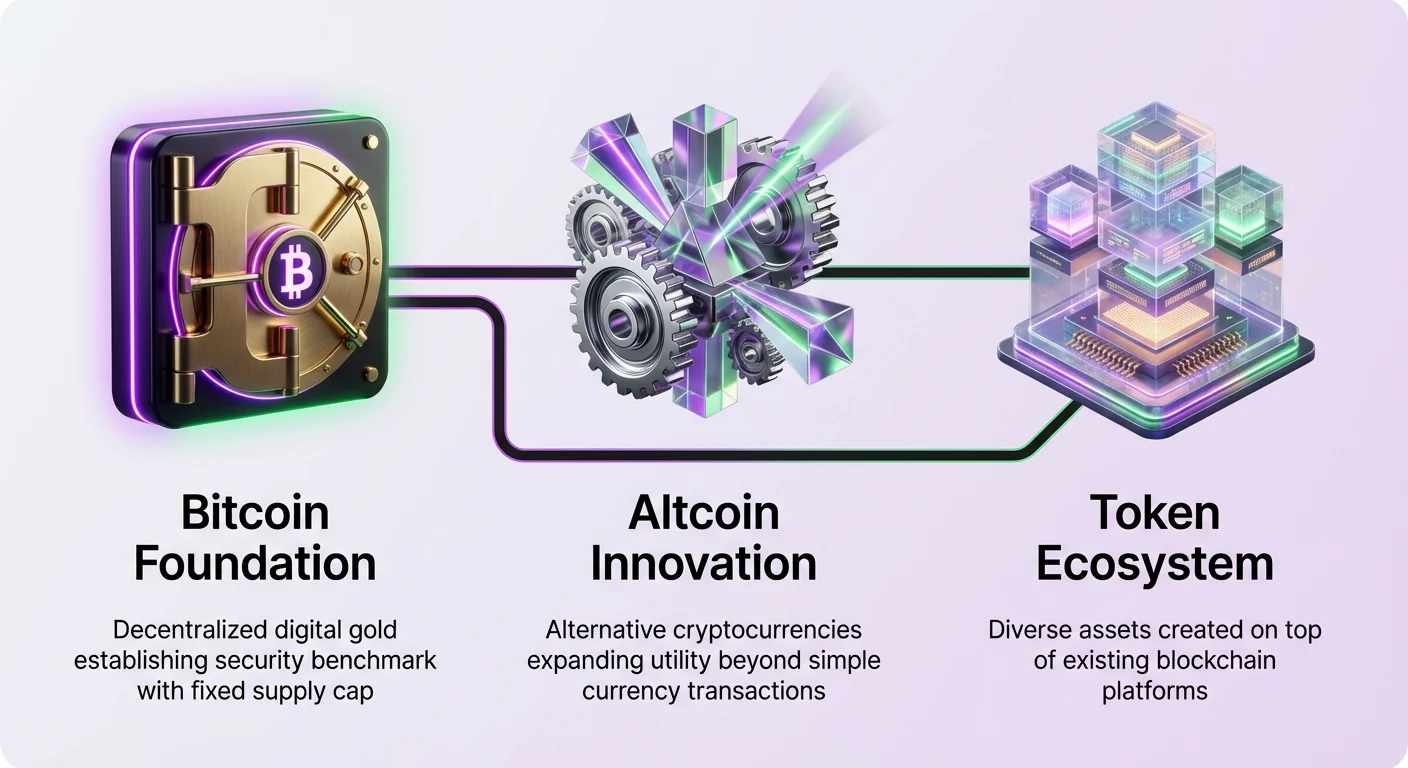
Bitcoin established the fundamental principles of the cryptocurrency industry. Its architecture was designed with specific goals that differentiate it from modern banking systems. It operates on a decentralized network, meaning no single entity controls it. This resistance to censorship and central points of failure has earned it a reputation as a secure store of value. Many investors view it as "digital gold" because it shares key characteristics with the precious metal, particularly regarding scarcity and durability.
The Mechanics of Scarcity
A defining feature of Bitcoin is its fixed supply cap. The protocol is hard-coded to ensure that only 21 million coins will ever exist. This finite supply stands in stark contrast to fiat currencies, such as the US dollar, which central banks can print in unlimited quantities. The predictable issuance rate of new coins, which decreases over time through a process called halving, creates a disinflationary pressure. This scarcity is the primary reason many institutional and retail investors treat Bitcoin as a hedge against inflation and economic instability.
Decentralization and Security Benchmark
Bitcoin utilizes a Proof-of-Work consensus mechanism to secure its network. Miners dedicate significant computing power to validate transactions and add blocks to the blockchain. This energy-intensive process makes the network incredibly difficult to attack or manipulate. Because the ledger is distributed across thousands of nodes worldwide, it offers a level of transparency and immutability that is unmatched in the sector. This security model has established Bitcoin as the benchmark for trust in the digital asset space. It prioritizes network integrity and security over transaction speed or flexibility.
The Expansion into Altcoins
The term "altcoin" simply refers to any cryptocurrency that is not Bitcoin. While the name implies a secondary status, these assets have evolved to fill gaps that Bitcoin was not designed to address. Bitcoin was built primarily to be a store of value and a medium of exchange. However, developers quickly realized that blockchain technology had limitations regarding speed, energy consumption, and programming capabilities. Altcoins emerged to solve these perceived problems and to introduce entirely new functionalities to the digital economy.
Some altcoins aim to simply be better money. They might offer faster transaction confirmation times or lower fees, making them more suitable for buying coffee than a high-value asset like Bitcoin. Others focus on privacy, utilizing advanced cryptography to obscure transaction details that are otherwise visible on public ledgers. However, the most significant evolution in the altcoin market came with the introduction of programmable blockchains. These platforms moved beyond simple value transfer to enable the creation of decentralized applications.
Distinguishing Coins from Tokens
One of the most important yet frequently misunderstood distinctions in the crypto space is the difference between a "coin" and a "token." While these terms are often used interchangeably in casual conversation, they represent distinct technical realities. A clear understanding of this difference is essential for evaluating the technical merit and independence of a project. The distinction lies primarily in the infrastructure that supports the asset.
Native Digital Currencies
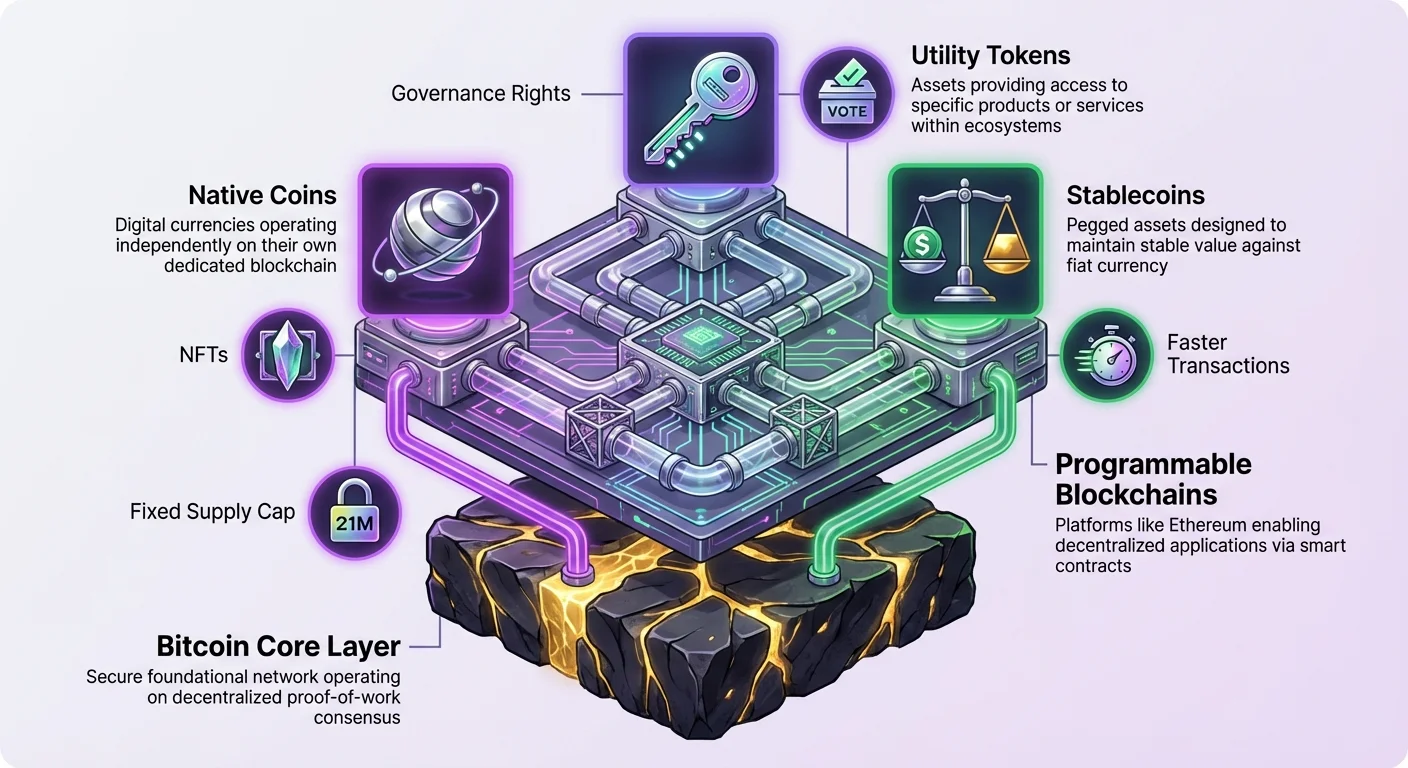
A coin is a cryptocurrency that operates on its own independent blockchain. Bitcoin is a coin because it runs on the Bitcoin blockchain. Similarly, Ether is a coin because it is the native currency of the Ethereum network. Coins are integral to the operation of their respective networks. They are typically used to pay for transaction fees, reward miners or validators for securing the network, and serve as the base unit of account within that system. They exist at the protocol level and are maintained by the network's consensus rules.
Assets Built on Existing Chains
In contrast, a token does not have its own blockchain. Instead, it is built on top of an existing blockchain platform using smart contracts. For example, countless assets exist on the Ethereum network as ERC-20 tokens. These assets rely on the host blockchain for security and transaction processing. Creating a token is generally much faster and less expensive than launching a new coin because developers do not need to build the underlying infrastructure or attract a network of validators to secure it.
Hybrid and Evolving Classifications
The line between coins and tokens can sometimes blur as projects evolve. There are instances where an asset starts as a token on one chain and later migrates to its own proprietary blockchain, effectively becoming a coin. Binance Coin is a prominent example of this transition. It launched as a token on the Ethereum network before moving to its own dedicated chain. Additionally, "wrapped" assets complicate the terminology. Wrapped Bitcoin, for instance, is a token on the Ethereum network that tracks the value of Bitcoin, allowing BTC holders to participate in Ethereum-based applications.
| Feature | Coin | Token |
|---|---|---|
| Infrastructure | Runs on its own native blockchain | Built on top of an existing blockchain |
| Creation | Protocol-level generation | Created via smart contracts |
| Primary Function | Network fees, security, currency | Utility, access, governance, asset representation |
Categories of Alternative Assets
The flexibility of token standards has led to an explosion of different asset types. Since developers can program specific rules into tokens, they can be customized for a wide variety of use cases beyond simple currency. This programmability is what allows the crypto ecosystem to disrupt industries ranging from finance to supply chain management. Understanding these categories helps investors navigate the diverse altcoin market.
Utility and Governance Models
Utility tokens are designed to provide access to a specific product or service within a blockchain ecosystem. They function somewhat like a digital coupon or an access key. For example, users might need a specific token to pay for decentralized cloud storage or to access premium features on a platform. Governance tokens take this a step further by conferring voting rights to holders. These tokens allow communities to collectively manage a project, voting on protocol upgrades, fee structures, and treasury allocations without a central authority.
Security and Asset Representation
Security tokens represent ownership of an external asset, much like a traditional stock or bond. These are often subject to strict regulatory requirements because they derive their value from an underlying business or asset rather than the utility of the network itself. In parallel, the market has seen the rise of Non-Fungible Tokens (NFTs). Unlike standard coins which are interchangeable, NFTs are unique digital items. They are frequently used to prove ownership of digital art, collectibles, or virtual real estate, creating a system of digital provenance that was previously impossible.
The Role of Stablecoins
Amidst the volatility of Bitcoin and other altcoins, stablecoins have carved out a critical niche. These assets are designed to maintain a stable value, typically pegged to a fiat currency like the US dollar or a commodity like gold. They serve as a bridge between the traditional financial system and the cryptocurrency economy. By holding a steady value, stablecoins allow traders to exit volatile positions without converting back to fiat currency, which can be slow and costly.
Stablecoins are also vital for the function of decentralized finance applications. They provide a reliable medium of exchange for lending, borrowing, and earning interest. While Bitcoin is often held for long-term appreciation, stablecoins are used for everyday transactions and remittances. They offer the speed and efficiency of blockchain transfers without the risk of the value changing during the transaction process. However, they do introduce different risks, such as the reliability of the entity holding the reserve assets backing the peg.
Technological Innovation Beyond Currency
While Bitcoin focused on secure money, the altcoin market has focused on extending blockchain utility. The introduction of smart contracts changed the trajectory of the industry. A smart contract is a self-executing contract with the terms of the agreement directly written into code. This innovation allows for trusted transactions and agreements to be carried out among disparate, anonymous parties without the need for a legal system, central authority, or external enforcement mechanism.
The Rise of Decentralized Finance
The application of smart contracts led to the creation of Decentralized Finance, or DeFi. This sector attempts to replicate traditional financial services—such as lending, borrowing, and trading—using autonomous computer code. In a DeFi system, a user does not need a bank to get a loan. Instead, they interact with a protocol that automatically matches them with a lender or a liquidity pool. Tokens play a central role here, acting as collateral, governance votes, or reward mechanisms for providing liquidity to the system.
Addressing Scalability and Speed
Another major driver of altcoin innovation is scalability. Bitcoin's design prioritizes security and decentralization, which results in a relatively low number of transactions per second. During times of high demand, the network can become congested. Many altcoins and competitive blockchains were built specifically to address this throughput issue. They utilize different consensus mechanisms, such as Proof-of-Stake, which require less energy and allow for faster block times. These high-speed networks aim to support consumer-grade applications that require thousands of transactions per second.
Investment Dynamics and Market Behavior
Investing in Bitcoin versus altcoins presents different risk profiles and potential rewards. Bitcoin is generally considered the most conservative investment within the crypto space. Its long track record, massive liquidity, and institutional adoption provide a level of stability that smaller assets lack. However, its large market capitalization means that the days of 100x returns in a short period are likely over. It behaves more like a mature asset class, moving with broader economic trends.
Volatility and Growth Potential
Altcoins, particularly those with smaller market capitalizations, offer the potential for explosive growth. A new project that successfully solves a niche problem or captures the public's imagination can see its value skyrocket in days. However, this potential comes with extreme volatility. Altcoins often experience price swings that are significantly more violent than Bitcoin. In a bear market, altcoins typically lose a much larger percentage of their value compared to the market leader, and many never recover their previous highs.
Liquidity and Market Cycles
Liquidity is another crucial factor differentiating these assets. Bitcoin can be bought and sold in massive quantities on virtually every exchange without significantly impacting the price. Smaller altcoins may suffer from low liquidity, making it difficult to enter or exit large positions quickly. Furthermore, the market often moves in cycles. Capital frequently flows into Bitcoin first, and as investors take profits, that capital rotates into large-cap altcoins and eventually into smaller, riskier tokens. Understanding these flows is essential for strategic investing.
Risks and Security Challenges
The diversity of the altcoin market brings with it an increase in specific risks. While the Bitcoin network has never been hacked, the same cannot be said for every project in the crypto space. The complexity of smart contracts introduces the risk of code vulnerabilities. If a developer makes a mistake in the code governing a token or a DeFi protocol, hackers can exploit that bug to drain funds. This technical risk is largely absent in holding simple Bitcoin.
Scams are also more prevalent in the altcoin sector. Because creating a token is relatively easy and cheap, malicious actors can launch projects with no intention of delivering a product. These "rug pulls" involve developers abandoning a project and taking investors' money. Additionally, the regulatory landscape for altcoins is far more uncertain than for Bitcoin. While Bitcoin is widely classified as a commodity, many tokens possess characteristics that may lead regulators to classify them as unregistered securities, creating legal compliance issues.
Conclusion
The cryptocurrency landscape has evolved from a single experiment in digital cash into a multi-faceted industry. Bitcoin retains its throne as the premier store of value, offering a decentralized alternative to traditional monetary systems. Its fixed supply and robust security model make it a unique asset class that prioritizes stability and trust. It serves as the foundational layer of the entire market, often dictating the broader trends of the industry.
However, the altcoin market has proven that there is demand for more than just digital gold. Through tokens and programmable blockchains, the industry is rebuilding financial services, art ownership, and organizational governance. While these assets carry higher risks and greater volatility, they drive the technological innovation of the sector. The interaction between the stability of Bitcoin and the experimentation of altcoins creates a dynamic ecosystem that continues to reshape the future of finance.
Diverse crypto assets offer distinct trade-offs between security, innovation, and potential returns for informed investors.