
Redefining the Modern Portfolio
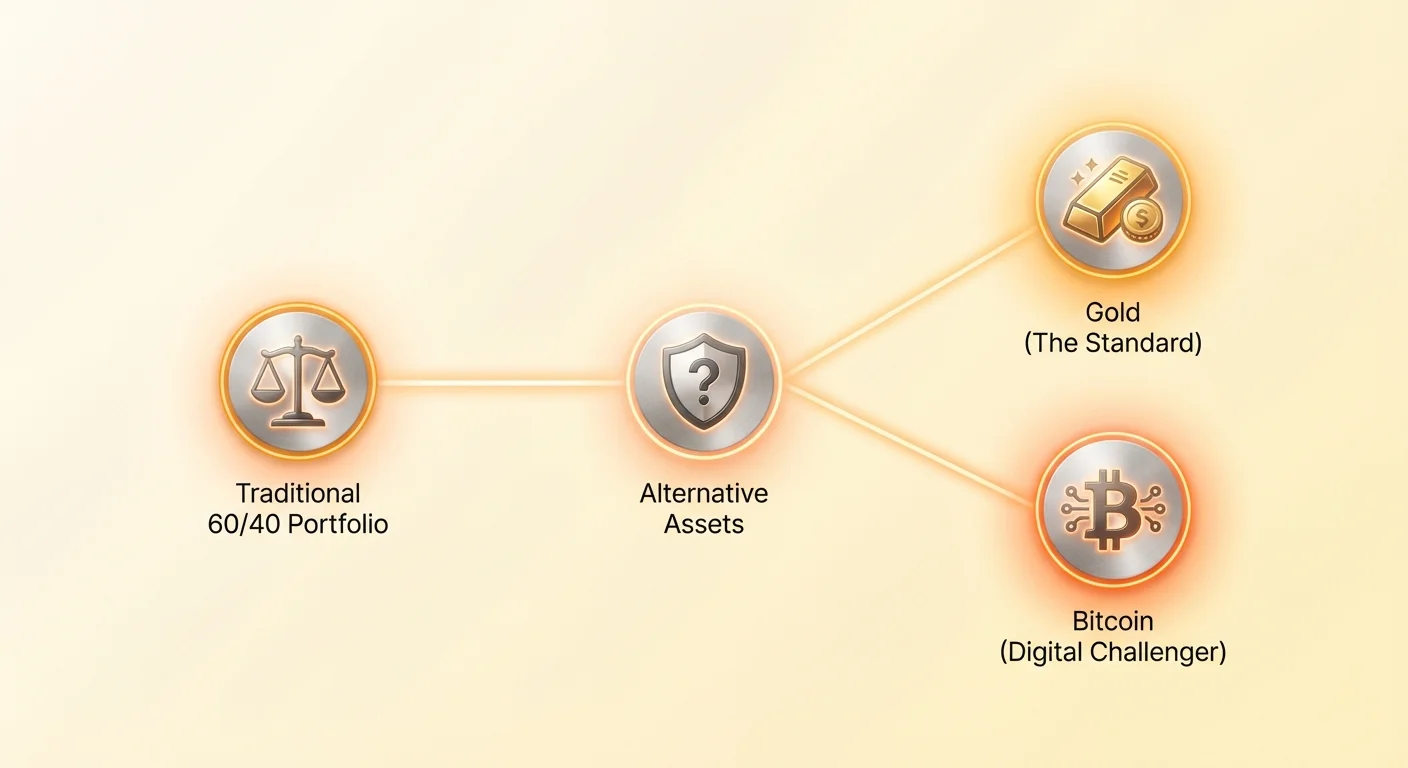
The traditional investment landscape has long relied on the 60/40 portfolio model. This strategy allocates sixty percent of capital to equities for growth and forty percent to bonds for stability and income. For decades, this balanced approach provided a reliable hedge against volatility. When stocks fell, bonds typically rose or held steady, smoothing out the equity curve. However, the economic environment has shifted dramatically in recent years.
Rising inflation rates and changing monetary policies have challenged the negative correlation between stocks and bonds. In certain market conditions, both asset classes have declined simultaneously, leaving investors without a safety net. This correlation breakdown has forced portfolio managers and individual investors to seek alternative assets that can provide true diversification. The search for non-correlated stores of value has led capital toward two primary contenders: gold, the ancient standard, and Bitcoin, the digital challenger.
Gold has served as the ultimate store of value for millennia. Its physical properties and historical track record make it a default safe haven during geopolitical turmoil or currency devaluation. Central banks hold it in reserve, and it acts as a recognized insurance policy against systemic financial failure. It is the incumbent heavy-weight in the commodities sector.
Bitcoin emerged in 2009 as a response to the vulnerabilities of the traditional financial system. Often described as "digital gold," it shares many of the precious metal's monetary properties but enhances them for the digital age. Bitcoin introduces a mathematically fixed supply and a decentralized network that operates without a central authority. As investors look to modernize the 40 percent defensive slice of their portfolios, the debate between allocating to gold or Bitcoin has moved to the forefront of asset management.
The Properties of Sound Money
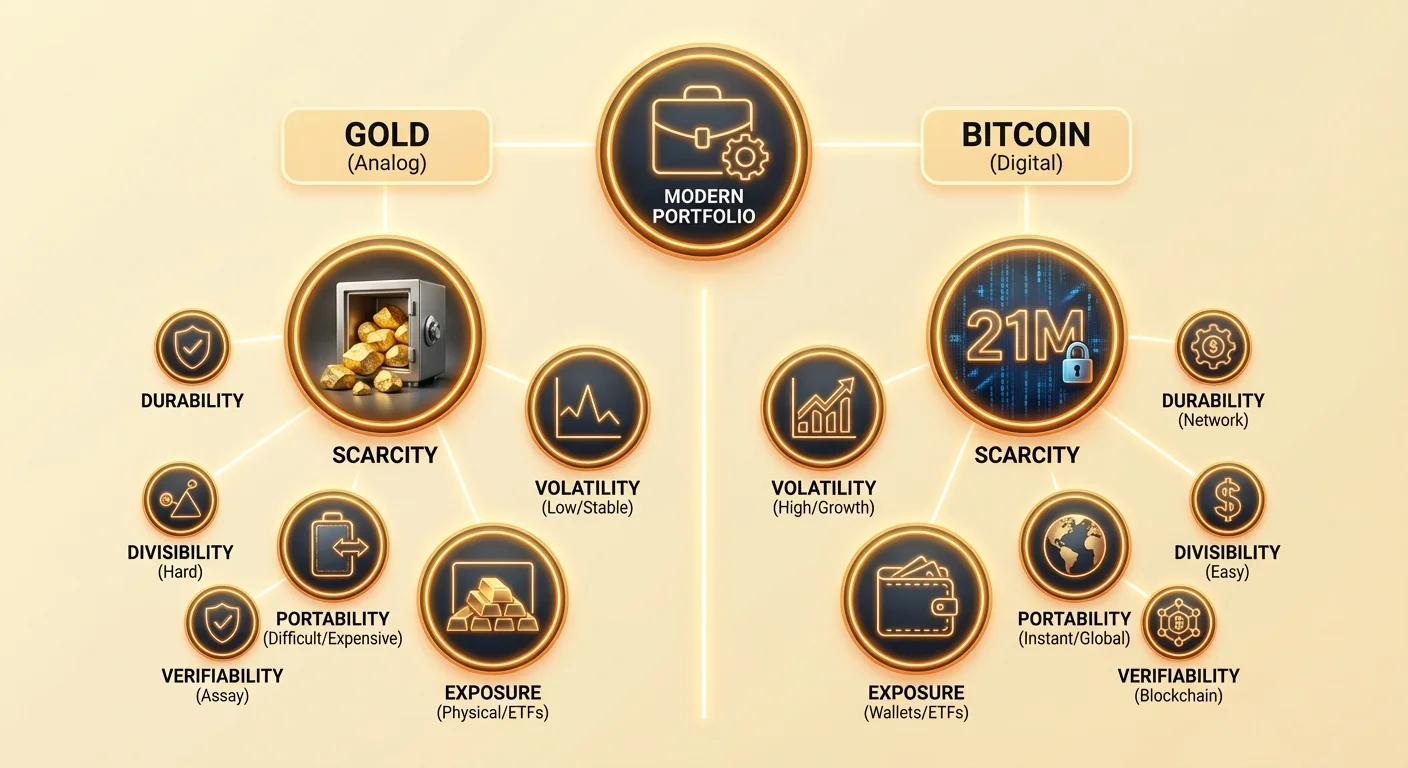
To understand why these assets are competing for the same capital, one must analyze the fundamental properties that define "sound money." A store of value must retain purchasing power over long time horizons. To achieve this, an asset needs specific characteristics: scarcity, durability, divisibility, portability, and verifiability. Both gold and Bitcoin possess these traits, but they achieve them through vastly different mechanisms.
Gold derives its value from physical scarcity and the difficulty of extraction. It is durable, resistant to corrosion, and historically proven. However, its physical nature creates limitations. Gold is heavy, expensive to transport securely, and difficult to divide into small units for daily transactions. Verifying the purity of gold requires specialized equipment and expertise, often necessitating trust in a third-party assayer.
Bitcoin replicates these monetary properties through code and cryptography. It exists only as data on a decentralized ledger. It is durable as long as the network exists, which is secured by globally distributed computing power. Its divisibility is superior to gold; a single Bitcoin can be split into 100 million satoshis, allowing for precise micro-transactions. Verification is instant and requires no trust in a counterparty, as the blockchain provides a transparent, immutable record of every transaction.
Scarcity and Supply Dynamics
The primary driver of value for both assets is scarcity. In an era where fiat currencies can be printed in unlimited quantities by central banks, assets with limited supplies become attractive hedges against debasement. The supply dynamics of gold and Bitcoin are distinct, with Bitcoin offering a level of predictability that gold cannot match.
Gold has a limited but unknown total supply. While we know how much has been mined, we do not know exactly how much remains in the earth or even on other planets. The supply of gold increases annually as mining companies extract more ore. Historically, this inflation rate hovers around one to two percent per year. Higher gold prices often incentivize more mining, which can eventually increase supply and dampen price appreciation.
Bitcoin operates on a strictly deterministic monetary policy. The protocol dictates that there will never be more than 21 million coins. New coins are issued through a process called mining, but the issuance rate is programmed to decrease over time. Approximately every four years, an event known as the "halving" cuts the reward for mining new blocks in half.
This mechanism ensures that Bitcoin's inflation rate steadily declines until it reaches zero. Currently, the inflation rate of Bitcoin is comparable to or lower than that of gold, and it will only decrease further. This absolute scarcity, unchangeable by any government or corporation, is the cornerstone of the bullish thesis for Bitcoin as a superior long-term store of value.
Comparative Analysis of Investment Attributes
When constructing a portfolio, investors must weigh the practical pros and cons of each asset. While they share a similar narrative purpose, their behavior in a portfolio can differ significantly. The choice often depends on an investor's risk tolerance, time horizon, and technical proficiency.
| Feature | Gold | Bitcoin |
|---|---|---|
| Supply | Limited but elastic | Fixed (21 Million) |
| Volatility | Low to Moderate | High |
| Portability | Difficult/Expensive | Instant/Global |
| Storage | Vault/Safe required | Digital Wallet |
| Yield | None (negative carry) | Potential via DeFi |
Volatility and Risk Profiles
Gold is prized for its relative stability. It is a mature asset class with deep liquidity and established market behavior. While it may not offer explosive growth, it generally preserves purchasing power and acts as a dampener on portfolio volatility. For risk-averse investors, gold provides peace of mind and protection against extreme market shocks without introducing wild price swings.
Bitcoin, conversely, is characterized by high volatility. Its price history is marked by dramatic boom and bust cycles. While the long-term trend has been upward, the asset frequently experiences significant drawdowns that can test the resolve of inexperienced investors. This volatility is a double-edged sword. It presents the opportunity for outsized returns that gold generally cannot offer, effectively acting as a "high-octane" version of a store of value.
For a 60/40 portfolio, adding a small allocation of a volatile non-correlated asset like Bitcoin can actually improve risk-adjusted returns. The key is sizing. Because Bitcoin is more volatile, a smaller position size is often required to achieve a similar impact to a larger gold position. Investors typically view Bitcoin as a growth-oriented store of value, whereas gold is viewed as a wealth preservation tool.
Accessibility and Liquidity
Buying and selling these assets has become increasingly accessible, yet the methods differ in efficiency. Gold markets are highly liquid but can be cumbersome for physical delivery. Investors can buy coins or bars, but they face premiums over the spot price and potential storage fees. Selling physical gold can also be inconvenient, requiring physical transport to a dealer and verification of authenticity.
Bitcoin trades 24 hours a day, 7 days a week, on a global network. It offers superior liquidity for immediate settlement. Investors can buy or sell any amount, from a few dollars to millions, instantly through exchanges or over-the-counter (OTC) desks. The ability to liquidate a position at any time, including weekends and holidays, gives Bitcoin a distinct advantage in terms of market access and capital mobility.
Mechanisms of Exposure and Custody
Modern financial infrastructure has evolved to provide multiple ways to gain exposure to both Bitcoin and gold. The method of ownership is a critical decision that impacts the security and utility of the investment. The rise of financial products has bridged the gap between traditional finance and these alternative assets.
The Role of Exchange-Traded Funds (ETFs)
For many traditional investors, ETFs represent the easiest path to allocation. Gold ETFs have been a staple of portfolios for years, allowing investors to track the price of the metal without the hassle of physical storage. These funds hold gold bars in secure vaults and issue shares representing ownership.
Bitcoin ETFs have recently emerged as a powerful bridge between the crypto ecosystem and institutional capital. Like gold ETFs, they allow investors to gain exposure to Bitcoin's price movements through standard brokerage accounts. This eliminates the technical barriers of managing cryptographic keys and wallets.
However, ETFs introduce counterparty risk. When investing in an ETF, you do not legally own the underlying Bitcoin or gold; you own a claim on a fund that owns the asset. This distinction is vital for purists who view these assets as insurance against financial system failure. In a catastrophic systemic collapse, ETF shares could potentially be frozen or inaccessible, whereas direct ownership remains in the control of the investor.
Direct Custody and Security
Direct ownership of gold involves physical possession. This requires a safe, a bank deposit box, or a secure vaulting service. The security model is physical: thick steel, alarms, and guards. The risk is theft or confiscation. History contains examples of governments confiscating private gold holdings during economic emergencies, highlighting a vulnerability of physical assets that cannot be easily hidden or moved.
Bitcoin introduces the concept of self-custody through digital wallets. A Bitcoin wallet stores the private keys necessary to access and spend funds on the blockchain. This allows individuals to be their own bank. Assets can be secured using hardware wallets, which are physical devices that keep keys offline, immune to computer viruses and online hackers.
For significant amounts of capital, investors can utilize multisig (multi-signature) wallets. This technology requires multiple approvals to authorize a transaction, similar to a digital vault requiring multiple keys to open. For example, a 2-of-3 multisig setup might require signatures from a hardware wallet at home, one in a bank vault, and one held by a trusted family member or custodian. This distribution of trust eliminates single points of failure and offers a level of security flexibility that physical gold cannot match.
Corporate Adoption and Treasuries
A major validation of Bitcoin as an asset class has been its adoption by public companies. Several forward-thinking corporations have added Bitcoin to their balance sheets as a treasury reserve asset. These companies view cash reserves as a liability in a high-inflation environment. By converting a portion of their treasury to Bitcoin, they aim to protect shareholder value against currency debasement.
This trend highlights a shift in corporate finance strategy. Traditionally, corporate treasuries held short-term government bonds or fiat currency. The inclusion of Bitcoin signals a belief in its long-term appreciation and its utility as a pristine collateral asset. While gold has also played a role in corporate reserves historically, Bitcoin's digital nature makes it easier for companies to manage, audit, and utilize for financial operations.
Market Participants and Liquidity Flows
Understanding the market dynamics of Bitcoin versus gold requires looking at the participants driving price action. Gold is dominated by central banks and large institutional holders. It is a massive, slow-moving market where price changes are generally gradual. The vast size of the gold market absorbs capital inflows with relatively small price impact.
Bitcoin's market cap, while substantial, is smaller than gold's. This allows for more dramatic price movements based on capital flows. The market is influenced by a mix of retail investors, institutional funds, and large holders known as "whales." Whales are individuals or entities that hold massive quantities of Bitcoin. Their buying and selling activities can significantly impact short-term price action, creating a unique market structure.
To navigate this, large investors often utilize Over-The-Counter (OTC) trading desks. OTC trading occurs directly between two parties, bypassing public exchange order books. This allows institutions to buy or sell hundreds of millions of dollars in Bitcoin without causing immediate price spikes or crashes. This sophisticated infrastructure mirrors the way large blocks of gold are traded, further legitimizing Bitcoin's status as a mature financial asset.
The Inflation Hedge Debate
The core argument for including either asset in a 60/40 portfolio is protection against inflation. Inflation erodes the purchasing power of the bond portion of a portfolio and can hurt equities if costs rise faster than revenue. Gold has a proven track record of keeping pace with inflation over decades and centuries. It is the reliable, slow-and-steady hedge.
Bitcoin is often touted as an inflation hedge due to its fixed supply. If the supply of fiat currency expands while the supply of Bitcoin remains fixed, the value of Bitcoin measured in fiat should theoretically rise. The data from the last decade supports this, with Bitcoin vastly outperforming inflation metrics. However, its shorter history means it is still establishing this reputation.
In periods of high inflation, Bitcoin has sometimes correlated with risk-on assets like tech stocks rather than acting purely as a safe haven. This suggests that while its mechanics are deflationary, the market still treats it partly as a technology investment. As the asset matures and adoption widens, many analysts expect it to decouple from equities and behave more like a true non-correlated store of value, similar to gold but with higher upside.
Strategic Portfolio Allocation
Integrating these assets into a framework requires a nuanced approach. It is rarely an "all or nothing" decision. A modern allocation framework often suggests holding both to capture their distinct benefits. Gold provides the ballast—the stability that lets investors sleep at night. Bitcoin provides the torque—the asymmetric upside potential that can significantly boost portfolio performance.
Rebalancing and Diversification
The volatility of Bitcoin requires active management through rebalancing. If Bitcoin doubles in price, its percentage of the portfolio grows, potentially exposing the investor to more risk than intended. Periodic rebalancing—selling some winners to buy underperforming assets—allows investors to lock in gains from Bitcoin's volatility while maintaining their target allocation.
For example, a modified portfolio might look like 55% equities, 35% bonds, 5% gold, and 5% Bitcoin. This allocation acknowledges the need for growth and stability while introducing alternative stores of value. The gold portion protects against deflation and severe market panic, while the Bitcoin portion protects against monetary debasement and offers exposure to the growth of the digital economy.
The Future of Money
Technology does not stand still, and money is a technology for storing and moving value. Gold was the peak technology for money in an analog world. It required physical security and trust in centralized vaults. Bitcoin represents the evolution of money for a digital, interconnected world. It allows value to be teleported globally without permission.
The digitization of gold is also underway. Tokenized gold—digital tokens backed by physical gold reserves—attempts to combine the stability of the metal with the transferability of crypto. This convergence suggests a future where the lines between these asset classes may blur. However, Bitcoin's lack of physical counterparty risk remains its unique value proposition. You cannot digitize a gold bar without trusting the person holding the bar. Bitcoin requires no such trust.
Conclusion
The evolution of the 60/40 portfolio is a necessary response to a changing economic reality. As correlations between stocks and bonds tighten, the need for alternative assets becomes undeniable. Gold and Bitcoin represent the two primary choices for hard money allocation, each serving a distinct role. Gold offers millennia of trust, stability, and a proven track record as a defensive asset. It is the foundation of safety. Bitcoin offers digital scarcity, portability, and unmatched growth potential. It is the offensive play on the future of value.
Investors do not need to choose one over the other exclusively. A diversified approach that leverages the stability of gold and the asymmetric upside of Bitcoin creates a robust defense against inflation and currency debasement. By understanding the unique properties, risks, and mechanics of each, investors can construct a portfolio resilient enough to withstand modern financial challenges. The combination of ancient stability and digital innovation offers a comprehensive framework for wealth preservation in the 21st century.
The most resilient portfolios of the future will likely hold both the analog security of the past and the digital scarcity of the future.