
The Ethereum network operates as a decentralized, shared global computer that requires a specific fuel to function. This fuel is Ether (ETH). Unlike traditional currencies or even Bitcoin, which primarily serves as a store of value or medium of exchange, ETH plays a dual role in its ecosystem. It functions as a peer-to-peer digital currency for payments, while simultaneously acting as the necessary resource to pay for computation. Every action performed on the network, from simple transfers to complex smart contract interactions, requires a fee paid in ETH.
This utility drives the economic engine of the platform. When users interact with decentralized applications (dApps) or financial protocols, they are not merely sending value; they are purchasing computational space. This creates a direct link between the usage of the network and the demand for the asset. As the ecosystem of applications grows to include decentralized finance (DeFi), games, and digital collectibles, the necessity for ETH increases accordingly.
The design of this economic model differentiates Ethereum from many other blockchain networks. While Bitcoin has a rigid, capped supply schedule engraved in its code from inception, Ethereum employs a more flexible monetary policy. This policy is governed by the community and adapts over time to ensure the network's security and sustainability. The issuance of new tokens and the removal of existing tokens from circulation are dynamic processes. These mechanics have evolved significantly since the network launched, transforming ETH into an asset with unique economic properties compared to its competitors.
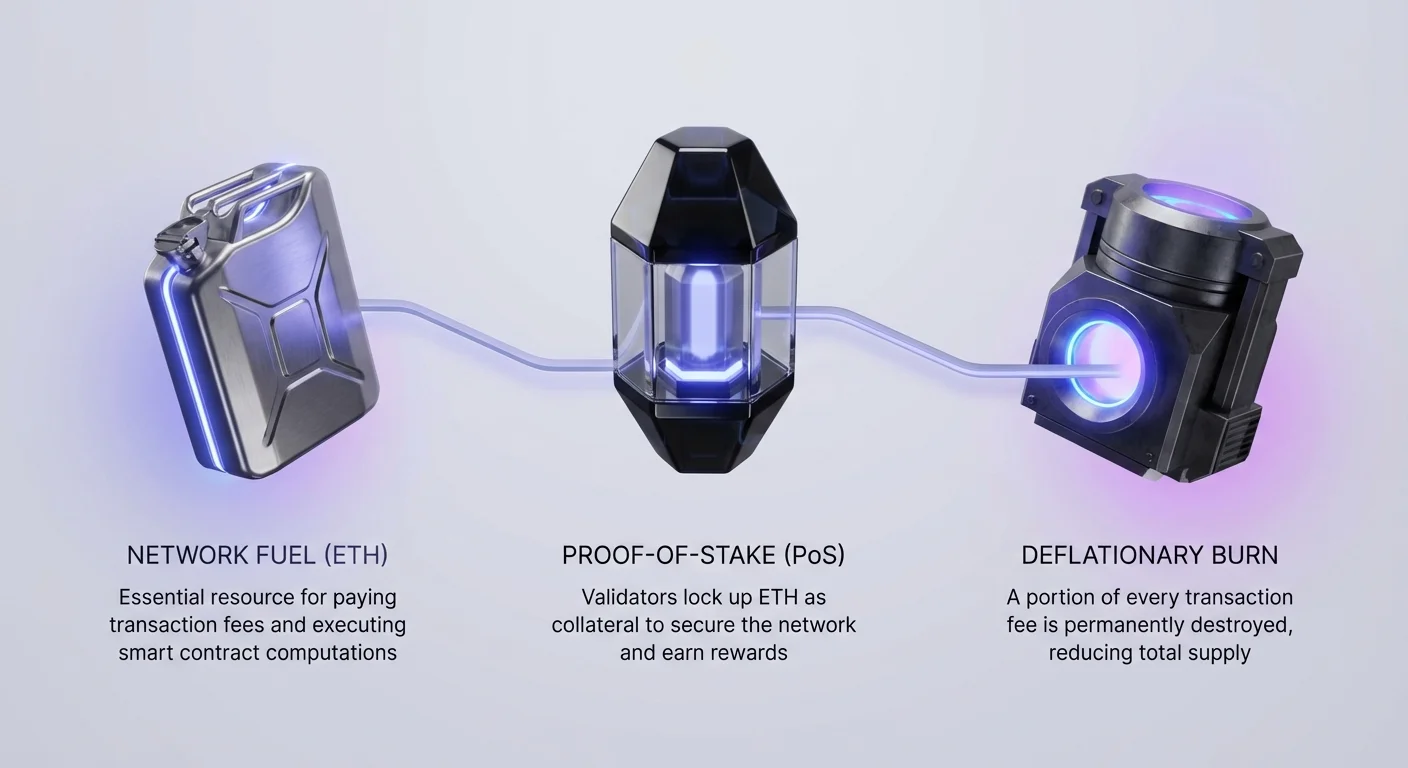
The Evolution of Monetary Policy
From Genesis to The Merge
Ethereum's supply schedule was not fixed at its launch in 2015. While Bitcoin established a hard cap of 21 million coins, Ethereum was designed without a predetermined upper limit on the total supply. Instead, the rate at which new ETH is issued is subject to change through decentralized governance processes and upgrades. Initially, the network operated under a Proof-of-Work consensus mechanism similar to Bitcoin. During this early phase, the block reward was set at 5 ETH per block, which added a significant amount of new supply roughly every 15 seconds.
As the network matured, the community implemented upgrades to reduce this inflation rate. The "Byzantium" upgrade in 2017 reduced the block reward to 3 ETH. Later, the "Constantinople" upgrade in 2019 further lowered it to 2 ETH. These reductions demonstrated the network's ability to adapt its issuance based on security needs rather than adhering to a static schedule.
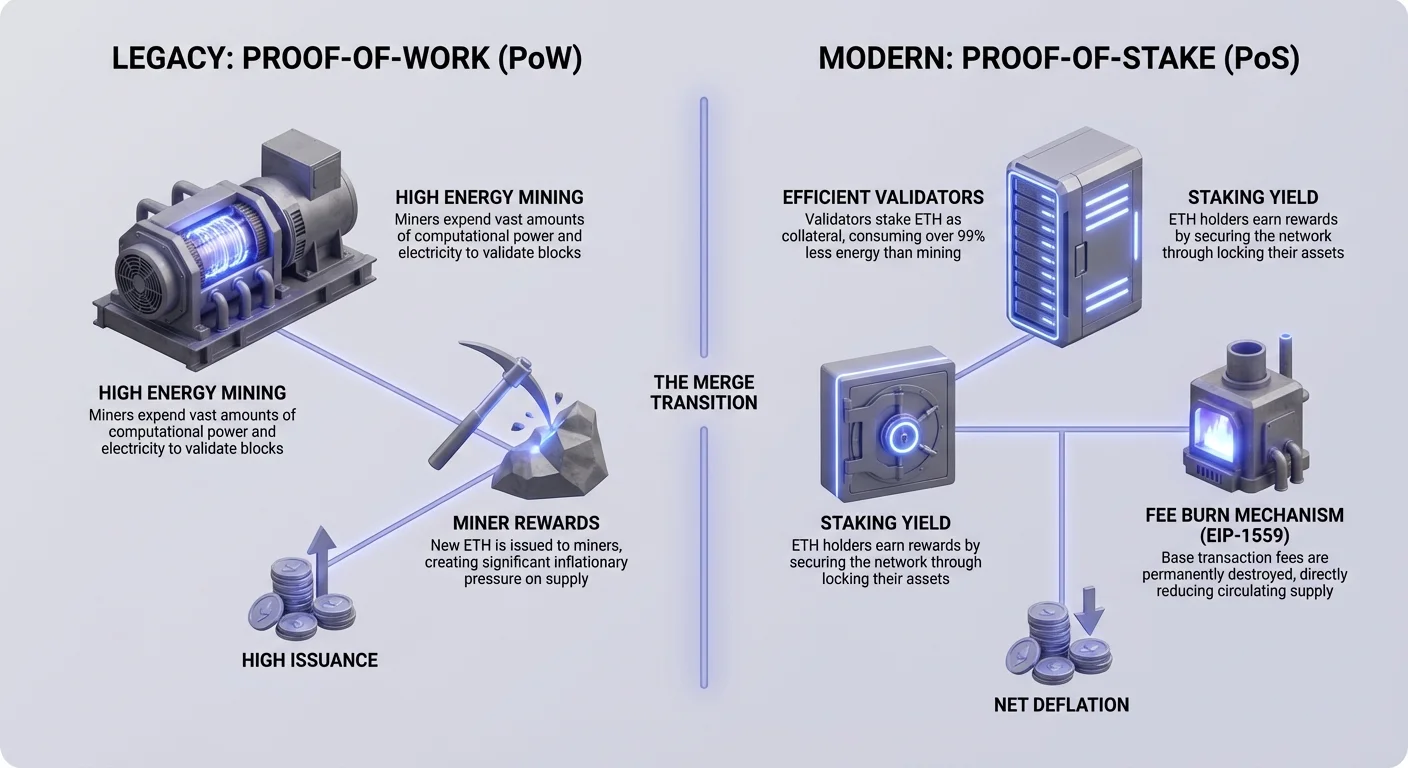
The most significant shift occurred in September 2022 with "The Merge." The network transitioned from Proof-of-Work to Proof-of-Stake, fundamentally altering the issuance model. Under the new system, the massive energy costs associated with mining were eliminated, allowing the network to reduce the issuance of new ETH by approximately 90%. This drastic reduction in the flow of new assets transformed the stock-to-flow ratio of Ethereum, making new supply significantly scarcer than in previous years.
The Deflationary Burn Mechanism
A critical component of Ethereum's modern economic structure is the "burn" mechanism introduced by Ethereum Improvement Proposal 1559 (EIP-1559). Before this upgrade, all transaction fees were paid to miners. EIP-1559 split the transaction fee into two parts: a base fee and a priority fee. The base fee is a mandatory charge required to include a transaction in a block, and crucially, this fee is destroyed (burned) rather than paid to validators.
This mechanism directly links network activity to the total supply of ETH. When the network is congested and demand for block space is high, the base fee increases. Consequently, more ETH is burned. During periods of intense activity, the amount of ETH destroyed can exceed the amount of new ETH created. This results in net deflation, where the total circulating supply of ETH actually decreases over time.
Comparatively, Bitcoin's inflation rate decreases roughly every four years through halving events but never turns negative. Ethereum's model allows for periods of supply contraction. Since the implementation of EIP-1559 in August 2021, millions of ETH have been permanently removed from circulation. This dynamic creates a unique economic pressure where increased utility and adoption directly reduce the available supply of the asset.
Governance and Adaptability
The governance of Ethereum's monetary policy differs significantly from the "code is law" immutability often associated with Bitcoin. While the lack of a hard cap might seem like a drawback to some, it provides the flexibility to ensure long-term network security. The issuance rate is minimal, just enough to incentivize validators to secure the blockchain.
Governance occurs through Ethereum Improvement Proposals (EIPs). These proposals are vetted, discussed, and approved by the community before implementation. This process allows the network to respond to technological advancements or economic necessities. For instance, if security needs change, the community can adjust staking rewards.
This adaptability ensures that the monetary policy serves the health of the network above all else. The shift to Proof-of-Stake and the introduction of fee burning were both results of this governance process. These changes have positioned ETH not just as a currency, but as a productive asset that yields rewards for staking and benefits from the systematic reduction of supply through network usage.
Transaction Fee Dynamics and Gas
Understanding Gas and Computational Effort
To process transactions, the Ethereum network uses a unit of measurement called "gas." Gas represents the computational effort required to execute a specific operation. Simple transfers require less gas, while complex smart contract interactions consume more. This system ensures that resources are allocated efficiently and prevents spam on the network.
Users must pay for this gas using ETH. The total fee for a transaction is calculated by multiplying the gas units used by the price per unit of gas. The price of gas is denominated in "gwei," which is a fractional unit of ETH (0.000000001 ETH).
| Component | Definition | Function |
|---|---|---|
| Gas Unit | Measure of computation | Determines complexity of the task |
| Base Fee | Mandatory network fee | Burned (removed from supply) |
| Priority Fee | Tip to validator | Incentivizes faster inclusion |
This structure creates a market for block space. Each block has a limit on the amount of gas it can contain (12.5 million units target). When many users want to transact simultaneously, they must pay a higher price per unit of gas to outbid others. This dynamic pricing ensures that the most urgent transactions are processed first, but it can leads to high costs during peak times.
Fee Customization and User Experience
Modern wallets allow users to customize the fees they pay based on their urgency. Users can typically choose between options like "Eco," "Fast," or "Fastest." An "Eco" setting sets a lower priority fee, meaning the transaction might wait in the memory pool until demand drops. A "Fastest" setting pays a higher tip to validators to ensure immediate inclusion in the next block.
The introduction of EIP-1559 improved the predictability of these fees. Previously, users had to guess the correct price in a "first-price auction" model, often overpaying to ensure success. Now, the base fee is algorithmically determined by the previous block's usage. If a block is more than 50% full, the base fee increases; if it is less than 50% full, it decreases.
This predictability benefits users by reducing the likelihood of stuck transactions or massive overpayments. However, the total cost is still subject to global demand. When the network is utilized heavily for NFT mints or high-frequency DeFi trading, the base fee can spike dramatically. This scalability constraint has driven the development of alternative solutions and competitors.
EVM Compatibility and Competitor Comparisons
The fee structure and "gas" concept pioneered by Ethereum have become the standard for many competing networks. Blockchains such as Avalanche, Polygon, and BNB Smart Chain utilize the Ethereum Virtual Machine (EVM). This means they support the same smart contracts and tooling as Ethereum, often including the same fee logic.
However, these competitors often optimize for higher throughput and lower fees. By processing more transactions per second, they keep the competition for block space lower, resulting in cheaper gas prices. For example, a transaction that might cost several dollars on Ethereum mainnet could cost cents on an EVM-compatible chain like Polygon.
Despite the cost difference, Ethereum remains the settlement layer of choice for high-value transactions due to its security and decentralization. Competitors often compromise on these aspects to achieve speed. The shared EVM standard allows users to manage assets across these different chains using the same wallet applications, creating a multi-chain ecosystem where users can choose between the security of Ethereum or the speed of its competitors.
Token Standards and Asset Interoperability
The ERC-20 Standard
A major driver of Ethereum's value is its ability to issue other digital assets. The ERC-20 standard defines a common set of rules for fungible tokens. Fungible means each token is identical to another, similar to how one dollar bill equals another. This standardization allowed for the explosion of the token economy, including stablecoins like USDC and USDT.
Before ERC-20, every token might require custom code to be stored or traded. The standard ensures that any ERC-20 token can interact seamlessly with any smart contract, decentralized exchange (DEX), or wallet that supports the Ethereum network. This interoperability is the foundation of the decentralized finance (DeFi) ecosystem.
The ease of deploying these tokens has led to thousands of unique assets living on Ethereum. From governance tokens that grant voting rights to utility tokens for specific applications, they all rely on the underlying network. Importantly, moving or trading any of these ERC-20 tokens requires paying fees in ETH. This ensures that the success of the token ecosystem directly accrues value to the native asset, ETH.
Wrapped Ether (WETH)
An interesting technical nuance exists regarding ETH itself. Because ETH was created before the ERC-20 standard was finalized, the native currency does not inherently follow ERC-20 rules. This creates a compatibility issue when trying to use ETH in decentralized applications designed solely for ERC-20 tokens.
To solve this, developers created Wrapped Ether (WETH). WETH is an ERC-20 token that represents ETH at a 1:1 ratio. Users can deposit ETH into a smart contract, which then mints an equivalent amount of WETH. The process is reversible: users can burn WETH to redeem their original ETH.
WETH acts as a bridge, allowing the native currency to function like any other token in the DeFi ecosystem. It enables ETH to be traded on decentralized exchanges and used in complex financial protocols without requiring custom code for the native asset. This workaround highlights the flexibility of smart contracts to solve infrastructure challenges.
Adoption Across the Ecosystem
The ERC-20 standard has been so successful that it has been adopted by almost all EVM-compatible networks. Chains like BNB Smart Chain and Avalanche use standards that mirror ERC-20, allowing developers to easily port applications between networks. This creates a competitive but interconnected landscape.
While other chains offer lower fees for transferring these tokens, Ethereum retains the largest liquidity and the most robust ecosystem of assets. The dominance of the ERC-20 standard reinforces Ethereum's position as the primary layer for digital asset issuance. Even when tokens are bridged to other networks, their primary value and settlement often remain anchored to Ethereum.
Stablecoins represent a massive portion of this utility. Tokens like USDT exist on Ethereum as ERC-20s, allowing users to hold US dollar value on the blockchain. While USDT also exists on other chains to reduce transfer costs, the immense volume of stablecoins on Ethereum drives significant demand for block space and gas fees.
Staking and Network Security
The Proof-of-Stake Model
The transition to Ethereum 2.0 marked a fundamental shift in how the network is secured. In the previous Proof-of-Work system, security was provided by miners expending energy. In the current Proof-of-Stake (PoS) model, security is provided by validators who lock up (stake) ETH.
Validators propose and validate blocks of transactions. To participate, a user must stake ETH as collateral. If a validator acts maliciously or fails to maintain uptime, a portion of their stake can be penalized or "slashed." This economic disincentive ensures that validators act in the best interest of the network.
Staking fundamentally changes the nature of ETH as an asset. Holders can now earn a yield on their holdings by contributing to network security. This reward comes from two sources: the issuance of new ETH and the priority fees (tips) paid by users. This yield-bearing property makes ETH attractive to investors looking for passive income.
Comparison with Other Consensus Models
Many competitors in the Layer 1 space also utilize Proof-of-Stake or variations of it, such as Delegated Proof-of-Stake (DPoS). In these systems, the core economic loop is similar: stake the native asset to secure the network and earn rewards. However, Ethereum's ecosystem is distinct due to the volume of fees generated.
Because Ethereum processes high-value transactions and hosts a vast DeFi economy, the priority fees paid to validators can be substantial. On networks with negligible fees, staking rewards rely almost entirely on the inflation of the native token supply. Ethereum's ability to generate real yield from user fees reduces the reliance on inflation to pay for security.
Furthermore, the sheer value of ETH staked provides a massive economic wall against attacks. To compromise the network, an attacker would need to acquire a majority of the staked ETH, a feat that becomes increasingly expensive as the value of the asset and the participation rate grow. This high level of economic security appeals to institutional investors and high-value applications.
Scaling Solutions and Future Economics
Layer 2 Rollups
As demand for Ethereum grew, gas fees became prohibitively expensive for average users. This led to the development of Layer 2 scaling solutions. These technologies, such as rollups, process transactions off the main Ethereum chain (Layer 1) while inheriting its security.
Layer 2s bundle hundreds of transactions together and submit only a summary of the data to the main Ethereum blockchain. This significantly reduces the cost per transaction. Users can interact with dApps, trade, and send payments on Layer 2 networks for a fraction of the cost of using the mainnet.
Crucially, Layer 2s still rely on ETH. They pay gas fees to the mainnet to settle their batches of transactions. Additionally, transactions within the Layer 2 environment typically use ETH for their own internal fees. This structure ensures that even as activity moves to cheaper layers, the economic link to the main chain remains intact.
Throughput and Efficiency
The roadmap for Ethereum focuses heavily on supporting these scaling solutions. Future upgrades aim to introduce mechanisms like "sharding" or specific data availability improvements to lower the cost of data storage for rollups. This would effectively increase the transaction throughput of the entire ecosystem.
Competitors often achieve high throughput by utilizing larger blocks or more centralized validator sets at the base layer. Ethereum's approach prioritizes keeping the base layer decentralized and secure, while pushing high-volume activity to Layer 2s. This modular approach attempts to solve the "blockchain trilemma" of achieving security, decentralization, and scalability simultaneously.
As these solutions mature, the monetary policy will continue to be influenced by the efficiency of the network. Lower fees on Layer 2 could drive massive adoption, leading to a higher volume of total transactions. Even if individual fees are low, the aggregate volume settled on the main chain contributes to the burn mechanism, maintaining the deflationary pressure on the asset.
Conclusion
Ethereum has established a complex and robust economic model that distinguishes it from both Bitcoin and general-purpose smart contract competitors. By transitioning to Proof-of-Stake and implementing the EIP-1559 fee burn mechanism, the network has linked its security and asset scarcity directly to the demand for its utility. As users interact with dApps, trade NFTs, or utilize DeFi protocols, they consume the fuel of the network, reducing the available supply and creating deflationary pressure.
The flexibility of Ethereum's governance allows it to adapt to changing technological landscapes, ensuring long-term sustainability. While competitors may offer lower fees through different trade-offs in centralization or throughput, Ethereum's layered approach preserves base-layer security while enabling scalability through Layer 2 solutions. This architecture positions ETH not just as a currency, but as a foundational collateral and yield-bearing asset for the decentralized web.
The combination of staking rewards and fee burning turns network usage into value for all holders.