
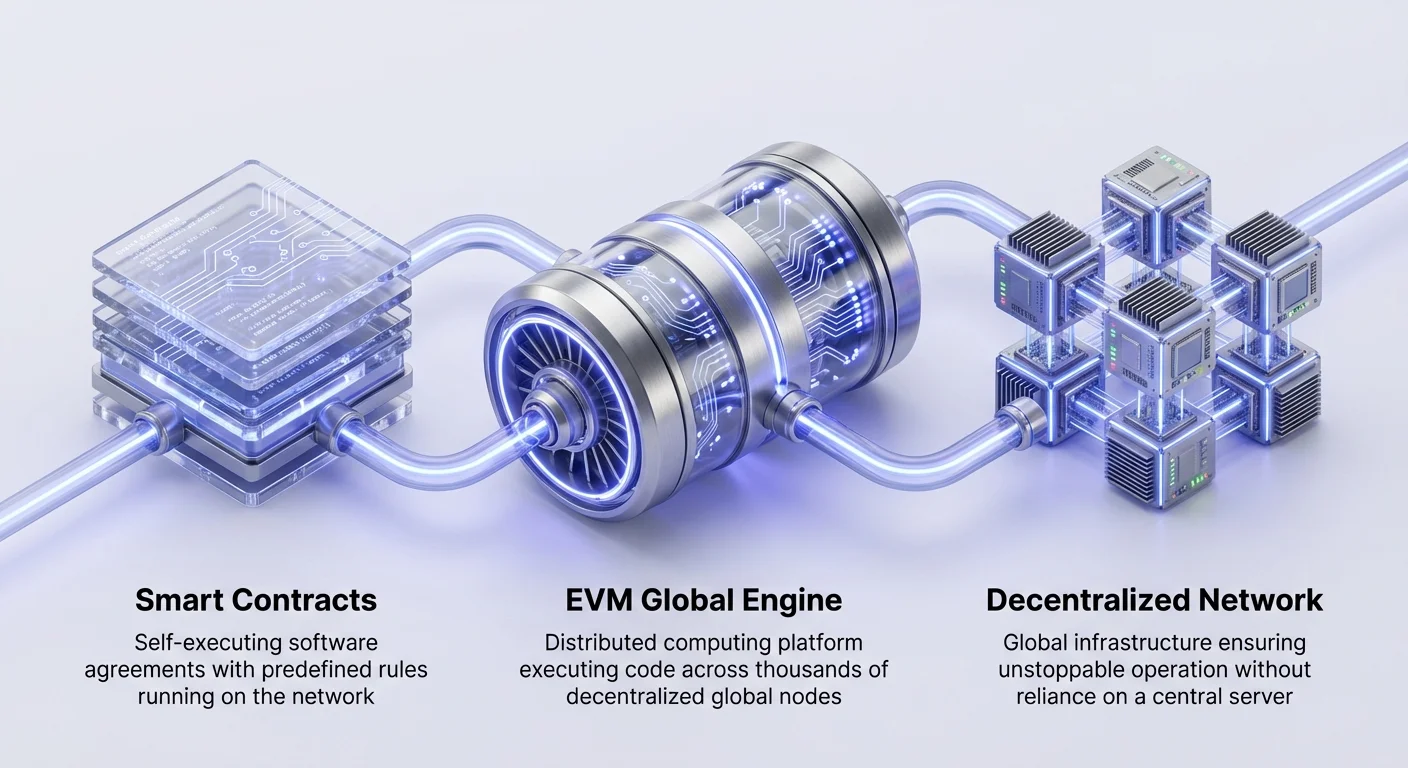
Ethereum is often described not merely as a cryptocurrency network, but as a global computer. While Bitcoin introduced the concept of a decentralized ledger for tracking value, Ethereum expanded this vision to include a decentralized platform for general computing. At the heart of this innovation lies the Ethereum Virtual Machine (EVM). This powerful engine is responsible for defining the rules of the network and executing the code that powers decentralized applications. It serves as the runtime environment for smart contracts, translating human-readable code into machine instructions that the network can process and verify.
The EVM is the component that differentiates Ethereum from a simple payment network. It transforms the blockchain into a programmable infrastructure where developers can build complex systems without central oversight. Unlike a physical computer that sits on a desk, the EVM is a virtual entity. It exists simultaneously on thousands of computers, or nodes, around the world. This distributed nature ensures that the system is not reliant on a single server or company. If one node fails, the network continues to operate without interruption, maintaining the durability and persistence of the data it holds.
The Virtual Machine Architecture
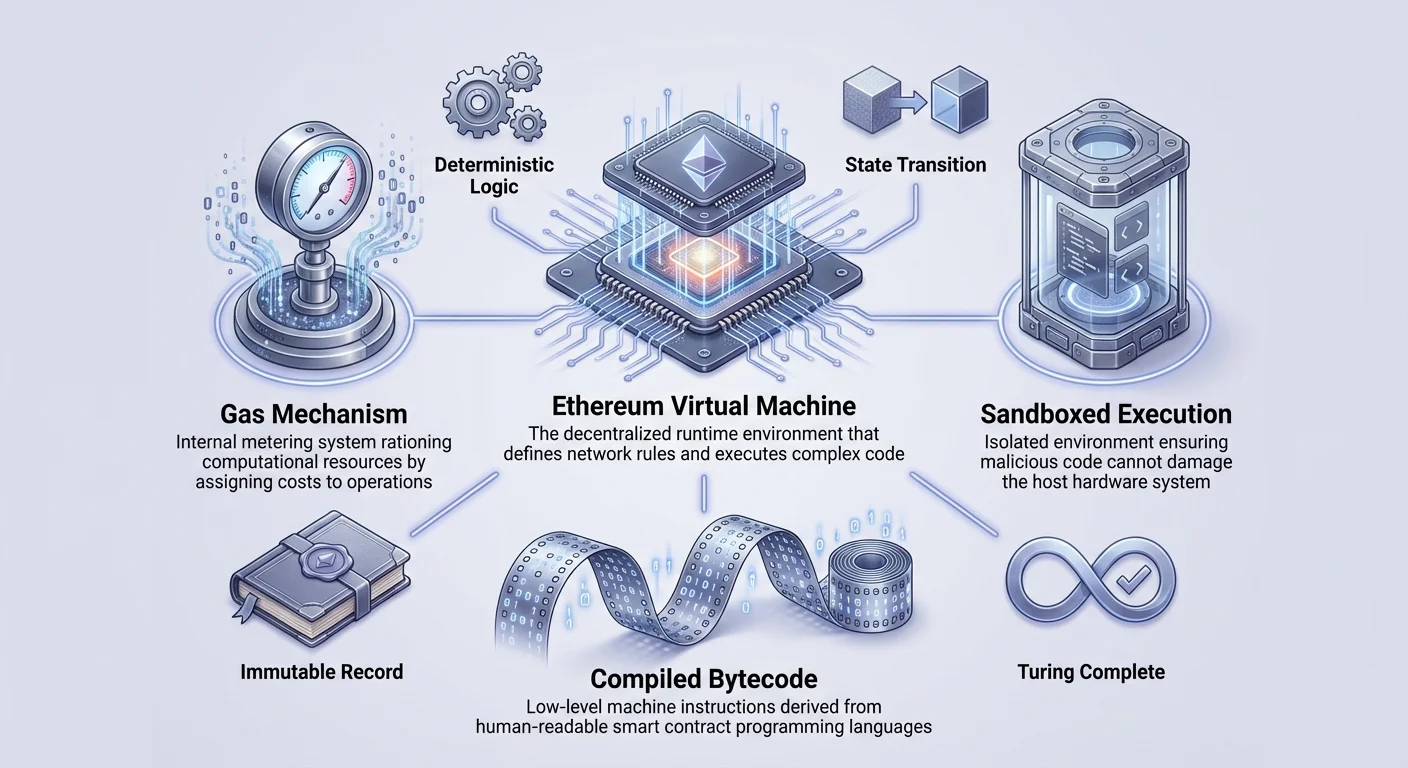
The architecture of the EVM is designed to be a "sandboxed" environment. This is a critical security feature for a decentralized network. When code runs inside the EVM, it is completely isolated from the rest of the host computer's system. The smart contract cannot access the file system, network, or other processes on the node running it. This isolation ensures that even if a malicious programmer deploys harmful code, it cannot damage the underlying hardware or the broader network infrastructure. The sandbox creates a safe boundary where untrusted code can be executed by strangers without risk to the validator.
This virtual machine is also "Turing-complete." In computer science terms, this means that the EVM can theoretically execute any mathematical computation or computer program, provided it has enough resources. This capability sets it apart from the more limited scripting languages used in earlier blockchains like Bitcoin. While Bitcoin’s language was intentionally restricted to simple logic for security reasons, Ethereum’s design embraces complexity. It allows for loops, complex logic gates, and sophisticated algorithms. This flexibility is what enables the vast ecosystem of applications we see today, from financial protocols to gaming logic.
Interpreting Bytecode and Instructions
The EVM does not understand high-level programming languages directly. Developers typically write smart contracts in languages like Solidity, which are designed to be readable by humans. However, the machine requires a more fundamental set of instructions. Before a smart contract is deployed to the network, it must be compiled into "bytecode." Bytecode is a low-level machine language consisting of a sequence of instructions that the EVM interprets efficiently.
When a smart contract is deployed, this bytecode is stored on the blockchain at a specific address. It becomes part of the network's permanent record. To interact with the contract, a user or another contract sends a transaction to that address. This transaction triggers the EVM to wake up, locate the bytecode associated with that address, and begin executing the instructions one by one. The machine moves through the code, performing calculations, storing data, or sending tokens as dictated by the logic pre-defined in the compiled bytecode.
The Mechanism of Smart Contracts
Smart contracts are the software programs that run on top of the EVM execution layer. They act as self-executing agreements where the terms are directly written into the code. Once deployed, these contracts are immutable, meaning their code cannot be altered. This immutability is derived from the underlying blockchain technology. Once the network agrees on the state of the computer and records the contract, it becomes a permanent fixture of the system. This provides a high degree of assurance to users that the rules of the game will not change mid-interaction.
These programs allow for "trustless" interactions. In traditional computing, you often have to trust a server administrator or a company to run code honestly. In the EVM model, the validity of the execution can be verified by anyone on the network. You do not need to trust the other party in a transaction or a middleman. You only need to trust the code itself and the public consensus of the network. This removal of intermediaries is a primary driver for the adoption of decentralized applications in finance and supply chain management.
Automated Execution and Logic
The execution of a smart contract acts like a digital "if-then" statement. The logic is deterministic, meaning that given the same input, the EVM will always produce the exact same output. For example, a contract could be programmed to hold funds until a specific date. If a user tries to withdraw before that date, the EVM checks the condition, sees it is not met, and rejects the transaction. If the date has passed, the "if" condition is satisfied, and the "then" action triggers the release of funds.
This automation eliminates the need for manual intervention. In a traditional setting, a lawyer or bank officer might verify dates and signatures before releasing funds. On Ethereum, the EVM acts as the impartial judge. It blindly follows the bytecode instructions without bias or emotion. This neutrality ensures that all participants are treated exactly according to the rules defined in the contract, regardless of their identity or status outside the network.
Transparency in Code and State
Transparency is another defining characteristic of the EVM execution layer. Because the bytecode is stored on a public ledger, anyone can inspect the program logic. While reading raw bytecode is difficult, source code is often verified and published, allowing users to audit the application before using it. This contrasts sharply with the "Web 2.0" model, where server-side code is a black box hidden from users. On Ethereum, the internal logic of a lending protocol or a game is open for public scrutiny.
Furthermore, the history of every application is fully transparent. The EVM tracks the state of every contract, including its current balance and internal data storage. Anyone can trace the history of interactions with a specific contract from its inception to the present moment. This auditability builds a culture of accountability. If a contract holds collateral for a loan, the exact amount and the specific digital assets held are visible to the entire world, verifiable on the blockchain without requesting permission from a bank.
Gas Metering and Resource Management
One of the most critical components of the EVM execution layer is the concept of "gas". Because the EVM is a shared resource distributed across thousands of computers, there must be a mechanism to ration computing power. Without a cost associated with execution, a malicious user could deploy a program with an infinite loop that runs forever, clogging up the entire network and preventing anyone else from using it. Gas solves this problem by assigning a cost to every operation.
Gas is a unit of measurement that represents the computational effort required to execute a specific instruction. Simple operations, like adding two numbers, cost a small amount of gas. Complex operations, like storing data permanently on the blockchain or verifying a cryptographic signature, cost significantly more. When a user initiates a transaction, they must pay for the gas required to execute their request. This payment is made in Ether (ETH), the native cryptocurrency of the network.
The Economics of Execution
The gas system creates an internal market for computing resources. Users submit a gas fee along with their transaction, effectively bidding for block space. Miners or validators, who operate the nodes running the EVM, prioritize transactions with higher fees. This economic design prevents spam attacks because attacking the network becomes prohibitively expensive. An attacker wishing to clog the network would have to pay real money for every second of computing time they consume.
This metering system also enforces efficiency. Developers are incentivized to write optimized code because inefficient code costs more to run. If a smart contract is poorly written and requires unnecessary calculation steps, users will have to pay higher gas fees to interact with it. Over time, market forces push developers toward creating lean, efficient bytecode that accomplishes tasks with the minimum amount of computational effort possible.
Limits and Network Protection
The EVM imposes a limit on the amount of gas that can be used in a single block. This block gas limit ensures that nodes can process blocks within a reasonable timeframe, keeping the network synchronized. If a transaction requires more gas than the maximum allowed, it will fail. This hard cap on execution prevents the network from stalling due to overly heavy computational loads. It ensures that the global computer remains responsive and that new blocks are produced at regular intervals.
Additionally, if a user sends a transaction but does not provide enough gas to cover the full execution of the code, the EVM will run the code until the gas runs out. At that point, the machine halts execution and reverts any changes made to the state. The user still pays the fee for the work done up to that point, but the transaction is effectively cancelled. This protects the validators, who performed the work, while ensuring that partial or failed computations do not corrupt the state of the ledger.
Transaction Execution and State Transitions
The EVM can be thought of as a state machine. At any given moment, the Ethereum network has a specific "state." This state includes the current balances of all accounts, the code of all smart contracts, and the internal storage of those contracts. When a transaction is executed, the EVM moves the network from one state to the next. This transition is strictly defined by the rules of the protocol and the logic of the bytecode being executed.
When a transaction is initiated, the EVM validates the signature to ensure it comes from the legitimate owner of the account. It then checks that the sender has enough ETH to cover the transaction value and the maximum gas fee. Once these checks pass, the EVM begins executing the operations in the transaction. This might involve transferring ETH from one account to another, which updates the balance entries in the state. Or, it might involve interacting with a smart contract, which updates the internal storage of that contract.
The finality of this execution is guaranteed by the consensus mechanism. Once a block of transactions is verified and added to the blockchain, the state transition is confirmed. Because the history of the blockchain is immutable, the record of this execution cannot be erased. The state change becomes permanent, serving as an undeniable proof that the transaction occurred and the code executed exactly as programmed.
| Component | Function | Benefit |
|---|---|---|
| Bytecode | Machine instructions | Efficient machine reading |
| Gas | Measures effort | Prevents spam loops |
| Sandbox | Isolates code | Protects node security |
EVM Compatibility and Ecosystem Expansion
The design of the Ethereum Virtual Machine has proven to be so robust that it has become a standard across the broader blockchain industry. Many competing networks have adopted the EVM architecture to ensure compatibility with the massive ecosystem of tools and applications built for Ethereum. Chains like BNB Smart Chain, Polygon, and Avalanche are "EVM-compatible," meaning they can run the exact same bytecode as Ethereum.
This compatibility is a strategic advantage. Developers who learn to write smart contracts for Ethereum can easily deploy their applications to these other networks without rewriting their code. They can use the same development tools, testing frameworks, and documentation. For users, this means that the interface and behavior of applications remain consistent across different blockchains. A decentralized exchange or a wallet that works on Ethereum can often support these other networks with minimal changes.
Scaling Through Layer 2 Solutions
The limitations of the main Ethereum network, particularly regarding transaction speed and cost, have led to the development of Layer 2 scaling solutions. Technologies like Optimism and Arbitrum use the EVM standard to process transactions off the main chain. They execute the computation in a compatible environment but then settle the final results back on Ethereum. This approach increases the total throughput of the ecosystem while relying on the security of the main network.
These Layer 2 solutions often use "rollups," which bundle many transactions together into a single batch. The EVM on the main chain only needs to verify the proof of this batch rather than executing every single transaction individually. This significantly reduces the gas cost for users. It demonstrates the flexibility of the EVM model, showing that it can serve not just as a direct execution engine, but also as a settlement layer for external computation environments.
The Evolution of the Standard
The EVM is not a static technology. It continues to evolve through a process of community consensus and upgrades. Proposals for improvements are debated and implemented to make the machine more efficient, secure, and capable. The transition to Proof-of-Stake with Ethereum 2.0 was a major milestone that altered the consensus mechanism securing the EVM, although the execution layer itself remained largely consistent to ensure backward compatibility.
Future upgrades aim to address lingering challenges such as state bloat and the complexity of verifiability. Concepts like "sharding" are being explored to allow the network to process multiple transactions in parallel, rather than sequentially. This would effectively split the EVM into multiple coordinated instances, vastly increasing its capacity. As these technologies mature, the EVM is solidifying its position as the standard operating system for the decentralized web.
Conclusion
The Ethereum Virtual Machine represents a fundamental shift in how we think about digital infrastructure. By decoupling computing power from centralized servers and distributing it across a global network of nodes, the EVM creates a platform that is open, transparent, and resistant to censorship. It transforms the passive storage of a ledger into an active engine capable of running complex logic and managing digital agreements without intermediaries. Through the use of bytecode, strict gas metering, and sandboxed execution, the system ensures that this shared computer remains secure and operational even in a trustless environment.
The influence of the EVM extends far beyond the Ethereum network itself. Its adoption as an industry standard by numerous other blockchains and scaling solutions highlights the resilience and utility of its design. Whether powering decentralized finance protocols, managing digital identities, or enabling new forms of digital art ownership, the EVM provides the reliable execution layer necessary for Web3. As the technology continues to scale and evolve, it promises to further democratize access to financial and computing resources on a global scale.
The EVM is the invisible engine ensuring that digital agreements are executed fairly, transparently, and without the need for human trust.