
Ethereum is frequently described in the blockchain industry as the "world's computer." This analogy serves as a powerful introduction to understanding how the network functions differently from its predecessors. While Bitcoin introduced the concept of decentralized digital money, Ethereum expanded this vision to create a shared, programmable platform. It is not merely a ledger that tracks currency movements between accounts.
Instead, it functions as a vast, distributed state machine. This machine is capable of running complex applications and executing arbitrary code without reliance on a central server. The network does not exist in a single location. It is maintained by thousands of computers around the globe, all working in unison to agree on the current status of the system.
This shared infrastructure represents a fundamental shift in how digital services are built and maintained. In traditional computing, a central entity controls the server, the database, and the rules of engagement. Users must trust that this entity is honest, secure, and operational.
On this decentralized platform, trust is placed in the code and the consensus of the network participants. The "state" of the computer—which includes account balances, smart contract code, and storage—is updated with every new block of transactions. This creates a transparent, immutable record that anyone can verify but no single person can alter unilaterally.
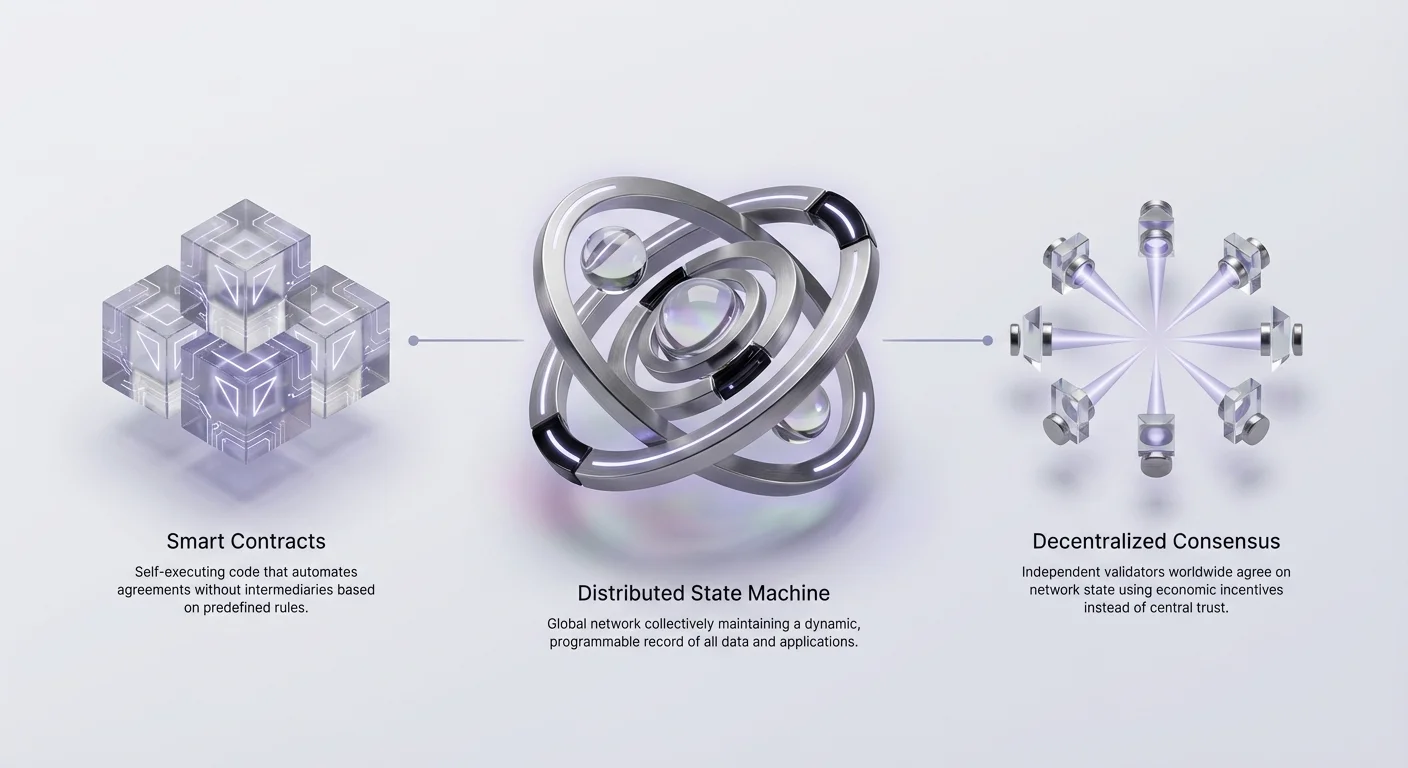
The Concept of a Distributed State Machine
To understand how this network operates, one must grasp the concept of a state machine. In computer science, a system's "state" refers to the information stored in the computer at a specific moment. This includes who owns what tokens, which smart contracts are deployed, and the current data stored within those contracts.
Defining the Global State
The global state is the collective memory of the network. It is not static; it changes continuously based on interactions. When a user sends a transaction or interacts with an application, they are essentially requesting a state transition. They are asking the network to move from the current state to a new one.
For example, if a user sends tokens to another address, the state must update to reflect the lower balance of the sender and the higher balance of the receiver. This transition is processed according to specific rules defined by the protocol. If the transaction violates these rules, such as trying to spend more tokens than exist in the account, the state transition is rejected.
Immutability and Permanent Records
Once the network agrees on a state transition and records it in a block, it becomes immutable. This means the history of the shared computer cannot be rewritten. Immutability gives participants a high degree of assurance that fraud is not being committed.
There is no administrator who can revert a transaction or edit the database to favor a specific user. This permanence extends to the history of applications as well. Anyone can audit the entire lifecycle of a lending protocol or a digital asset, tracing it back to its inception. This transparency stands in stark contrast to legacy systems where data processing often occurs inside "black boxes" with hidden algorithms.
Turing Completeness
A defining characteristic of this distributed machine is that it is "Turing complete." This term implies that the system is capable of running any computer program, provided it has enough resources and time. While Bitcoin was designed primarily for managing programmable money, this platform allows for the execution of any type of application logic.
This capability transforms the blockchain from a simple calculator into a fully functional computer. Developers can write complex logic, known as smart contracts, which the network executes exactly as programmed. This flexibility is what enables the creation of decentralized finance protocols, games, and governance systems that run autonomously.
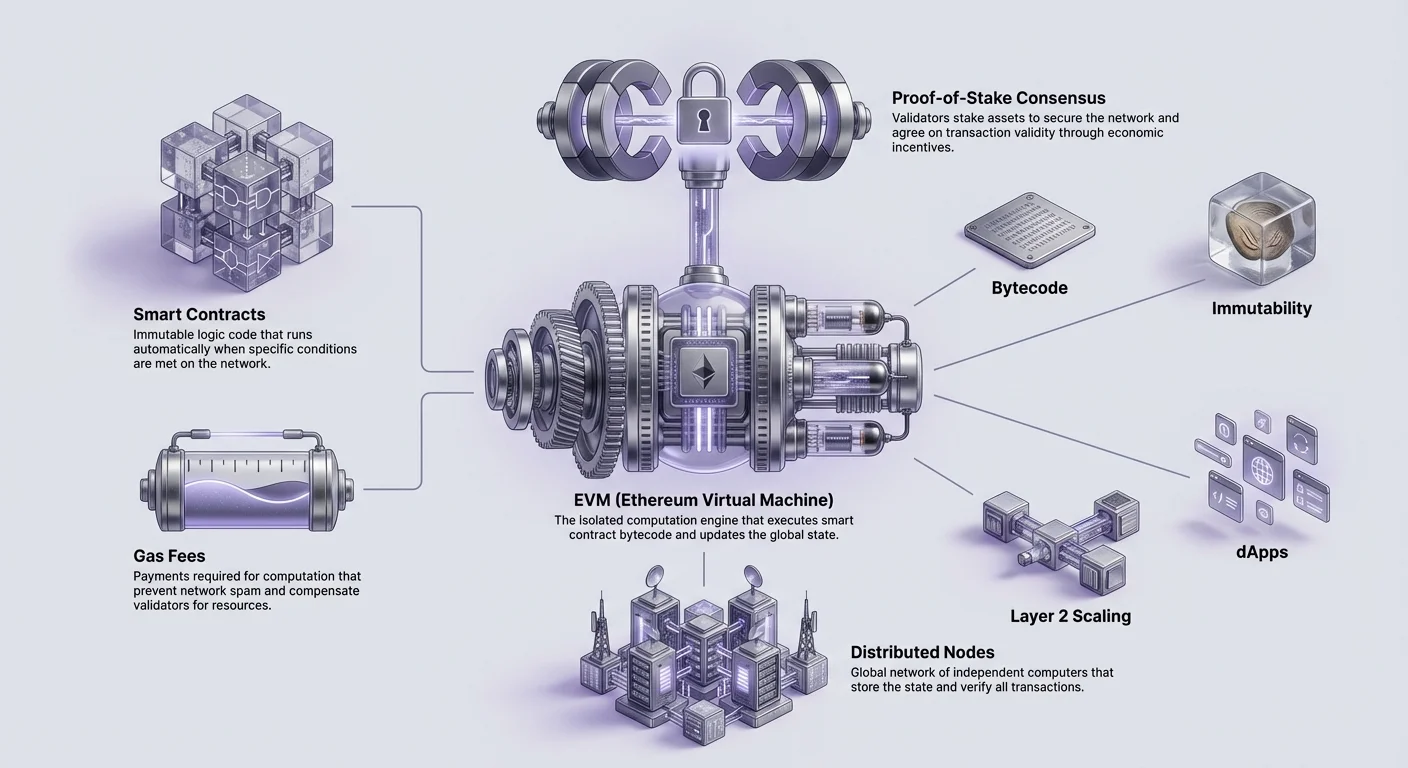
The Role of Nodes and Verification
The integrity of the global state relies entirely on the network of nodes that maintain it. A node is a computer that runs the client software of the blockchain. These nodes connect to one another to form a mesh network, sharing information and validating transactions.
Distributed Infrastructure
The network is distributed, meaning the processing power and memory required to run the system are spread out across the world. There is no central data center. If a government or malicious entity wanted to shut down the network, they would have to shut down every single node simultaneously.
This decentralized structure ensures durability. As long as nodes continue to operate, the network survives. This resilience makes it extremely difficult to censor transactions or prevent average people from using the platform. The infrastructure is open and permissionless, allowing anyone with the necessary hardware to join the network as a node operator.
Trustless Verification
One of the core value propositions of this technology is the ability to verify information without trusting an intermediary. In a traditional banking system, users trust the bank and its auditors to track balances correctly. On this blockchain, users can verify the state for themselves.
Nodes independently check the validity of every transaction and block. They ensure that the rules of the protocol are followed strictly. If a bad actor attempts to broadcast an invalid block, honest nodes will reject it. This process creates a system where truth is established through mathematical verification rather than institutional reputation.
Consensus Mechanisms: Agreeing on Truth
Since there is no central authority to dictate the state of the network, the distributed nodes must have a way to agree. This process is known as consensus. It is the mechanism by which the network synchronizes the global state across thousands of independent computers.
The Shift to Proof-of-Stake
Originally, the network utilized a Proof-of-Work consensus model similar to Bitcoin, where miners solved complex mathematical puzzles to validate transactions. However, the network has transitioned to a mechanism called Proof-of-Stake (PoS). This shift was designed to address scalability concerns and reduce the immense energy consumption associated with mining.
In this model, the security of the network is not derived from raw computational power. Instead, it comes from validators who stake their cryptocurrency assets. Validators lock up a certain amount of the native token as collateral to participate in the consensus process.
The Role of Validators
Validators are responsible for checking transactions, verifying activity, and voting on the outcome of the blockchain. They are chosen to propose new blocks based on the amount of cryptocurrency they hold and have staked. This process is random but weighted by the size of the stake.
When a validator proposes a new block, other validators attest to its validity. If the block contains valid transactions, it is added to the chain, and the state is updated. This cooperative process ensures that the network moves forward in unison.
Economic Incentives and Security
The consensus mechanism is secured by economic incentives. Validators earn rewards for processing transactions and maintaining the network honestly. Conversely, they face severe penalties for malicious behavior.
If a validator attempts to attack the network or validate fraudulent transactions, their staked assets can be "slashed." This means they lose a portion or all of their collateral. This economic risk forces participants to act in the best interest of the network. The cost of attacking the system becomes prohibitively high, as the attacker would effectively have to destroy their own wealth to cause disruption.
The Engine: Ethereum Virtual Machine (EVM)
At the heart of this distributed computer lies the Ethereum Virtual Machine, or EVM. The EVM is the computation engine that executes the smart contracts and manages the state changes. It is the environment in which all accounts and applications live.
A Sandboxed Environment
The EVM operates as a sandboxed environment. This means the code running inside the EVM is isolated from the rest of the network and the host machine. This isolation is critical for security.
If a smart contract contains a bug or malicious code, the sandbox prevents it from accessing the underlying operating system of the node or affecting other parts of the blockchain protocol. The EVM ensures that applications can run side-by-side without interfering with one another, maintaining the stability of the global platform.
Bytecode and Interpretation
When developers write smart contracts, they typically use high-level programming languages. However, the EVM does not understand these human-readable languages directly. The code must be compiled into "bytecode," a low-level language consisting of operational codes that the machine can interpret.
When a transaction triggers a smart contract, the EVM reads this bytecode and executes the instructions step-by-step. This process is deterministic, meaning that if the same code is run with the same inputs, it will always produce the exact same output. This consistency is vital for a network where thousands of nodes must reach the same conclusion.
The Function of Gas
Computation on a shared global resource is not free. Every operation performed by the EVM requires a fee known as "gas." Gas is a unit of measurement that represents the computational effort required to execute a specific task. This fee is essential for Mastering Gas Fees.
Complex operations require more gas, while simple transfers require less. Users pay this fee using the network's native cryptocurrency. This mechanism serves two purposes: it compensates validators for their resources, and it prevents spam. Without gas fees, a malicious actor could execute an infinite loop of code that would clog the network and halt processing for everyone else.
Smart Contracts: Logic on the Blockchain
Smart contracts are the building blocks of applications on this platform. They are computer programs that are stored on the blockchain and run automatically when predetermined conditions are met.
Autonomous Execution
A smart contract functions like a digital agreement. It contains logic that defines "if this happens, then do that." For example, a contract could be programmed to release funds to a seller only once a digital asset has been transferred to the buyer.
Once deployed, this code runs exactly as written. There is no need for a middleman to interpret the terms or enforce the agreement. The network enforces the logic impartially. This automation reduces the need for intermediaries like lawyers or escrow agents, streamlining complex interactions.
Immutable Application Logic
Because smart contracts are stored on the blockchain, they inherit the property of immutability. Once the code is deployed, it cannot be changed (unless specific upgrade paths are coded in from the start). This gives users confidence in how the application will behave.
Participants can inspect the code before interacting with it. They know that the rules of the game will not change arbitrarily in the middle of a transaction. This transparency is a cornerstone of the decentralized web, allowing for trustless interactions between strangers.
Token Standards and Interoperability
Smart contracts also enable the creation of new digital assets. Developers use standard templates, such as the ERC-20 standard, to create tokens that are compatible with the entire ecosystem. These standards define how tokens can be transferred and how transactions are approved.
This standardization ensures that a token created by one developer can easily interact with a decentralized exchange or lending protocol built by another. It creates a composable environment where different applications can be plugged together like "money Legos" to create entirely new financial products.
Decentralized Applications (dApps)
Smart contracts provide the backend logic, but users interact with them through Decentralized Applications, or dApps. A dApp combines the smart contract infrastructure with a user interface, usually a website or mobile app, that makes the technology accessible.
Permissionless Access
One of the key characteristics of dApps is that they are permissionless. Anyone with an internet connection can access them. The network does not filter users based on geography or status.
Unlike centralized apps where a company can ban users or delete accounts, dApps operate on open protocols. A user simply connects their digital wallet to the interface to begin interacting. This open access democratizes financial services and digital tools, potentially serving unbanked populations who lack access to traditional systems.
Categories of dApps
The flexibility of the EVM has led to the explosion of various dApp categories. Decentralized Finance (DeFi) is the most prominent, attempting to recreate traditional financial systems like lending and trading without banks. Users can earn interest or borrow assets directly from protocols.
Other categories include gaming, where players truly own their in-game assets as NFTs, and Decentralized Autonomous Organizations (DAOs). DAOs use smart contracts to manage governance, allowing members to vote on decisions and manage funds without a central corporate structure.
Web3 and User Ownership
These applications represent the shift to Web3, a new iteration of the internet. In Web 2.0, centralized platforms own user data and control access. In Web3, users own their data and assets.
dApps enable a model where value is distributed to the participants rather than extracted by intermediaries. For example, a decentralized social network could allow users to monetize their own content directly. This shift in power dynamics is driven by the underlying capability of the blockchain to verify ownership and execute logic without centralized gatekeepers.
Scalability and EVM Compatibility
As the demand for blockspace grows, the network faces challenges regarding scalability. The main chain can only process a limited number of transactions per second, leading to congestion and higher fees during peak times.
Scaling Solutions
To address this, the ecosystem is adopting various scaling strategies. Layer-2 solutions, such as rollups, process transactions off the main chain while inheriting its security guarantees. They bundle many transactions into a single batch and submit the proof to the main network.
This approach reduces the load on the primary nodes while maintaining decentralized verification. Additionally, future upgrades like sharding aim to split the network's database into smaller pieces, allowing nodes to verify only a portion of the data while still maintaining overall consensus.
The EVM Standard
The success of the Ethereum Virtual Machine has established it as a standard in the industry. Many other blockchains have adopted EVM compatibility, allowing them to run the same applications and smart contracts.
| Blockchain | Type | Key Feature |
|---|---|---|
| BNB Smart Chain | Layer 1 | High throughput, low fees |
| Polygon | Layer 2/Sidechain | Scaling solution for Ethereum |
| Avalanche | Layer 1 | Unique high-speed consensus |
This compatibility means that developers can easily port their dApps to different networks. It creates a multi-chain ecosystem where the EVM serves as the common language. Users benefit from a wider range of platforms that offer different trade-offs between speed, cost, and security, all while using the same wallets and tools they are accustomed to.
Conclusion
The evolution of blockchain technology from a simple ledger to a global, distributed state machine represents a significant leap in computer science. By combining thousands of nodes into a unified consensus network, Ethereum has created a platform that is transparent, immutable, and permissionless. The ability to execute arbitrary code via the EVM has unlocked entirely new categories of applications, from DeFi to DAOs.
As the network transitions to Proof-of-Stake and integrates scaling solutions, it continues to refine the balance between decentralization, security, and efficiency. The concept of a "world computer" is no longer just a theoretical analogy but a functional reality hosting billions of dollars in value and innovation. The power of this system lies not in any single component, but in the collective verification provided by its decentralized architecture.
A decentralized global state allows users to verify truth through code instead of trusting centralized institutions.