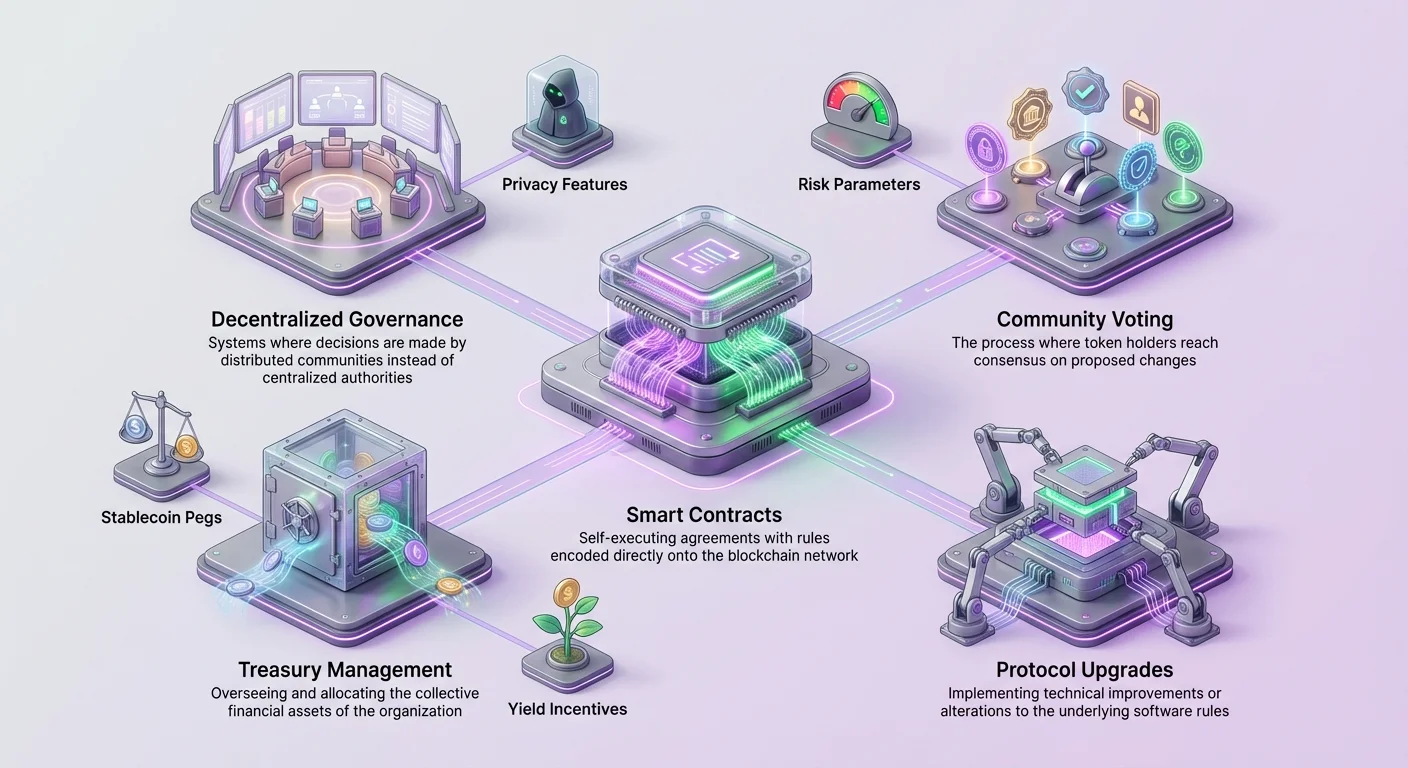
The shift from traditional financial systems to blockchain technology has introduced new ways to manage organizations and value. At the heart of this evolution lies the concept of decentralized governance. Unlike centralized institutions where decisions are made by a board of directors or government authorities, decentralized networks often rely on distributed communities to guide their future. This power is frequently exercised through governance tokens and staking mechanisms. These tools allow participants to vote on protocol upgrades, manage treasuries, and influence the direction of the ecosystem.
In the cryptocurrency landscape, this model is most visible within Decentralized Autonomous Organizations, or DAOs. These entities operate without a central authority, replacing hierarchical management with software rules and community voting. The value of decentralized voting power becomes evident when analyzing how different projects maintain stability, privacy, and utility. From managing stablecoin pegs to upgrading privacy protocols, governance tokens serve as the essential link between users and the protocols they utilize.
The Function of DAOs in Crypto
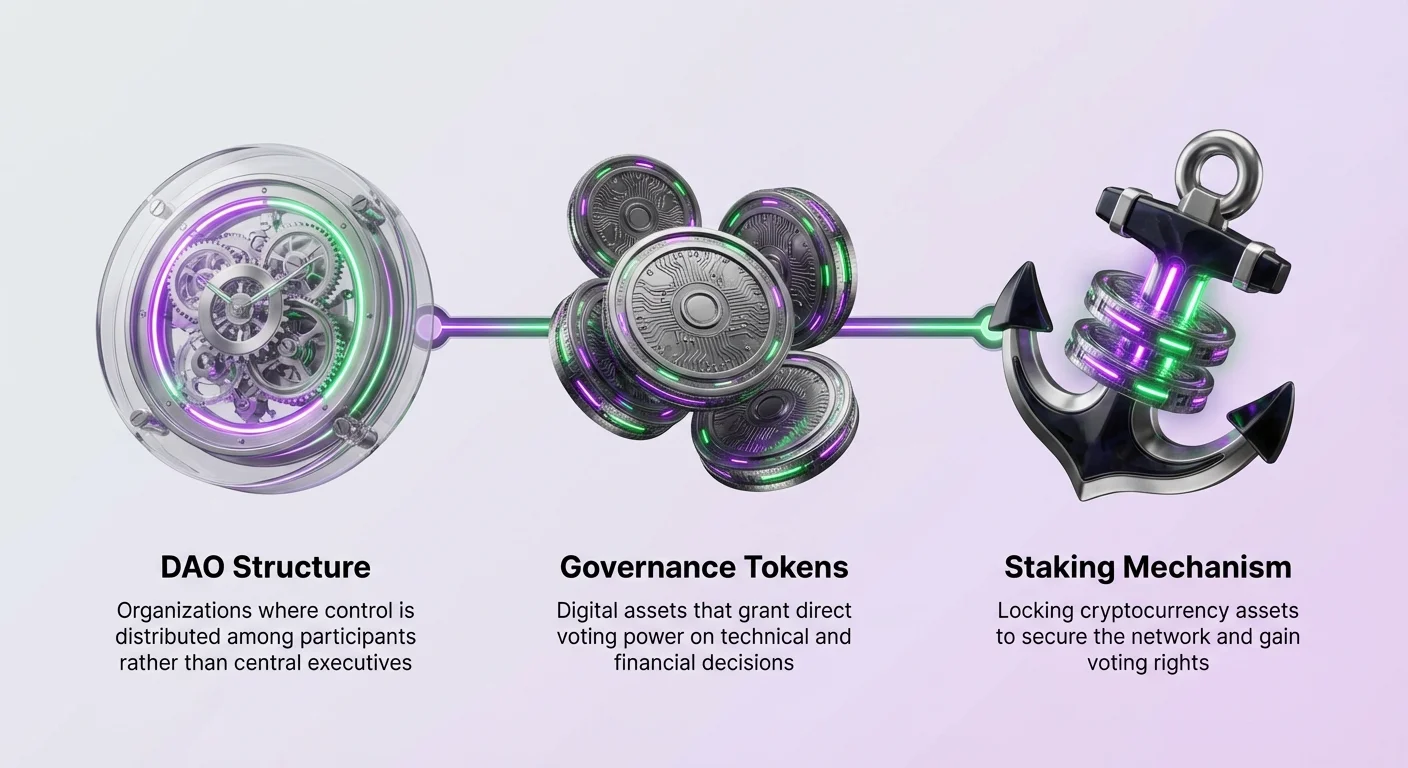
A Decentralized Autonomous Organization represents a structure where control is distributed among token holders rather than concentrated in the hands of a few executives. The primary function of a DAO is to facilitate decision-making in a transparent and trustless manner. In many cases, the rules of the organization are encoded in smart contracts. These are self-executing agreements that run on the blockchain. Changes to these rules often require a consensus from the community, which is achieved through voting processes.
Governance tokens are the instrument through which this voting power is expressed. Owning these tokens is akin to holding shares in a company, but with direct access to technical and financial decisions. For instance, in the decentralized finance (DeFi) sector, DAOs manage complex lending platforms and stablecoin issuers. They determine collateral types, set interest rates, and decide on protocol upgrades. This ensures that the platform evolves according to the needs of its users rather than the dictates of a private entity.
The resilience of a DAO depends heavily on the engagement of its community and the distribution of its voting power. If a protocol is truly decentralized, it becomes resistant to censorship and external pressure. This contrasts sharply with centralized entities that can be compelled by regulators to freeze assets or block transactions. By distributing governance, DAOs aim to create "unstoppable money" and financial systems that are open to anyone with an internet connection.
Governance in Stablecoin Ecosystems
Stablecoins provide a clear example of how governance impacts the functionality and security of digital assets. While centralized stablecoins like USDT and USDC are managed by private companies, decentralized alternatives rely on DAOs to maintain their value. The mechanisms used to keep a stablecoin pegged to the US dollar often require active management and adjustment. In a decentralized model, this management is performed by the community of governance token holders.
The MakerDAO and Sky Transition
One of the most prominent examples of stablecoin governance is the ecosystem behind DAI. Originally managed by MakerDAO, this decentralized lending platform allows users to mint stablecoins by depositing collateral. The governance of this system was historically conducted through the MKR token. Holders of MKR voted on critical risk parameters, such as which assets could be accepted as collateral and what fees should be charged. This allowed the system to adapt to market conditions without a central bank.
In a significant evolution, MakerDAO recently rebranded to Sky. This transition introduced a new governance token, SKY, designed to incentivize participation in the ecosystem. Under this new model, the legacy MKR token can be upgraded to SKY at a specific ratio. This change aims to enhance decentralization and encourage broader engagement. The governance process now oversees the newly introduced Sky Dollar (USDS), which replaced DAI in this specific iteration of the protocol. This demonstrates how governance tokens are not static; they can evolve to meet new strategic goals.
Algorithmic and Hybrid Models
Beyond collateralized debt positions, other stablecoin models rely on different governance structures. Frax (FRAX), for example, utilizes a hybrid approach that is partially collateralized and partially algorithmic. The ecosystem includes Frax Shares (FXS), a token specifically used for governance and staking. Holders of FXS influence the protocol's collateral ratio and other stability mechanisms. This highlights the role of governance tokens in managing complex financial algorithms that balance risk and capital efficiency.
Another example is Decentralized USD (USDD), launched by the Tron DAO. Unlike fiat-backed competitors, USDD relies on a consortium and algorithms to maintain its peg. The Tron DAO manages the reserves, which include assets like TRX and BTC. Here, the governance body is responsible for ensuring that the reserves are sufficient to back the stablecoin. This places a heavy responsibility on the voting members to maintain transparency and solvency, illustrating the high stakes involved in decentralized financial management.
Staking: The Engine of Governance
Staking is the mechanism that often underpins decentralized governance. It involves locking up cryptocurrency assets to support the network's operations. In exchange for this commitment, users receive rewards and, crucially, voting rights. Staking aligns the incentives of the users with the health of the protocol. If the protocol succeeds, the value of the staked assets and the governance power they represent generally increases.
Proof-of-Stake and Voting Rights
In many blockchain networks, staking is directly tied to the consensus mechanism known as Proof-of-Stake (PoS). In this model, validators are chosen to create new blocks based on the amount of crypto they hold and are willing to "stake" as collateral. This system replaces the energy-intensive mining found in Bitcoin's Proof-of-Work. However, staking goes beyond just block creation; it is the primary method for distributing voting weight in governance proposals.
When users stake their tokens, they are often granted the ability to vote on protocol upgrades. For example, in the Zano ecosystem, the project employs a hybrid consensus model that merges Proof-of-Work security with Proof-of-Stake efficiency. This design allows for decentralized participation without requiring expensive hardware. Zano's governance is conducted on-chain, where stakers can vote on proposals. This ensures that those who have a financial stake in the network are the ones making decisions about its future.
Incentives and Yield
Staking also serves as a method for earning interest, which encourages long-term holding and participation. Stablecoin protocols and other DeFi platforms often offer yield to users who deposit their assets into smart contracts. In some dual-asset strategies, users provide liquidity to trading pairs on decentralized exchanges. While this generates fees, it also often rewards users with governance tokens. This distribution method puts voting power into the hands of active participants, theoretically leading to more informed decision-making.
However, high yields often come with higher risks. When depositing governance tokens or stablecoins into a protocol, users face smart contract risks and potential volatility. The "yield farming" phenomenon allows users to maximize returns, but it requires a deep understanding of the underlying governance protocols. If a protocol is poorly managed by its DAO, the value of the governance token—and the staked principal—can decline rapidly.
Privacy in Decentralized Governance
A major challenge in traditional blockchain governance is the lack of privacy. On public ledgers like Ethereum, every vote is traceable to a specific wallet address. This transparency, while useful for auditability, can expose voters to coercion, bribery, or targeted attacks. Privacy-focused projects are addressing this by integrating confidentiality into the governance process itself.
Anonymous Voting Mechanisms
Projects like Zano are pioneering privacy-preserving governance. Zano is a layer-1 blockchain designed for enterprise-grade privacy and security. Its architecture supports a Decentralized Autonomous Organization where stakers can vote anonymously on protocol upgrades. This is achieved through advanced cryptographic techniques that obscure the voter's identity while still verifying their eligibility and voting weight.
By utilizing ring signatures and stealth addresses, Zano ensures that governance participation does not reveal a user's financial holdings or voting patterns. This creates a safer environment for decision-making, allowing stakeholders to vote their conscience without fear of retaliation or social pressure. This approach reinforces the concept of censorship resistance, extending it from simple transactions to the governance of the network itself.
Confidential Assets and Control
The integration of confidential assets into governance structures represents the next frontier. Zano allows for the creation of confidential assets that inherit the blockchain's privacy features. This means that tokens used for voting or representing value can be transferred and stored without revealing amounts or addresses. This level of privacy is crucial for businesses or individuals who wish to participate in decentralized ecosystems without exposing their entire financial history to the public.
The ability to issue privacy-preserving tokens enables new forms of organizations. A private DAO could theoretically manage a treasury or vote on sensitive business strategies without leaking information to competitors. This functionality is supported by Zano's "Zarcanum," a hidden-amount Proof-of-Stake model. It allows the network to reach consensus and validate governance actions without compromising the privacy of the participants.
Centralization vs. Decentralization Risks
The debate between centralized and decentralized governance is central to the crypto industry. Centralized stablecoins like USDT and USDC offer stability and high liquidity. They are backed by reserves held in traditional bank accounts and managed by specific companies (Tether Limited and Circle, respectively). This centralization allows for efficient compliance with regulations, but it introduces counterparty risk. Users must trust that the issuer actually holds the reserves they claim.
Decentralized governance tokens aim to remove this need for trust. Protocols like MakerDAO (now Sky) and Tron DAO use code and community incentives to maintain stability. This reduces the risk of a central entity freezing funds or acting maliciously. However, decentralized models face their own set of challenges. They are often more volatile and complex. The decision-making process can be slower, as it requires community consensus rather than a unilateral executive decision.
| Governance Type | Primary Mechanism | Key Advantages | Major Risks |
|---|---|---|---|
| Centralized | Corporate Board | Speed, Regulatory Compliance | Censorship, Counterparty Trust |
| Decentralized | DAO Voting | Censorship Resistance, Transparency | Complexity, Smart Contract Bugs |
| Algorithmic | Code/Incentives | Capital Efficiency, Automation | De-pegging, Death Spirals |
There is also the risk of "governance attacks," where a malicious actor accumulates enough voting power to force through detrimental changes. This highlights the importance of widespread token distribution. If a large portion of governance tokens is held by a small group of developers or early investors, the DAO may be decentralized in name only. True decentralization requires a broad and active community of stakeholders.
Lessons from Governance Failures
The history of crypto is marked by experiments in governance that failed to maintain stability. The collapse of the TerraUSD (UST) ecosystem serves as a stark warning. UST was an algorithmic stablecoin that relied on a two-token system with LUNA. The governance and stability mechanism incentivized users to burn LUNA to mint UST, and vice versa, to keep the peg.
While this system worked for a time, it ultimately could not withstand a massive "run on the bank." The governance mechanism failed to react quickly enough to restore confidence, leading to a total loss of value for holders of both tokens. This event underscored the fact that decentralized governance is not a magic solution. It requires robust economic design and the ability to manage crises.
The failure of UST also highlighted the risks of complex algorithmic mechanisms that are not fully backed by collateral. In contrast, over-collateralized systems like DAI (before its transition) proved more resilient because they did not rely solely on market incentives to maintain value. Governance token holders in these systems must constantly evaluate risk parameters to prevent similar collapses.
Community Power in Memecoins
While governance is often associated with serious financial protocols, it also plays a role in the volatile world of memecoins. Assets like Dogecoin (DOGE) and Shiba Inu (SHIB) started as jokes but grew into massive communities. The "governance" in these ecosystems is often less formal than in a DeFi protocol but is equally powerful. It relies on social consensus and community hype.
Memecoins are typically community-driven. While they may not always have a formal DAO structure governing protocol parameters, the community's collective action drives value and adoption. For instance, the Shiba Inu ecosystem has evolved to include components like ShibaSwap, where governance plays a role. However, the primary force remains the enthusiastic support of the "army" of holders.
This type of informal governance demonstrates the power of social coordination. However, it also carries significant risks. Without formal structures and clear utility, the value of these assets is highly speculative. The "governance" is often swayed by social media trends and influencer endorsements rather than technical fundamentals. This contrasts with utility-focused DAOs where voting is based on economic parameters and protocol security.
The Future of Decentralized Voting
As the crypto space matures, the mechanisms of governance are becoming more sophisticated. The move by MakerDAO to rebrand to Sky and introduce new tokenomics signals a trend toward more sustainable and engaging governance models. The goal is to encourage active participation and prevent voter apathy, which plagues many DAOs.
Privacy will likely play a growing role in the future of voting. Systems like Zano that offer default privacy and anonymous staking provide a blueprint for how governance can protect user data while ensuring security. This is essential for avoiding the "surveillance economy" and preserving the ethos of financial freedom.
Furthermore, the regulatory landscape for governance tokens is evolving. Governments are increasingly scrutinizing DAOs to determine if they should be regulated as securities or traditional corporations. This uncertainty creates a complex environment for developers and voters. However, the inherent censorship resistance of truly decentralized networks offers a counterweight to overreach.
Conclusion
Governance tokens and DAOs represent a fundamental shift in how digital organizations are managed. By replacing centralized intermediaries with code and community voting, these systems offer a path toward greater transparency and user control. Staking mechanisms align financial incentives with network security, ensuring that those who hold the power also share the risk. Whether managing the stability of a dollar-pegged asset or upgrading a privacy protocol, decentralized voting is the engine that drives the crypto ecosystem forward.
However, this power comes with significant responsibility. The risks of smart contract failures, bad governance decisions, and regulatory uncertainty are real. Users must understand the specific mechanisms of the tokens they hold, from the privacy features of Zano to the stability models of Sky and Frax. As the technology evolves, the balance between transparency, privacy, and efficiency will determine the success of the next generation of decentralized organizations.
Decentralized governance empowers users to control financial protocols directly, replacing trust in central authorities with verifiable code and community voting.