TRON has established itself as a distinct player in the blockchain sector by focusing heavily on high throughput and content distribution. While many networks compete directly with Ethereum for decentralized finance dominance, TRON carved out a specific utility role in the transfer of value. Launched in 2017, the network was designed to decentralize the web and provide a platform where content creators could interact directly with consumers.
Over time, this initial vision evolved into a robust infrastructure for stablecoin transactions and decentralized applications. The network prioritizes speed and low costs, addressing two of the most significant barriers to entry for mainstream crypto users. By eliminating the high transaction fees often associated with older blockchains, TRON created an environment conducive to high-frequency trading automation and micro-transactions.
This efficiency has made the network a preferred rail for global settlements, particularly involving US dollar-pegged assets. The architecture supports a high volume of transactions per second, positioning it as a practical solution for users in regions where traditional banking is expensive or inaccessible. The governance model, known as TRON DAO, allows token holders to influence the network's direction, maintaining a balance between decentralization and efficiency.
The Delegated Proof-of-Stake Consensus
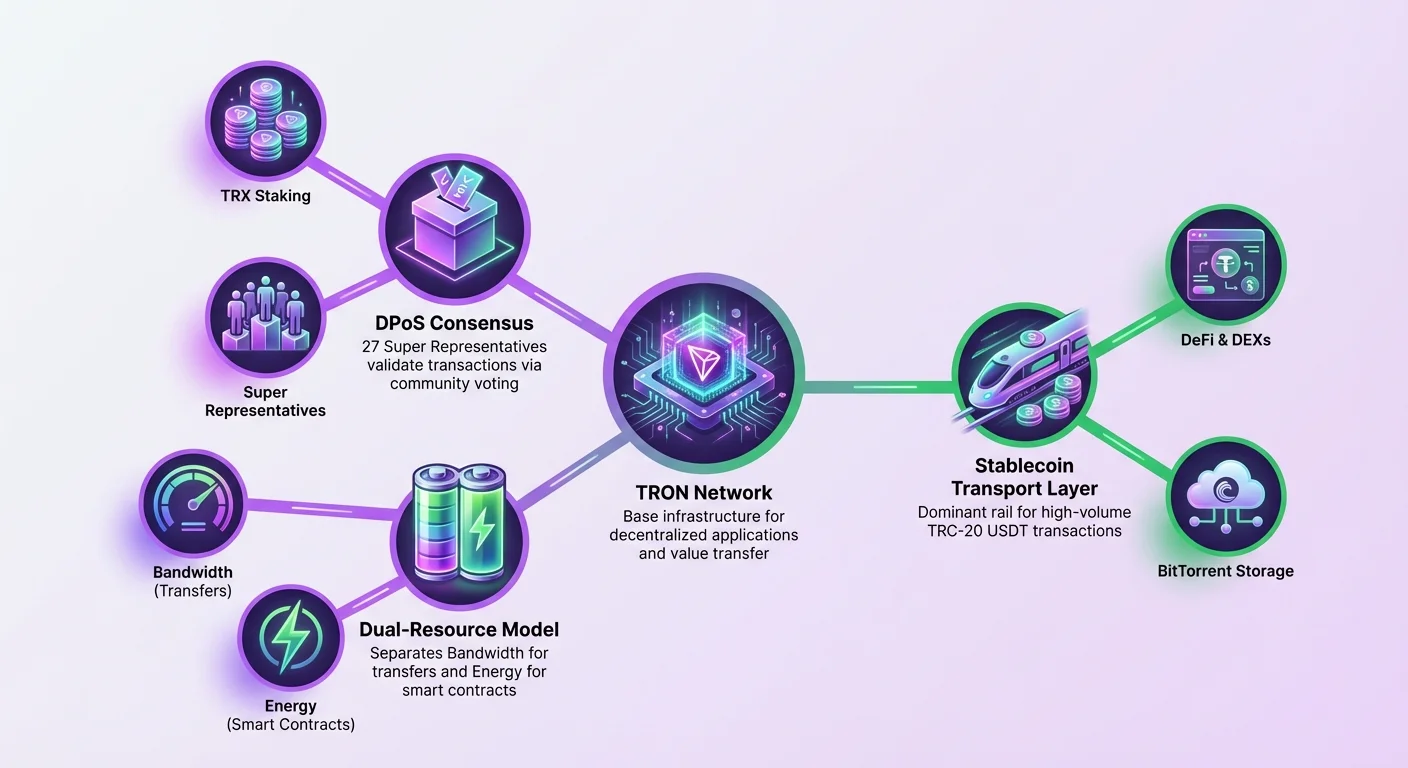
TRON operates on a Delegated Proof-of-Stake (DPoS) consensus mechanism. This system differs significantly from the Proof-of-Work model used by Bitcoin or the traditional Proof-of-Stake model used by Ethereum. In the TRON ecosystem, token holders stake their TRX to vote for "Super Representatives."
There are 27 Super Representatives responsible for validating transactions and creating new blocks. These representatives are voted in by the community, and the list is updated every six hours based on voting tallies. This limited number of validators allows the network to achieve consensus rapidly, resulting in faster block times and higher throughput.
However, this speed comes with trade-offs regarding decentralization. Critics often point out that having only 27 active validators makes the network more centralized than competitors with thousands of independent nodes. Despite these concerns, the DPoS model has proven effective for maintaining network stability and handling massive transaction volumes without congestion.
The Unique Resource Model
One of TRON's most innovative technical features is its dual-resource model for transaction fees. Unlike networks that rely solely on a native token for "gas," TRON separates network resources into "Bandwidth" and "Energy." This system allows active users to transact for free if they hold enough stake.
Bandwidth is used for standard transactions, such as sending TRX or tokens from one wallet to another. Every account receives a daily allocation of free Bandwidth, allowing for a few free transactions every 24 hours. If a user requires more, they can freeze (stake) TRX to generate additional Bandwidth points.
Energy is a separate resource required for executing smart contracts. Smart contracts are the automated code that powers decentralized applications. Running this code requires computational power, which is measured in Energy. Users interact with dApps or move TRC-20 tokens by freezing TRX to obtain Energy, effectively removing the volatility of gas prices from the dApp interaction experience.
Dominance in the Stablecoin Market
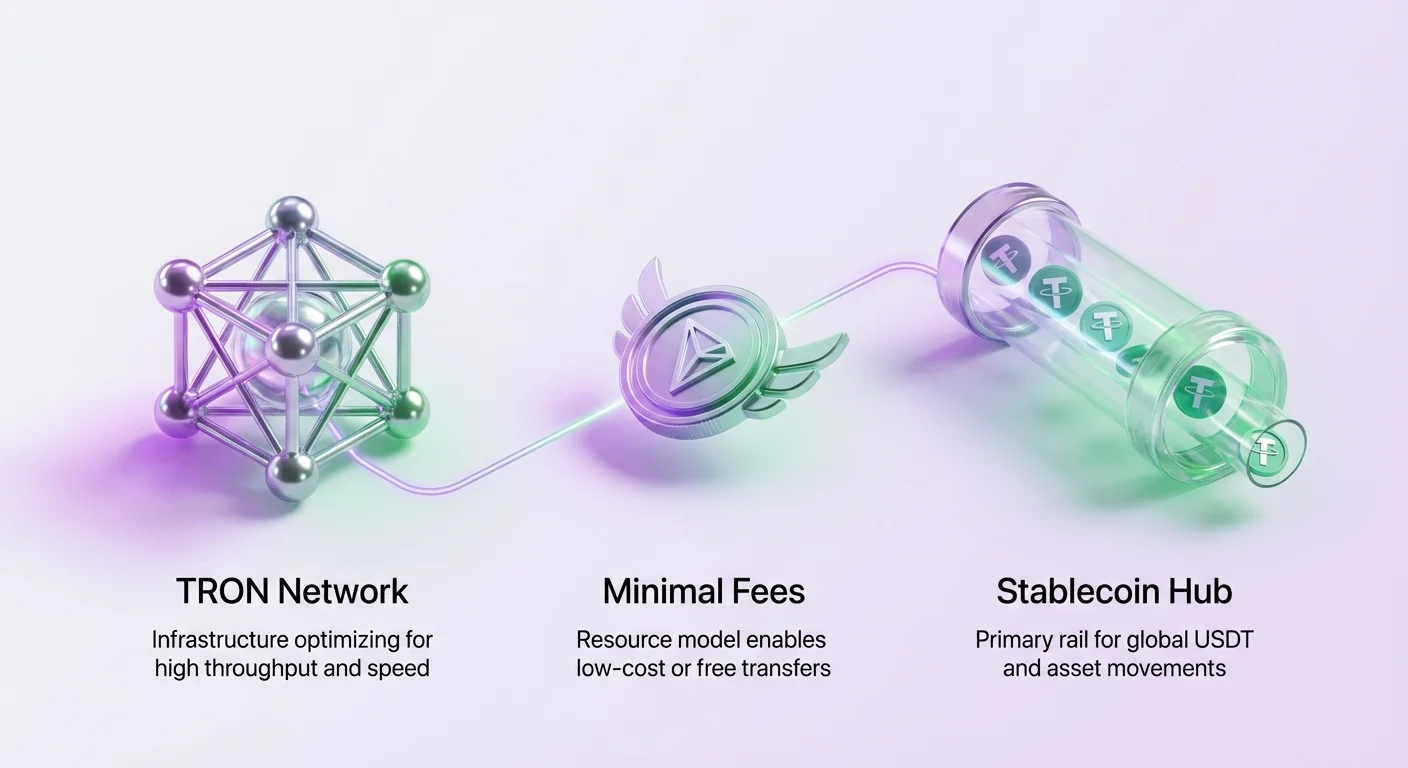
The most significant success story for TRON is its adoption as a primary transport layer for stablecoins, particularly Tether (USDT). A substantial portion of the total USDT supply circulates on the TRON network rather than Ethereum. This shift occurred primarily due to the fee structure differences between the two chains.
On Ethereum, sending a stablecoin transaction can cost several dollars, or much more during periods of network congestion. On TRON, the same transfer often costs a fraction of a cent or is entirely free for users with staked assets. This cost efficiency attracts traders who need to move funds between exchanges quickly to arbitrage price differences.
Beyond trading, this utility has found a massive use case in emerging markets. In countries with unstable local currencies or strict capital controls, citizens often turn to US dollar stablecoins to preserve wealth. TRON provides the most accessible rail for these users, as they can transact with minimal overhead costs, making peer-to-peer digital cash payments viable for daily needs, leveraging stable asset mechanics.
Technical Standards and Interoperability
The TRON network utilizes token standards that mirror those found on Ethereum, facilitating an easier transition for developers and users. The most common standard is TRC-20, which is functionally equivalent to Ethereum's ERC-20. This compatibility allows wallets and exchanges to integrate TRON-based tokens with minimal friction.
TRC-20 vs. Legacy Standards
The TRC-20 standard is the backbone of the TRON DeFi and stablecoin ecosystem. It defines a common list of rules that all tokens must follow, allowing them to interact seamlessly with smart contracts and decentralized exchanges. This standardization was critical for the adoption of USDT on the network.
Before TRC-20 became the dominant standard, TRON utilized TRC-10 tokens. These were native tokens created directly on the blockchain without the need for a smart contract. While TRC-10 tokens require lower transaction fees and are easier to issue, they lack the programmability of TRC-20. Today, the smart contract capabilities of TRC-20 make it the preferred choice for complex financial applications.
BitTorrent and Decentralized Storage
A key component of TRON’s broader ecosystem is its integration with BitTorrent. TRON acquired BitTorrent in 2018, bringing the world's largest decentralized file-sharing protocol under its umbrella. This strategic move aimed to merge blockchain incentives with peer-to-peer content distribution.
The BitTorrent File System (BTFS) creates a decentralized storage network where users can earn tokens by sharing their unused hard drive space. This infrastructure supports the vision of a decentralized internet (Web3), where data is not controlled by centralized servers. The integration provides a utility layer for dApps that require large-scale data storage, something that is prohibitively expensive to store directly on a blockchain ledger.
Decentralized Finance (DeFi) on TRON
While Ethereum remains the center of innovation for decentralized finance, TRON has built a thriving, self-contained DeFi ecosystem. The network hosts a suite of applications that replicate the core functions of traditional finance, such as lending, borrowing, and exchanging assets.
Platforms like JustLend allow users to supply liquidity and earn interest on their holdings or borrow assets against collateral. The speed of the underlying network ensures that these interactions occur near-instantaneously. For high-frequency traders or automated market makers, this responsiveness is a critical advantage.
Decentralized exchanges (DEXs) on TRON, such as SunSwap, facilitate the trading of TRC-20 tokens without intermediaries. These platforms use automated market maker (AMM) algorithms to determine prices based on supply and demand. The low fees on TRON enable users to participate in liquidity pools with smaller amounts of capital, lowering the barrier to entry compared to more expensive chains where gas fees might exceed the potential yield.
Strategy for Emerging Market Adoption
TRON’s growth strategy has largely targeted markets outside of the traditional Western financial hubs. In regions like Southeast Asia, Latin America, and Africa, the demand for accessible financial tools is high, but the tolerance for high fees is low. TRON’s architecture serves this demographic effectively.
Remittances and Cross-Border Payments
The traditional remittance industry is notorious for high fees and slow settlement times. Migrant workers sending money home often lose a significant percentage of their earnings to intermediaries. TRON offers a compelling alternative by allowing users to send stablecoins directly to recipients’ wallets.
This process bypasses the banking swift network and traditional money transfer operators. The recipient receives the full value in seconds and can convert it to local currency using peer-to-peer markets. This use case drives organic adoption, as users are motivated by necessity and cost-savings rather than speculative investment.
Banking the Unbanked
For individuals without access to bank accounts, a smartphone wallet on the TRON network acts as a digital bank. Users can hold savings in stable assets, earn yield through DeFi protocols, and pay for goods and services. The low barrier to entry—requiring only an internet connection and a device—democratizes access to financial services.
This "bottom-up" adoption strategy contrasts with the institutional focus of some other blockchains. By securing the grassroots user base in developing economies, TRON builds a sticky network effect. Once users are accustomed to the speed and low cost of the network, they are less likely to migrate to more expensive alternatives for their daily transactions.
Comparison with Competitors
To understand TRON’s niche, it is helpful to compare its core metrics against other major smart contract platforms. The following table outlines key differences in consensus, speed, and fee models.
| Feature | TRON | Ethereum | Solana |
|---|---|---|---|
| Consensus | Delegated Proof-of-Stake (DPoS) | Proof-of-Stake (PoS) | Proof-of-History + PoS |
| Throughput | ~2,000 TPS | ~15-30 TPS (Layer 1) | ~65,000 TPS (Theoretical) |
| Fee Model | Bandwidth & Energy (Resource) | Gas (Auction-based) | Gas (Base fee + Priority) |
TRON sits in a middle ground regarding performance. It is significantly faster than Ethereum’s base layer but theoretically slower than newer high-performance chains like Solana. However, its established history and deep liquidity in stablecoins give it a competitive moat that purely technical specifications might not reveal.
Challenges and Centralization Risks
Despite its utility, TRON faces valid criticism regarding its governance structure. The DPoS model relies on a small number of Super Representatives to secure the network. This concentration of power raises concerns about censorship resistance and the potential for collusion among validators, highlighting the inherent trilemma trade-offs.
Governance Dynamics
In a system with only 27 validators, it is theoretically easier for a malicious actor to compromise the network compared to a system with thousands of nodes. The voting process is weighted by the amount of TRX staked, meaning large token holders (whales) have disproportionate influence over who becomes a Super Representative.
This dynamic can lead to centralization of governance, where the interests of large stakeholders are prioritized over the broader community. While this has not resulted in significant network failures to date, it remains a point of contention for purists who value maximum decentralization above efficiency.
Regulatory Landscape
Like all major blockchain projects, TRON operates in an uncertain regulatory environment. The heavy use of stablecoins on the network draws attention from financial regulators concerned about money laundering and capital controls. As governments move to regulate digital assets, networks that facilitate anonymous or semi-anonymous cross-border flows may face increased scrutiny.
TRON DAO has taken steps to address compliance, but the permissionless nature of the blockchain means the developers cannot control who uses the network. The challenge moving forward will be maintaining the open nature of the platform while navigating the evolving legal frameworks in different jurisdictions.
The Role of TRX Token
The native cryptocurrency, TRX, serves multiple functions within the ecosystem. It is the unit of account, a governance token, and the fuel for the resource model. Its value is intrinsically tied to the usage of the network.
Staking and Resource Management
To access the free transaction model, users must lock up TRX. This removes tokens from circulation, potentially creating scarcity if demand for network resources increases. Users who stake TRX receive "TRON Power," which allows them to vote for Super Representatives.
In return for staking and voting, users earn staking rewards. This incentive structure encourages long-term holding and active participation in governance. It aligns the interests of the token holders with the security and health of the network.
Deflationary Mechanisms
TRON has implemented mechanisms to burn TRX, reducing the total supply over time. A portion of the fees paid for resource consumption is burned rather than redistributed. As network activity grows—driven by stablecoin transfers and DeFi usage—the rate of burning increases.
This deflationary pressure is designed to support the value of TRX. Unlike inflationary tokens that constantly dilute holders, a deflationary model aims to reward long-term participants. However, the effectiveness of this mechanism depends entirely on sustained and growing network usage.
Future Outlook and Development
Looking ahead, TRON aims to expand its utility beyond simple value transfer. The roadmap includes further integration of real-world assets (RWAs) and the development of more complex decentralized applications. The network is also exploring Layer 2 solutions and cross-chain bridges to enhance interoperability with the broader crypto ecosystem.
The continued dominance of USDT on TRON suggests that the network has found a durable product-market fit. As long as Ethereum fees remain high for small transactions, TRON will likely retain its share of the stablecoin market. The challenge will be to innovate fast enough to fend off newer, high-performance chains that offer similar low-fee environments with different technical trade-offs.
Developers are also focusing on the metaverse and gaming sectors. The high throughput of the network makes it suitable for blockchain gaming, which requires frequent, low-value transactions for in-game assets. By attracting game developers, TRON hopes to diversify its user base beyond financial speculation and remittances.
Conclusion
TRON has successfully identified and capitalized on a specific need within the cryptocurrency landscape: the demand for fast, affordable stablecoin transactions. By prioritizing throughput and a unique resource model over absolute decentralization, it has become a critical infrastructure for users in emerging markets and high-frequency traders. The network’s integration with BitTorrent and its robust DeFi ecosystem further solidify its position as a versatile utility layer.
While valid concerns regarding centralization and governance persist, the practical benefits of the network continue to drive adoption. The widespread use of TRC-20 stablecoins demonstrates that for many users, cost and speed are the deciding factors in choosing a blockchain. As the industry matures, TRON’s ability to navigate regulatory challenges and maintain its technical edge will determine its long-term relevance in the decentralized web.
TRON succeeds by providing a practical, low-cost highway for global dollar transactions rather than competing solely on ideology.