
Stablecoins have emerged as a fundamental pillar of the cryptocurrency ecosystem, designed to solve the extreme volatility that characterizes assets like Bitcoin and Ethereum. While traditional cryptocurrencies fluctuate wildly based on market sentiment, stablecoins aim to maintain a consistent value, typically pegged one-to-one with a sovereign currency like the US dollar.
This stability allows traders to lock in profits without exiting the crypto ecosystem and enables businesses to settle international payments efficiently. However, the mechanism used to achieve this stability varies significantly between projects, creating a complex matrix of risks.
Understanding these risks requires dissecting the underlying collateralization models. Not all dollars on the blockchain are created equal. Some are digital IOUs backed by cash in a vault, while others are algorithmic promises backed by code and game theory.
The Stability Trilemma
The design of any stablecoin faces a challenge often referred to as the stability trilemma. Developers must balance three competing objectives: decentralization, capital efficiency, and price stability. It is notoriously difficult to achieve all three simultaneously.
Fiat-backed coins offer high stability and capital efficiency but sacrifice decentralization. Crypto-backed coins offer decentralization and stability but often suffer from poor capital efficiency due to the need for over-collateralization. Algorithmic coins attempt to solve all three but frequently fail catastrophically on the stability front during high volatility.
The Role of Arbitrage
Regardless of the model, almost all stablecoins rely on market participants to maintain the peg through arbitrage. When the price of a stablecoin drifts above $1.00, traders are incentivized to sell or mint more tokens to capture the difference.
Conversely, when the price dips below $1.00, traders are incentivized to buy the token at a discount and redeem it for $1.00 worth of collateral. The efficiency and reliability of this redemption mechanism determine the strength of the peg. If the redemption path is blocked or obscure, the peg can break.
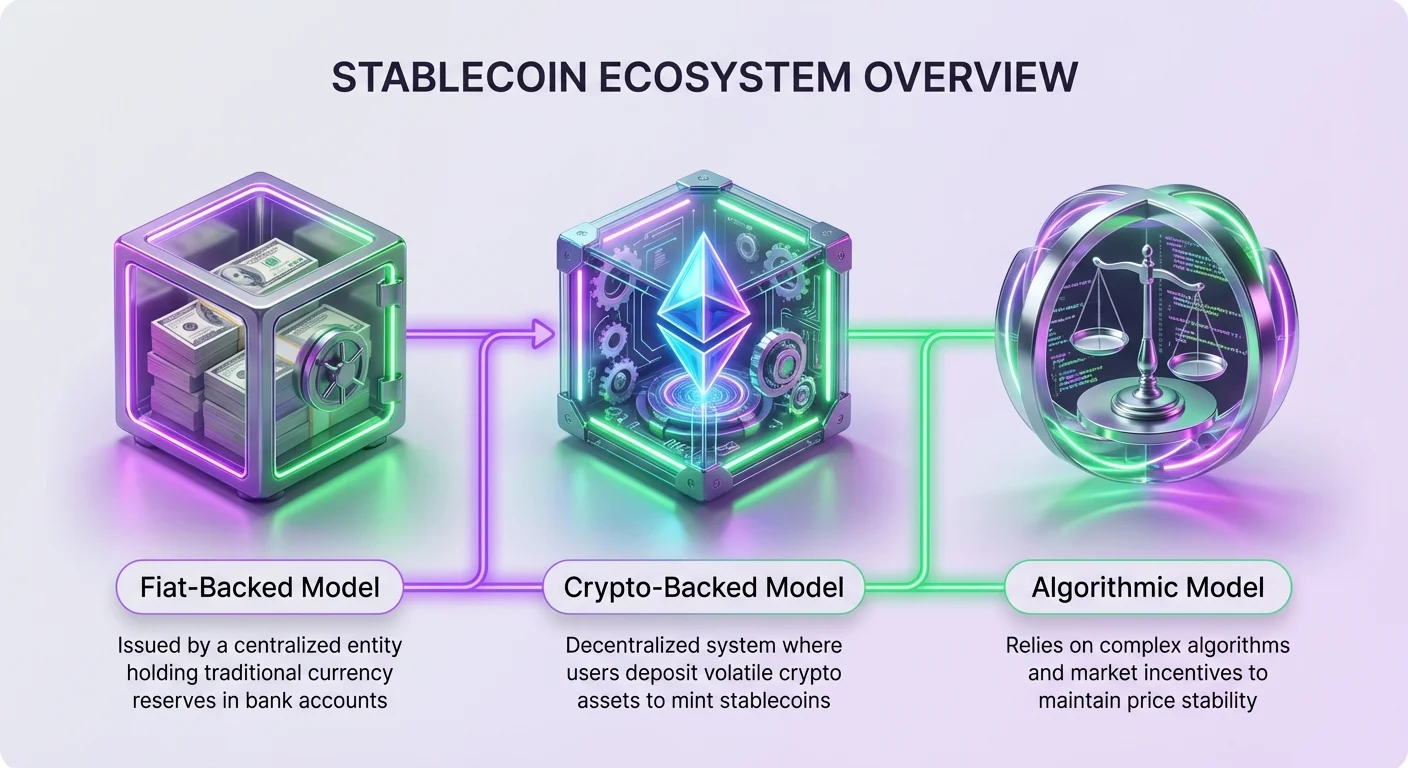
Fiat-Collateralized Models: The Centralized Standard
The most prevalent form of stablecoin is the fiat-collateralized model. In this system, a centralized issuer holds reserves of traditional assets—such as cash, treasury bills, or commercial paper—that correspond to the number of tokens in circulation.
For every digital dollar issued, there should theoretically be a physical dollar or equivalent sitting in a bank account. When a user wants to redeem their tokens, the issuer destroys the digital token and wires the fiat currency to the user's bank account.
Understanding the Trust Requirement
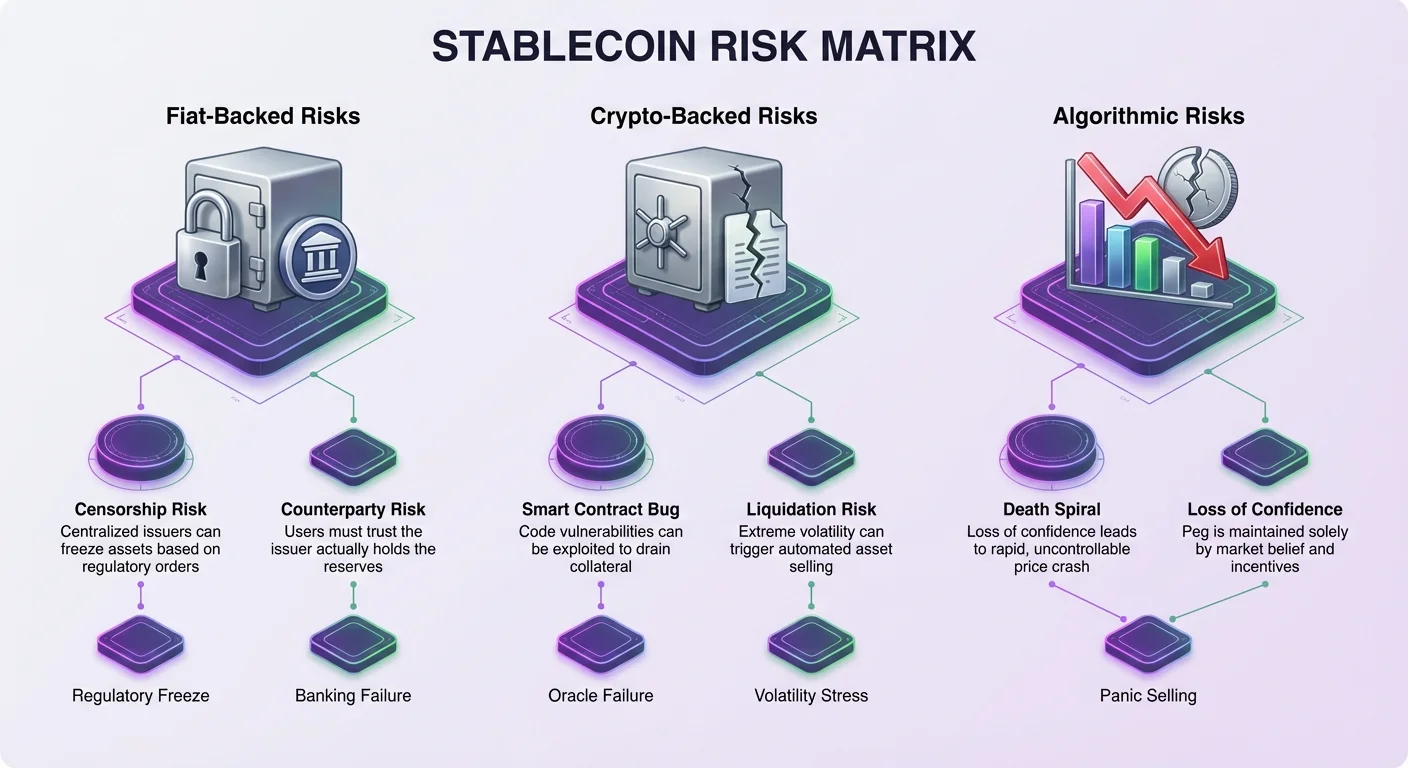
The primary risk in this model is counterparty risk. Users must trust that the issuer actually possesses the reserves they claim to have. If an issuer mints more tokens than they have backing for, the system operates on a fractional reserve basis, which can be disastrous if a "bank run" occurs.
Historically, transparency has been a major point of contention. Tether (USDT), the largest stablecoin by market capitalization, has faced years of scrutiny regarding the composition of its reserves. While it has weathered numerous controversies and maintained its relevance, the lack of a full, real-time audit requires users to rely on periodic attestations.
Conversely, USD Coin (USDC), issued by Circle, has positioned itself as the compliant alternative. It is backed by audited reserves of cash and short-term US government bonds. This strict adherence to regulation provides higher confidence in the backing but introduces a different set of risks related to censorship and government control.
Regulatory and Censorship Vectors
Fiat-collateralized stablecoins are centralized by definition. The companies issuing them are subject to the laws of the jurisdictions in which they operate. This means they can be compelled by law enforcement to freeze assets.
Both Tether and Circle have complied with requests to freeze addresses associated with illicit activities. While this is often framed as a security feature for compliance, it highlights a critical lack of censorship resistance. A user's funds are only as safe as their standing with the regulatory bodies governing the issuer.
Furthermore, these stablecoins are vulnerable to the traditional banking system. In 2023, USDC experienced a temporary de-peg event when Silicon Valley Bank, where Circle held a portion of its cash reserves, collapsed. This incident revealed that even fully backed, regulated stablecoins inherit the systemic risks of the traditional financial rails they rely on.
Crypto-Collateralized Models: The Decentralized Alternative
To eliminate the reliance on traditional banks and centralized trusted parties, developers created crypto-collateralized stablecoins. These tokens are backed by other cryptocurrencies, such as Ethereum or Bitcoin, which are held in smart contracts.
The most famous example of this model is DAI, originally created by MakerDAO (now evolving into the Sky ecosystem). In this system, users deposit volatile crypto assets into a vault or Collateralized Debt Position (CDP).
The Mechanism of Over-Collateralization
Because the underlying collateral is volatile, these systems must be over-collateralized. To mint $100 worth of stablecoins, a user might need to deposit $150 or $200 worth of Ethereum. This buffer protects the system against sudden drops in the value of the collateral.
If the value of the collateral falls below a certain threshold, the smart contract automatically liquidates the asset—selling it to repay the debt and ensure the stablecoin remains solvent. This automated process removes the need for a central authority to manage reserves.
However, this model introduces capital inefficiency. A significant amount of capital effectively sits dormant in smart contracts to back a smaller amount of spendable stablecoins. This limits the ability of the stablecoin to scale rapidly compared to fiat-backed competitors.
Smart Contract and Liquidation Risks
While this model reduces centralized counterparty risk, it increases technical risk. The entire system relies on the integrity of the smart contract code. A bug or exploit in the protocol could drain the collateral, rendering the stablecoin worthless.
Additionally, extreme market volatility can stress the liquidation mechanisms. If the price of the collateral crashes faster than the protocol can liquidate it, the system may become under-collateralized. This scenario is known as a "bad debt" accumulation.
To mitigate this, modern versions of crypto-backed stablecoins often diversify their collateral types. For instance, DAI began accepting centralized stablecoins like USDC as collateral to reduce volatility. While this stabilized the peg, it ironically reintroduced the censorship risks associated with the centralized assets backing the decentralized token.
Algorithmic Stablecoins: The High-Risk Frontier
Algorithmic stablecoins represent the most experimental and risky category. These tokens attempt to maintain a peg without relying on a reserve of external assets. Instead, they use complex algorithms and game theory to control the supply of the token.
The classic example is the "seigniorage shares" model, which typically involves a two-token system. One token is the stablecoin, and the other is a volatile governance or equity token.
The Mechanics of Supply Elasticity
The system relies on incentives. When the stablecoin trades above $1.00, users are encouraged to burn the volatile token to mint more stablecoins, increasing supply and driving the price down. When the stablecoin trades below $1.00, users burn the stablecoin to mint the volatile token, reducing supply and driving the price up.
TerraUSD (UST) was the most prominent example of this model. It grew to a massive market capitalization by offering high yields on deposits. The system worked flawlessly during bull markets, as demand for the stablecoin drove up the price of the sister token, LUNA.
The Death Spiral Phenomenon
The fatal flaw of this model is the "death spiral." If confidence in the system evaporates, users rush to exit the stablecoin simultaneously. To redeem their value, they must mint massive amounts of the volatile token.
This hyper-inflation of the volatile token causes its price to crash. As the backing token's value approaches zero, the system can no longer support the stablecoin's peg. This occurred with UST in May 2022, wiping out billions of dollars in value in a matter of days. The collapse demonstrated that without external collateral, a stablecoin is backed only by faith and demand.
Other algorithmic attempts, like USDD on the Tron network, have tried to mitigate this by introducing partial collateralization or reserves of Bitcoin and other assets. However, the core risk remains: if the market loses faith in the algorithm's ability to defend the peg, the value can plummet rapidly.
Hybrid and Derivative Models
Innovation in the sector has led to hybrid models that attempt to combine the best features of previous iterations. These protocols often use a mix of collateral and algorithmic adjustments.
Frax (FRAX) introduced a fractional-algorithmic mechanism. It is backed partly by USDC and partly by its own governance token, FXS. The ratio of collateral to algorithm shifts based on market confidence. When the market is stable, the system becomes more algorithmic (capital efficient). When volatility hits, it becomes more fully collateralized.
Delta-Neutral Hedging Strategies
Another emerging model is exemplified by Ethena's USDe. This is a "synthetic dollar" that does not hold fiat in a bank. Instead, it holds crypto assets like staked Ethereum and simultaneously opens a short position in the derivatives market.
This "delta-neutral" strategy aims to hedge against price movements. If Ethereum drops in price, the short position gains value, offsetting the loss in the collateral. This allows the protocol to maintain a stable dollar value without over-collateralization.
While innovative, this introduces complex risks involving derivatives exchanges. The protocol relies on the ability to maintain short positions and the solvency of the exchanges where these positions are held. It effectively trades banking risk for exchange and execution risk.
Privacy-Preserving Stablecoins
A major criticism of most stablecoins, whether centralized or decentralized, is the lack of privacy. Transactions on public blockchains like Ethereum are visible to everyone. Wallet addresses can be tracked, and financial histories can be analyzed by surveillance firms.
This transparency creates fungibility issues. If a stablecoin address is "tainted" by interaction with a gambling site or a mixer, those tokens might be rejected by exchanges or merchants. To address this, a new generation of privacy-focused stablecoins is emerging.
The Confidential Asset Framework
Projects like Zano have introduced the concept of Confidential Assets. These are tokens that inherit the privacy features of the underlying privacy chain. In this system, the sender, recipient, and transaction amount are cryptographically obscured.
The Freedom Dollar (fUSD) is an implementation of this technology. It is a decentralized stablecoin pegged to the US dollar but operating on the Zano blockchain. Unlike transparent tokens, transactions with fUSD are shielded by ring signatures and stealth addresses.
Mitigating Surveillance Risks
By hiding transaction data, these assets protect users from the "surveillance capitalism" prevalent in the crypto space. It ensures that a user's salary, spending habits, or business dealings are not public information.
Mechanically, fUSD operates as a hybrid. It is over-collateralized by the native ZANO coin and uses algorithmic mechanisms to maintain its peg. This structure aims to provide the censorship resistance of a crypto-backed coin with the anonymity of cash.
However, these assets face heightened regulatory scrutiny. Governments wary of illicit finance often view privacy-enhancing technologies with suspicion. This could limit the on-ramps and off-ramps available for privacy stablecoins compared to their transparent counterparts like USDC.
Analyzing De-Peg Risk Factors
A "de-peg" occurs when a stablecoin deviates significantly from its target value. While minor fluctuations (e.g., $0.998 to $1.002) are normal, sustained drops indicate a failure of the stabilizing mechanism.
Understanding the triggers for these events is crucial for risk management. The cause of a de-peg usually depends heavily on the collateral model being used by the specific token in question.
| Collateral Model | Primary De-Peg Trigger | Recovery Probability |
|---|---|---|
| Fiat-Collateralized | Banking failure or Regulatory freeze | High (if reserves exist) |
| Crypto-Collateralized | Flash crash causing bad debt | Medium (depends on parameters) |
| Algorithmic | Loss of market confidence | Low (Death Spiral risk) |
Liquidity Crunches and Panic
For centralized stablecoins, de-pegs are often driven by liquidity crunches in the traditional banking sector. If the issuer cannot move cash quickly enough to satisfy redemption requests, market makers may stop buying the token, causing the price to float downward.
For algorithmic stablecoins, the trigger is often psychological. If a large sell order creates a momentary dip, it can trigger a panic. Once the "bank run" psychology sets in, the algorithm may be unable to contract supply fast enough to counter the selling pressure.
The Role of Liquidity Pools
In the DeFi ecosystem, stablecoins rely heavily on liquidity pools (e.g., Curve Finance) to maintain their peg. These pools allow users to swap between different stablecoins with low slippage.
If the balance of a pool becomes skewed—for example, if everyone is selling USDT to buy USDC—the pool becomes unbalanced. This can force the price of the sold asset down. Arbitrageurs usually step in to correct this, but if the imbalance is too severe, the peg can break on the secondary market even if the primary redemption mechanism is theoretically sound.
Counterparty and Censorship Risks
The centralized nature of fiat-backed stablecoins introduces a unique vector of risk: censorship. Because the smart contracts for tokens like USDT and USDC are controlled by a central entity, that entity has "god mode" privileges over the ledger.
They can blacklist specific addresses, effectively freezing the funds held in them. This capability is often a requirement for operating within the US regulatory framework. However, for users seeking the permissionless attributes of cryptocurrency, this is a critical flaw.
The Reach of Jurisdiction
This risk extends beyond criminals. In theory, broad sanctions or changes in political landscapes could lead to the freezing of assets belonging to citizens of entire nations. Users holding these tokens are essentially holding a claim on a US bank account, subject to US foreign policy.
Decentralized options like DAI (in its original form) and privacy coins like fUSD attempt to mitigate this. By removing the central administrator, they aim to make the money unstoppable. However, as DAI has integrated real-world assets and USDC into its reserves, its immunity to censorship has been debated.
Projects that rely purely on crypto-collateral or private blockchains offer stronger censorship resistance. Zano's architecture, for example, hides the asset type and amount, making it technologically difficult for any entity to target specific transactions or users for censorship.
Yield and Utility Risks
Many users hold stablecoins not just for safety, but to earn yield. This introduces a secondary layer of risk unrelated to the stability of the coin itself.
Lending platforms and exchanges often offer interest rates on stablecoin deposits ranging from 5% to over 100%. These yields come from lending the assets to traders or from liquidity mining incentives.
The Risk of Depositing
When you deposit stablecoins into a centralized "crypto bank" or a decentralized protocol, you are taking on additional risk. If the borrower defaults or the protocol is hacked, you may lose your principal, even if the stablecoin itself remains perfectly pegged.
In 2022, several high-profile centralized lending platforms collapsed, leaving depositors with nothing. Users must differentiate between holding a stablecoin in a self-custodial wallet (where the risk is the peg) and depositing it for yield (where the risk is the counterparty).
Impermanent Loss in AMMs
Providing liquidity to Decentralized Exchanges (DEXs) is another popular way to earn yield. Users deposit pairs of assets, such as ETH-USDC. However, this exposes the user to "impermanent loss."
If the price of Ethereum changes significantly relative to the stablecoin, the liquidity provider may end up with less value than if they had simply held the assets in their wallet. This is a complex financial risk that is often overlooked by users chasing high Annual Percentage Yields (APYs).
Conclusion
The stablecoin landscape is not a monolith; it is a spectrum of trade-offs. Fiat-collateralized tokens like USDC and USDT offer the highest liquidity and price stability but carry significant centralization and censorship risks. They act as the bridge between traditional finance and crypto, inheriting the strengths and weaknesses of both.
Crypto-collateralized options like DAI (now part of Sky) and newer privacy-focused assets like fUSD offer a path toward decentralization and censorship resistance. They utilize the native properties of blockchain technology to secure value, protecting users from banking failures and surveillance, though often at the cost of capital efficiency or complexity.
Algorithmic models remain the high-risk, high-reward sector of the market. While they promise the holy grail of decentralization and capital efficiency, history has shown they are prone to catastrophic failure when market confidence wanes. Investors must carefully assess the collateralization model, the transparency of reserves, and the technical architecture before entrusting their capital to any digital dollar.
Diversifying across different types of stablecoins can help mitigate the specific risks inherent in any single model.