
The landscape of finance has undergone a seismic shift with the advent of blockchain technology. For decades, traditional investing relied heavily on centralized intermediaries. Banks, brokerages, and exchanges acted as the gatekeepers of wealth generation. They facilitated transactions, held custody of assets, and determined the yield that capital providers received. In this model, the intermediary captures a significant portion of the value generated, leaving the investor with a modest return.
Decentralized Finance, or DeFi, challenges this status quo by replacing the middleman with code. Through the use of smart contracts on networks like Ethereum's modular scaling, investors can now interact directly with protocols. This shift has introduced new concepts such as yield farming and staking. These mechanisms offer return on investment (ROI) potentials that often dwarf those found in traditional finance accounts. However, these opportunities come with a fundamentally different risk profile and operational structure.
Understanding the comparative ROI between these new methods and traditional avenues requires a deep dive into the mechanics of how yield is generated. It is not simply about higher numbers; it is about the efficiency of capital distribution. In DeFi, the friction costs of physical branches, employee salaries, and corporate profits are removed. The result is a system where the majority of the fees and interest generated flow directly to the participants who provide the liquidity.
The Foundation of Decentralized Yield
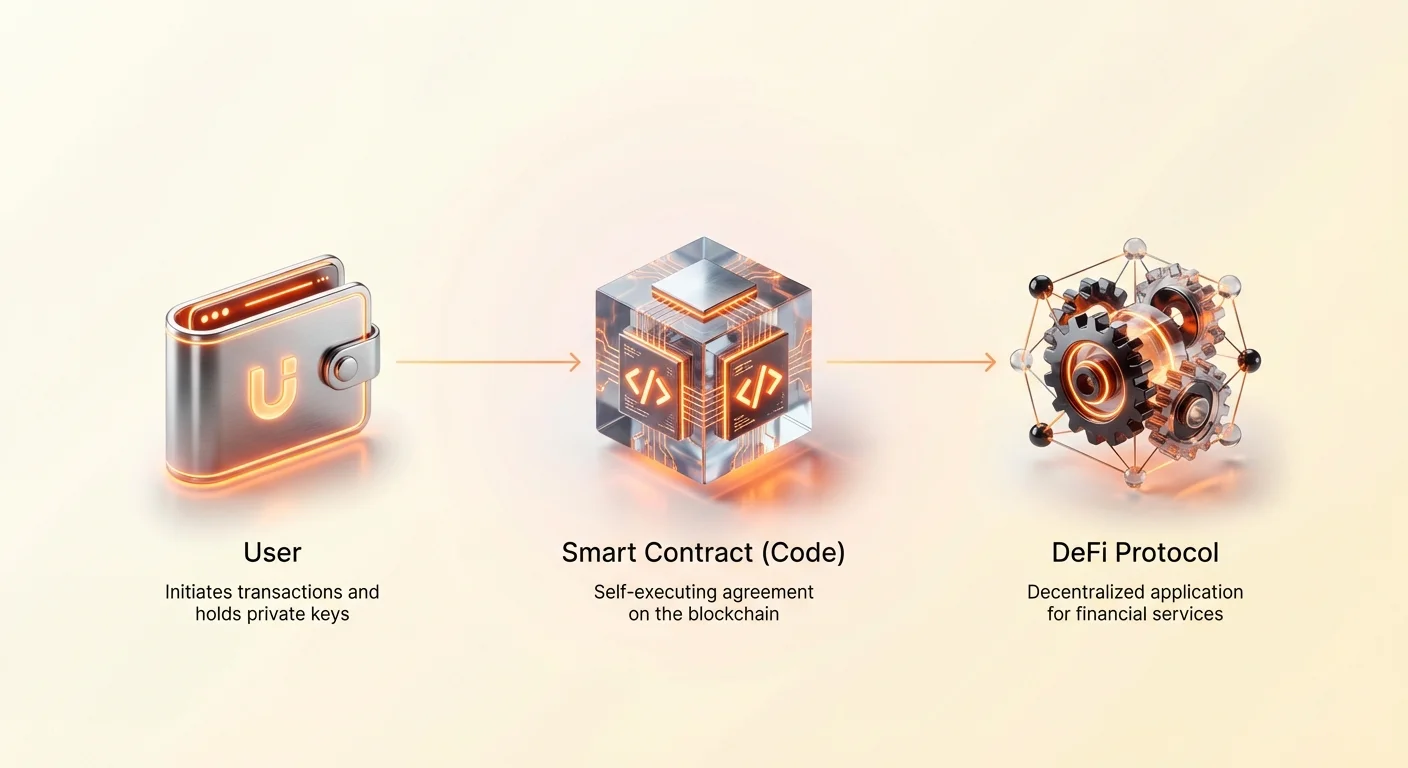
To comprehend where the yield comes from, one must first understand the vehicle that delivers it. DeFi relies on decentralized applications, or dApps. These are software programs that run on peer-to-peer networks rather than centralized servers. Unlike a traditional app that connects you to a company's database, a dApp connects you to a blockchain.
The engine powering these applications is the smart contract. A smart contract is a self-executing agreement with the terms written directly into code. It lives on a trustless network, meaning its validity does not depend on a third party. When you deposit funds into a high-yield DeFi account, you are not giving money to a banker. You are sending assets to a smart contract address that is programmed to perform specific functions automatically, ensuring immutability and finality.
This automation is the key driver of efficiency. In traditional finance, executing a loan or a trade involves settlement layers and manual verification. Smart contracts handle these processes instantaneously and transparently. Because the code is open-source, anyone can verify how the contract functions. This transparency eliminates the "black box" nature of traditional banking, where customers rarely know how their deposits are being utilized or what the true profit margins of the institution are.
Smart Contracts vs. Traditional Agreements
The distinction between a paper contract and a smart contract is critical for investors. A traditional contract relies on legal systems and enforcement for validity. If a counterparty breaches the agreement, the remedy involves lawyers and courts. This creates a high barrier to entry and significant overhead costs. These costs ultimately eat into the returns available to the investor.
Smart contracts, by contrast, are deterministic. They execute exactly as programmed based on "if this, then that" logic. For example, a contract can be programmed to release funds only when a specific condition is met. If the condition is not met, the funds remain locked or are returned. There is no need for an escrow agent or a lawyer to oversee the transaction. The code itself acts as the impartial judge and executioner of the agreement.
This technology transforms the nature of trust. In a traditional investment, you trust the reputation of the bank or the regulatory framework of the country. In DeFi, you trust the logic of the code. While this introduces new technical risks, it removes the risk of human error, bias, or institutional fraud in the execution of the agreement. This efficiency allows for the creation of complex financial products that are accessible to anyone with an internet connection.
Mechanics of Yield Farming and Lending
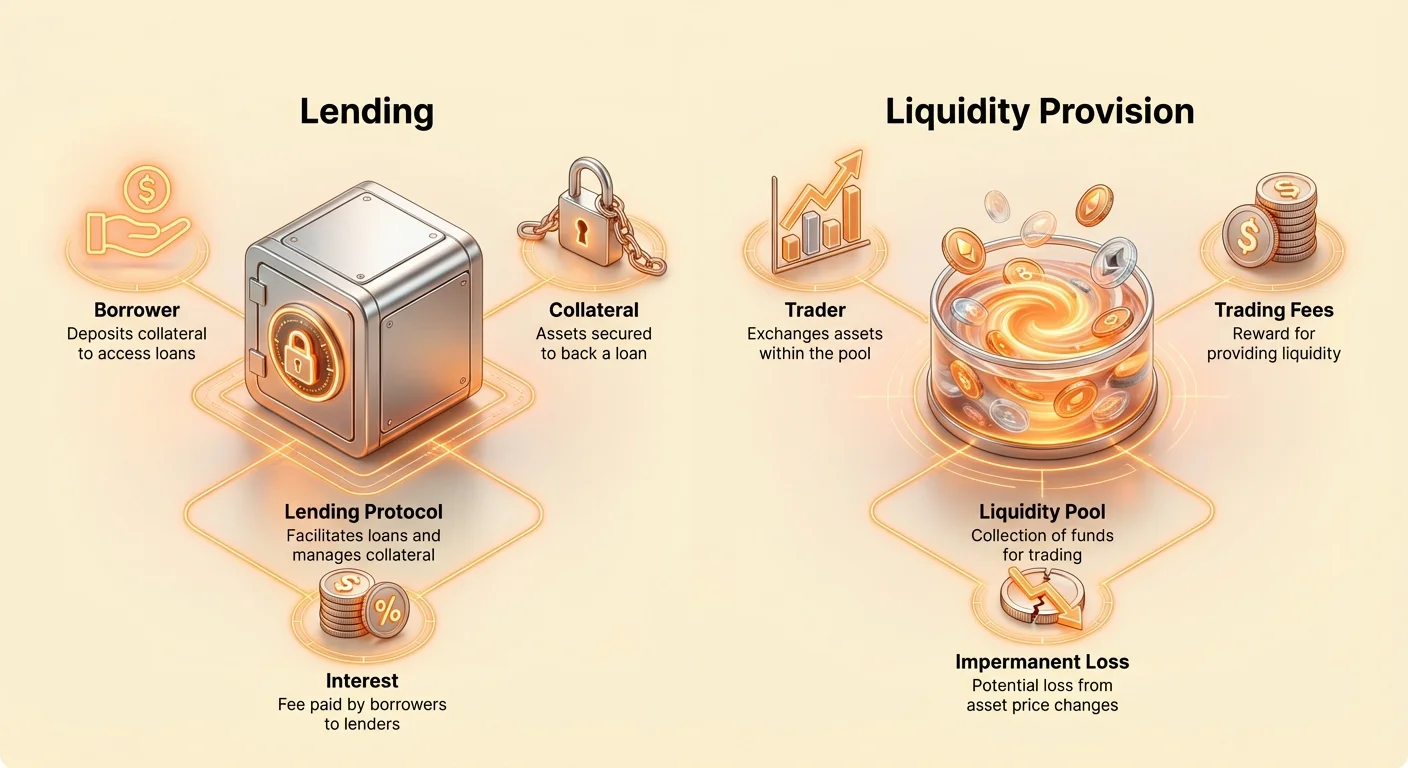
Yield farming is a term that describes the process of putting crypto assets to work to generate returns. It is analogous to a high-yield savings account but operates through different mechanisms. In the traditional world, a bank takes your deposit, lends it out at a higher rate, and pays you a fraction of the interest. In DeFi, you deposit your assets into a liquidity pool or a lending protocol, and the smart contract distributes the fees or interest directly to you.
One of the most common strategies involves smart contract-based lending. Users can deposit cryptocurrencies like Ethereum or stablecoins into a protocol to be lent out to borrowers. The borrowers pay interest, which is distributed to the lenders. Because there is no bank taking a cut for overhead, the yields can be significantly higher. However, the mechanics of securing these loans differ substantially from traditional credit.
Over-Collateralization and Risk Management
In traditional banking, loans are often secured by credit scores and legal recourse. If a borrower defaults, the bank pursues them legally. In DeFi, there are no credit scores and identities are often anonymous. To solve this, protocols use over-collateralization. This means that to borrow funds, a user must deposit more value than they wish to borrow.
For instance, a smart contract might require a user to deposit $200 worth of Ethereum to borrow $100 worth of stablecoins. The smart contract holds the Ethereum as collateral. If the value of the Ethereum drops below a certain threshold, the contract automatically liquidates the collateral to repay the loan. This mechanism ensures that the lending pool remains solvent without needing to know the identity of the borrower, allowing users to monitor LTV and liquidation risks.
This system allows for "permissionless" participation. Anyone can become a lender and earn yield, and anyone with assets can become a borrower. The yield generated is dynamic, fluctuating based on supply and demand for the specific asset. During periods of high demand for leverage, interest rates in DeFi can spike dramatically, providing lucrative returns for lenders that are uncorrelated with traditional interest rates set by central banks.
Liquidity Provision and Trading Fees
Another primary avenue for yield is providing liquidity to decentralized exchanges (DEXs). A DEX allows users to trade one digital asset for another without a centralized order book. Instead, they rely on Automated Market Makers (AMMs). These protocols require pools of assets to facilitate trades.
Investors can deposit pairs of assets, such as ETH and USDC, into these pools. In return, they receive a portion of the trading fees generated by the platform. This is often referred to as "crowd-sourced" liquidity. In traditional markets, market making is reserved for large institutional players. In DeFi, any individual can be a market maker.
The ROI from liquidity provision comes from trading volume. The more activity a trading pair sees, the more fees are generated for the liquidity providers. However, this comes with the risk of impermanent loss, where the value of the deposited assets changes relative to holding them simply in a wallet. Despite this, the combination of trading fees and additional token incentives often results in annualized returns that far exceed traditional equity dividends, especially when strategies are employed for mitigating impermanent loss.
Airdrops: The Hidden ROI Factor
When comparing ROI, one unique feature of the crypto ecosystem is the "airdrop." This concept has no direct equivalent in traditional investing. An airdrop occurs when a project distributes free tokens to users who have interacted with their protocol. This is often done to decentralize governance, reward early adopters, or market the project to a wider audience.
For an active DeFi participant, airdrops can represent a significant portion of their total return. Projects may take a "snapshot" of the blockchain at a specific date. Addresses that engaged with the protocol before that date—by trading, lending, or holding assets—are deemed eligible. The distributed tokens often have immediate market value and can sometimes be sold for substantial sums.
Mechanisms of Distribution
Airdrops are not random; they are meritocratic based on on-chain activity. Early models simply required a wallet address, but modern airdrops use sophisticated metrics. They might look at the volume traded, the duration of liquidity provision, or the number of interactions with a smart contract. This rewards genuine users rather than passive speculators.
For example, when a major decentralized exchange launches a governance token, they might retroactively reward every user who ever made a trade on the platform. In traditional finance, using a stock brokerage for years does not entitle you to free equity in the brokerage firm. In Web3, user ownership is a core tenet, and airdrops are the mechanism for transferring that ownership.
This adds a layer of speculative ROI to yield farming. Users often interact with new protocols not just for the immediate yield, but for the potential of a future airdrop. While not guaranteed, these "loyalty dividends" can significantly boost the overall profitability of a DeFi portfolio compared to a static stock portfolio, especially if they follow a clear airdrop hunting strategy.
Analyzing the Risk Spectrum
While the ROI in DeFi is alluring, it is inextricably linked to higher risk. The phrase "high yield" serves as a signal for high risk in any financial market, and crypto is no exception. Traditional investing in government bonds or blue-chip stocks carries risks related to interest rates and economic downturns. DeFi carries these market risks but adds technical and systemic risks unique to the sector.
Smart Contract Vulnerabilities
The most prominent risk in DeFi is code failure. Smart contracts are written by humans, and human code can contain bugs. Even reputable projects that have been audited by security firms can suffer from exploits. If a hacker finds a loophole in the logic of the smart contract, they may be able to drain the funds pooled within it.
In traditional finance, if a bank's software has a glitch, the bank is usually liable, and insurance (like FDIC in the US) protects deposits up to a limit. In DeFi, transactions are irreversible. If a smart contract is drained, the funds are often lost permanently. There is rarely a customer service department to call or a legal recourse to pursue, especially if the attackers remain anonymous.
This "technical risk" means that an investor must trust not only the market conditions but also the integrity of the software. The open-source nature of dApps allows for community vetting, which strengthens security over time. The longer a protocol exists without incident, the more "battle-tested" it is considered. However, for newer protocols offering the highest yields, the risk of a zero-day exploit remains a primary concern.
Malicious Actors and Rug Pulls
Beyond accidental bugs, there is the risk of deliberate fraud. The permissionless nature of blockchain means anyone can deploy a smart contract. Scammers can create dApps that look legitimate but contain malicious code designed to steal funds. This is known as a "rug pull."
In a typical scenario, developers might launch a project with high advertised yields to attract capital. Once a significant amount of value is locked in the protocol, the developers use a backdoor in the code to withdraw all user funds and disappear. Alternatively, they might hold a massive supply of the project's native token and dump it on the market, crashing the price to near zero.
Phishing is another vector for loss. Attackers often create replica websites that mimic popular DeFi platforms. If a user connects their wallet to these fake sites, they may inadvertently sign a transaction giving the attacker permission to drain their assets. This requires investors to be hyper-vigilant about verifying URLs and contract addresses—a level of due diligence not typically required when logging into a brokerage account, which is covered in our advanced DeFi security guide.
Comparative Overview: TradFi vs. DeFi
To summarize the differences in ROI potential and structure, it helps to look at the fundamental drivers of value in both systems. Traditional investing relies on the growth of underlying businesses or the creditworthiness of governments. DeFi investing relies on market efficiency, liquidity demand, and protocol usage.
| Feature | Traditional Investing | DeFi Yield Farming/Staking |
|---|---|---|
| Source of Yield | Corporate profits, debt interest | Trading fees, lending interest, token inflation |
| Access | Permissioned (KYC, Geography) | Permissionless (Global, Open) |
| Custody | Third-party (Bank/Broker) | Self-custody (Smart Contract) |
The "risk-free rate" in traditional finance is generally considered to be the yield on US Treasury bonds. In DeFi, there is no true risk-free rate. Even stablecoin yields, which utilize assets pegged to the dollar, carry smart contract and de-pegging risks. Therefore, the premium earned in DeFi is compensation for assuming these complex technological and systemic risks.
The Role of Intermediaries
The absence of intermediaries in DeFi is the primary reason for the disparity in returns. In TradFi, the spread between what a borrower pays and what a depositor receives is the bank's profit margin. In DeFi, this spread is compressed significantly. Smart contracts do not require salaries, bonuses, or office space. They run on gas fees paid to the network.
This efficiency allows for a more equitable distribution of wealth among participants. However, it also places the burden of responsibility entirely on the user. In TradFi, the intermediary provides a layer of safety and customer support. In DeFi, the user is their own bank. This sovereignty is powerful but unforgiving. A lost private key or an interaction with a malicious contract results in irreversible loss.
The Future of Yield
As the technology matures, the gap between these two worlds may narrow. We are already seeing the emergence of "CeDeFi" (Centralized Decentralized Finance) and institutional adoption of smart contracts. Regulatory frameworks are beginning to catch up, potentially offering more consumer protections for DeFi participants. This could lower the risks, but likely compress the yields as compliance costs are introduced.
Currently, yield farming and staking represent a frontier in investment. They offer tools for wealth generation that were previously accessible only to sophisticated market makers or banks. The ability to earn yield on assets without selling them, to participate in governance, and to receive airdrops creates a dynamic investment environment.
For the traditional investor, allocating capital to DeFi requires a shift in mindset. It moves away from analyzing quarterly earnings reports to analyzing tokenomics, total value locked (TVL), and smart contract audits. The ROI potential is higher because the participant is taking on the roles previously held by infrastructure providers.
Conclusion
Yield farming and staking offer a compelling alternative to traditional fixed-income and equity strategies. By leveraging smart contracts and decentralized networks, investors can access revenue streams that were previously captured by financial intermediaries. The automation of lending, borrowing, and trading allows for near-instant settlement and transparent fee distribution. This structural efficiency is the primary driver behind the elevated returns seen in the sector.
However, these returns are not free money. They are the market's compensation for navigating a complex, technical, and unregulated landscape. The risks of smart contract exploits, rug pulls, and user error are significant and omnipresent. Unlike traditional finance, where safety nets exist, DeFi requires a high degree of personal responsibility and technical literacy. The potential for outsized ROI exists, but it is inextricably paired with the risk of total capital loss.
DeFi offers higher potential returns by removing middlemen, but requires technical vigilance and acceptance of significant software-based risks.