
Constructing a cryptocurrency portfolio that tracks a specific market index or sector requires more than just selecting a basket of assets. It demands a sophisticated approach to execution, maintenance, and performance measurement. Investors seeking to mirror the performance of the broader market or specific niches must navigate liquidity constraints, transaction costs, and rebalancing intervals.
The primary goal of index tracking is to capture the beta, or general market performance, of a defined asset class. In the volatile world of digital assets, this often involves holding a weighted mix of high-cap coins like Bitcoin and Ethereum, alongside a tail of smaller altcoins. However, the mechanics of acquiring these assets and keeping the portfolio aligned with its target weights present unique operational challenges.
Successful index tracking relies heavily on the choice of execution venues. For the initial construction of a portfolio, especially when capital deployment is significant, standard retail exchanges may not offer sufficient liquidity at a stable price. Conversely, for the ongoing maintenance of the portfolio, such as minor adjustments to asset weights, speed and low fees become the priority. Understanding the distinct roles of Over-the-Counter (OTC) desks, swap platforms, and zero-fee exchanges is essential for choosing the right venue for building a robust tracking strategy.
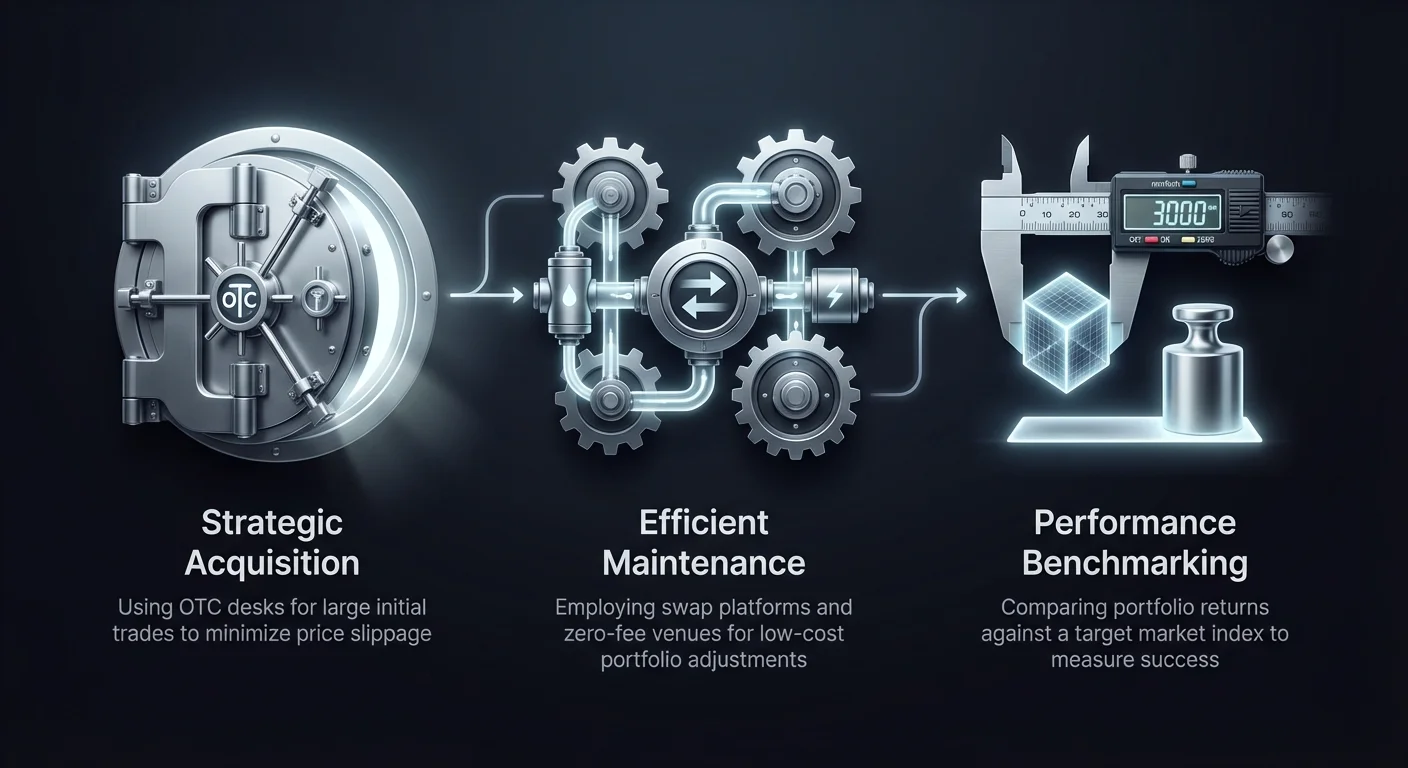
Strategic Execution for Large Allocations
When initiating a position for a crypto index fund or a substantial personal portfolio, the method of acquisition is critical. Buying large quantities of multiple assets on a standard order book can lead to slippage, where the act of buying drives the price up, resulting in a higher average entry cost. This market impact can immediately degrade the performance of an index relative to its theoretical benchmark.
Leveraging OTC Desks for Initial Deployment
Over-the-Counter (OTC) trading provides a solution for the initial capital deployment phase of portfolio construction. OTC desks facilitate direct transactions between a buyer and a seller, bypassing the public order books of centralized exchanges. This structure allows for the execution of large volumes without signaling intent to the broader market or causing immediate price spikes.
For an index tracker, this means the core components of the portfolio, such as Bitcoin or Ethereum, can be acquired at a predictable price. Institutional-grade OTC platforms often utilize smart order routers that connect to global liquidity pools. This ensures that even massive orders are filled with minimal market disruption.
Furthermore, OTC services often provide personalized support, including trade facilitation and settlement assistance. This human element is valuable when coordinating the complex entry requirements of a multi-asset portfolio. Settlement times are also a key factor; premier desks offer same-day settlement on wire transactions, allowing the portfolio manager to deploy capital efficiently and reduce the "cash drag" that occurs when funds sit idle.
Privacy and Price Stability
Confidentiality is another operational advantage of using OTC desks for index construction. When large buy orders appear on a public exchange, they can attract predatory trading behaviors, such as front-running. By keeping the transaction off the public books, investors protect their entry prices.
Additionally, some OTC providers offer price-matching features or competitive execution guarantees. This ensures that the portfolio's cost basis remains as low as possible relative to the market average at the time of trade. Securing a favorable entry price is the first step in successfully tracking an index, as high initial costs create a performance deficit that must be overcome by future gains.
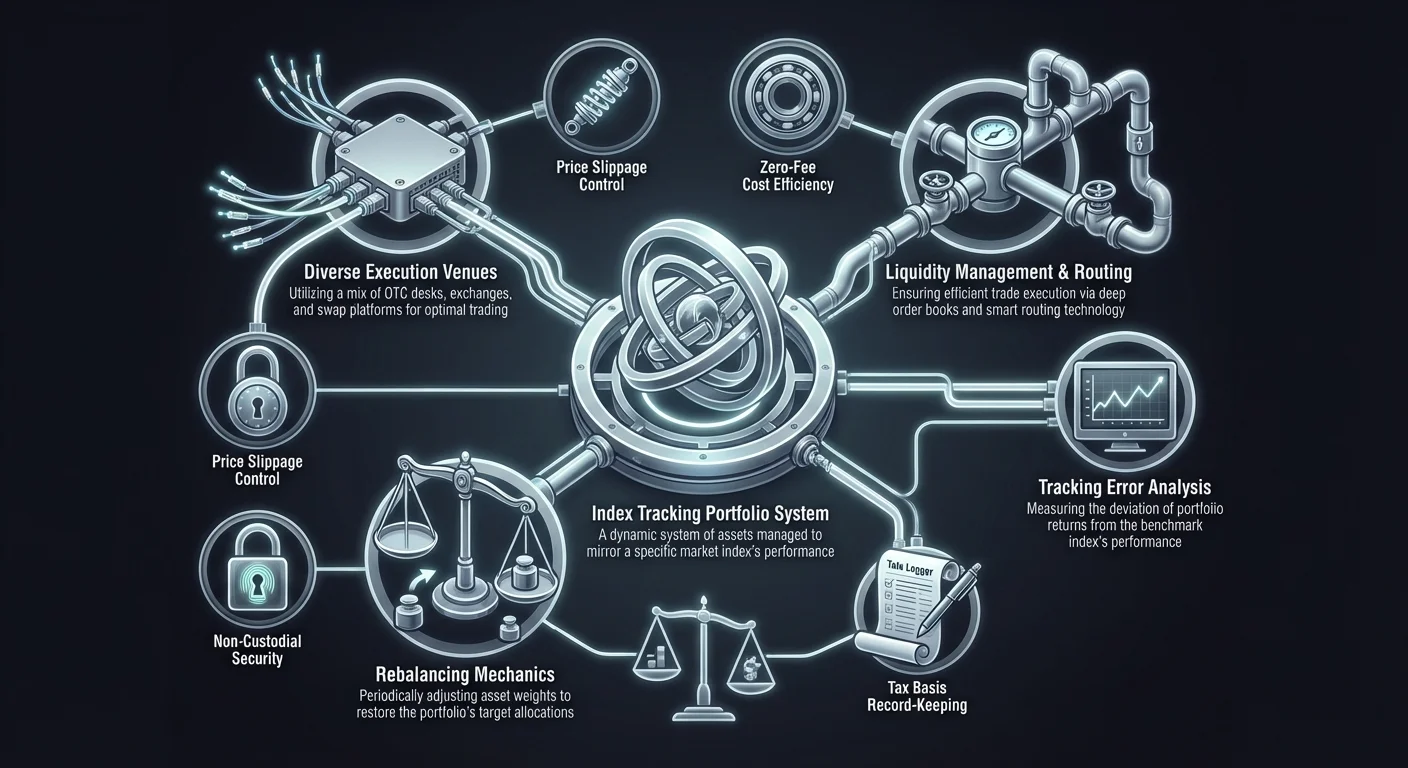
Rebalancing Mechanics and Swap Platforms
Once a portfolio is constructed, the market values of individual assets will inevitably diverge from their target weights. A coin that doubles in value may suddenly represent too large a portion of the index, while a lagging asset may become underrepresented. Rebalancing is the process of selling winners and buying losers to restore the original target allocations.
The Role of Instant Swap Platforms
Cryptocurrency swap platforms have emerged as vital tools for the maintenance phase of index tracking. Unlike traditional exchanges that may require moving funds between trading accounts or navigating complex order types, swap platforms facilitate direct exchanges between assets. This is particularly useful for rebalancing, where the goal is to convert a portion of Asset A directly into Asset B.
Non-custodial swap services allow investors to execute these adjustments without depositing funds into a centralized exchange wallet. This aligns with security best practices, as the assets remain under the user's control until the moment of exchange. The speed of these transactions is also a factor; high-performance swap engines can complete exchanges in minutes, ensuring that the portfolio does not remain unhedged or misaligned for long periods.
Managing Volatility with Rate Options
During the rebalancing process, market volatility can alter the exchange rate between the time a transaction is initiated and when it settles. To mitigate this, sophisticated swap platforms often offer two distinct rate models: fixed and floating rates.
| Rate Type | Mechanism | Best Use Case |
|---|---|---|
| Fixed Rate | Locks price at transaction start | Volatile markets/precise weighting |
| Floating Rate | Price updates until settlement | Stable markets/accepting variance |
For index tracking, where precise weighting is often the objective, fixed-rate swaps provide certainty. The portfolio manager knows exactly how much of the target asset they will receive, allowing for accurate realignment of the portfolio percentages. Floating rates may offer a slightly better price if the market moves favorably, but they introduce uncertainty that can complicate the strict mathematical requirements of index rebalancing.
Cost Efficiency and Zero-Fee Trading
The frequency of rebalancing has a direct impact on the net performance of a portfolio. Frequent adjustments ensure the index is tracked closely but can rack up significant transaction fees. Conversely, infrequent rebalancing saves money but allows for "drift," where the portfolio no longer resembles the target index. Minimizing trading costs is therefore essential for strategies that require regular activity.
Utilizing Zero-Fee Exchanges
Zero-fee crypto exchanges have become an important component in the toolkit of active portfolio managers. These platforms eliminate commission costs on spot and sometimes futures trading, allowing for friction-free adjustments. For a portfolio that tracks a dynamic index requiring weekly or even daily rebalancing, the savings from zero-fee trading can compound significantly over time.
By removing the cost barrier to trade execution, these platforms allow for more granular management. An investor can correct a minor deviation in asset weight of 1% or 2% without worrying that the trading fee will exceed the benefit of the adjustment. This capability enables "continuous rebalancing" strategies that keep the portfolio extremely tight to its benchmark.
Strategic Order Types
Beyond simple fee avoidance, advanced order types available on these platforms support better index tracking. Limit orders, for instance, allow the manager to set specific price points for rebalancing, ensuring that assets are only sold or bought when they hit favorable valuations.
Some platforms also incentivize liquidity provision. In a "maker-taker" fee model, placing a limit order that adds liquidity to the book might earn a rebate rather than costing a fee. For sophisticated index builders, acting as a market maker during the rebalancing process can actually generate a small revenue stream, effectively turning an operational cost into a gain.
Benchmarking and Performance Utility
Building the portfolio is only half the battle; measuring its success is the other. Benchmarking is the process of comparing the portfolio's returns against a standard reference point. In the context of index tracking, the benchmark is the theoretical index itself (e.g., the Top 10 Crypto Index or a DeFi Sector Index).
Tracking Error and Analysis
The primary metric for success in this strategy is "tracking error," which measures the standard deviation of the difference between the portfolio's returns and the benchmark's returns. A low tracking error indicates that the execution strategies—using OTC for bulk, swaps for speed, and low-fee venues for maintenance—are working effectively.
If the tracking error is high, it suggests that operational inefficiencies are dragging down performance. This could be due to high slippage during rebalancing, excessive fees, or delays in trade execution. Analyzing these metrics helps the investor refine their choice of platforms. For example, if slippage is identified as the culprit, moving larger rebalancing trades to an OTC desk or a platform with deeper liquidity might be the solution.
Comparative Benchmarking
Investors also use benchmarks to determine if their index strategy is worth the effort compared to holding a single asset like Bitcoin. By plotting the portfolio's performance against Bitcoin's price action, one can assess whether the diversification into altcoins is providing alpha (excess returns) or simply increasing volatility.
This comparative analysis is crucial for validation. If a complex 20-asset index consistently underperforms a simple Bitcoin holding after factoring in fees and taxes, the strategy may need to be reassessed. This highlights the importance of the cost-saving measures discussed earlier; often, it is the reduction of friction costs via zero-fee trading or efficient swaps that allows a diversified index to outperform a single-asset holding.
Security Considerations in Portfolio Management
The operational complexity of managing an index-tracked portfolio introduces multiple attack vectors. Unlike holding a single asset in cold storage, an active index strategy requires frequent interaction with various platforms and smart contracts.
Custodial vs. Non-Custodial Risks
When using centralized exchanges for zero-fee trading or OTC desks, investors face counterparty risk—the danger that the platform itself could fail or be compromised. To mitigate this, best practices involve keeping the majority of the portfolio's value in cold storage and only moving the specific amounts needed for rebalancing onto the exchange.
Non-custodial swap platforms offer an alternative that aligns better with security-conscious investors. Since these platforms do not hold user funds, the risk of a centralized hack is significantly reduced. The assets move directly from the user's wallet to the swap contract and back, ensuring that the investor retains control of the private keys at all times.
Regulatory Compliance and Safety
Using regulated platforms adds another layer of security. Exchanges and OTC desks that adhere to frameworks like KYC (Know Your Customer) and hold certifications (such as SOC 1/2) demonstrate a commitment to operational integrity. While this reduces privacy compared to anonymous trading, it provides legal recourse and assurance of solvency, which is vital for institutional-grade portfolios.
Investors must weigh the trade-offs between the speed and privacy of unregulated decentralized platforms and the safety assurances of regulated centralized entities. Often, a hybrid approach is best: utilizing regulated OTC desks for the massive core positions and decentralized or non-custodial tools for agile handling of the smaller, more volatile tail assets.
Institutional Approaches to Indexing
Institutional investors have pioneered many of the strategies now available to retail traders. Their approach to index tracking is characterized by a heavy reliance on algorithmic execution and deep liquidity access.
Smart Order Routing
Institutions rarely rely on a single exchange for their index construction. Instead, they utilize smart order routers that split a single large trade across multiple venues. This technique minimizes the impact on any single order book and ensures the average execution price is as close to the market mid-point as possible.
Retail investors can mimic this by manually diversifying their execution venues or using aggregators that scan multiple DEXs and CEXs for the best rates. The concept remains the same: never let the size of your trade dictate the price you pay.
Structured Liquidity Products
For very large portfolios, institutions often negotiate bespoke liquidity terms. This might involve agreeing to buy a specific volume of assets over a set period at a reference price. While retail investors cannot typically access these exact contracts, the principle of "dollar-cost averaging" serves a similar purpose.
By breaking up the acquisition of index assets over time, investors smooth out short-term volatility. This acts as a simplified version of the structured liquidity products used by hedge funds, protecting the portfolio from bad timing luck during the initial setup phase.
Tax Implications of Active Rebalancing
It is impossible to discuss portfolio rebalancing without addressing the tax consequences. In many jurisdictions, swapping one cryptocurrency for another is a taxable event. This means that every time an investor rebalances their index to restore target weights, they may trigger capital gains or losses.
Record Keeping and Basis Tracking
The frequent activity required for tight index tracking generates a high volume of transactions. Accurate record-keeping becomes a monumental task but is absolutely necessary. Investors must track the cost basis (the original value) of every fraction of a coin sold during a rebalancing event.
Using platforms that provide detailed transaction histories and API integration with tax software is essential. OTC desks and major exchanges typically offer robust reporting tools, whereas decentralized swap platforms may require more manual tracking. Failure to account for these tax liabilities can erode the perceived gains of the portfolio, making tax efficiency a core component of the overall strategy.
Strategic Loss Harvesting
Rebalancing also offers an opportunity for tax optimization through loss harvesting. If a specific asset in the index has dropped significantly in value, selling it to rebalance (or to swap into a similar asset) allows the investor to realize a loss. This loss can often be used to offset gains elsewhere in the portfolio, reducing the overall tax burden.
This advanced strategy requires precise execution. The investor must be aware of "wash sale" rules where applicable and ensure that their rebalancing activities remain compliant while maximizing tax efficiency. This interplay between maintaining index weights and managing tax liabilities is what separates professional-grade portfolio management from casual hodling.
Choosing the Right Platform Mix
Ultimately, building a crypto portfolio with index tracking is an exercise in selecting the right tools for each specific function. There is no single platform that is perfect for every aspect of the strategy.
The Hybrid Model
A hybrid model often yields the best results. An investor might use a major OTC desk to acquire the initial 70% of the portfolio that consists of Bitcoin and Ethereum, securing a stable entry price and professional settlement.
For the remaining 30% comprised of various altcoins, the investor might utilize a high-volume, zero-fee exchange to accumulate positions cost-effectively. Finally, for the monthly rebalancing maintenance, a non-custodial swap platform could be employed to quickly adjust weights without the security risk of keeping funds permanently on an exchange.
Evaluating Liquidity and Support
When selecting these platforms, liquidity is the paramount metric. A platform may offer zero fees, but if the liquidity is thin, the spread (the difference between buy and sell prices) will be wide, effectively acting as a hidden fee. Investors should prioritize platforms that demonstrate high trading volumes and deep order books for the specific assets in their index.
Customer support also plays a vital role. When managing a complex portfolio, issues with transfers or settlements can be stressful and costly. Platforms with 24/7 support and a reputation for resolving technical issues quickly add a layer of reliability that is crucial for long-term index tracking success.
Conclusion
Building a crypto portfolio that effectively tracks an index is a dynamic process that blends financial theory with technical execution. It requires a shift in mindset from picking winning coins to managing a system of assets. The structural foundation of this system relies on the intelligent use of OTC desks for capital preservation during large entries, swap platforms for agile and secure rebalancing, and zero-fee exchanges for cost-efficient maintenance.
By benchmarking performance against broader market metrics, investors can continuously refine their execution strategies. The goal is to minimize the friction caused by fees, slippage, and operational drag, thereby allowing the portfolio to capture the true performance of the market sector it tracks. As the crypto market matures, the tools available for these strategies continue to evolve, offering institutional-grade capabilities to individual investors.
Success in crypto indexing comes from combining rigorous rebalancing discipline with the strategic use of specialized execution venues to minimize costs and slippage.