
The modern financial system is built on the foundation of fiat currency—money issued by governments that is not backed by a physical commodity like gold or silver. While this system offers flexibility and facilitates economic growth, it inherently carries two major risks for savers: inflation (the steady rise in prices, reducing purchasing power) and devaluation (the loss of value in a currency relative to others).
For decades, investors have sought “safe haven” assets—like gold, real estate, or inflation-protected bonds—to protect their wealth against these risks. Bitcoin, introduced during the 2008 financial crisis, was designed with a fundamentally different monetary policy than fiat currency, immediately positioning it as a potential antidote to currency debasement.
This analysis moves beyond simple definitions to explore Bitcoin’s performance as a sophisticated macroeconomic hedge. We will distinguish between Bitcoin’s role as a Store of Value (SOV) and an active Inflation Hedge, examine its historical behavior against the Consumer Price Index (CPI), and assess its correlation with traditional inflation-fighting instruments, providing a framework for incorporating digital scarcity into a modern investment thesis.
Distinguishing the Macro Roles: Store of Value vs. Inflation Hedge
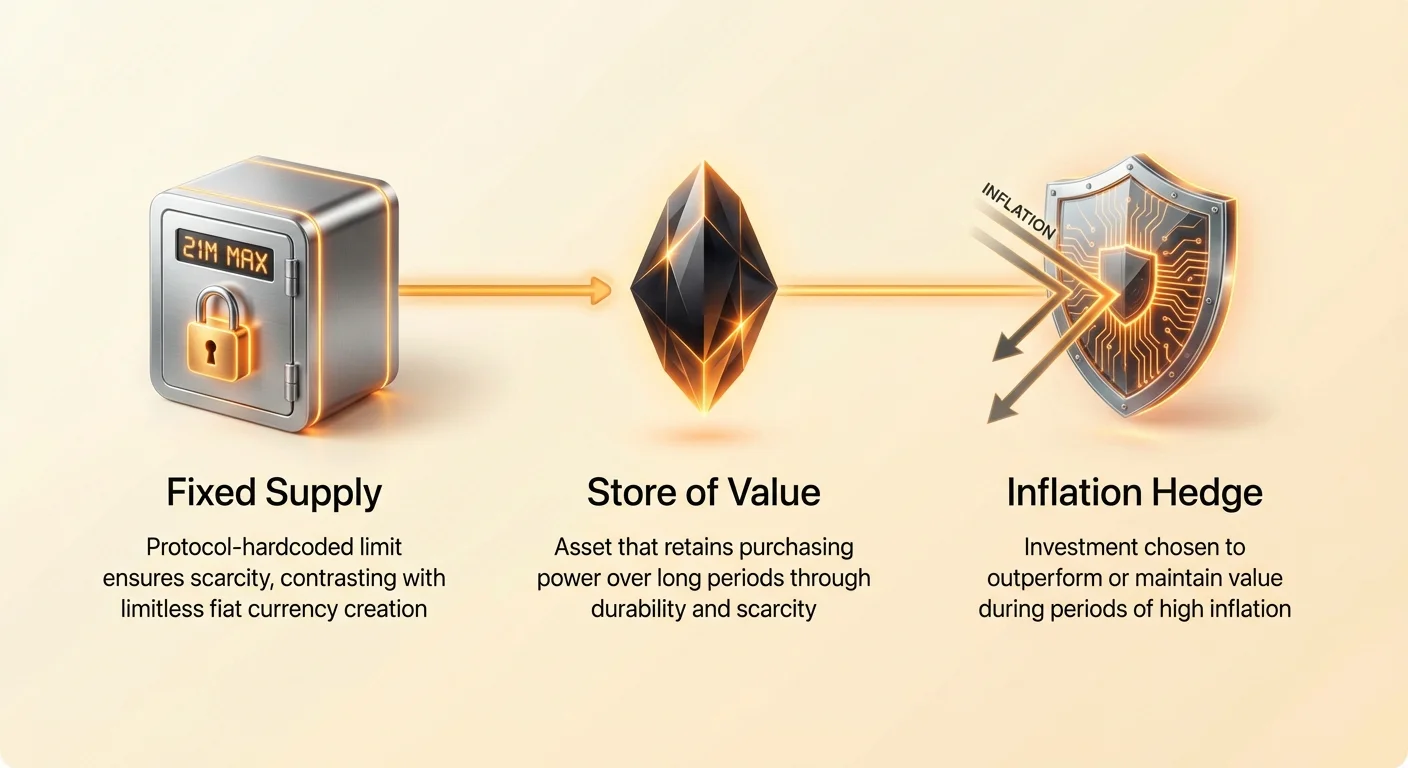
When assessing Bitcoin’s utility in a portfolio, it is crucial to understand the subtle but significant differences between two key macroeconomic functions: acting as a Store of Value and functioning as an Inflation Hedge.
The Function of a Store of Value (SOV)
A Store of Value is any asset that retains its purchasing power over long periods without significant depreciation. The primary requirements for an effective SOV are durability, portability, divisibility, and, most importantly, scarcity.
Bitcoin is designed to be a superior SOV due to its digital scarcity. Unlike fiat currencies, which can be printed endlessly, Bitcoin has a fixed maximum supply of 21 million coins. This hard cap ensures that no matter how high the demand grows or how much money is created globally, the supply of Bitcoin remains predictable and limited. This non-sovereign scarcity is the foundational layer of Bitcoin’s long-term value proposition, aiming to resist the corrosive effects of time and loose monetary policy.
The Purpose of an Inflation Hedge
An Inflation Hedge, conversely, is an asset specifically chosen to outperform or maintain purchasing power during defined periods of high inflation (usually measured by the CPI). An effective hedge must show a positive correlation with rising inflation indicators, meaning its price rises when consumer prices rise.
While Bitcoin’s scarcity makes it a strong candidate for an SOV, its role as a short-term inflation hedge is more complicated. Short-term performance analysis often shows that Bitcoin does not move in lockstep with monthly CPI data, particularly when inflation spikes are driven by short-term supply chain shocks rather than deep monetary debasement. However, its dramatic long-term appreciation suggests that it acts as a superior hedge against monetary expansion and fiat erosion over multi-year cycles.
The Convergence of Scarcity and Demand
For Bitcoin to serve as a macro hedge, it must fulfill both roles: its scarcity must provide the long-term stability of an SOV, and market demand must surge during times of systemic financial stress to provide the short-term protection of a hedge. The confluence of fixed supply (low elasticity) and growing global demand during crisis periods (high volatility) is what generates Bitcoin’s unique, though often extreme, performance profile.
The Supply Dynamics: Why Bitcoin Challenges Fiat Monetary Policy
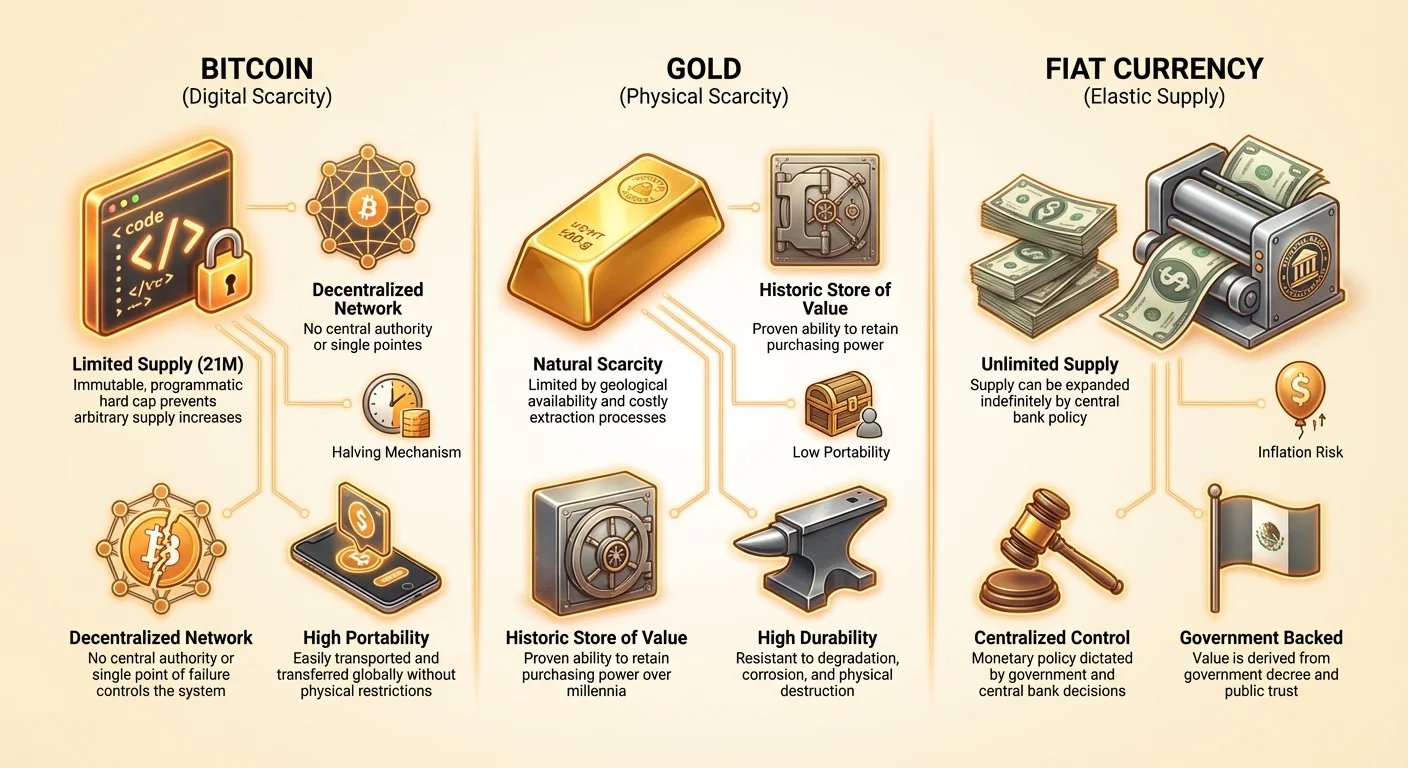
Bitcoin’s hedging capability is rooted entirely in its programmed scarcity. By contrasting the digital coin’s fixed supply mechanisms with the elastic supply of fiat currencies, we can understand the supply-side investment thesis.
The 21 Million Hard Cap
The fundamental difference between Bitcoin and the US Dollar (or any other fiat currency) is the 21 million coin limit. Central banks can, and often do, increase the money supply (M2) to stimulate the economy or finance deficits. This action devalues every existing unit of currency.
Bitcoin’s code prevents any authority, centralized entity, or consensus group from increasing the total supply. This hard cap eliminates the counterparty risk associated with central banks and government policy, making Bitcoin a unique asset in a world where almost all financial instruments carry some form of inflation risk.
The Halving Mechanism and Issuance Schedule
Bitcoin’s supply is not just finite; its issuance is predictable and decelerating. Approximately every four years, the reward miners receive for validating a block is cut in half—an event known as the Halving.
This programmatic reduction in new supply means that the inflation rate of Bitcoin is systematically falling toward zero. It creates a predictable supply shock that is designed to counteract demand fluctuations. By ensuring that the flow of new coins constantly slows down, the Halving mechanism enforces scarcity and is often viewed as the primary driver behind Bitcoin's major parabolic cycles. This controlled supply schedule is a direct algorithmic countermeasure to the uncontrolled money printing that characterizes fiat systems.
Addressing Hyperinflation and Devaluation
While mainstream economies rarely experience clinical hyperinflation (where prices rise by over 50% per month), many emerging markets regularly face severe currency devaluation. In nations grappling with unstable political systems, capital controls, and rapidly inflating domestic costs, Bitcoin often functions as a critical escape hatch.
In these localized contexts, Bitcoin is not just a theoretical hedge; it is a practical tool for preserving family wealth and facilitating cross-border trade without relying on failing government institutions. This real-world adoption underscores its value as a non-sovereign, censorship-resistant SOV, particularly when trust in the local currency approaches zero.
Analyzing Performance: BTC vs. CPI and Macro Indicators
To validate the thesis that Bitcoin is a macro hedge, we must analyze its performance during periods of elevated inflation, comparing its returns against traditional metrics like the Consumer Price Index (CPI) and M2 Money Supply.
Bitcoin Inflation Hedge Performance Over Time
Historically, Bitcoin has delivered staggering returns that, over the long term (5+ years), dwarf the erosion caused by CPI. For example, during the high-inflationary environment following the COVID-19 stimulus measures (2020–2022), the US CPI rose significantly. While short-term volatility saw major drawdowns in Bitcoin’s price, its peak performance during this cycle far outpaced CPI.
Crucially, bitcoin inflation hedge performance is measured not just in dollars, but in its ability to retain or increase purchasing power. If inflation averages 3% per year, an asset must return more than 3% just to break even. Bitcoin’s annualized returns have historically placed it far ahead of this necessary hurdle, demonstrating its long-term hedging efficacy.
The Correlation Puzzle: BTC vs. CPI
One of the main criticisms leveled against Bitcoin as an immediate inflation hedge is its often low or negative short-term correlation with monthly CPI reports. When CPI data is released, Bitcoin's price movements often track risk-on assets (like high-growth tech stocks) rather than traditional inflation assets (like oil or gold).
This behavior suggests that the market views Bitcoin less as a simple commodity hedge and more as a risk-on technology bet. When central banks raise interest rates to combat inflation, these tightening policies negatively impact speculative assets, pulling Bitcoin down with the broader market.
However, the macroeconomic correlation bitcoin exhibits changes depending on the time horizon. While short-term correlations may link it to NASDAQ, long-term analysis reveals a consistent correlation with the expansion of the global monetary supply (M2). As central banks expand their balance sheets, the resulting liquidity often flows into scarce assets like Bitcoin, solidifying its role as a hedge against fiat debasement, even if not a direct hedge against short-term price increases (CPI).
Volatility and the Cost of Hedging
While Bitcoin offers superior protection against long-term purchasing power erosion, its extreme volatility must be factored into the investment thesis. Gold, the classic inflation hedge, offers low volatility but modest returns. Bitcoin offers potential parabolic returns but comes with dramatic drawdowns (50% or more).
For an investment analyst, this means Bitcoin acts as a high-Beta, high-reward inflation hedge. It serves to turbocharge a portfolio’s inflation protection, but requires a strong stomach and a long time horizon to ride out the inevitable market cycles.
Benchmark Comparison: BTC Against Traditional Hedges
A critical step in assessing Bitcoin's utility is comparing its performance against established hedging instruments, particularly Treasury Inflation-Protected Securities (TIPS) and physical commodities like Gold.
The Role of Real Yields and BTC Correlation
The concept of real yields—the return on an investment after accounting for inflation—is central to understanding the macro environment for scarce assets. Real yields are typically derived from the yield on TIPS.
When real yields are positive (meaning bond investors are making money after inflation), it suggests that money is relatively tight, and assets tied to current cash flow (like bonds) are attractive. Conversely, when real yields are negative, it signals that inflation is eating into bond returns, making non-yielding, scarce assets (like Gold and Bitcoin) more attractive. Investors are incentivized to flee yielding instruments that guarantee a negative real return.
Historically, Bitcoin has shown a strong inverse correlation with real yields. When real yields drop deeply into negative territory, Bitcoin tends to perform strongly. This pattern reinforces the narrative that Bitcoin is primarily a hedge against monetary easing and the resulting destruction of purchasing power.
Comparison to TIPS: The Indexed Standard
Treasury Inflation-Protected Securities (TIPS) are bonds whose principal value adjusts with the CPI. They are the most direct, low-risk form of inflation protection available, offering a guaranteed positive real return (even if small).
Bitcoin cannot compete with the stability or guaranteed indexing of TIPS. TIPS are defensive and guarantee protection against CPI. Bitcoin is aggressive and volatile. TIPS are suitable for capital preservation; Bitcoin is suitable for capital appreciation over the long term, acting as a high-risk counter-balance to the guaranteed, but slow, protection offered by TIPS.
Gold and Commodities: The Hard Asset Thesis
Gold has been the standard SOV for millennia. It shares Bitcoin's scarcity (though gold supply increases slowly through mining) and resistance to central authority manipulation.
- Correlation: Gold and Bitcoin have historically exhibited low correlation with each other, meaning they move independently. This makes them excellent diversifying assets within the hedging portion of a portfolio.
- Performance: Bitcoin has vastly outperformed Gold since its inception, largely due to its superior liquidity, portability, and network adoption rate. Gold’s utility as an inflation hedge is often questioned in the short term, as it often lags CPI increases.
Commodities (like oil, industrial metals, and agricultural products) are often superior short-term hedges because their prices directly feed into the CPI calculation. However, commodities are not stores of value; they are typically consumed, requiring costly storage and carrying risks, making them unsuitable for long-term wealth preservation compared to Bitcoin.
Portfolio Integration and the Macro Hedge Thesis
For financial professionals and serious investors, integrating Bitcoin into a portfolio requires moving beyond anecdotes and applying structured investment theory.
Modern Portfolio Allocation (The Low Correlation Benefit)
One of Bitcoin's most valuable characteristics for a portfolio analyst is its historical low correlation with traditional assets (stocks, bonds, real estate). Low correlation means that when traditional assets decline (e.g., during a broad market correction or recession), Bitcoin may move independently, thus dampening overall portfolio volatility and improving risk-adjusted returns (Sharpe ratio).
While Bitcoin’s correlation with the NASDAQ has increased during recent periods of monetary tightening, it retains significant diversification benefits when viewed across a full economic cycle, particularly in the event of unforeseen systemic risks or geopolitical instability.
Bitcoin as ‘Digital Gold’ in a Systemic Risk Scenario
The core of the macro hedge thesis rests on Bitcoin’s ability to perform when trust in the traditional financial system is undermined. Its non-sovereign, permissionless nature makes it an ideal hedge against regulatory black swans, banking failures, or international conflicts that freeze or seize traditional assets.
In this context, Bitcoin acts as a global, digital safety deposit box—a risk-off asset for the digital economy. This positions it not just against inflation, but against fundamental systemic risks that government bonds or gold stored in centralized institutions might not withstand.
Actionable Tip: DCA and Long Time Horizons
Because of Bitcoin's immense volatility, attempting to time its movements based on monthly inflation reports is extremely risky. The most robust strategy for using Bitcoin as a macro hedge is Dollar-Cost Averaging (DCA).
DCA involves investing a fixed sum of money at regular intervals, regardless of price. This disciplined approach leverages the long-term upward trajectory driven by scarcity and network growth while mitigating the short-term impact of massive drawdowns, aligning the investment strategy with the multi-year macro hedge objective.
Conclusion: Is Bitcoin a Perfect Macro Hedge?
Bitcoin is not a perfect hedge against short-term, supply-shock-driven inflation (like a sudden spike in oil prices). Its high volatility means it cannot guarantee capital preservation over a six or twelve-month window like TIPS can.
However, when viewed through the lens of monetary debasement and the long-term erosion of purchasing power caused by government spending and fiat expansion, Bitcoin performs exceptionally well. Its programmed scarcity and decentralized nature make it a robust Store of Value—one that guarantees a systematically falling supply floor against the backdrop of an ever-expanding fiat supply.
Bitcoin’s true utility as a macro hedge lies in its dual function: it is a superior long-term SOV that also provides unparalleled diversification benefits due to its low correlation with most traditional assets, particularly during periods of negative real yields. For investors seeking protection against systemic financial instability and the fundamental risks associated with sovereign monetary policy, Bitcoin offers a unique, albeit volatile, mechanism for self-sovereignty and wealth preservation in the digital age.