
Kriptovalūtas ieguves pasaule bieži izraisa sarežģīta datora koda un masīvu serveru fermu attēlus. Lai gan tehniski precīzi, šis skatījums izlaiž kritisko realitāti: Bitcoin ieguve ir, pirmkārt un galvenokārt, augsta līmeņa, intensīvi konkurējošs industriālais bizness.
Ieguvēji nav tikai matemātisko mīklu risinātāji; viņi vada sarežģītas operācijas, kas paredzētas peļņas maksimizēšanai, vienlaikus nodrošinot globālu triljona dolāru vērtu tīklu. Izpratne par to, kā ieguvēji gūst ienākumus, kādas ir viņu ekspluatācijas izmaksas un kā viņi pielāgojas programmētiem ienākumu samazinājumiem (t.s. "halving"), ir būtiska, lai saprastu decentralizētās drošības ekonomisko pamatu.
Šis ceļvedis pārsniedz vienkāršas definīcijas, lai analizētu ekonomiskos stimulus, efektivitātes rādītājus un ieguves sektora ilgtermiņa dzīvotspēju. Mēs kritiski novērtēsim, kā Bitcoin tīkls plāno uzturēt savu drošības budžetu, kad sākotnējā bloka subsīdija — garantētā maksājuma ieguvējiem — neizbēgami saruks, liekot veikt fundamentālu pāreju uz atkarību no darījumu nodevām.
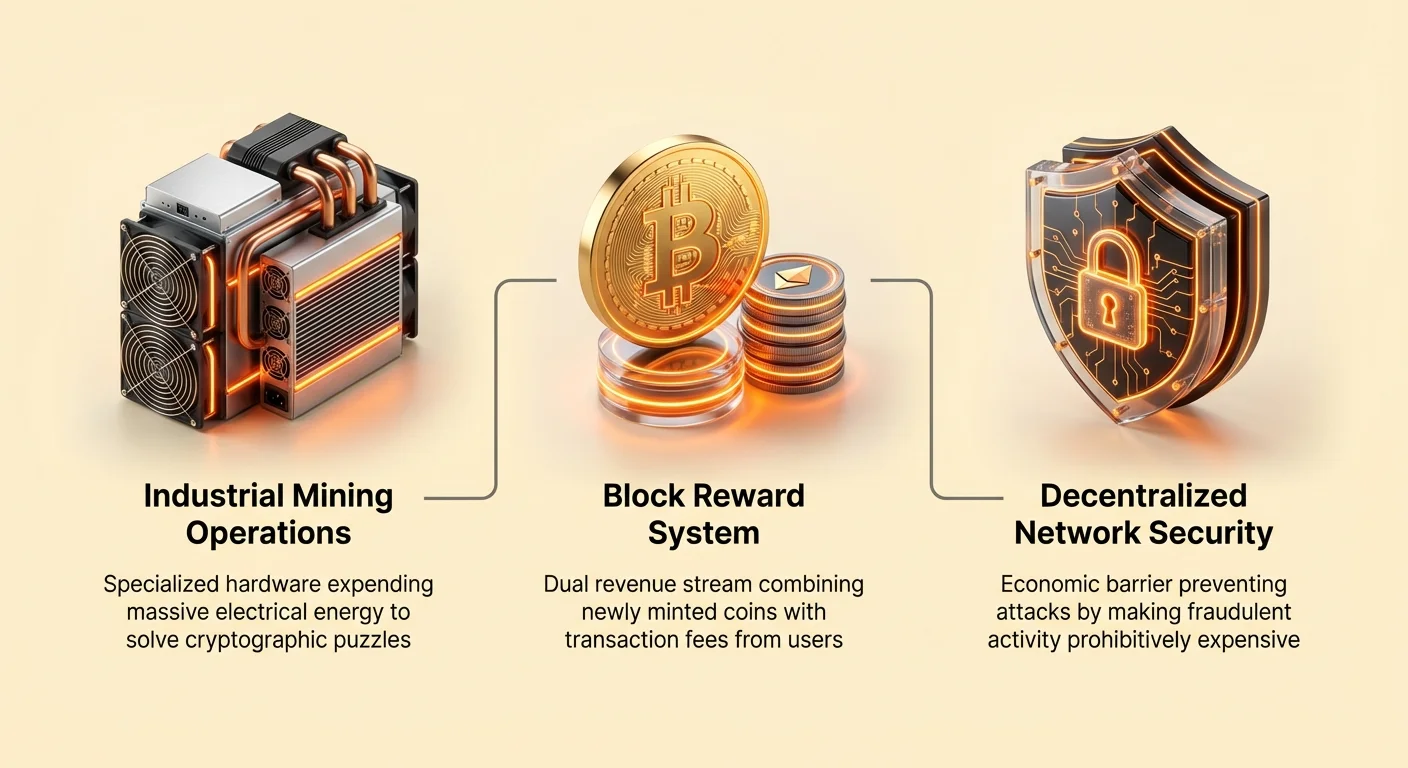
The Miner's Role: Securing the Network for Reward
Miners are the lifeblood of a Proof-of-Work (PoW) blockchain like Bitcoin. Their job is to expend real-world resources (electricity and hardware) to validate transactions, bundle them into blocks, and add these new blocks to the immutable ledger known as the blockchain. This process ensures the integrity of the network and prevents fraudulent double-spending.
This labor is not free; it is driven entirely by economic reward, known as the block reward.
The Dual Revenue Stream: Subsidy and Fees
A miner’s total income stream comes from two primary sources, which together form the Block Reward:
- The Block Subsidy: This is the primary revenue stream today. It represents brand-new coins minted by the protocol and awarded to the miner who successfully adds the next block to the chain. This subsidy is predetermined and decreases over time according to a fixed schedule.
- Transaction Fees: These are small fees paid by every user who sends a transaction on the network. The user pays this fee to incentivize miners to include their transaction in the next block. These fees are collected by the winning miner along with the subsidy.
For Bitcoin, the long-term design anticipates a complete shift, moving from the block subsidy being the dominant incentive (as it is currently) to transaction fees eventually covering the entire cost of network security.
The Function of Proof-of-Work (PoW)
Proof-of-Work is the fundamental mechanism that underpins Bitcoin’s security. It demands that miners prove they have performed computational work by attempting to solve an extremely difficult, random cryptographic puzzle.
The network is essentially holding a massive, continuous lottery. The cost of buying a "lottery ticket" is the electricity consumed by the mining hardware.
- Security: By requiring miners to spend real energy (and thus incur high costs), PoW makes it economically prohibitive for any single bad actor to seize control of the network. Attacking Bitcoin would require expending more energy than the rest of the honest network combined, an act known as a 51% attack.
- Decentralization: Because the puzzle is solved randomly, PoW ensures that any miner, anywhere in the world, who can afford the necessary hardware and energy, has a chance to win the reward and propose the next block.
Understanding the Bitcoin Block Reward
To analyze mining profitability, one must first grasp the predictable nature of Bitcoin’s revenue model, specifically the programmed decrease in the block subsidy.
Defining the Block Subsidy
When Satoshi Nakamoto designed Bitcoin, they instituted a fixed supply cap of 21 million coins. To manage the issuance of these coins and distribute them fairly over time, they created the block subsidy.
Initially, the subsidy was 50 BTC per block. A new block is found, on average, every 10 minutes. This structured release rate provides both a predictable schedule for coin introduction and a robust, guaranteed payment for miners in the early stages of the network's life.
This guaranteed subsidy is the bedrock of the early Bitcoin security model, allowing the network to bootstrap security before widespread transaction usage could support a competitive fee market.
The Halving Mechanism: An Economic Clock
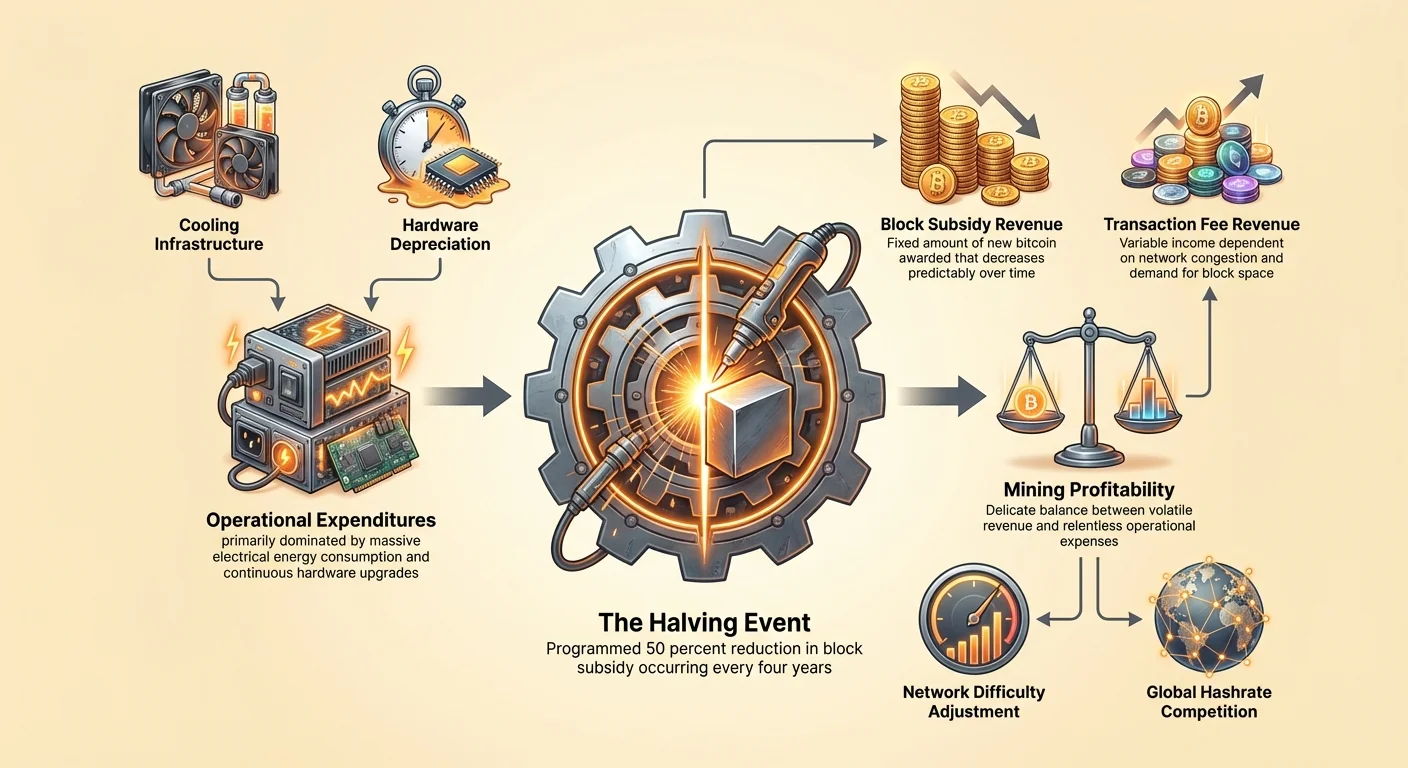
The most crucial factor influencing the mining business model is the halving. The halving is a programmed event where the block subsidy is cut in half approximately every four years (specifically, every 210,000 blocks).
| Halving Year | Pre-Halving Subsidy | Post-Halving Subsidy |
|---|---|---|
| 2009 (Genesis) | 50 BTC | |
| 2012 | 50 BTC | 25 BTC |
| 2016 | 25 BTC | 12.5 BTC |
| 2020 | 12.5 BTC | 6.25 BTC |
| 2024 | 6.25 BTC | 3.125 BTC |
The halving serves two core economic functions:
- Controlled Scarcity: It ensures predictable disinflation, increasing the scarcity of Bitcoin over time.
- Stress Test: It forces miners to continually become more efficient and rely less on the guaranteed reward, paving the way for the eventual transition to a fee-driven economy.
Each halving creates a massive economic shockwave, instantly slashing a miner's primary revenue source by 50%. This event is what drives the unrelenting industrial need for higher efficiency and lower operational costs.
The Centrality of Transaction Fees
As the subsidy shrinks toward zero (projected around the year 2140), transaction fees must take over the entire burden of funding network security.
Transaction fees are paid by users who want their transfers confirmed by miners. If you send a transaction, it first lands in the mempool (memory pool), a waiting area for unconfirmed transactions.
Miners prioritize transactions based on the fee offered per byte of data. This creates a market where fees rise dramatically when the network is congested and competition for block space is high.
- Fee Volatility: Unlike the fixed subsidy, fee revenue is highly volatile. It can spike during periods of high market activity or innovation (like during the growth of NFTs or layer-2 solutions) and plummet during quiet market lulls.
- The Incentive Problem: The long-term challenge is ensuring that even during periods of low usage, the total revenue (subsidy + fees) remains high enough to compensate the miners necessary to secure the network. If revenue drops too low, miners switch off, the network hashrate falls, and the cost of launching a 51% attack decreases, thereby lowering security.
Calculating Mining Profitability: The Economics of Competition
Mining is a highly optimized game of margins. Understanding profitability requires moving beyond the simple price of Bitcoin and analyzing the specific costs and efficiencies of the operation.
Key Input Costs (The Operating Ledger)
A successful mining operation runs like any energy-intensive industrial business. The main variable costs are relentless and must be optimized hourly:
- Electricity (The Dominant Cost): This is the single largest expense, often accounting for 70% to 90% of a miner’s operating budget. Profitability is critically dependent on the cost per kilowatt-hour (kWh). Operations often locate in areas with stranded energy (e.g., natural gas flaring sites, remote hydroelectric dams) to secure the lowest possible prices.
- Hardware Depreciation (The Capital Expenditure): Mining uses specialized hardware known as Application-Specific Integrated Circuits (ASICs). These machines are costly, but their lifespan is short, typically only 2-4 years before newer, more powerful models make them obsolete (a process called obsolescence by efficiency). Miners constantly budget for upgrading their fleet.
- Infrastructure and Cooling (Overhead): This includes the physical structure (the warehouse or modular data center), networking gear, security, and crucially, cooling systems. The constant heat generated by thousands of ASICs requires substantial capital and energy input for climate control.
- Maintenance and Labor: While automated, large facilities require technicians for repair, monitoring, and optimization.
The Profitability Equation: Revenue vs. Difficulty
A miner's ability to turn a profit is a race against two moving targets: the market price of Bitcoin and the network difficulty.
Revenue is straightforward: (BTC Mined per Day) * (BTC Price).
The Challenge of Difficulty: As more miners join the network (attracted by high profitability), the total combined computing power (hashrate) increases. Bitcoin’s protocol automatically adjusts the puzzle's difficulty every 2,016 blocks (roughly every two weeks) to ensure that, regardless of how much computing power is on the network, a block is found, on average, every 10 minutes.
- Impact: When difficulty rises, an individual miner, using the same hardware and energy as before, mines fewer coins. This immediately squeezes margins and forces the least efficient miners to shut down until the difficulty falls again, or until the Bitcoin price rises to absorb the increased cost.
The Profitability Hurdle: A miner only stays in business if:
\text{Revenue} > \text{Variable Costs (Electricity) + Fixed Costs (Overhead)}
When the electricity cost to produce one Bitcoin exceeds the market price of one Bitcoin, the operation becomes instantly unprofitable and must be curtailed.
Introducing Hashrate and Efficiency Metrics
Miners measure their output using two key terms:
- Hashrate: This is the rate at which the mining hardware can perform cryptographic calculations. It is measured in hashes per second (H/s), typically scaled up to Terahashes (TH/s) or Petahashes (PH/s). A miner’s goal is to maximize their total hashrate contributing to the network.
- Joule per Terahash (J/TH) or Watt per Terahash (W/TH): This is the measure of the hardware's energy efficiency. It tells a miner how much energy (Joules or Watts) is required to perform one unit of computation (Terahash). Modern ASIC manufacturers relentlessly compete to lower this number. The lower the J/TH, the more profitable the machine, regardless of the price of Bitcoin.
Example Scenario:
- Old Miner A: Produces 100 TH/s at 50 W/TH (5,000 Watts total).
- New Miner B: Produces 100 TH/s at 25 W/TH (2,500 Watts total).
Miner B is twice as energy-efficient, meaning they pay half the electricity cost to secure the same revenue. This efficiency gap is the reason why older machines must be consistently retired or relocated to areas with nearly free energy sources.
Energy Efficiency Metrics: The Industrial Reality
For financial professionals and serious investors analyzing the mining sector, two key metrics—PUE and EROEI—are essential for assessing the operational excellence and true cost of securing the network.
Power Usage Effectiveness (PUE) Explained
PUE is an industry standard metric used in data centers to measure energy efficiency. It is the ratio of the total energy entering the mining facility to the energy actually consumed by the mining equipment itself.
- Interpretation: A PUE of 1.0 would mean that 100% of the energy is going directly to the miners, with zero energy lost to cooling, lighting, or ventilation. This is physically impossible.
- Real-World Goal: Most well-optimized industrial mining facilities aim for a PUE between 1.05 and 1.2. A facility with a PUE of 1.2 means that for every 100 Watts consumed by the ASICs, an extra 20 Watts are spent on supporting systems (cooling, fans, etc.).
- Optimization: Miners attempt to lower their PUE by deploying specialized cooling solutions, such as immersion cooling (submerging ASICs in non-conductive liquid) or locating operations in cold climates, which dramatically reduces HVAC overhead. PUE determines the true operational cost of maintaining a facility.
Energy Return on Energy Invested (EROEI)
EROEI (Energy Return on Energy Invested) is a concept derived from traditional energy analysis, but it is highly relevant to crypto mining economics. It measures the ratio of usable energy (or value equivalent) delivered by an energy-producing process to the energy consumed to deliver it.
In the context of Bitcoin mining, we adapt this metric to understand the economic sustainability: How much value (in BTC) is produced relative to the energy consumed?
A true EROEI analysis requires calculating the energy input for:
- Operational Energy: The electricity needed to run the ASICs.
- Embodied Energy: The energy required to manufacture the ASIC hardware, build the data center, and maintain the supply chain.
As the difficulty rises and the subsidy shrinks, the EROEI of mining must remain high enough that the economic benefit (the security provided by the BTC reward) justifies the massive real-world energy expenditure. If the EROEI falls too low, the security provided by the system is compromised because the economic incentive is insufficient to attract high levels of capital investment.
The Arms Race in ASIC Hardware
The competition to maintain profitability is not just fought through cheap electricity; it is fought through innovation in chip design.
Manufacturers of ASICs (like Bitmain or MicroBT) are in a constant technological arms race to produce chips with lower J/TH ratings. A new generation of miners can instantly wipe out the margins of older machines, even if those older machines have the advantage of cheaper electricity.
This dynamic creates massive capital expenditures for miners. They must constantly forecast Bitcoin's future price and difficulty to determine if investing millions in the latest hardware will generate enough ROI before that hardware becomes economically obsolete due to the next technological leap. This rapid technological obsolescence is a unique feature of the mining business model.
The Halving's Impact: Stress Testing the Business Model
The halving is the most significant cyclical event in the mining sector. It functions as a harsh economic stress test, forcing market consolidation and driving massive efficiency gains.
Short-Term Pain: Immediate Revenue Cuts
When a halving occurs, the subsidized portion of the block reward drops instantly by 50%. The primary short-term consequences are immediate and brutal:
- Instant Loss of Margin: For many miners operating on thin margins, especially those with higher electricity costs or older hardware, the revenue cut renders their operations instantly unprofitable.
- The "Capitulation" Event: Unprofitable miners are forced to power down their machines, a process known as miner capitulation. This sudden reduction in active hashrate causes the overall network hashrate to drop sharply.
- Difficulty Readjustment: Following the hashrate drop, the network's difficulty algorithm eventually adjusts downwards (after the 2,016 block period). This adjustment makes it easier for the remaining miners to find blocks, thus restoring some of their lost profitability. This cycle of shock and recovery is predictable.
Long-Term Viability: The Need for Price Appreciation or Fee Growth
In the long run, the survival of the mining industry post-halving relies on one or both of the following occurring:
- Bitcoin Price Appreciation: Historically, every halving has been followed by a significant rise in the fiat price of Bitcoin. If the BTC price doubles, the miner is economically back to square one, maintaining their pre-halving fiat revenue despite receiving half the number of BTC.
- Increased Transaction Fees: If the price does not appreciate quickly enough, fees must rise to compensate for the lost subsidy. This requires increased adoption and usage of the network to generate competition for block space.
The ultimate measure of successful adaptation is whether the market provides a higher fiat value for the fewer coins mined, or whether increased usage provides higher fee revenue.
The Consolidation Effect: Who Survives a Halving?
Halvings serve as Darwinian events that accelerate industrial consolidation:
- The Winners: Large-scale, well-capitalized mining corporations with access to cheap, often renewable, power (sub-US$0.04 per kWh) and the latest, most efficient ASICs thrive. They can acquire distressed assets (old hardware sold cheaply by capitulating miners) and expand their market share while margins are low.
- The Losers: Small-scale hobby miners or institutional miners relying on expensive grid power cannot compete. They are forced to sell their hardware and exit the market, reducing the overall hashrate dedicated to securing the network until the next price cycle makes their operations viable again.
This consolidation trend means that mining is increasingly moving from a distributed hobby to a geographically concentrated, professional industry, requiring deep expertise in finance, energy management, and data center operations.
Ilgtermiņa drošības budžets: Pāreja uz nodevu atkarību
Kritiskākais ekonomiskais jautājums, kas stāv Bitcoin nākotnē, ir tas, kā tīkls maksās par drošību, kad bloka subsīdija saruks līdz gandrīz nullei. To bieži dēvē par Drošības budžeta problēmu.
Nodevu atkarības neizbēgamība
Kad bloka subsīdija turpina dalīties uz pusi reizi četros gados, tā kļūs par nenozīmīgu ieguvēja kopējā ienākumu kopas daļu. Protokols ir fundamentāli izstrādāts, lai pārietu drošības finansēšanai pilnībā uz darījumu nodevām.
Šai pārejai nepieciešams robusts, likvīds un konkurējošs tirgus blokvietai. Bez pietiekamiem nodevu ienākumiem kopējā bloka atlīdzība kristīs zem sliekšņa, kas nepieciešams, lai motivētu pietiekami augstu hashrate, kas atturētu no 51% uzbrukuma.
Piemērs: Ja bloka atlīdzība ir 0.5 BTC, un operacionālās izmaksas visam globālajam tīklam šī bloka ražošanai ir ekvivalenta 0.75 BTC, ieguvēji uzreiz sāks izslēgties. Hashrate krīt, padarot tīklu pagaidu mazāk drošu, līdz grūtība pielāgojas vai cena atjaunojas.
Bitcoin ilgtermiņa drošība tādējādi balstās uz turpinātu lietderību un augstu pieprasījumu pēc darījumiem bāzes slānī. Inovācijas, piemēram, Lightning Network (Layer 2 mērogošana), ir izšķirošas ikdienas darījumiem lēti apstrādāt, bet tām arī periodiski jānorēķinās ar augstas vērtības darījumiem bāzes slānī, lai turpinātu ģenerēt nodevu ienākumus ieguvējiem.
Spēles teorija un stimuli nodevu dominētajā nākotnē
Spēles teorija, kas pamato pāreju uz nodevām, ir sarežģīta:
- Labais: Ja Bitcoin sasniedz globālā rezerva statusu, pat nelielas nodevas par augsti vērtīgiem, neregulāriem bāzes slāņa darījumiem (piemēram, nacionālo banku pārskaitījumu norēķiniem) var ģenerēt masīvus kopējos ienākumus, pārsniedzot šodienas bloka subsīdiju dolāros.
- Risks (Tragedija kopīgo resursu): Ja nodevas ir zemas ilgstoši, ieguvēji var būt kārdināti sadarboties vai prioritizēt savtīgus ieguves stratēģijas, lai maksimizētu savu mazo nodevu daļu, potenciāli apdraudot tīkla stabilitāti. Tomēr ieguves tirgus atvērtais, konkurējošais raksturs un masīvās 51% uzbrukuma izmaksas ir izstrādātas, lai pārvarētu šos īstermiņa alkatīgus stimulus.
- Galīgais stimuls: Lielākā daļa lielu ieguves operāciju arī tur ievērojamu Bitcoin daudzumu. Viņu galīgais stimuls ir uzturēt tīkla integritāti un drošību, lai aizsargātu viņu holdingu vērtību (sava bilances). Šī ieinteresētība darbojas kā spēcīgs atturētājs pret naidīgām darbībām, saskaņojot viņu pašinteresi ar tīkla ilgtermiņa veselību.
Praktiski padomi ieguves investīciju analīzei
Fīnansu profesionāļiem vai nopietniem individuāliem investoriem, kuri vēlas iesaistīties ieguves sektorā, nepieciešama niansēta analītiskā sistēma, tālu pāri vienkāršai cenas grafika apskatei.
1. Izmaksu analīze: Patiesais izdzīvošanas rādītājs
Novērtējot ieguves operāciju vai akciju, prioritizējiet izmaksas par ražotu monētu pār izejas hashrate jaudu.
- Meklējiet caurspīdīgumu: Pieprasiet datus par viņu PUE. Iekārta, kas ziņo PUE ievērojami virs 1.2, darbojas neefektīvi un saskaras ar augstākiem riskiem lejupslīdes periodos.
- Identificējiet enerģijas avotu: Konkrētā cena par kWh ir uzņēmuma vislabāk sargātais noslēpums. Meklējiet stratēģiskas partnerības, kas nostiprina ilgtermiņa enerģijas līgumus vai izmanto apgrūtinātus enerģijas aktīvus (piemēram, dedzināmpārvades gāzi, vulkāna ģeotermālo), kas ir inherenti lētāki un mazāk pakļauti tīkla svārstībām.
2. Aparatūras flotes vadība
Analizējiet viņu izvietotās aparatūras vidējo efektivitāti.
- J/TH benchmarkings: Salīdziniet ieguves uzņēmuma vidējo J/TH efektivitāti ar jaunāko ASIC paaudzi. Ja viņu flote ir ļoti atkarīga no mašīnām, kas ir 2-3 paaudzes vecas, tās ir ievainojamas pret nākamo grūtības pieaugumu un būs spiestas veikt ātras, dārgas modernizācijas pēc halving.
- Kapitāla izdevumu (CapEx) plānošana: Robustam ieguves biznesam jābūt skaidram, finansētam plānam nepārtraukti atjaunināt floti, lai paliktu konkurētspējīgs.
3. Nodevu dinamikas prognozēšana
Lai gan grūti, ir izšķiroši iekļaut nodevu svārstīgumu ienākumu modelī.
- Ne modelējiet tikai uz subsīdijas pamata: Nākotnes naudas plūsmas modeļiem arvien vairāk jāņem vērā nodevu ienākumi. Analizējiet vēsturiskos augsto nodevu periodus, lai izprastu uzņēmuma pakļautību un atkarību no tīkla noslodzes.
- Analizējiet tīkla lietderību: Meklējiet datus, kas norāda uz pieaugošu pieprasījumu pēc blokvietas — piemēram, otrā slāņa risinājumu izaugsmi vai pieaugošo dienas darījumu skaitu —, jo tas paredz augstākus vidējos nodevu ienākumus.
Secinājumi
Bitcoin ieguve ir ekonomiskais dzinējs, kas pārvērš reālās pasaules enerģiju digitālā retībā un decentralizētā drošībā. Tā nav tikai tehnisks process, bet agresīvi konkurējošs, augsta kapitāla industriālais bizness, ko nosaka asas maržas un cikliski ekonomiski šoki.
Halving mehānisms ir ieguves ekonomikas galvenais pulkstenis, sistemātiski stresa testējot ieguvējus un liekot nepārtraukti uzlabot efektivitāti, ieviešot zemākus PUE un augstākus EROEI operācijas. Bitcoin tīkla drošības budžeta veiksmīga ilgtermiņa dzīvotspēja pilnībā balstās uz bezšuvju un galīgo pāreju no paļaušanās uz augstu bloka subsīdiju uz robustu, likvidu darījumu nodevu tirgu.
Investoriem un tīkla dalībniekiem vienlīdz izpratne par šīm fundamentālajām ekonomiskajām spiedieniem — izmaksu konkurenci, aparatūras ieroču sacensību un neizbēgamo pāreju uz nodevu atkarību — ir atslēga, lai saprastu kodolmehānismus, kas uztur Bitcoin pašsuverenitāti un nodrošina tā nākotni kā globālu aktīvu.