
The blockchain landscape has evolved significantly since the inception of Bitcoin, moving beyond simple peer-to-peer payments into complex ecosystems capable of hosting decentralized applications. Among the most prominent infrastructure layers in this space is BNB Smart Chain (BSC). Originally launched to address the scalability limitations of early smart contract networks, BSC has established itself as a high-performance Layer 1 blockchain. It operates as a base layer within the broader BNB Chain ecosystem, providing an environment where developers can build and deploy digital assets efficiently.
The network distinguishes itself through a unique relationship with a major centralized exchange, Binance, while maintaining a decentralized architecture for transaction processing. This hybrid positioning allows it to benefit from significant technical resources and user adoption channels. The platform focuses heavily on reducing barriers to entry for both users and developers. It achieves this primarily through a structural emphasis on speed and cost-effectiveness.
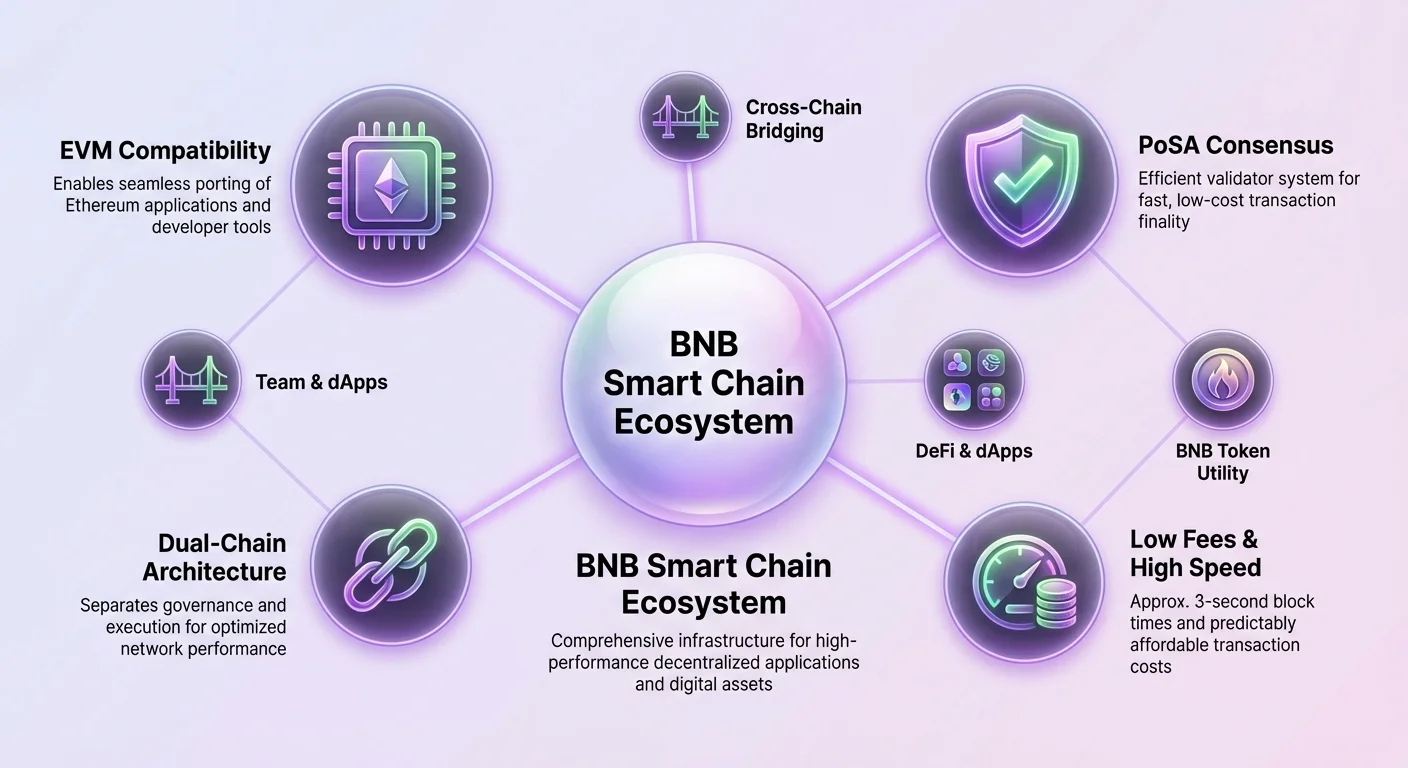
Unlike networks that rely on energy-intensive mining, BSC utilizes a consensus model designed for high throughput. This design choice results in transaction confirmation times of approximately three seconds. For users, this translates to a responsive experience similar to modern web applications. The network's native token, BNB, fuels these operations, serving as the primary medium for paying transaction fees and participating in network governance.
The Dual-Chain Architecture
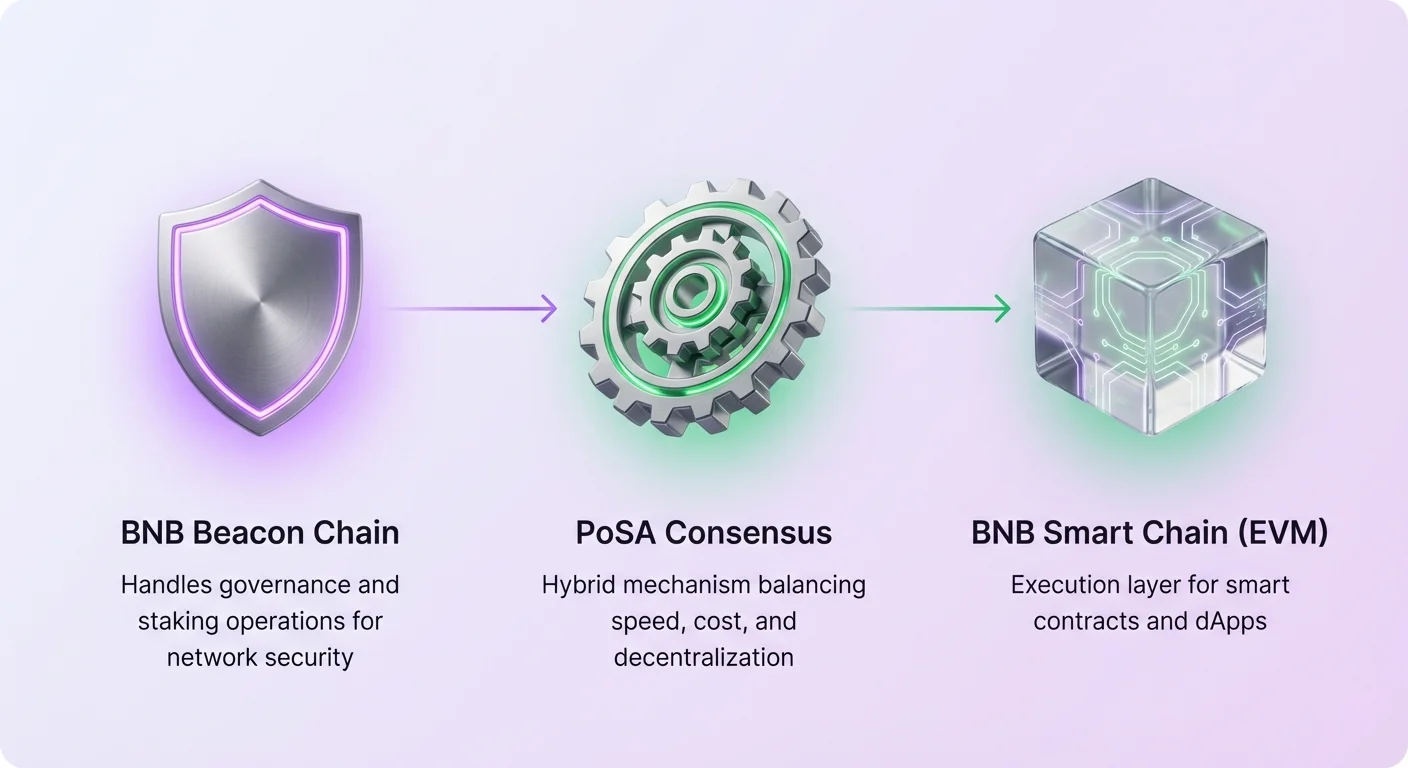
The BNB Chain ecosystem is not a single blockchain but rather a dual-chain structure. This architecture separates specific functions to optimize performance. The first component is the BNB Beacon Chain, previously known simply as Binance Chain. This layer is dedicated to governance and staking operations. It handles the voting logic and validator selection processes that secure the network. By isolating these management functions, the ecosystem ensures that governance decisions do not congest the execution layer.
The second component is the BNB Smart Chain itself. This is the execution layer where smart contracts run and transactions are processed. It is fully compatible with the Ethereum Virtual Machine (EVM). This compatibility is a strategic technical decision. It allows developers who have written code for Ethereum to port their applications to BSC with minimal changes. They can use the same tools, such as MetaMask and Remix, which significantly lowers the learning curve for migration.
This dual structure enables the network to balance security with functionality. While the Beacon Chain focuses on the stability and security of the consensus logic, the Smart Chain focuses on computing power and scalability. Communication between these two layers is seamless, allowing for the fluid movement of assets and data. This interconnected design supports a robust environment for decentralized finance protocols and other complex blockchain applications.
EVM Compatibility and Developer Access
Ethereum Virtual Machine compatibility is a cornerstone of the BSC strategy. The EVM is the standard computation engine used by Ethereum to execute smart contracts. By adopting this standard, BSC ensures interoperability with the largest developer community in the crypto space. Applications built using Solidity, the primary programming language for Ethereum, run natively on BSC. This eliminates the need for developers to learn new coding languages or rewrite their entire codebase.
This approach has fostered a rapid expansion of the ecosystem. Projects that face congestion or high costs on other networks can deploy parallel versions on BSC. This creates a multi-chain presence where the application logic remains consistent across different platforms. Users benefit from being able to interact with familiar interfaces and protocols while paying significantly lower transaction fees.
Furthermore, EVM compatibility extends to token standards. The network supports the BEP-20 standard, which functions similarly to Ethereum's ERC-20. This standardization allows for the easy creation and exchange of fungible tokens. It also supports non-fungible token (NFT) standards, enabling a diverse range of digital assets. The ability to mirror Ethereum's functionality while offering higher speed provides a compelling alternative for high-volume applications like gaming.
The Proof of Staked Authority Consensus
The engine powering BNB Smart Chain is the Proof of Staked Authority consensus mechanism. This model is a hybrid that combines elements of Delegated Proof of Stake (DPoS) and Proof of Authority (PoA). It is designed to achieve shorter block times and lower costs than traditional Proof of Work or standard Proof of Stake systems. In this system, network security is maintained by a limited set of validators.
Validators are responsible for producing blocks and validating transactions. To become a validator, participants must stake a significant amount of BNB. However, unlike open permissionless systems where anyone with hardware can mine, PoSA relies on a system of elected authority. Token holders delegate their BNB to trusted validators. The validators with the highest stake are selected to the active set, which takes turns proposing new blocks.
This limitation on the number of active validators is intentional. By keeping the validator set small, the network reduces the communication overhead required to reach consensus. There is less latency because fewer nodes need to propagate and verify the data before a block is finalized. This efficiency is what allows for the network's three-second block times.
Validator Selection and Incentives
The selection process for validators is dynamic and based on on-chain governance. This creates a competitive environment where validators must maintain a high reputation and reliability to attract delegations. If a validator acts maliciously or suffers from downtime, they risk losing their staked BNB and their position in the active set. This economic alignment ensures that the operators of the network infrastructure are financially motivated to act honestly.
Backup mechanisms are also built into the system. "Candidates" serve as standby validators. If an active validator fails or is removed, a candidate can step in to maintain network functionality. This redundancy ensures the blockchain remains operational even under stress or during maintenance events. The system prioritizes stability and uptime above all else.
In terms of compensation, the model differs significantly from inflationary blockchains. There is no block subsidy or inflation of the BNB token supply to pay validators. Instead, validators earn revenue strictly from the transaction fees generated by the network. This fee-based incentive structure encourages validators to process as many transactions as possible efficiently. It also aligns the success of the validators directly with the usage and adoption of the network.
Decentralization vs. Efficiency
The PoSA model represents a specific trade-off in the "blockchain trilemma of security, scalability, and decentralization." By limiting the validator count, BSC achieves high scalability and speed. However, this approach is often critiqued for being more centralized than networks like Ethereum or Bitcoin, which have thousands of nodes. The reliance on a smaller group of validators means users place a higher degree of trust in a select few entities.
Proponents argue that this trade-off is necessary for certain use cases. High-frequency trading, real-time gaming, and micro-transactions require speed and low costs that highly decentralized networks often struggle to provide. The PoSA mechanism creates a middle ground. It offers more decentralization than a traditional database or private server but operates with greater efficiency than a fully decentralized Proof of Work chain.
Governance plays a crucial role in balancing this power. BNB holders have the right to vote on protocol parameters and upgrades. This on-chain governance allows the community to influence the direction of the network. While the validator set is small, the power to elect those validators is distributed among all token holders who choose to stake and delegate.
Fee Strategy and Deflationary Economics
BNB Smart Chain implements a fee strategy designed to be predictable and affordable. The cost of executing smart contracts is calculated in "gas," similar to Ethereum, but the unit price is kept considerably lower. This makes the network particularly attractive for complex transactions that would be prohibitively expensive elsewhere. The native token, BNB, functions as the "fuel" for these transactions.
A key economic feature of the network is its lack of inflation. Unlike many Layer 1 blockchains that mint new tokens to reward miners or stakers, BSC has a fixed or decreasing supply. Since validators are paid exclusively in transaction fees, the protocol does not dilute the holdings of existing investors to pay for security. This creates a distinct economic environment where the token's value is derived from utility and scarcity.
The network also incorporates burn mechanisms to reduce supply over time. A portion of the transaction fees collected by the protocol is often removed from circulation. Additionally, automatic burn protocols utilize on-chain data to adjust the burn rate. This deflationary pressure aims to increase the scarcity of the asset as network usage grows. The combination of utility for gas and decreasing supply forms the core of the BNB economic thesis.
Ecosystem Evolution and Expansion
The trajectory of the network has been defined by constant adaptation. The journey began with Binance Chain in 2019, which was primarily designed for fast trading but lacked smart contract capabilities. Recognizing the explosion of decentralized finance (DeFi), the team launched Binance Smart Chain in September 2020. This pivot allowed the ecosystem to capture a massive share of the DeFi market during periods when Ethereum suffered from chronic congestion.
In February 2022, a significant rebranding occurred. The network dropped the "Binance" name to become "BNB Smart Chain." The acronym BNB was redefined to mean "Build and Build." This change signaled a shift toward a more open, community-driven ecosystem, attempting to distance the blockchain layer from the centralized exchange entity. The goal was to emphasize the permissionless nature of the infrastructure.
The ecosystem has continued to expand beyond the base Layer 1. New developments include ZkBNB, a zero-knowledge proof rollup designed for scaling. This Layer 2 solution aims to bundle transactions off-chain for even greater speed and lower costs. Additionally, BNB Greenfield introduces decentralized data storage to the ecosystem. These expansions transform the network from a simple smart contract platform into a comprehensive web3 infrastructure suite.
Comparison of Blockchain Architectures
| Feature | BNB Smart Chain | Ethereum | Solana |
|---|---|---|---|
| Consensus | PoSA (Hybrid) | Proof of Stake | Proof of History |
| Throughput | High (~2k+ TPS) | Moderate (~15-30 TPS) | Very High (Thousands) |
| Fee Structure | Low, Stable | High, Variable | Very Low |
| Developer Language | Solidity (EVM) | Solidity (EVM) | Rust / C++ |
DeFi and Institutional Use Cases
Decentralized Finance remains the primary driver of activity on the chain. The low-fee environment enables high-frequency trading, yield farming, and algorithmic stablecoin protocols to operate efficiently. Retail users who are priced out of high-fee networks often find their entry point into DeFi through BSC. Lending and borrowing protocols have seen substantial liquidity inflows due to the ease of moving assets.
Beyond basic trading, the network supports complex financial instruments. These include synthetic assets, which track the value of real-world assets, and crypto derivatives. Prediction markets also thrive here, leveraging the fast block times for rapid settlement of binary outcomes. The infrastructure supports a high volume of interactions, which is essential for protocols that require frequent state updates.
Institutional interest has also grown, driven by the network's reliability and the support of the wider Binance ecosystem. While initially focused on retail, the development of compliant infrastructure and permissioned environments is attracting larger entities. The integration of stablecoins and the ability to tokenize assets provide the necessary rails for traditional finance to experiment with blockchain technology.
Interoperability and Bridging
In a multi-chain world, the ability to move assets between networks is critical. BNB Smart Chain was designed with connectivity in mind. Cross-chain bridges allow users to transfer digital assets from Ethereum, Solana, or other networks onto BSC. This is often done to access lower fees or specific applications that are exclusive to the BNB ecosystem.
The bridging process typically involves locking an asset on the source chain and minting a "wrapped" version on the destination chain. For example, a user can bridge ETH to BSC to use it in DeFi applications without paying Ethereum mainnet gas fees for every transaction. Official bridges and third-party protocols like Celer cBridge facilitate these transfers.
However, bridging introduces specific risks. The security of a wrapped asset depends on the security of the bridge holding the original collateral. BSC has focused on improving bridge security standards to mitigate these risks. The ecosystem encourages the use of reputable bridges and provides resources to help users understand the mechanics of cross-chain transfers. This connectivity ensures that BSC remains an open hub rather than an isolated silo.
Smart Contract Functionality
The execution layer of the network is optimized for general-purpose smart contracts. These self-executing contracts enable the automation of complex agreements without intermediaries. From simple token swaps to complex decentralized autonomous organizations (DAOs), the logic is handled entirely on-chain.
The EVM compatibility ensures that the behavior of these contracts is predictable for developers coming from other EVM chains. This standardization reduces the likelihood of bugs or vulnerabilities being introduced during the migration process. Developers can use established audit firms and testing frameworks to secure their code.
Furthermore, the network supports upgradeable contracts. This allows developers to improve their applications over time without disrupting the user experience. As the blockchain space matures, the ability to iterate and fix issues is becoming increasingly important. BSC provides the flexibility required for modern software development lifecycles.
Comparative Landscape
When analyzing the broader market, BNB Smart Chain occupies a unique middle ground. It offers a balance between the established dominance of Ethereum and the bleeding-edge speed of newer alt-L1s like Solana and Avalanche. While Ethereum remains the leader in total value locked and decentralization, its transaction costs can be prohibitive for many users. BSC addresses this directly.
Compared to Solana, which uses Proof of History to achieve massive throughput, BSC relies on its EVM compatibility as a key differentiator. While Solana requires developers to learn Rust, BSC allows them to stick with Solidity. This lowers the friction for developer adoption. However, Solana arguably offers higher theoretical ceilings for transaction speed.
Avalanche presents another competitor with its subnet architecture and rapid finality. Like BSC, it is EVM compatible. The competition between these chains often centers on incentive programs and community engagement. BSC leverages the massive user base of the Binance exchange to maintain a steady flow of new users, a competitive advantage that purely decentralized networks struggle to replicate.
Risks and Security Considerations
Despite its advantages, the network faces distinct challenges. The primary criticism centers on the number of validators. With a limited set of active nodes, the network is theoretically more susceptible to collusion or censorship than networks with thousands of validators. Critics argue that this compromises the "trustless" nature of blockchain technology.
Network congestion can also be an issue. During periods of extreme market volatility, the demand for block space can spike. While the network handles high throughput, no blockchain is immune to scaling limits. Spam transactions can exacerbate this issue, although the fee structure is designed to discourage malicious spamming.
Users must also be aware of the risks associated with dApps. Because it is easy and cheap to deploy contracts on BSC, the network hosts a large number of experimental and sometimes malicious projects. "Rug pulls" and scams are more common in low-fee environments where creating a token costs very little. Users must exercise due diligence and research projects before interacting with them.
Conclusion
BNB Smart Chain has firmly established itself as a critical component of the global blockchain infrastructure. By prioritizing speed, low costs, and EVM compatibility, it has democratized access to decentralized finance and digital assets for millions of users. Its unique Proof of Staked Authority consensus model offers a pragmatic solution to the scalability dilemma, balancing efficiency with a structured form of decentralization.
The network continues to evolve, moving beyond its initial identity to become a comprehensive ecosystem for web3 development. With the introduction of Layer 2 scaling solutions and decentralized storage, the platform is positioning itself for the next generation of internet applications. While challenges regarding centralization and security remain, the continued adoption and development activity suggest that BSC will remain a dominant force in the crypto landscape.
High-performance infrastructure combined with low fees creates the most accessible path for mass blockchain adoption.